Category Archives: Physics and Astronomy at Western Blog

Opinions from the community at The Department of Physics and Astronomy of Western University.

Those lazy profs, part 3

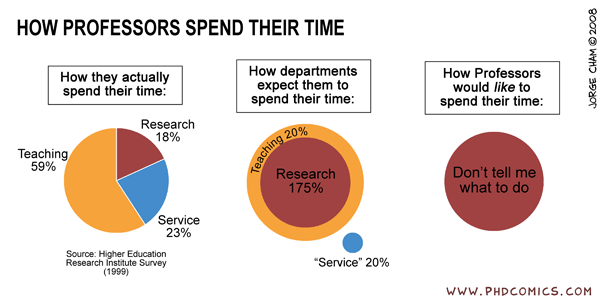
As usual, PhD Comics has it about right. In my January and February posts, I tried to describe a little about what the teaching and research parts of the job entail. But service is even more nebulous — what does it mean? [Generally no tennis or badminton is involved.]

Part of service is doing things for the benefit of the Department or University. So this might mean being a member of committee that selects scholarship recipients, in which case one reads a lot of application forms, tries to rank the applicants, and then goes to a meeting in which the committee comes to a consensus. Or it might mean being on a committee which is deciding on changes to the curriculum — again, doing some background reading and then going to a meeting where things get discussed. Service also includes things like being a member of the University Senate (I suspect meetings are also involved here) or a department chair or Dean (again, meetings, probably also paperwork).

Another kind of service would be service to one’s scientific community. This would include things like peer review of papers, grant applications, or (for astronomers) telescope time applications. There are two kinds of review here: in one type, the reviewer sees only one paper/application and does a detailed check for sensibility and worthiness. In the other kind, more like the scholarship application, the reviewer sees a whole bunch of applications and has to rank them relative to each other. These are somewhat different and it can take time to switch one’s mindset from one to the other. Other things that qualify as service to one’s profession might include organizing conferences, helping to run a professional society like the Canadian Astronomical Society, or being an outside reviewer of another university’s department or program.

Finally, there is service to the wider community: being a judge at a science fair, giving a public talk, visiting a school to talk about your field, answering questions from the public on a website. Different fields vary in how important this is considered to be: in astronomy, because we use taxpayers’ money to do something which (some would say) doesn’t have immediate economic value, most of us consider outreach to be extremely important. Plus we think we get to do fantastic stuff and we love to tell people about it! Admittedly it helps that many people are interested in our field, moreso than in others, like (say) actuarial science.

So that’s academic service from my point of view. As I have to keep explaining to my Mom, we don’t get paid extra for this; it’s part of the job. How big a part? I refer you to the eloquent statement by Jorge Cham — it’s supposed to be 20% of one’s time, and if you can accomplish it by not actually spending any time on it (see middle chart), so much the better.

Supernova in nearby galaxy M95

I just learned that there’s a possible (but nearly certain) supernova on the rise in the relatively nearby spiral galaxy M95. This is exciting, because it should get bright enough to spot in small telescopes! By coincidence, Mars happens to be sitting in the sky very close to the location of M95; that makes it easier to find in that you have an obvious landmark in the sky, but tougher because Mars is so close and so bright it swamps the region with light!

Right now, the supernova is still at roughly 12th magnitude, making it too faint to see without bigger ‘scopes, or smaller ones with digital cameras. However, it was only discovered on March 16, so it’s most likely going to get brighter. The galaxy itself is about magnitude 9 or 10, so the supernova may get that bright.

There are quite a few pictures of the galaxy+supernova on Flickr, but most are copyrighted aren’t free license so I can’t post them here. However, searching the site for “M95 supernova” yielded a few of them. You can also find a list of links here. I think this one in particular is cool; it has bright lines going across that’s scattered light from nearby Mars!

However, by a funny coincidence (?), the European Southern Observatory chose a Very Large Telescope image of M95 as its Picture of the Week just this morning:

[Click to galactinate.]

I say it’s a coincidence because there’s no mention of the supernova in the caption. Anyway, M95 is a gorgeous barred ring spiral: the bar is the rectangular feature in the middle, and the ring around it of gas and stars is not uncommon in galaxies (like here and here). M95 is about 35-40 million light years away, and is part of a small group of a couple of dozen galaxies called the Leo I group. M96, another spiral in the group, is even prettier!

Back to the supernova, DeepSkyVideos put together a very quick-and-dirty video about it which manages to be very informative and good despite being put up so quickly:

If you have a good telescope and detector, the coordinates of the supernova are online. Astrobob has a good finder chart for it. I’ll note that observations right now are critical; the physics of the explosion are best characterized by how rapidly it brightens. At this point, we don’t even know if it’s a Type I or Type II! So observe it if you can. And if you take good pictures or see any online that are not copyrighted freely licensed, please let me know!

And as a final note for now: we’re in no danger from this. I normally wouldn’t bother writing that, but a lot of people seem jittery due to 1) the 2012 nonsense, b) the recent (coincidental) solar flares, and γ) the asteroids (DA14 and AG5) I wrote about last week. So to proclude any fear-mongering, I’ll just say this supernova is something like 400 million trillion kilometers away, and probably won’t even get bright enough to see in binoculars. I hope that helps assuage any fears.

Image credit: ESO

 1299  828 Share Share296

March 19th, 2012 6:31 PM Tags: ,
by in Astronomy, Pretty pictures | 27 comments | RSS feed | Trackback >

Lots of good info and links on the Bad Astronomer’s blog

Plugging citizens into science, and putting the fun in funding!

One thing that keeps on surprising me is how often interested lay persons ask about possibilities to assist a scientist in his/her research. Non-scientists are often curious, interested and motivated, and so there is a huge potential for help, support and resources from all those interested folks! In the last two decades, there has been an exciting transformation in how citizens can become part of (and even guide!) scientific research. This is a great evolution, sicne it allows much more science to be done, and could even lead to a completely new funding model for scientific research as illustrated below.

In the mid-nineties, several researchers started developing programs to tap into this huge resource by designing programs for distributed computing — where a large number of home users contribute their computer spare CPU time by running a low-priority calculation, and so form a large and powerful computer network. There is indeed great power in numbers, and coincidentally, one of the first (if not the first) such projects was the Great Internet Mersenne Prime Search (GIMPS) project that is (still) searching for so-called Mersenne prime numbers.  For many years, I ran a Linux version of the mprime program on all computers that I had access to. One of the stimuli may have been the fact that there was a $100,000 award from the Electronic Frontier Foundation for the first prime number that has more than 10 million digits. The 45th Mersenne prime number was found in August 2008, and after rigorous verification, confirmed as the prize winner in November 2009. If you’re interested, the number is 243,112,609 – 1 and totals nearly 13 million digits. Interestingly, the 46th Mersenne prime number was found and was named as one of the best inventions of 2008 by Time magazine. Not a bad score for a number!

Since 1999, the University of California at Berkeley has been running another immensely popular distributed computing program called SETI@Home.A cleverly designed screensaver program uses your unused CPU cycles to analyze radio waves and search for possible extraterrestrial signals. This project has attracted well over 5 million users! More and more such projects have surfaced, and it is one way for scientists to access computing resources that are otherwise unaffordable. A great example is the world community grid which aims to be the world’s largest computer grid (more than half a million users to date), and which is funded and operated by IBM to support humanitarian research. If you’re looking for some honorable projects to donate your computer time to, go have a look! You could help find a cure for cancer!

More recently, social networks and mobile technology have played a big role in the success of a whole new series of citizen science projects. 2006 saw the launch of the Stardust@Home project, once more by UC Berkeley. This time, scientists weren’t looking for your spare CPU cycles, but asked you to scan microscope images to find interstellar dust particles in an aerogel. Why? Because the human brain is much much better at this than a computer is. Inspired by this approach, the Galaxy Zoo project took off in 2007 where now your help was asked to classify galaxies. The project was such a success that a whole series of similar projects is now hosted under the name Zooniverse — from galaxy classification to searching for interstellar gas bubbles to hunting for planets or finding targets for the New Horizons spacecraft once it’s done with Pluto. The Zooniverse project has now even expanded to include climate research, whale research and studies about the lives of ancient Greeks! More than 600,000 volunteers participate — and anyone can, since no science education is needed. There is in the meantime a long list of papers in the literature describing new discoveries done by these sorts of projects. In Astronomy 1021, we offer some of these as projects, and many students absolutely love the idea of taking part!

Very recently, I found out about another type of citizen involvement in research, this time through actively contributing research funding: petridish.org. It goes like this: scientists propose projects and include rewards for whoever backs their proposal up financially at a certain level.  Citizens can pledge whatever amount they see fit for whatever project they like. Again, large numbers that contribute small amounts make enough for funding your research! Who knows, maybe soon we’ll all be posting our research proposals on facbook!


doing the rounds locally

Normal 0 false false false MicrosoftInternetExplorer4

Hong Kong has six universities. I was surprised to learn that all of them are English-language universities, since while most educated people here speak at least some English, the lingua franca is certainly Cantonese. I am working at City University, which is in Kowloon, a few kilometers north of the main commercial/tourist area (although, to be honest, all of urban Hong Kong is commercial). Last week I visited Chinese University (CUHK), which is located about four subway stops north-westish of City U. The physics department there has the reputation of being the best among those at the six local universities, and in fact it has two Nobel Prizewinners associated with it – 1957 Laureate C. N. Yang, of Yang-Mills theory, is a “Distinguished Professor-at-Large,” and Charles Kao, who won in 2009 for the development of fiber optics, was a professor at CUHK for a while, and later the president of the university. Leo Lau, who spent some time at Western, was Chair of the physics department there, and later Dean of Science.

I didn’t know anyone there, however, so I resorted to perusing their web pages. I was pleased to find a prof there named Lei Xu, whose research interests were very similar to mine. I emailed him and politely invited myself for a visit. I spent a morning talking to him, looking around his lab(s), learning about his research and telling him about mine. I learned some useful things, which I’ll get a grad student to think about when I get home! I then went for lunch with several members of the department and a rather overwhelmed-looking young fellow who, it turned out, was there for a job interview.

There are other people in the department that I should also talk too, but they were busy with the job candidate the day I visited. It’s easy for me to go there again before I come home, though.

As an aside, I was interested to see a large statue of the “Goddess of Democracy,” who was made famous at Tienanmin Square twenty-three years ago, standing outside the University subway station. A sign next to it documented the problems experienced by this poor statue. Apparently she was a bit too controversial, and no-one, including the current University president, wanted to upset the Beijing government by hosting the statue. Eventually – with large support from the CUHK students and faculty, if not the senior administration – she was placed at the train station, where she is an impressive sight. 

Writing about writing

As a physics professor I write a lot, and I also spend a lot of time editing other people’s writing. In fact, I would say that writing is probably the most important part of my job. Of course I have to be good at physics, and I have to have good ideas, and I have to keep beating on my students – pardon me, I mean constructively encouraging my students – to get things done, but none of this would get me anywhere if I couldn’t write about it. I think it’s also true that writing is an extremely important part of many other jobs that our students could find themselves in after leaving school – almost everyone has to write a report to their boss at some point. 

On the way to getting this job, I had to write a couple of theses, which are essentially full-length books about the research I did as a student. I need money to pay my students and to run my research operation, and to get money I need to write grant proposals. While the ideas and so on are very important, if I can’t express those ideas clearly in the written proposal, I shouldn’t expect to get funded. Once the research is done, I have to tell the world about it, and I do this by writing papers. It is a lot easier to get a paper published if it is well-written, and, more importantly, it is a lot easier for other scientists to read and understand a paper that is well-written. Since my ultimate success as a physics researcher depends on how other people regard my research, I am not going to be successful if I am unable to get people to read about my work.

My students have to write, too, and since I want my students to succeed, I try very hard to ensure that what they write is of high quality. This is sometimes very hard. I have had students who write very well, but I have also had students whose writing was awful. Sometimes language is an issue – it is obviously very difficult for someone to write a 300-page PhD thesis in their second language – but often there are problems that go beyond language. I have had students who were native speakers but had essentially no idea how to string sentences together to tell a coherent story. I had a student from China whose English writing was grammatically and structurally fine, but completely disorganized. That student told me that she was a poor writer even in her own language.

There are several aspects to writing. The first has nothing to do with the actual words: it is the ability to get the content right. On a large scale, this involves deciding what you want to say, what ideas you want to convey, essentially what the story is that you want to tell. On a smaller scale, you need to figure out what level of detail is appropriate, and you have to organize what you want to say: you need to decide in what order to present things so as to produce a clear and logical storyline. These are hard things to do, especially for one who has not done a lot of serious technical writing. One you know what you want to say, you need to write it down. Here you have to worry about the mechanics of writing – sentences and paragraphs, spelling and punctuation. This seems to be hard for some people, too, despite that fact that in this case there are usually rules that can be learned and, one hopes, followed. A third aspect involves getting the right style – a physics journal paper would be written in a very different style from a letter to your mom. In my view, the first aspect is by far the most important. It is relatively easy to edit a well-organized draft for grammar, punctuation, and even style, but it’s a lot harder to deal with a piece of writing that is poorly organized, is missing important information, or wanders through the subject matter like the random walks I talked about in my last post. 

I think it’s essential that our students learn how to write properly. I’m less certain how to achieve this. Certainly practice is essential, and for that reason I always assign essays or written projects in my third- and fourth-year courses and grad courses. But students need to get feedback on their writing if they are going to become good at it, and they don’t really get that until they start working on their honors thesis. Western has courses on technical writing, but there really isn’t any space in our modules for them. I’ve thought about teaching students to write in our seminar course, but it’s hard to make students do much work in a zero-credit course.

I’ll have more to say about this subject in future posts.

Trip to India Feb 2012

My first major stop was Pune, in Maharashtra state, and about 150 km southeast of Mumbai. Here, I visited the Inter-University Center for Astronomy and Astrophysics (IUCAA). This is India’s top research institution for astrophysics, and runs a very active visitors program for faculty snd students, as well as frequent workshops and conferences. IUCAA is involved in many major international astronomy projects, and is on track to garnering the next Advanced LIGO gravitational wave detector for India. Faculty and graduate students are welcome for extended stays, ideally centered around a workshop related to their work. Guest accommodations and meals are available at IUCAA itself – Dr. Ajit Kembhavi, Director, is happy to host you, so you just have to pay your way to get to Pune! The beautiful courtyard at IUCAA, pictured here, and containing statues of Galileo, Newton, Einstein, and the ancient Indian astronomer Aryabhatta, really lends itself to thought and reflection.

What about undergraduate students? Any undergraduate student that is considering an exchange visit to India should seriously consider Pune University. (IUCAA is also located on the Pune University campus.) This university has a beautiful sprawling campus that is set apart from the city traffic, and has Departments in most major subjects, including Physics. It is also home to the Indian office of the Ontario-Maharashtra-Goa exchange program. Vaishali Potnis, OMG India Coordinator, is happy to help any students settle into Pune. There are already about 10 Ontario undergraduate students on exchange at Pune University in any given year. The OMG program website (http://www.omgprogram.org/)describes how to apply for travel grants.


Later in my trip, in New Delhi, I visited the Indira Gandhi National Open University (IGNOU; http://www.ignou.ac.in). This is the largest distance studies university in the world, with 3.5 million students! IGNOU also operates in 40 other countries besides India. I met with Dr. Ravi Singh, who holds a PhD in Physics from Western, supervised by Prof. Mahi Singh. Ravi is Director of the Regional Services Division at IGNOU, and shared his vision of expanded offerings in distance education. Considering that India currently has 12% rate of postsecondary education, and wants to get to about 30% like the USA and other developed countries, the only feasible way to approach such numbers in the next decade or two is by relying on distance education. Here, distance education does not mean fully online education, as there are test-taking centers across the country and also access to regional laboratory facilities. Ravi felt that Western and other foreign universities could join in this effort by offering summer courses on site (e.g., at Western) and also creating new online courses not covered in IGNOU’s current curriculum.


I also visited the Sharda University (http://www.sharda.ac.in/), a new private university in Greater Noida, Uttar Pradesh, some 40 km east of New Delhi. Private universities are a new phenomenon in India, operating on a for-profit basis and offering an entryway to university education for those who cannot get into top government schools but have the money to pay for an education. In a country with very limited spaces in the top public univerisites, there is a big market for private providers. Sharda University opened only in 2009, but boasts impressive new facilities and already operates with many domestic and international students. I was hosted by Prof. Sunil Kumar Mishra, who organized a very lavish reception, and gave me a chance to talk about Western and also some of my group’s work on star and planet formation. Dr. Mishra is Director of the Research and Technology Development Center, and the science effort here is very much in the applied sciences. Due to its nice atmosphere, facilities, and existing group of international students, this university also seemed an interesting destination for Canadian undergraduates seeking an exchange term in India.

Overall, a very informative trip to a rapidly changing country. I found New Delhi to be completely transformed from my last visit in 2004, with a bright gleaming new airport, new highways, monuments, glass-paneled office towers, and public transport options. Western stands to benefit by staying engaged with India and indeed all the emerging economies of the world.

How I spent my year’s leave, part 4: random walks in Hong Kong

While in Hong Kong, I have been working with Jonathan Wylie on the theory of diffusion with “traps”. This is related to some of my experiments, and what we are aiming for is a way to extract some new physical information from our experimental measurements. The experiments involve measuring the diffusion of little tracer particles suspended in a complex fluids. For simple Brownian motion, the mean squared displacement increases linearly with time. In many complex fluids, we see something rather different: At very short times, the mean squared displacement increases linearly. Then over some intermediate time range, the mean squared displacement flattens out into a plateau. At longer times, it grows linearly again, but with a lower diffusion constant than at short times. The plateau occurs because the tracers get trapped by the microstructure of the complex fluid. However over longer times, the microstructure evolves and the particles can escape from the traps and diffuse freely again. The calculations we are doing – actually it’s mostly Jonathan so far – involve using the formal theory of random walks to figure out the distribution of distances traveled by the tracers in the presence of traps. The particles diffuse freely until they hit a trap, then they are held in the trap for a time drawn from a particular distribution, then they diffuse again. Parts of the calculation are straightforward, if you know about random walk theory. But parts are what you might call interesting. I have had to refresh my memory about Green functions, which caused me nightmares when I was a student and played a significant role in my decision to become an experimentalist. We have also run across one of those pathological cases that mathematicians warn us about, but which never happen in real life – we get an expression involving an integral over an infinite sum, and it turns out that you cannot interchange the order of the sum and the integral. All good stuff. The idea is that this will model our experimental data, and the ratio of the diffusion constants we find at short and long times will depend on the time the particles spend in the traps.

How to thesis: Time management

Last month, I briefly mentioned I’d talk a bit more about scheduling. So I figured it would be good to follow up on that.

Managing my time well is also something I’ve learned to do in graduate school (although one could maybe argue that I’m still not so great at it). It’s not that nobody ever tried to teach me how to do it before now, it’s more that a lot of the usual ways (e.g. keeping an agenda) don’t really work for me (e.g. I never check the thing). So I’ve tried figuring out what works for me and maybe some of these things will work for some of you too.

To Do Lists

These are things I make not only to keep track of what I’ve done and what I should do, but also because there’s this nice satisfying feeling that comes from crossing an item off the list.

One thing I’ve found really useful lately is actually the Tasks feature that come with gmail. That way every time I check my email I can be reminded of the things I should be doing. With this feature, it’s even possible to create separate lists for different spheres of life. Right now I have a list for research; another for tasks that are still related to work, but not research (e.g. job applications, TA duties); and one for my personal life.

I keep a paper version of my to do list for the week, however and I try to plan out little ones each day. Which brings me to…

Setting Mini-Goals

In research, you’re not going to get everything done in a single day and getting to the point where you’ve completed enough work for a paper (or a thesis) can seem really far away. Further, it isn’t even always clear what you have to do in order to get to this end state or it can be really easy to lose sight of what has to be done.

To avoid losing sight of everything, it’s helpful to break every large task into many smaller tasks. This can be done over the course of months or weeks or even throughout a day.

To keep from spending too much time on one task, I try to set mini-goals as I work throughout the day (e.g. by 3pm, I want a program that does x). I also try to hold myself accountable for how I spent my time. To do this, I use this document:

time_well_spent.pdf
Download this file

It’s basically a pdf that I print out each week that helps me plan out my week and my days.  This version is just 5 days (my weekends are a bit more free-form).  I usually try to write down what I’ve done every hour or so and set small goals to be accomplished throughout the day.  Sometimes it’s difficult to stick to this, but when I do it definitely helps.

I (once again) hope that something I’ve said can be useful to someone else.  If you have suggestions for how to manage time effectively, you’re welcome to leave these suggestions in the comments.

Until next month.


Sarah is in the final year of her PhD. “How to thesis” is a series in which she imparts various (hopefully) useful things she has learned during her graduate career.

Those lazy profs, part 2

Last month I tried to explain how I spend my teaching time both inside and outside the classroom. So what about the other 60% of my time: 40% for research and 20% for service. What do those mean? Let’s tackle the research part this month.

I’m an observational astrophysicist, which means that my research consists of using observational data to figure out how the universe works. But this doesn’t mean that I spend my nights at a telescope glued to the eyepiece. I use data from telescopes on the ground (CFHT, Gemini,  JCMT, and others) and in space (Hubble, Spitzer, Chandra) to try and answer specific questions about how stars in nearby galaxies are born, live and die. So, broadly, my research might go something like this.

  1. Think of an interesting question and find out if it’s already answered. This usualy involves a lot of reading, mostly through the Astrophysics Data Service.
  2. If not answered, figure out what data might be needed to answer it. If already answered, go back to step 1.
  3. Figure out whether the data already exist. This can involve a lot of web-searching at online archives of telescope data. Someday there will be one-stop-shopping for such (the “Virtual Observatory”) but not yet.
  4. If the data already exist, great: download them and get to work. If not: figure out what telescope could generate the necessary data, write a compelling proposal for telescope time, and design (& perhaps perform) the observations. [The previous sentence summarizes what can be months of work and will perhaps be the subject of a future post.] Sometimes it turns out that it’s not feasible to get the necessary data, in which case go back to step 1.
  5. Once data are in hand, “reduce” them. The idea is to go from numbers in some kind of digital image to physical measurements, for example luminosity of an object in Watts. This step is what grad students spend a lot of their time on.
  6. Finally, figure out the meaning of the physical measurements. Often this is done by comparing to simulations or other theoretical models — do the models and data agree? If not, is there a plausible reason why?
  7. Share the results of the research: write a journal paper, give a conference talk or seminar, present a poster. More often than not, I do all three for a given piece of research (sometimes at different stages in the work).
  8. Hopefully the research has suggested new questions to explore: return to step 1.

Many of these steps are done in collaboration with other people (see recent post by John de Bruyn) — one person doesn’t usually have the required technical expertise to do everything. (And see also this paper on the decline of the single-author paper in astronomy.) Almost all of these steps are done while sitting in front of a computer, but that computer can be nearly anywhere in the world. I know people who reduce the data from observing runs on their airplane flights home. Or write their papers in telescope control rooms. I’m usually too tired to do either.

You’ll also notice that there’s a lot of “back to step 1” in the list above. That’s the nature of research: 2 steps forward, 3 steps back, a couple of sideways steps. Eventually we get somewhere, but it’s not always where we expected. But that’s why it’s fun.

Now, if you will excuse me, I have an observing proposal to write.

Carl Wieman’s insights into teaching science

If you have not heard of Carl Wieman, his bio is on http://cwsei.ubc.ca/.  In 2009, he has given various talks on scientific approach in science education.  Many of you who are in tuned with science education would no doubt know of his work.

I found that he had transcribed his talk into five written parts here: http://www.science20.com/carl_wieman/why_not_try_scientific_approach_science_education

While you may not agree with his proposed solutions, I would like to quote two points here that I find particularly good that may pique your interests:


  1. “puzzle of my graduate students—why their first 17 years of education seemed so ineffective, while a few years of doing research turned graduate students into expert physicists”
  2. “… novices see the content of physics instruction as isolated pieces of information— handed down by an authority and disconnected from the world around them — that they can only learn by memorization.  To the novice, scientific problem-solving is just matching the pattern of the problem to certain memorized recipes.
    Experts—i.e., physicists—see physics as a coherent structure of concepts that describe nature and that have been established by experiment. Expert problem-solving involves employing systematic, concept-based, and widely applicable strategies.”

I would love to hear what your thoughts are on Wieman’s insights or if you have ideas of how best to turn novices into experts.