Northern lights in song lyrics

http://www.youtube.com/watch?v=ls9yJTphLxg

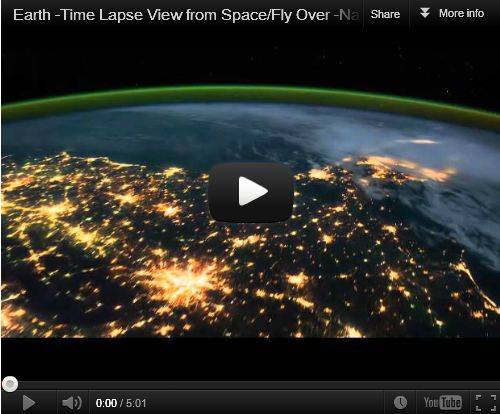
By sheer coincidence I had been watching some of great video footage taken of the Earth by the astronauts in the ISS. I had also been listening to good old Stan Rogers for the first time in ages.

In Stan’s “Canol Road” there is a nice set of lyrics:


“It’s God’s own neon green above the mountains here tonight,

Casting brittle coloured shadows on the snow.”


Awesome examples of surface tension

In my fourth year here at Western, I took a fluid dynamics course with John deBruyn.  Many of the topics we touched on fascinated me, but nothing quite amazed me like surface tension.  During the course, I studied how the basilisk and different insects walk on water.  While the basilisk, or Jesus lizard, uses a large force and surface area to keep him running on the water’s surface, insects, such as the water strider, rely on surface tension to keep them afloat.

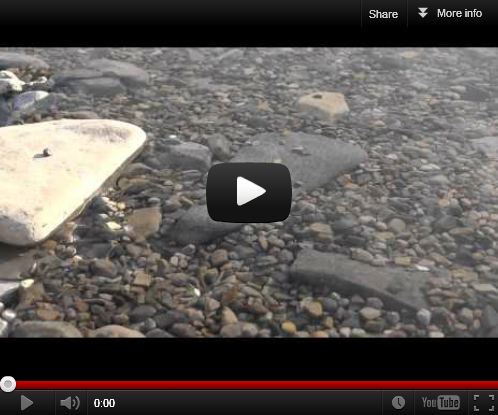
Over a year later, thousands of kilometres away, surface tension still boggles my mind.  I took this picture of menisci on rocks near Resolute Bay on the beach of the Northwest Passage.

There were also small rocks floating on the surface of the water, drifting in and out with the waves.  Since Posterous does not approve of my file format, the video can be seen on YouTube here: 

http://www.youtube.com/watch?v=pzvS5nDxb24


Summer conference round-up

In an earlier post I mentioned the conferences that I was attending this summer: 3 of them in the space of about 7 weeks, which is a little crazy. I’m now back from the last of them so it’s time to update you on what happened. One thing I learned, that I should have known earlier, is that four and a half hours is not a long-enough red-eye flight on which to get a reasonable amount of sleep!

At CASCA 2012 I went to quite a few talks, although unfortuately I missed a number of talks given by Western grad students. Many talks were excellent: in particular I found the Qilak Award (for contributions to education and public outreach) lecture by John Percy to be so full of good advice that I tweeted most of it. I also picked up some interesting gossip, such as the fact that the Canada-France-Hawaii Telescope was closed for over two months after its dome shutter failed, and talked to some colleagues about a number of things, including science. And we went to the Rothney Observatory just outside of Calgary, from which we completely failed to see any of the Venus transit. (It’s not the conference organizers’ fault that it was cloudy.)

The Great Andromeda Galaxy meeting was much more science-focused for me. Most of the talks were longer and there were plenty of reports from various big projects. This was also a “centennial meeting” celebrating the life and career of the late Martin Schwarzschild, so there were some historical talks as well. Someone pointed out on Twitter that it was interesting to watch the change between the Apple standard background image of M31 (which, interstingly, is missing one of M31’s satellite galaxies) and whichever picture of the galaxy was contained in the talk. The most popular one seemed to be the GALEX ultraviolet image. The meeting ended with a talk by David Spergel where he both summarized the meeting and told us a little about the “gift” of two unused space telescopes to NASA. He couldn’t give full details since some of us in the room were foreigners. Really. Ask me about ITAR if you don’t believe this.

The Gemini Science and Users’ meeting just finished last Friday. This one featured a number of invited talks on a number of topics from exoplanets to high-redshift galaxies. I think these were uniformly excellent, which pleased me since I was in charge of the committee picking the speakers! This meeting also featured updates on a number of the Gemini instruments, including the upcoming FLAMINGOS-2 (which has had some problems but is nearly ready to go), Gemini South Adaptive Optics Imager,  Gemini Planet Imager. Also in the works is a fiber-optic pipeline between the Gemini telescope and the CFHT, so that the ESPaDOnS spectrograph can be fed with light from the larger Gemini-North telescope.  The question of what instruments to build next also came up for discussion, and I think it’s fair to say there was some controversy about this, with some people arguing strongly for a very wide wavelength-coverage spectrograph, GIROS, and others wanting a fuller discussion of the options. Gemini also has a new incoming director (who, in this small world of astronomy, happens to be a sometime collaborator of mine) and the consensus is that he’s got quite the opportunity and challenge ahead of him.

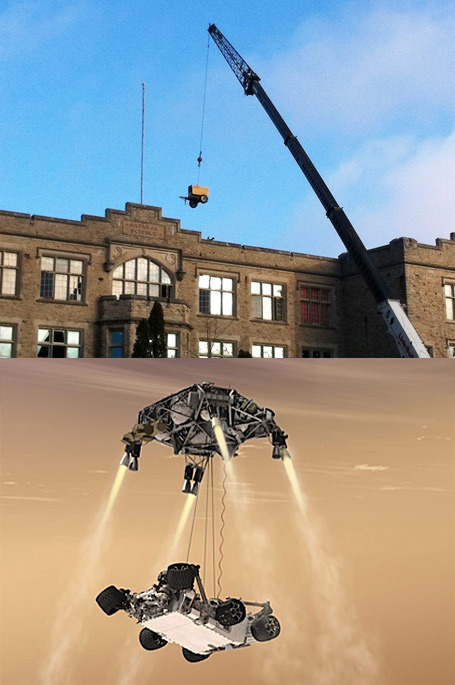
Seven Minutes of Terror (at the Cronyn Observatory?)

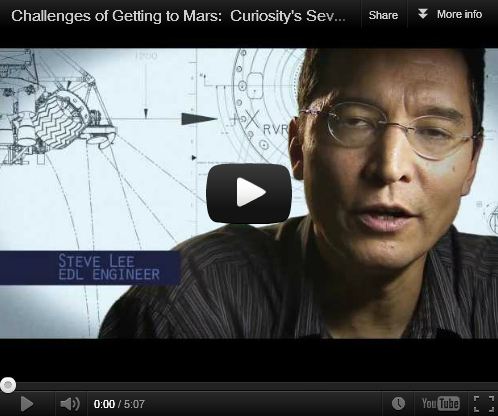
Early in the morning of August 6 (EDT), the Mars Science Laboratory will attempt a spacecraft landing like nothing that’s ever done before. The video linked below tells you the whole story: it’s pretty crazy!


We’ll have a live feed running at the Cronyn Observatory for the event, so please join your fellow space enthusiasts (and insomniacs) to see whether they can pull this off.


Ordinary Physics solves another mystery.

For several years, the known laws of physics seemed inadequate to explain what should have been a simple physics textbook exercise: the trajectory of the Pioneer spacecraft through the outer Solar System. The Pioneer 10 and 11 probes were launched in the early seventies in preparation for the later Voyager Planetary Grand Tour. The mission was a success, and by the eighties, both Pioneer probes were minding their own business well beyond the orbits of Jupiter and Saturn. In the absence of significant gravitational forces other than from the Sun, the expected trajectory is easily calculated. However, telemetry data showed that both probes were systematically slowing down just a tiny bit more than could be expected from the gravitational pull of the Sun alone. Scientists were baffled and tried to come up with all sorts of hypotheses to explain what became known as “The Pioneer Anomaly”. In spite of the fact that the Voyager probes did not show this effect, some scientists even suggested that our theory of gravity needed revisions.

This week, there is finally an answer. After many years of painstakingly collecting all the necessary data, scientists have convincingly shown that the effect is due to thermal radiation. The effect is tiny, but over the long distances that the Pioneer probes have flown (check out their current position), it becomes noticeable. Too bad for sci-fi writers in need of new inspirational physics, but once more, ordinary physics saves the Universe!

The impressive efforts undertaken by the researchers are described in this story from sciencedaily, but you physics buffs probably want to jump straight to the paper in Physical Review Letters.