Most people I’m sure are already aware of the TED (Technology, Entertainment, and Design) talks.
I am not sure why I like Theo Jansen’s kinetic sculptures so much.
[youtube http://www.youtube.com/watch?v=HSKyHmjyrkA]
It could be the almost miraculous way in which they come to life in a strong wind.
There is also something about Theo Jansen himself. Is he a mathematician, engineer, artist, or mix of each?
But it is the seeming simplicity of the design of his famous ‘mechanism’ that also enchants me. It strikes the same chords (pun intended) as listening to Glen Gould or Andres Segovia play Bach.
There is also something about longevity and stick-to-it-ive-ness of the artist and musician that I admire in people like Theo Jansen. He has publicly given away the details of his movement mechanism, and one could easily understand if this alone, in terms of fame, would have satisfied Mr. Jansen. But he has continued working on his kinetic creatures for 20 years, making it a life long passion – not unlike Gould, Segovia, or Bach.
Alex D. has already made an interesting posting in our blog about ‘the golden ratio’ and the Fibonacci sequence in nature, and I would be curious to know if any of the lever arms in Mr. Jansen’s design have similar ratios. In fact if one looks at the Jansen mechanism, it has a curvature that is not dissimilar to portion of a nautilus shell.
Then again, such a simple work of geomety perhaps also harkens back to the days when engineers and physicists creatively designed all kinds of machines containing ingenious cams, gears, governors, and other mechanisms,
As explained by They Might be Giants in this catchy tune (and adorable video).
If you were wondering what carbon, nitrogen (and oxygen) have to do with turning hydrogen into helium, the process is known as the CNO cycle. The CNO cycle isn’t actually the most important process for fusing hydrogen to helium in the Sun (that would be the proton-proton chain). Although some of the helium in the Sun is created through this reaction, it plays a much more significant role in stars more massive than our Sun.
A pair of nearly-Earth sized planets have been discovered orbiting close to a star which has already passed through the red giant phase. The planets orbit close enough to their parent star that they would have been englufed by the star when it was a red giant and have (somewhat) survived.
You can find the original paper here, if you would like to learn more.
This past summer, the stitching group Stitch London (located in the other London) held an event called Stitched Science at the Science Museum. This event featured a knitted/felted model solar system (including Martians for Mars) as well as a knitted nebula and a crocheted Marie Curie and Galileo among many other sciencey stitched pieces.
However, these examples don’t include all instances of physics or astronomy acting as inspiration for knitted or crocheted projects by a long shot. There are crocheted space shuttles. There are knitted solar system sweaters, Galileo mittens, atomic orbital plushes. There’s even a knitted a Higgs boson and a scarf featuring the CMBR power spectrum.
If we look at more mathematically inspired projects, there are mobius scarves, irrational constant mittens, Lorenz manifold mobiles and pi scarves, such as this one I made last year:
The stripes each represent one digit. There are 101 digits of pi represented in this scarf.
So next time someone tries to tell you that physicists aren’t the creative types, you can point to the abundance of physics-inspired knitting and prove them wrong.
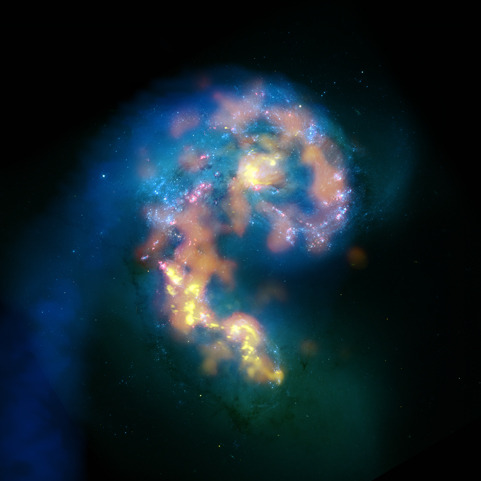
ALMA, the Atacama Large Millimeter Array, is the newest and most advanced millimetre and sub-millimetre telescope in the world. Located on the Chajnantor Plateau in Chile, the observatory is still under construction and will not be completed until the end of 2012. It is an international collaboration between countries in Europe, North America, Eastern Asia, and the host country Chile. By observing at these wavelengths, we see the signatures of molecules in space. It’s only in cold, dense environments where molecules can form, and we know these to be the sites of star formation.
The image shown above was released to the public in October, 2011, and is the first image to be released from ALMA as part of their Early Science observing cycle. It shows a well known collision between two galaxies named The Antennae observed in various parts of the electromagnetic spectrum: optical from the Hubble Space Telescope in white/pink; radio emission from the Very Large Array in blue; and millimetre emission from ALMA in orange/yellow. The ALMA data tell us that large, massive resevoirs of molecular gas (specifically carbon monoxide in this image, a proxy for observing molecular hydrogen) lie along the ridge in the bottom of the image, while more spread out molecular gas exists along the upper rim. This gas will eventually collapse due to the force of gravity and repeatedly fragment into smaller and smaller clouds until stars are eventually born.
Still under half complete, ALMA surpasses the capabilities of any other millimetre/sub-millimetre facility in the world. We eagerly wait to see what new surprises this innovative instrument has in store for us in the near future and after it is fully operational.
If you add up all the stuff we see in the Universe (stars, planets, kittens, etc. also called baryonic matter) and compare that to the estimated amount of stuff that actually makes up the Universe, you find that the stuff we can see makes up a paltry 5% of it. Only 5%! Where’s all this other stuff, then??? Part of the answer is “dark matter”.
Dark matter was first hypothesized about in 1933 by a crotchety old astronomer named Fritz Zwicky. He argued that adding up the masses of the individual galaxies in clusters did not come anywhere close to the total mass of the cluster itself. Therefore, some of the mass was missing.
In the 1970s, astronomer Vera Rubin measured the rotational velocities of spiral galaxies and found that they were rotating at a roughly constant velocity all the way to the edges of the galaxy. The problem with this is that galaxies are not solid objects, thus they have differential rotation (they rotate at different speeds depending on how far you are from the centre). Physics says that the rotational velocity should depend on two variables: the distance (radius) from the centre and the mass interior to a circle with the same radius. As we move outward from the centre, we only add a little bit of mass, but we add a lot of radius, so the velocity should decrease. But Vera Rubin’s discovery says different! The rotation stays the same, so we are adding a lot more mass than we think—but still, we can’t see it!
This is the crux of the missing matter problem. Physics is telling us that a large part of our Universe is something we can’t see, but it seems to interact with everything else through gravity. But how do we test if it’s really matter we’re missing and not just a fundamental misunderstanding of physics? The answer comes in the form of the Bullet Cluster.
The Bullet Cluster (pictured below) is the result of a collision between two galaxy clusters. The gas in the each of the clusters, made of normal everyday matter (remember, baryonic matter), slammed into the gas from the other cluster. During the collision, it got heated and glowed in the X-rays (pink in the image). Part of Einstein’s Theory of General Relativity says that one of the effects of mass is the bending of spacetime. This sounds complicated, but never fear! Basically, an object with mass can bend space around it. Proof of this came in 1919 when scientists observing the Sun during a total solar eclipse saw stars that were known to be behind the Sun! Galaxy clusters do something similar, acting as a “gravitational lens”. Through this effect, we can see the stetched out and magnified arcs of distant background galaxies from behind the cluster. By carefully modeling the lensing arcs, scientists discovered that most of the mass was not between the two clusters with the hot gas. Rather, it had passed through the collision unimpeded (shown in blue in the image). Thus, most of the mass of the two clusters was dark and made of something that would not even collide with other stuff.
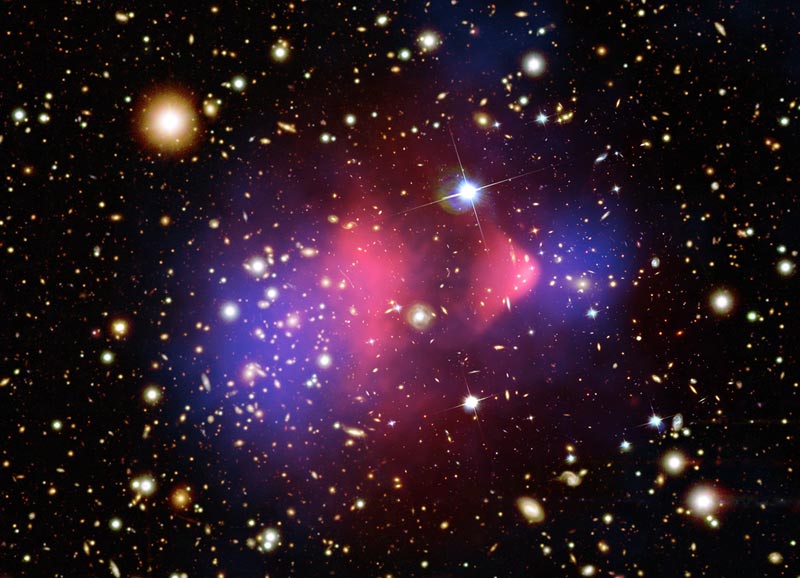
Today, we know that baryonic matter makes up approximately 5% of the Universe, dark matter makes up 23% and some new mysterious substance called dark energy makes up the remaining 72%. We actually live in an era of the Universe dominated by dark energy! What is this dark energy and what is it doing? That’s a story for another time.
Image Credit: NASA/CXC/M.Markevitch et al.; NASA/STScI; Magellan/U.Arizona/D.Clowe et al.; ESO WFI

What happens when a star reaches the end of its life? Well, if it’s a massive enough star (about 8 times as massive as our Sun), it will explode in a brilliant flash called a supernova (there are a few different ways to get a supernova, and this one is called a Type II supernova). What’s left behind is a stellar remnant—either a neutron star or a black hole depending on it’s mass. If the remnant mass is less than about 8 times the mass of the Sun, then it will be a neutron star; more than 8 times the Sun’s mass and it’s a black hole (this is called the Tolman-Oppenheimer-Volkoff limit, analagous to the Chandrasehkar limit for accreting white dwarf stars if you’re familiar). To make a stellar remnant above the T-O-V limit, you need a supernova progenitor to be about 20 times the mass of the Sun. Stars this massive aren’t very common, so black holes formed this way should be relatively rare.
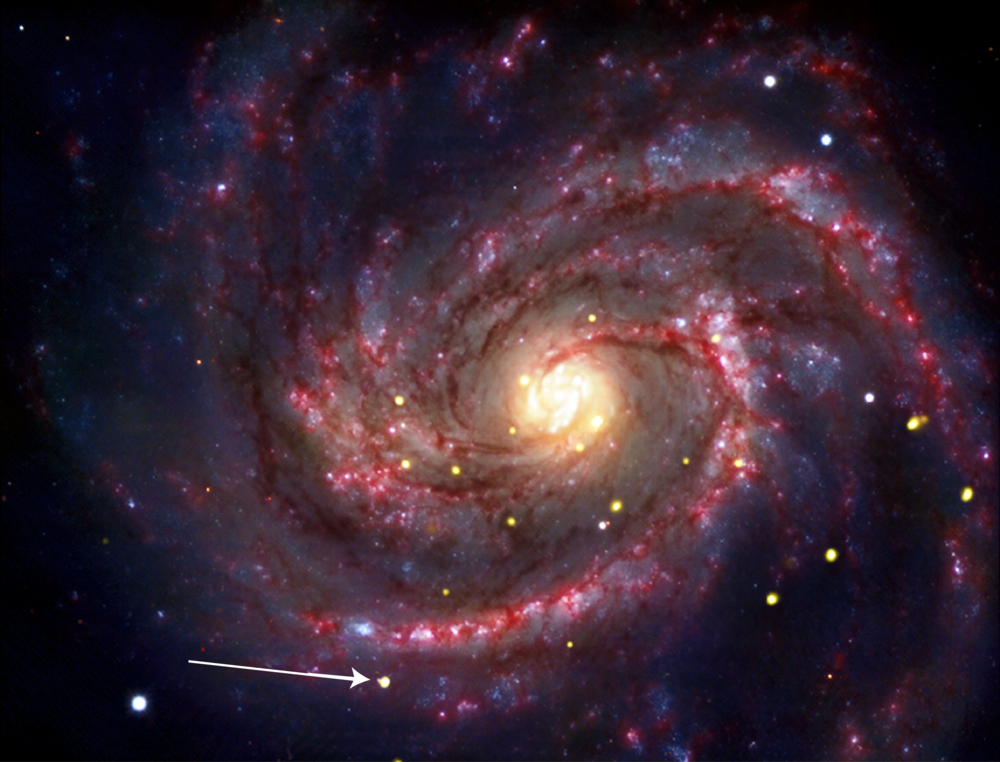
How can we test if the T-O-V limit is true? Last year, NASA’s Chandra X-ray Observatory observed a supernova in the galaxy M 100 named SN 1979C. The interesting thing about this supernova is that we know which star did it! It’s so close that we can look in archival images and see which star was there before the explosion. From this, we know that the star was approximately 20 times the mass of the Sun. New observations from Chandra indicate that there is an accreting compact object where the star was. This means that there is either a neutron star or black hole that is consuming the gas that was thrown out in the explosion. However, the Chandra observations can’t distinguish between it being a black hole or a neutron star! While this seems like a failure on science’s part, it’s not really because it confirms that the T-O-V limit is around 20 times the Sun’s mass. Any more massive, and we should clearly see the effects of a black hole. Any less, and we should see an accreting neutron star.
If it is a black hole, it’s interesting to note that it would be the youngest one we’ve ever discovered. While we observed the explosion of the star, and therefore the formation of the black hole, in 1979, it really occured 55 million years ago and it took all that time for the light to reach us from the distance of M 100.
Photo: X-ray/Optical/Infrared composite image of galaxy M 100. The accreting compact remnant resulting from SN 1979C is the bright X-ray point indicated with an arrow. (Image Credit: X-ray: NASA/CXC/SAO/D.Patnaude et al, Optical: ESO/VLT, Infrared: NASA/JPL/Caltech)