Minimoons paper highlighted by AAS Nova

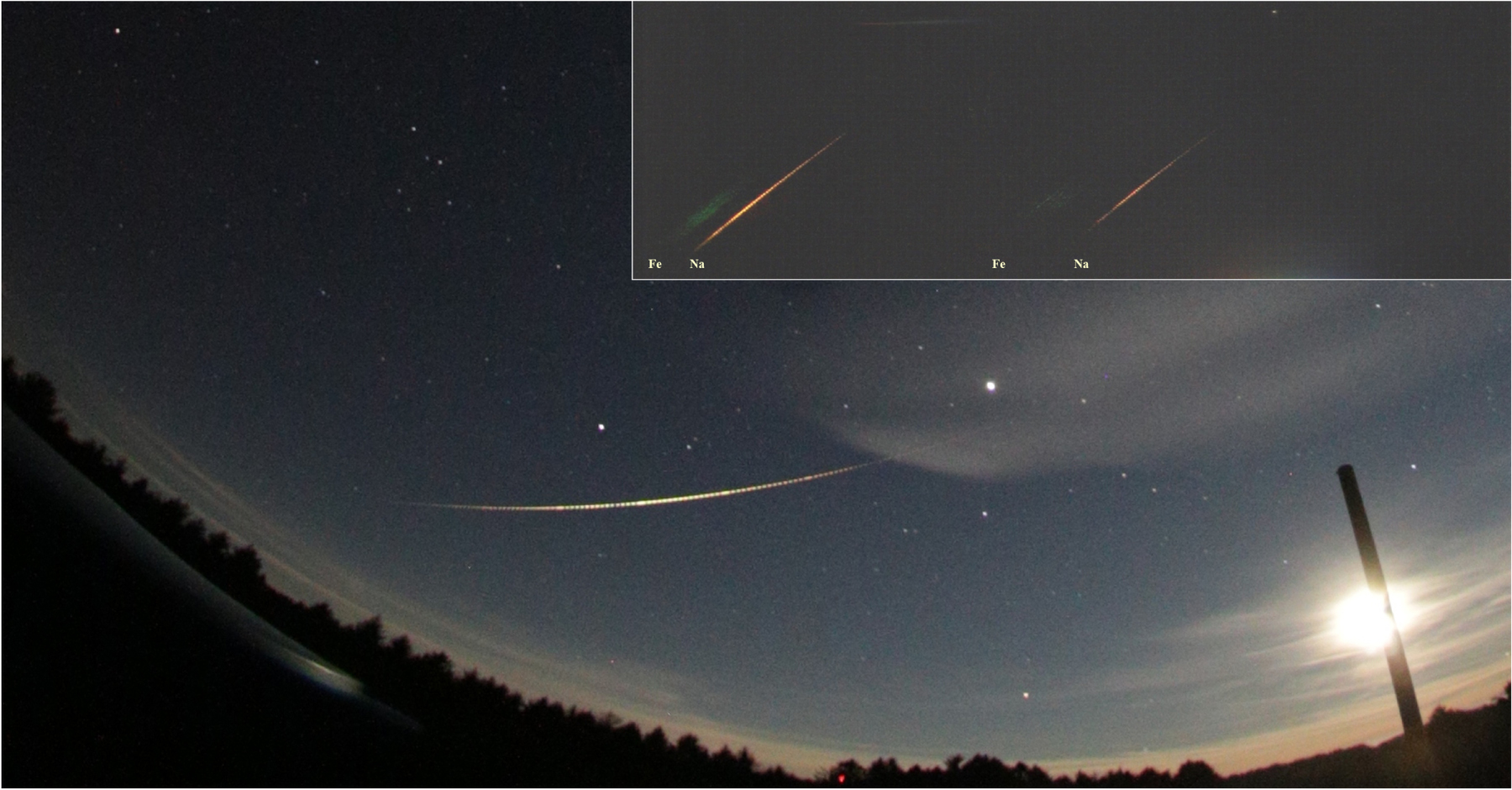
2014 fireball image captured by European Fireball Network.

see also [AAS Nova Facebook] [AAS Facebook]

A ground-breaking paper by Western researchers David Clark, Paul Wiegert, and Peter Brown, along with their Czech colleagues, shows with great certainty that a fireball observed in 2014 by Czech automated monitoring stations was the result of a grazing entry of a Temporarily Captured Orbiter, or Minimoon.

The paper, published in the Astronomical Journal,  was highlighted by American Astronomical Society (AAS) Nova web site. This site showcases recent research results of great interest.

The results of the Clark et al. research indicates that the 2014 Czech fireball was the second ever known observation of a Minimoon, and the first observation of one hitting the Earth.   Canadian astronomer Clarence Chant in 1913 was the first to theorize  that such a class of solar system bodies could potentially exist.

Minimoons are extremely difficult to observe, but recent models indicate that our Earth-Moon system may be temporarily capturing hundreds of such objects each year.

Jan Cami interviewed about Mars opposition and Cronyn Observatory public night program

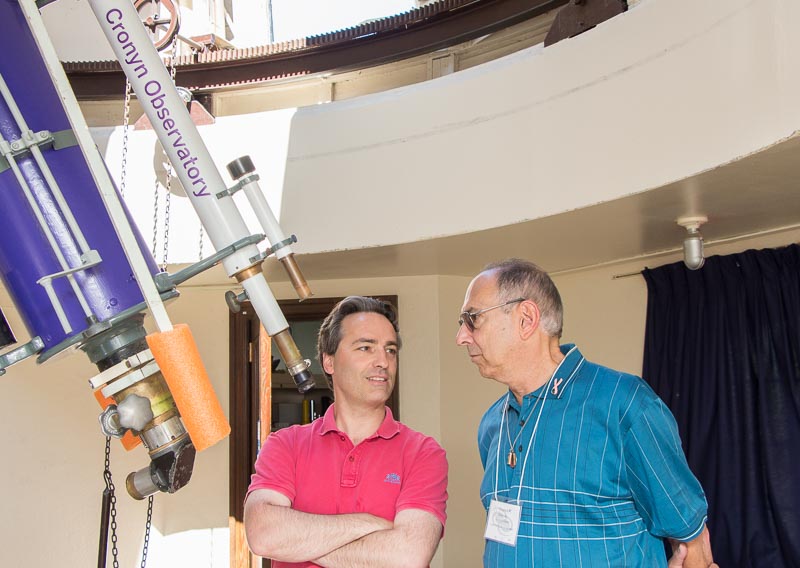
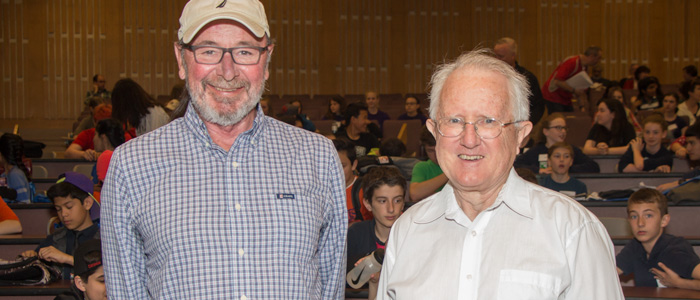
Jan Cami (left) with Canadian comet hunter David Levy (right) on May 24, two days after Mars opposition.

The London Free Press interviewed Cronyn Observatory Director Jan Cami. [see article]

There is great public interest in the recent May 22 opposition of Mars which this year also had the red planet at a very close approach to the Earth.

In the evening sky, Mars is presently shining as brightly as Jupiter.

Professor Cami reminds the readers of the London Free Press that Cronyn Observatory is open regularly during the summer months. Saturday evening public nights run from May through to the end of August.

It is a great summer for planet viewing.

On May 28, approximately 120 visitors came to the observatory, heard talks by Dr. Andy Pon, and had a chance to view the three planets Mars, Saturn, and Jupiter, along with a fly-by of the International Space Station.  A warm summer evening of star gazing doesn’t get much better than this.

Edith Yeung awarded Mitacs-JSPS research internship

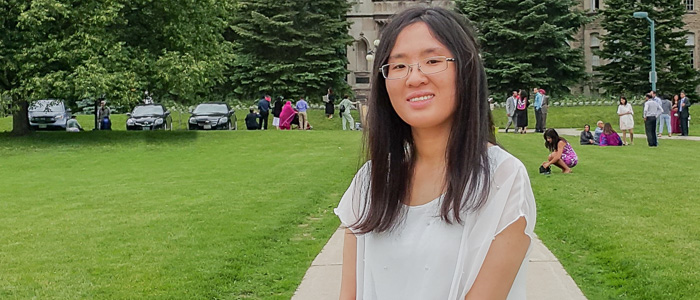
Edith Yeung
Edith Yeung

Congratulations to physics graduate student, Ms. Edith Yeung for winning a competitive Mitacs-JSPS internship to go to Japan.

This year, Mitacs has partnered with the Japan Society for the Promotion of Science (JSPS) to support students of Canadian universities to experience collaborative research in Japan.  Of those who have applied, Edith Yeung was one who has been recently awarded the competitive Mitacs-JSPS Internship award.  She will be conducting research under Professor Yoshikazu Suzuki at the University of Tsukuba in Ibaraki, Japan, from June 14 to August 24, this summer.

Prof. Suzuki’s lab focuses on the development of inorganic materials for energy and environmental applications.  During her stay in Japan, her project, entitled “Incorporation of Radical Polymers as Electrolyte into Perovskite and Dye-sensitized Solar Cells”, aims to fabricate more efficient cells, thus improving their competitiveness in the renewable energy market.

Edith Yeung is a Masters student in Physics under the supervision of Prof. G. Fanchini.  Her research project at Western is on the optimization of perovskite solar cells using perovskites of the CH3NH3PbI3 variety for nighttime usage.


Comet hunter David Levy visits Cronyn Observatory

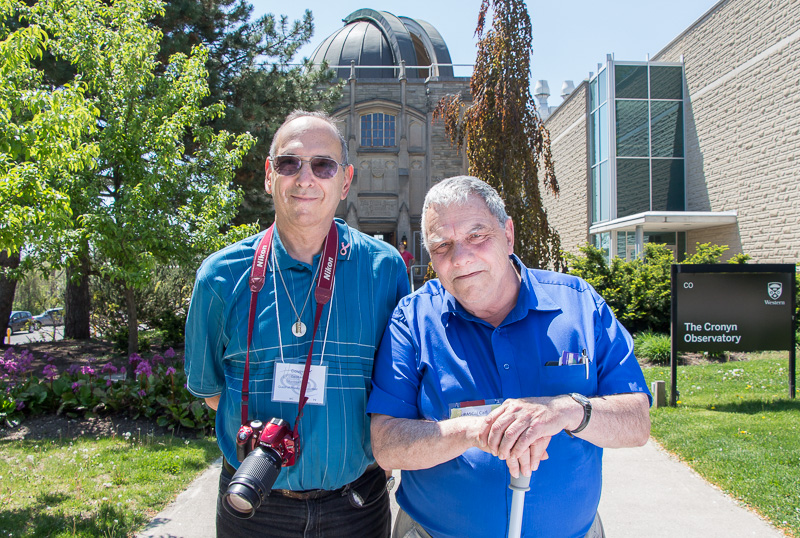
David Levy (left) and Carl Jorgensen (right).
David Levy (left) and Carl Jorgensen (right) visit the Hume Cronyn Memorial Observatory.

Famed Canadian comet hunter David Levy, and his longtime friend from Montreal Carl Jorgensen visited the Hume Cronyn Memorial Observatory on Monday, 23 May 2016.

The astronomers were in London to attend the General Assembly of the Royal Astronomical Society of Canada (RASC), which was held at Fanshawe College 19-23 May, and hosted by the London Centre of the RASC.

David Levy was one of the guest speakers at the 2016 RASC Assembly, where Physics and Astronomy faculty members Stan Metchev and Peter Brown also gave research talks.

London RASC members Mark Tovey and Tricia Colvin escorted the visitors to the observatory where Director Jan Cami gave a historical tour and Henry Leparskas took photos. The observatory’s Coronado 90mm solar scope was used to view a wonderful sunspot and a gigantic limb prominence.

David and Carl first met through their involvement with the RASC in Montreal when they were in their early teens. They both have asteroids named after them in honour of their longstanding contribution to the astronomical community. [asteroid Jorgensen] [asteroid Levy]

David had donated his 14″ Celestron telescope to the Montreal Centre of the RASC where it continues to be the primary telescope at their observatory, where Carl continues to be an active member.

David is well known for his co-discovery of  Comet Shoemaker-Levy-9 which slammed into the planet Jupiter in 1994.

[images on Flickr]

Hundreds visit Western to view transit of Mercury

mercury_transit_event

Monday 9 May 2016 dawned crisp and clear.

Before the sun broke over the horizon, a handful of Physics and Astronomy volunteers, Tim Hortons cups in hand, were preparing Cronyn Observatory for a day of public viewing of the transit of planet Mercury.

Mercury transits across the face of the sun roughly 13 or 14 times per century.  The next two such transits that will be visible from North America will occur in 2019 and 2032.

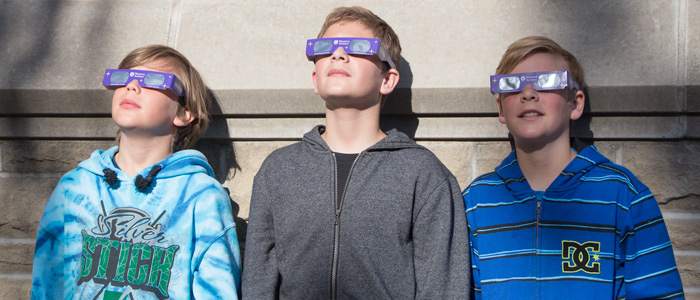
Telescopes were set up for safe viewing of the event, and newly designed eclipse glasses were made available to the public.

The event was a co-operative effort between The Department of Physics and Astronomy, The Centre for Planetary Science and Exploration (CPSX), The Department of Philosophy,  The Rotman Institute of Philosophy,, and last but certainly not least, The Royal Astronomical Society of Canada (RASC) London Centre.

As the sun peeked over the corner of Alumni hall at about 7am, all telescopes, armed with solar protection filters, were trained on it.

There was a nice complement of telescopes available for viewing:

The historic 25.4cm Cronyn refractor used a projection system via a Herschel wedge prism. On the deck of the observatory Heather MacIsaac had her 90mm Maksutov scope, Allan Leparskas manned his Canon 7D camera with 400mm(w 1.5x extender), and Everett Clark was in charge of the departmental 21cm Schmidt-Cassegrain scope.

In the Cronyn Observatory classroom there was a live network feed of the transit viewing from the Coca Cola Space Science Center at Columbus State University in Columbus, Georgia, on the banks of the famous Chattahoochie River.

In the basement of the observatory, the middle room held a planetary transit simulation device, which turned out to be very popular. In addition, the far room of the basement contained historic items from the observatory’s past, including H.R. Kingston’s telescope, the Colgrove-Kingston Sotellunium, a recreated dark room, and many small historic items from the John Barnett collection, to name a few.

The following equipment was distributed behind the observatory in the courtyard beside the Engineering building; Dave Clark’s 20 cm. Schmidt Cassegrain scope, Steve Gauthier’s 20 cm. Newtonian reflector (stopped down), Mike Costa’s 60mm refractor, Dale Armstrong’s 80mm refractor, Peter Jedicke’s Sunspotter, and Paul Keran’s ED80 Skywatcher refractor, which was used along with a Malincam CCD camera to show an image on a TV monitor.

Observatory Director Jan Cami used the department’s 90mm Coronado solar telescope, complete with Hydrogen alpha filter.

Out in front of the observatory, Kendra Kellogg set up a planet walk. An orange balloon representing the Sun was placed at the Cronyn Observatory front walk. The planets were then spaced down the street at distances exactly proportional to their real distances from the sun, but scaled to the size of the orange balloon. Thus, visitors could walk from the Sun out through the solar system out as far as Saturn, which was situated near the Schulich School of Medicine.

Short astronomy talks were given by volunteers in one of the Engineering building classrooms that is closest to the observatory. Professors Sarah Gallagher spoke on “The Wonderful Thing about Transits”;  Chris Smeenk on “Why Mercury Made Einstein’s Heart Flutter”; and Catherine Neish made her presentation on “Icy Hot Mercury” twice.   Along with these talks, members of the Rotman Institute of Philosophy Jamie Shaw and Craig Fox had on hand a demonstration of the warping of space-time.

In total, including some classes of grade 6 and grade 9 school students, approximately 400 visitors took part in the viewing of the Mercury transit.

A few memorable moments.

Early in the morning some volunteers made the fortuitous sighting of an Exosat satellite pass in front of the Sun as they were viewing through telescopes.

In addition, one lucky photographer obtained an image of a jet airplane as it flew past the disk of the Sun while Mercury was in transit.

Lastly we had one special visitor who had grown up and lived along the shores of Mercury Bay in New Zealand. This is the location of the famous Cooks Beach where Captain Cook had landed in order to view the transit of Mercury on 9 November 1769. Our visitor had not witnessed a transit of Mercury until visiting Western on May 9, 2016.

Special thanks to Cronyn Observatory Director Jan Cami, along with co-ordinator of volunteers Dilini Subasinghe, whose efforts made the event possible.

Volunteers included Dilini Subasinghe, Parshati Patel, Shannon Hicks, Kendra Kellogg, Sarah Gallagher, Chris Smeenk, Jamie Shaw, Catherine Neish, Craig Fox, Christy Caudill, Dave Stock, Juan-Sebastian Bruzzone, Karina Jasinski, Will Hyland, Heather MacIsaac, Paul Kerans, Mike Costa, Dave Clark, Everett Clark, Steve Gauthier, Dale Armstrong, Peter Jedicke, Bob Duff,  Tony Martinez,  John de Bruyn, Els Peeters, Jan Cami, John Landstreet, Laura Lenkic, Nathalie Thibert, Maryam Tabeshian, Aaron Sigut, Ian Mulholland, Anahi Granada, Collin Knight, Alyssa Gilbert, Tashlin Reddy, Shailesh Nene, Henry Leparskas.

[images on Flickr]

 

Patrick Whippey and Peter Frank – 40 years of outreach

Lets_talk_Science_Patrick_Peter_2016
Patrick Whippey (right) and Peter Frank (left)

On Thursday, May 5, 2016, several hundred eager students filled Social Sciences 2050 for a day of Lets Talk Science Challenge.

Opening the day was a liquid nitrogen demonstration by Prof. Emeritus Patrick Whippey and staff member Peter Frank.

It was a smashing performance by Patrick, with Peter keeping the show running as smoothly as clockwork.

“A bit more nitrogen, if you will, Peter”, Patrick would softly say.

“We’ll do the thermocouple demonstration next”, would suggest Peter quietly, all the while with balloons exploding and soccer balls violently smashing against the wall.

This is the typical banter between two people who have just marked their 40th year of doing outreach demonstrations together.

Patrick recalls that his involvement in outreach started in 1970, when, as a new faculty member in Physics and Astronomy, a young Geophysics colleague Charlie Carmichael suggested that they try some outreach.

Patrick continues to organize and run the London and District Science and Technology Fair (now known as the Thames Valley District Science and Engineering Fair), as well as the Science Olympics, which attracts almost 1000 students for a day long event at Western each spring.

Peter began doing outreach demonstrations with Patrick in 1976.

Congratulations to both!

[more images of Let’s Talk Science LN2 demonstration]


Great Lakes Quasar Symposium kicks off with Karen Leighly’s keynote talk

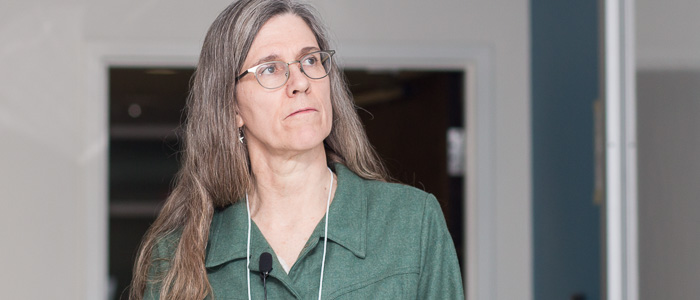
Karen Leighly, of the University of Oklahoma, gave the keynote presentation.
Karen Leighly, from the University of Oklahoma,  gave the keynote presentation.

Karen Leighly, from the University of Oklahoma, gave the keynote presentation to open the Great Lakes Quasar Symposium 2016 at Western.

Karen’s talk was titled, “Using Photoionization to Understand Outflows in AGN and Quasars”.

Associate Dean Pauline Barmby welcomed the symposium participants on behalf of the Faculty of Science.

Organizer Sarah Gallagher made opening remarks.

The symposium runs through May 4th, and is being held in the Physics and Astronomy building, and includes oral and poster research presentations.

[images on Flickr]