Day 1 of meteorite search is complete

march2014-132

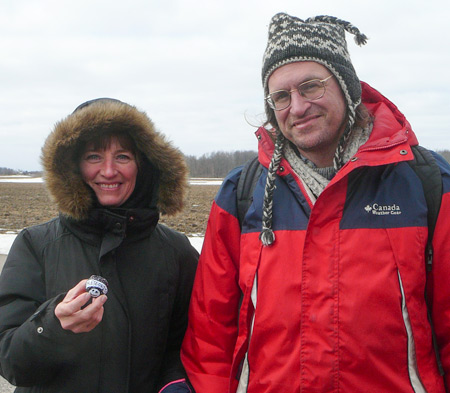
A hardy group of about twenty volunteer meteorite hunters spent the day of March 23, 2014 searching for possible meteorite fragments that may have dropped from the sky on the evening of Tuesday March 18 when a bright fireball fly over the Aylmer area.

Dr. Phil McCausland (at right in photo), an assistant professor in Earth Science at Western, and member of the Centre for Planetary Science and Exploration (CPSX), led the search.

Observations by Western Meteor Physics Group’s array of all-sky cameras, along with meteorological wind data for the time of the fireball have led the researchers to believe that meteorite fragments may have been deposited in an area just north of St. Thomas, Ontario.

While scouring the fields in the area is one way in which the meteorite pieces can be found, the most significant information regarding the location of possible fragments comes from members of the general public.

Members of the public who may have heard something unusual, or have seen possible evidence of meteorite impact on the evening of Tuesday, March 18 at approximately 10:24 pm, are urged to contact Phil McCausland as soon as possible by phoning 519-661-2111, ext. 88008 or on his cell at 519-694-3323.

Indications of landfall may include a broken or cracked window, or perhaps hearing the sound of pieces hitting the roof or window, or you may find a small dark unusual looking rock in your driveway, sidewalk, or along the road. These meteorites may range in size from peas or grapes, up to golf ball or baseball size.

No meteorite pieces were found on March 23.

[images from day 1 of the search]

[original press release, which includes link to fireball information site]
[fireball information site – with photos, videos, and map]

[CTV, London, news coverage of day 1 of search]

Western astronomers to hunt for St. Thomas meteorite fragments

st_thomas_fireball_2014

Researchers from Western University have released footage of a basketball-sized meteor that was almost as bright as the full moon. The meteor lit up the skies of southwestern Ontario earlier this week and Western astronomers are now hoping to enlist the help of local residents in recovering one or more possible meteorites that may have crashed in the area just north of St. Thomas, Ontario.

For video footage, still images and site maps, please visit: http://meteor.uwo.ca/research/fireball/events/st_thomas/overview.html

The Physics and Astronomy Department at Western’s Faculty of Science has a network of all-sky cameras in southern Ontario that scan the atmosphere monitoring for meteors.

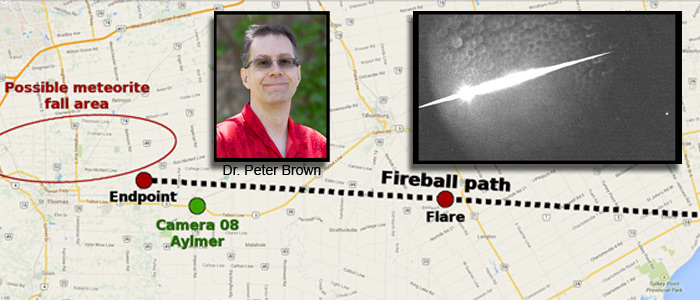
Peter Brown, Director of Centre for Planetary Science and Exploration (CPSX), who specializes in the study of meteors and meteorites, says that on the evening of Tuesday, March 18 a long-lasting fireball which occurred near 10:24 p.m. was detected by seven all-sky cameras of Western’s Southern Ontario Meteor Network (SOMN) and two camera systems in Ohio and Pennsylvania jointly operated with NASA’s Meteoroid Environment Office.

The brilliant fireball started near Port Dover at a height of 75 km and moved almost due westward before ending at 32 km altitude between Aylmer and St. Thomas, Ontario. One or more meteorites were produced by the slow fireball based on the video records from the cameras.

Brown along with Phil McCausland, an Assistant Professor and Meteorite Curator at Western’s Department of Earth Sciences, are now working to get the word out amongst interested people who may be willing to see if they can spot any fallen meteorites.

The two researchers will be joined by Bill Cooke, lead of NASA’s Meteoroid Environment Office, tomorrow (Friday, March 21) at St. Thomas Municipal Airport at 11 a.m. EST to provide a complete update to media.

Researchers at Western are interested in hearing from anyone approximately 5 km north or northwest of St. Thomas, who may have witnessed or recorded this event, seen or heard unusual events at the time, or who may have found possible fragments of the freshly fallen meteorite.

According to McCausland, meteorites are of great scientific value. He also points out that in Canada meteorites belong to the owner of the land upon which they are discovered. If individuals intend to search they should, in all cases, obtain the permission of the land owner before searching on private land.

Meteorites may best be recognized by their dark and scalloped exterior, and are usually denser than normal rock and will often attract a fridge magnet due to their metal content. In this fall, meteorites may be found in a small hole produced by their dropping into soil. Meteorites are not dangerous, but any recovered meteorites should be placed in a clean plastic bag or container and be handled as little as possible to preserve their scientific information.

If you have questions, observations or possible meteorites from this March 18, 2014 event, please contact Phil McCausland at 519-661-2111, ext. 88008 or on his cell at 519-694-3323.

For updates, follow @mediawesternu and the hashtag #stthomasmeteor

MEDIA CONTACT: Jeff Renaud, Senior Media Relations Officer, 519-520-7281, jrenaud9@uwo.ca, @jeffrenaud99

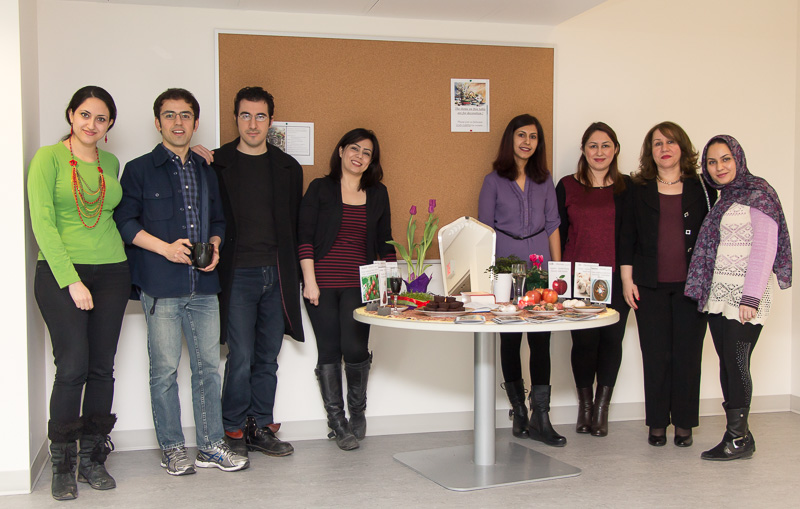
A small celebration of Norouz, Persian New Year

nouroz_2014_1

March 20th—is the first day of Spring and the beginning of the New Year in the Persian Solar Calendar. The exact time of the vernal equinox this year is 12:57 p.m. and that’s the time families and friends will gather around the traditional “Haft-Seen” (the seven S’s) Table to celebrate the start of New Year, called Norouz, for 1393.

A small celebration was held in the graduate student lounge, accompanied by tea, coffee, and an assortment of sweets.

[ see more images]

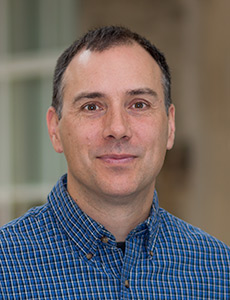
Paul Wiegert wins Faculty Scholar Award for 2014

wiegert_300

Astronomer Dr. Paul Wiegert has won the Faculty Scholar Award. Paul will hold the title of Faculty Scholar for 2014-16.

This is a campus-wide award with several recipients each year that are chosen for recent outstanding contributions to teaching and/or research by a faculty member who has sustained excellence in all three of research, teaching, and service. Paul’s recent discovery of Earth’s Trojan asteroids formed a strong foundation to his nomination.


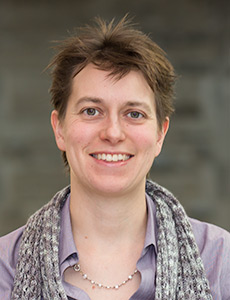
Pauline Barmby wins the Florence Bucke Science Prize for 2014

barmby_300

Astronomer Professor Pauline Barmby has won the 2014 Florence Bucke Science Prize in recognition of her outstanding research record.

The Bucke prize is awarded annually to a faculty member from any of the Science Departments who is 45 years of age or less, and is based on an assessment of the quality and importance of their research.

An award ceremony and lecture is tentatively scheduled for the week of April 7.

Fun Curling Night

curling_8march2014

A group of about 40 curlers,  with skills ranging from novice to expert,  took to the ice at the London Curling Club on Saturday, March 8, 2014.

After a short introductory set of lessons, a friendly competition was held between members of the Department of Physics and Astronomy and members of the Department of Medical Biophysics.

There was lots of fun had by all, with plenty of sliding,  yelling,  cheering, and even a few spills, which were luckily not serious.

Five teams took to the ice for the competition.

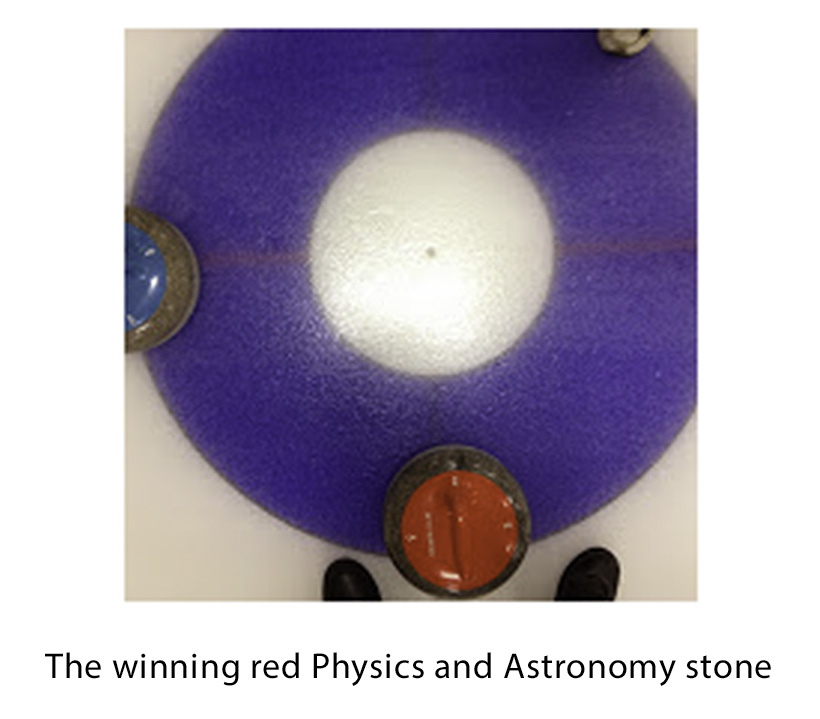
It came down to the last rock of the last game to decide a winner. The team score was two games each. In the fifth game, Physics and Astronomy were up by one, and had a rock mostly in the 4 foot off to one side.  It was up to the last rock thrown by Medical Biophysics. Their draw was expertly thrown (and they only had one sweeper !) but ended up a few centimetres outside of the Physics and Astronomy winning shot rock.  Photos of the deciding array of rocks were taken, and then the youngsters jolted, while the rest of us hobbled, off to celebrate a great night.

Thanks go to Pauline and Charlie for organizing this event.

[images are here]

winning_stone