Chad Harris is finalist for I.I. Rabi Award of the International Society of Magnetic Resonance in Medicine.

chad_harris_350

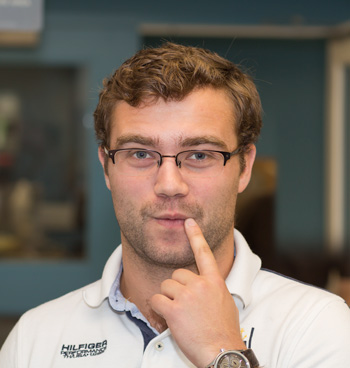
PhD candidate Chad Harris has been selected as a finalist for the I. I. Rabi Award in basic science of the International Society for Magnetic Resonance in Medicine.

Chad will be given the opportunity to give both a 20 minute talk and a poster paper on his topic of “A new approach to shimming: The dynamically controlled adaptive current network.”

The winner among the finalists will be determined on the basis of the manuscript, abstract, and presentations. Finalists receive a $500.00 prize.

“Chasing Ice” movie trailer, plus largest glacier calving event ever witnessed by humankind.

In case you’ve been living under a rock like me (I hear geologists asking, “What kind of rock?”).

Official video of the 75 minute glacier calving event in Greenland.

And I want to see this film about the adventures of National Geographic photographer James Balog and his crew!

Trailer for “Chasing Ice”


The Final Step

Last week I went to a workshop called “Take the Final Step” which was designed to help and encourage female science & engineering professors to apply for promotion to professor. For people who don’t know what this means, at most North American universities there are 3 ranks of professor. Assistant professors are the newbies, who don’t have tenure. Associate professor is the rank that usually goes along with getting tenure. Then “professor” (or “full professor”) is the highest rank.

It’s pretty obvious why assistant professors want to become associate professors: in  general, it’s an “up-or-out” situation: you either get promoted or you are looking for another job. But “why would anyone want to be a full professor?” is a question often discussed around the dinner table at my house. At some universities, the promotion comes with a pay raise. At many, being a full professor is a prerequisite for holding higher academic positions or committee memberships. At most places it’s some kind of recognition that one is known and respected in one’s field.

In lots of science and engineering fields there are very few women full professors. Our department has just one, and lots of physics departments don’t have any. Even in astronomy, which has a much higher percentage of women compared to physics, I saw a recent data point [can’t find the reference] saying that the fraction of full professors who are women is only about 11%. Part of this is a time lag (roughly 15 years from PhD to full prof) combined with lower participation by women in the past, but that’s not the whole story. In general, women tend to spend longer as associate professors than men. They’re less likely to request promotion and more likely to be told they’re not ready. The Council of Canadian Academies recently did a report on this topic which covers all of academia, not just science and engineering.

The workshop was geared to answering practical questions: what are the criteria for promotion? [“Excellence”, apparently. Universities aspire to be like Lake Wobegon, where all the students and all the faculty are above average.] How to acquire an international research reputation? [Go to the right conferences, among other things.] How to manage a lab’s worth of techs, post docs and students? [Pick the right people to start; set clear expectations.] How to balance research with teaching and service? [Might as well focus on research; sad to say, not many people get promoted on the basis of teaching.] How to navigate academic politics? [with your eyes open.] How to balance the rest of your life with a job that can be all-consuming? [No one had a good idea for this one, sadly.].

I thought about it and realized that I was taught by exactly two female profs over my entire undergrad and graduate career. Not exactly a ton of role models. So it was inspiring to see the many speakers at this workshop who were female (full) professors. A few of them brought their “promotion dossiers” for us to look at, and they were impressive.
But the professors themselves made strong claims that they weren’t superhuman, which I think is also important to know.

The take-home message from the workshop was that promotion to full professor is certainly not impossible, but it doesn’t just happen — it takes thought and planning. But it should be within our grasp, and we owe it to those who will come after us to at least try.

Survey on CCA report

I’d like to remind you to take the time to fill out NSERC survey about the findings of the CCA report on funding science research. This report, and the feedback NSERC receives about it, will have an important influence on the reallocation of funds within the Discovery Grant program, and in the allocation of any future funding increases.

The survey is at: www.nserc-crsng.gc.ca/NSERC-CRSNG/Reports-Rapports/Assessment-Assessment_eng.asp

It took me about 45 minutes to complete. It is a horrible survey, and both the questions and the way they are worded are complicated. You should read at least the executive summary of the CCA report (on the CCA website) and the document outlining the CAP’s response (which CAP members received by email recently). But it’s important!

Meteor Physics group joins the hunt for the ‘Windsor Hum’

windsor_hum_research_announcement

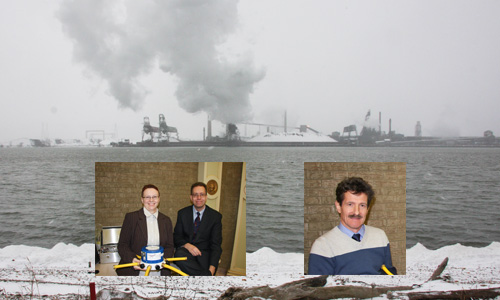
Dr. Peter Brown (right side of left inset) and the Meteor Physics group at Western will take their expertise in low frequency infrasound detection abroad, in order to help find a possible source of the so called ‘Windsor Hum’. Among the Meteor Physics group are PhD candidate Elizabeth Silber (at left in left inset), and research scientist Zbignew Krzeminski (right inset).

The Windsor Hum is a long standing ‘noise’ that has plagued a part of the Windsor, Ontario community for several years.  It has been described on Youtube.

The group from Western will work alongside engineer Dr. Colin Novak of the University of Windsor.

The announcement was made at The University of Windsor by Bob Dechert, Parliamentary Secretary to the Minister of Foreign Affairs.

The Canadian federal government is funding the project.

[See it in The Western News] [CBC News] [images of the news conference]

ASX 10th Annual Symposium, “Life Beyond Earth” – Friday, January 25

asxlogo

Astronomy & Space Exploration Society (ASX)’s 10th Annual Symposium – “Life Beyond Earth” (Friday, Jan 25) 
The event will feature talks on the latest in exoplanets, the possibility of life elsewhere in the universe, and the social and cultural aspects of such a fascinating discovery.
 
Featuring:
  – Dr. Chris McKay, Planetary Scientist at NASA Ames Research Center
  – Dr. Sara Seager, Professor of Planetary Science and Physics at the Massachusetts Institute of Technology (MIT)
  – Dr. Kathryn Denning, Co-Principal Investigator of Intelligence In Astrobiology at SETI, and Associate Professor in Dept. of Anthropology at York University
 
DATE & TIME: Friday, January 25, 2013 @ 7:00pm – 10:00pm (Doors open 6pm, reception at 10pm)
 
LOCATION: Macloed Auditorium, Medical Sciences Building, 1 King’s College Circle, University of Toronto
 
ADMISSION:
  – Students: FREE with ID & pre-registration on: http://asxsymposium</x>2013.eventbrite.ca/
  – Public: $15 (before Jan 7, 11:00pm), $20 (Regular), $25 (at the door).  Obtain tickets at: http://asxsymposium</x>2013.eventbrite.ca/
 
(Info c/o Alyssa Gilbert, CPSX)

Blaine Chronik receives CFI grant for MR device and technology research. John R. de Bruyn is one of the co-investigators.

chronik_MR-compatible_devices_CFI

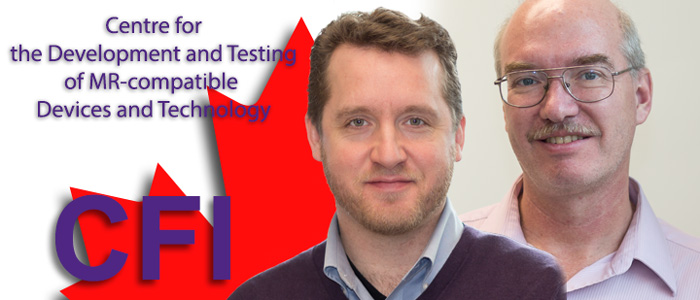
Dr. Blaine Chronik (photo at left), is the principal investigator in the new “Centre for the Development and Testing of MR-compatible Devices and Technology” which has just been awarded a Canadian Foundation for Innovation (CFI) grant. One of the co-investigators in the Centre is John R. de Bruyn (photo at right).

The project aims to improve healthcare for Canadians by facilitating the development of safer, more advanced medical devices for use within safer, more advanced MRI systems. Proximity and access to this infrastructure will give Canadian companies an additional advantage in the fast-paced and competitive medical device industry.

The project proposes to create a comprehensive medical device testing and development facility to support companies and academic groups in the development of medical devices that are safe and operational even while within an MR scanner. The focus is entirely on the creation of a platform of projects to provide the expertise on the MR-compatibilty aspects of this problem.

John de Bruyn’s role will be to characterize materials to be used in testing MR-compatible devices, and to develop “new and improved” materials for this application.

[see Western News] [Western Gazette] [Blaine Chronik’s research web page] [ John de Bruyn’s research web page]