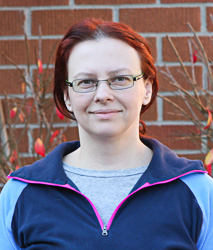
Elizabeth Silber takes her #NSERC postdoctoral fellowship to Brown University

Dr. Elizabeth Silber

Western’s Dr. Elizabeth Silber has been awarded a prestigious NSERC Postdoctoral Fellowship (PDF) for 2016-17 .  She will be taking the fellowship to Brown University in Providence, Rhode Island.

She was the top female candidate in Physics and Astronomy and thus received an invitation to also apply for the Loreal-NSERC research supplement, though unfortunately the supplement is not available to those taking the PDF out of country.

Elizabeth is currently working as a postdoctoral fellow with Dr. Gordon Osinski, where she is modelling  impact craters.
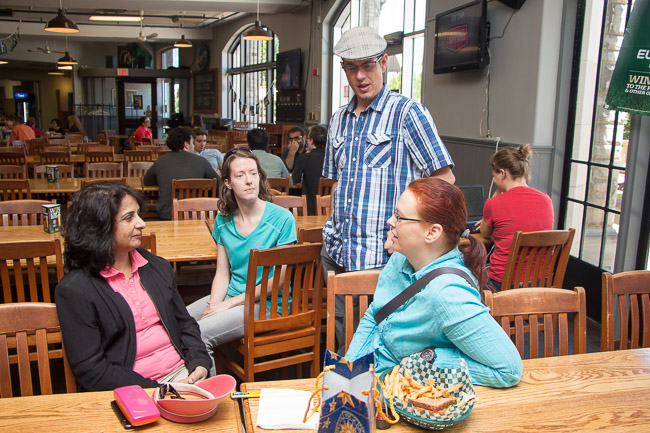
Elizabeth_farewell_650px-1
Saying farewell.

Elizabeth graduated with Distinction with Hon. BSc. (Specialization in Astrophysics and Major in Planetary Science) in 2007, followed by a 2014 PhD titled “Observational and theoretical investigation of cylindrical line source blast theory using meteors” under Dr. Peter Brown’s supervision.
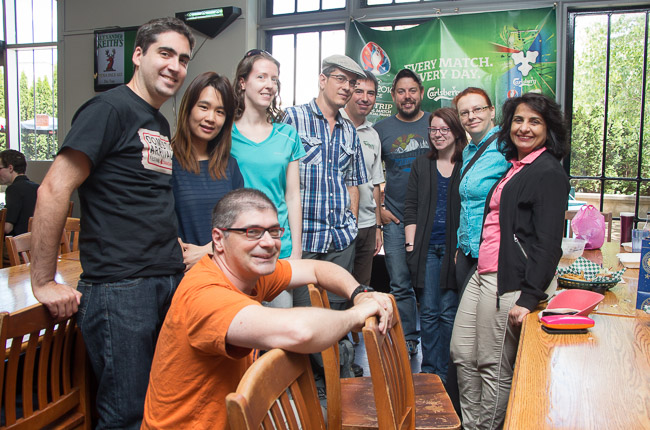
Elizabeth_farewell_650px-2At Brown University  Elizabeth will be in the Department of Earth, Environmental, and Planetary Sciences, where she will work on numerical modelling of impact cratering processes on icy bodies in the Solar System. For example, Europa, Jupiter’s satellite, is one of the primary targets (apart from our neighbour Mars) for search for possible life in the Solar System.

One of Elizabeth’s research objectives will be to model multi-ring basins (these are enormous craters) in order to investigate and constrain the thickness of the Europa’s crust, which is important in establishing the state of internal heating (e.g. how much heating in the shell vs contribution of rocky interior). Inference about internal heating could shed more light on various geophysical processes, including tidal heating in the icy shell, better understanding of surface features, and finally, it has astrobiological implications, such as hydrothermal activity. This work can also be expanded to include other icy bodies, as well as rocky bodies (such as Ceres, Moon and Mercury).
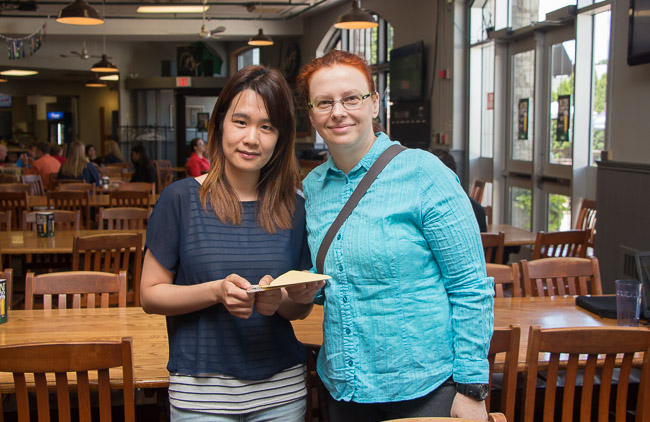
Elizabeth_farewell_650px-3In speaking of this new phase of her career, Elizabeth reflects, “I’d like to say that I am very grateful for all the opportunities I had here at Western, including being involved in really awesome research and unique projects, and meeting amazing people. There is nothing more fulfilling than being able to work on research you love, and at Western I got that chance. Of course, that’s thanks to my doctoral advisor (P. Brown) and my postdoctoral supervisor (G. Osinski).“
Join us for Asteroid Day at Cronyn Observatory on June 30, 2016

Asteroid Day Web Banner_2016The Centre for Planetary Science and Exploration, in collaboration with the Department of Physics and Astronomy and the Department of Earth Sciences, will be hosting a special event on Asteroid Day (June 30th). Asteroid Day is a global awareness campaign where people from around the world come together to learn about asteroids and what we can do to protect our planet, families, communities, and future generations from future asteroid impacts. Asteroid Day is held each year on June 30, the anniversary of the largest impact in recent history, the 1908 Tunguska event in Siberia.

Event Details:

Date: 30th June 2016

Time: 3:00 to 7:00 PM (come and go as you please; entrance is free)

Location: The Hume Cronyn Memorial Observatory (search for “Cronyn” on this interactive google map).
Parking information can be found here.

Social Media: Tweet your pictures with the #AsteroidDay and #WesternU hashtags. Follow the event on Facebook.

Activities: 

Public Talks by three Asteroid Experts:

3:00 PM- Prof. Peter Brown “The Tunguska event and the hazard of asteroid impacts”

4:30 PM- Prof. Paul Wiegert “Fire from the sky: how rocks from space fall to Earth”

6:00 PM- Prof. Audrey Bouvier “Meteorites: messengers from asteroids and planets”

Meteorite Expert on site – have a rock you think might be meteorite? Bring it to our expert and find out!

Meteorites and Impactites on display

Solar Observing (weather permitting)


Web site:  http://cpsx.ca/outreach/public_events/asteroid_day.html


Purple Crow Lidar group members attended worldwide NDACC Lidar Working Group meeting in Switzerland

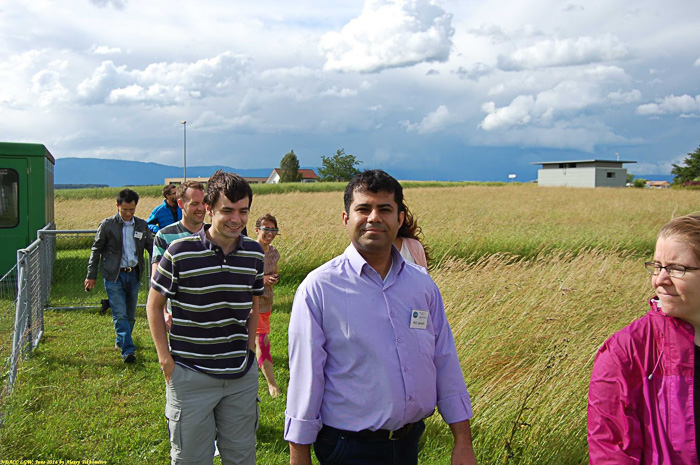
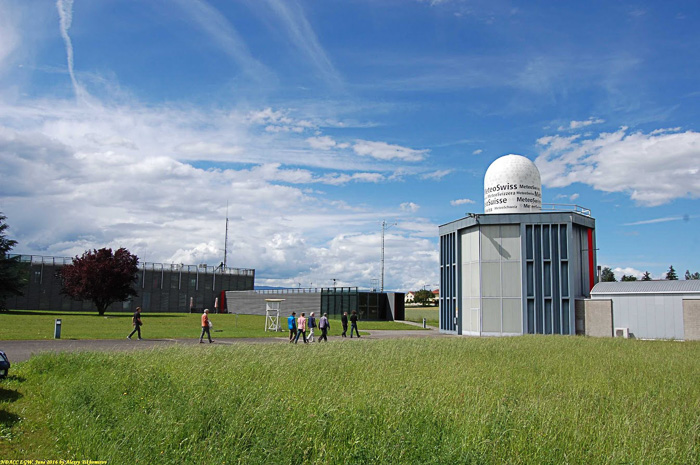
LWG_700-1
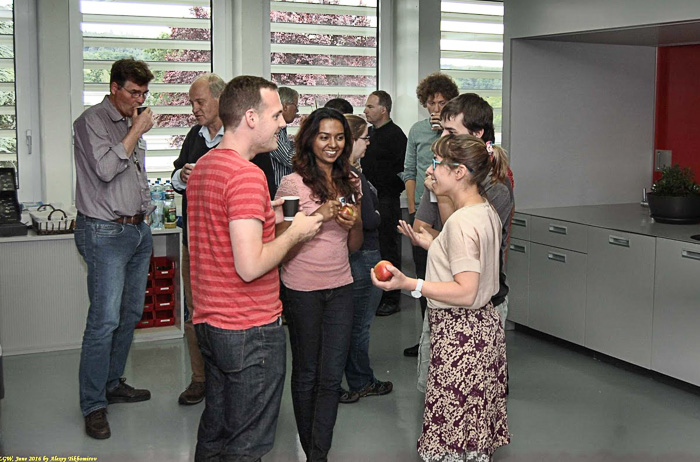
Some members of Western’s Purple Crow Lidar in Payerne, Switzerland. (all photos by Alexy Tikhomirov)

The Lidar Working Group of the Network for Detection of Atmospheric Composition Change (NDACC), met in Payerne, Switzerland, during the week of June 20, 2016. This working group represents approximately 50 worldwide lidar research groups.

LWG_300-2Western’s Purple Crow Lidar was represented by the entire research team, headed by Prof. Bob Sica, along with graduate students Ali Jalali, Shannon Hicks, Shayamila (Sham) Mahagammulla, Jeff VanKerkhove, Ghazal Farhani, as well as Western MSc graduate, now at the  LATMOS lab in France, Robin Wing.

LWG_300-3Each of the Western students gave a presentation at the meeting.

Western Adjunct professor  Alexander Haefele of MeteoSwiss was one of the organizers of the event.   He, along with Western’s Prof.  Sica,  gave a half day workshop on the Optimal Estimation Method.

After the meeting, the members of Western’s Purple Crow Lidar spent the week working with colleagues at MeteoSwiss.

[sample of beautiful images by Alexy Tikhomirov of Dalhousie University]

Neven Vulic successfully defends PhD thesis

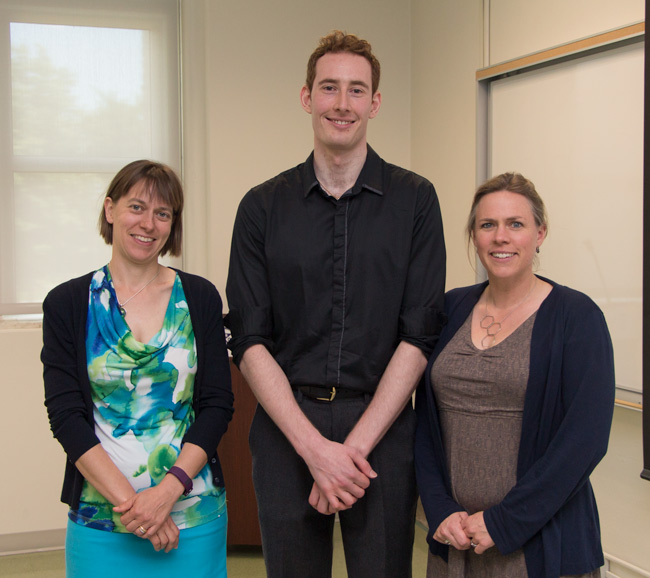
Neven Vulic (centre) flanked by supervisors Pauline Barmby (left) and Sarah Gallagher (right).

Neven Vulic successfully defended his PhD thesis on Tuesday, June 21, 2016.

Prior to his examination, Neven gave a public lecture on his thesis, which was titled, “X-ray Populations in the Local Group: Insights with Hubble & Chandra“.

Neven was co-supervised by astronomers Pauline Barmby and Sarah Gallagher.


Students bring home CAP Congress 2016 awards

Western graduate students excelled at the Canadian Association of Physicists (CAP) Congress in Ottawa during the week of June 11, 2016.

Carolyn Cadogan and Ye Li took home first and second place for oral papers in the DCMMP division.

Carolyn’s paper was titled, “Enhancing the Luminescence of Silicon Nanoclusters embedded in Silicon Nitride”. Carolyn is a Physics and Astronomy graduate student co-supervised by Lyudmila Goncharova and Peter Simpson.

Ye’s paper was titled, “Nighttime solar cells”. Ye is a Chemistry graduate student supervised by Giovanni Fanchini.

Both Carolyn and Ye received Honorable Mentions for their oral papers in the overall oral paper competition.


June 2016 Graduation

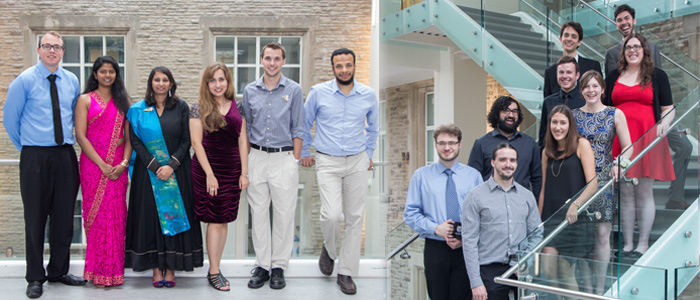
MSc and PhD on the left, with BSc on the right.

[Flickr images]

Spring graduation for Sciences was held on Thursday, June 16, 2016.

A noon hour reception and recognition ceremony were held in the Physics and Astronomy atrium and in classroom PAB 100.

Students, their families, and friends were formally welcomed by Acting Chair Aaron Sigut and Associate Graduate Chair Silvia Mittler.

Undergraduate Chair Eugene Wong was the master of ceremonies for the proceedings.


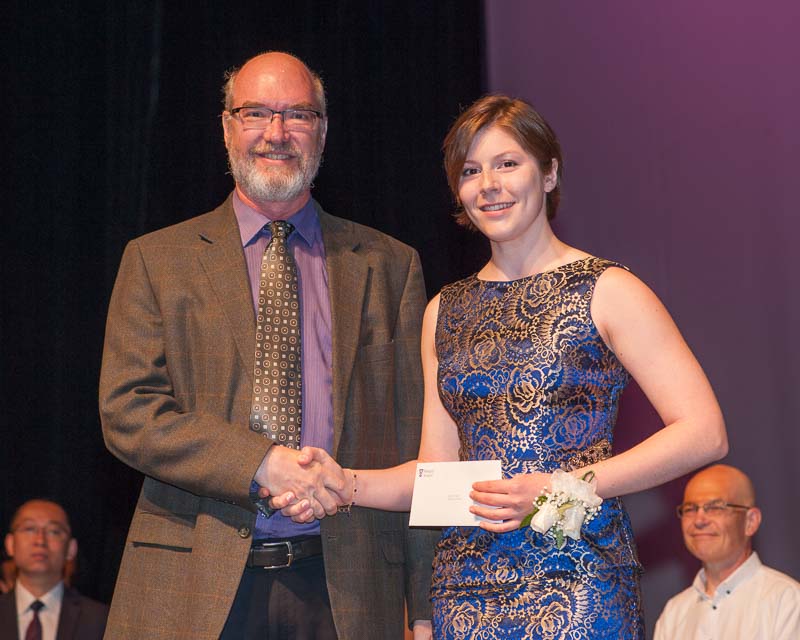
Prof. John de Bruyn presents Nathalie Thibert with the DonH Hay Prize
Prof. John de Bruyn (left) presents Nathalie Thibert with the Don Hay Prize. (photo Mitch Zimmer)

Graduate students were introduced by their supervisors. Undergraduate students were introduced and queried by Prof. Wong as to their future plans.

Each graduating student received the traditional departmental coffee mug.

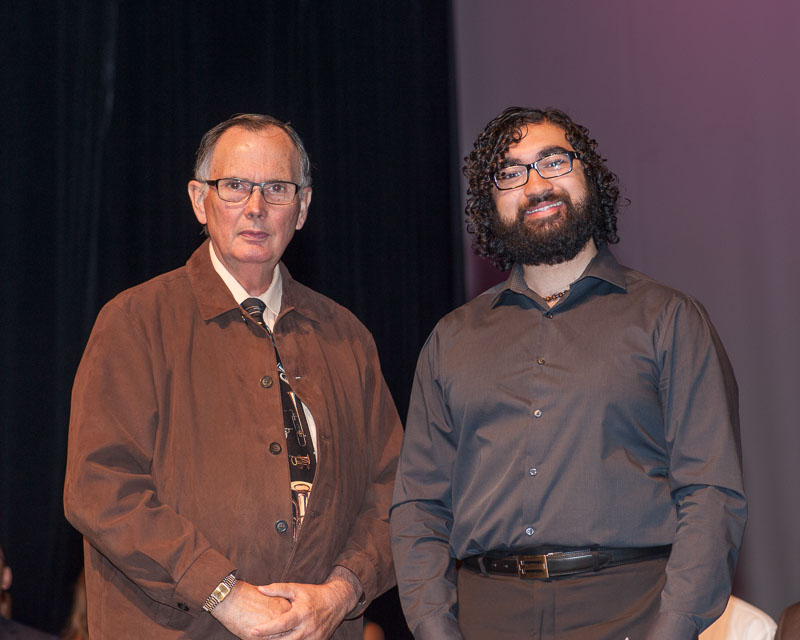
University award winners were Nathalie Thibert (Don Hay Prize), and Sumit Sharma (Compton Dearle Gold Medal)

Paul Ross (left) presents Sumit Sharma with the Compton Dearle Gold Medal.
Paul Ross (left) presents Sumit Sharma with the Compton Dearle Gold Medal. (photo Mitch Zimmer)

A special departmental undergraduate recognition award was presented to BSc graduate Nathalie Thibert for academic excellence and community engagement. Graduating PhD student Parshati Patel was recognized as a role model in community and outreach engagement for graduate students.

Finally, Physics and Astronomy staff members Peter Frank and Henry Leparskas were thanked by the students.

PhD graduates Thesis title Supervisor
Ahmed, Ahmed “Nitrogen Abundances in Early-Type Be Stars” Aaron Sigut
Patel, Parshati “The Inner Gaseous Disks Of Herbig Be Stars” Aaron Sigut/John Landstreet


MSc graduates Thesis title Supervisor
Abeyasinghe, Pubuditha “Structure-Function Relationship of the Brain: A comparison between the 2D Classical Ising model and the Generalized Ising model” Andrea Soddu
Brzozowski, Marek “The Study of Nano-optics In Hybrid Systems” Mahi Singh
Changizrezaei, Setarehalsadat “Simulation of Heterogeneous Colloidal Particles Immersed in Liquid
Crystals”
Colin Denniston
Karpiak, Mike “Detection and Characterization of a Nontransiting Planet in the KOI 3445 System” Paul Wiegert


BSc graduates Thesis title
Altenbeck,Johnathan Robert MSc at Western
Aubrey,Jason Considering Med School
Bloxam,Kevin MSc at McGill, Atmospheric and Oceanic Sciences
Pywowarczuk,Adam Graduate studies
Rose,Christopher
Sharma,Sumit Med School
Thibert,Nathalie Chantal Applying Hierarchical Clustering to Broad Absorption Line Profiles for Quasar Classification. MSc in Astronomy at Saint Mary’s University in Halifax on Extragalactic Astronomy and Galaxy Evolution
Villeneuve,Hayley Move to BC, and look for a position. Perhaps join the military and become a jet pilot.
Whitfield,Danielle Nicole For the summer, working at Canadian Poetry Press in the English department while completing two computer science courses. In the fall, Computer Science diploma through Western Continuing Studies

In memoriam: John David Jackson

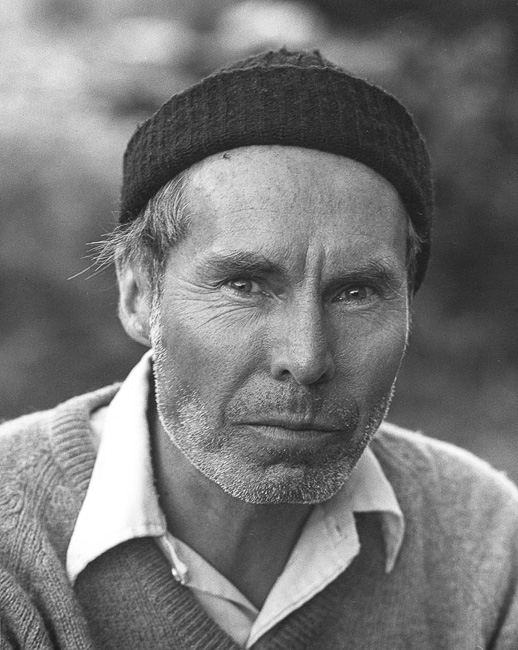
Unofficial portrait at Lake Ediza, 1978, by Kurt Gottfried
Unofficial portrait at Lake Ediza, 1978, by Kurt Gottfried.

Eminent physicist (John) David Jackson passed away in Lansing, Michigan, on May 20, 2016 at age 91.

London,Ontario born David Jackson received his Honors B.Sc. in Physics and Mathematics from Western in 1946.

The late Prof. Emeritus Don Moorcroft described the effect that David Jackson had in his brief tenure as an undergraduate at Western.

“Some of the graduates from this period went on to prominent careers in science. I remember R.L. Allen telling me that he sometimes asked the students in the class to suggest questions for the final exam in the 4th year course in electricity and magnetism which he taught (I think some of their mark was based on the quality of the questions). This led to difficulties for R.L. in 1946 when one of the students provided questions which were too difficult for the instructor, let alone the others in the class. The student’s name was J. David Jackson (MIT, PhD, 1949; now emeritus professor of Physics, University of California, Berkeley), who went on to a very distinguished career, and, amongst graduate students, notoriety, as the author of Classical Electrodynamics, which has provided problems to confound several generations of graduate students (and the occasional instructor!). Western recognized Dr. Jackson with an Honorary D.Sc. in 1989. Recently Dr. Jackson has very generously endowed a graduate scholarship in the Department in memory of his parents, as well as two undergraduate science scholarships, named in honour of R.L. Allen and Gar Woonton.

Dr. Jackson won a gold medal in physics in 1946.”, writes Moorcroft.

The University of California at Berkeley web pages provide this glimpse into David Jackson’s career,

“John David Jackson received his B. Sc. from the University of Western Ontario in 1946 and his Ph.D. from the Massachusetts Institute of Technology in 1949. He taught at McGill University for seven years and at the University of Illinois for ten before coming to Berkeley in 1967. He has held a Guggenheim Fellowship (Princeton, 1956-57), a Ford Foundation Fellowship (CERN, 1963-64), and Visiting Research Fellowships at Cambridge (Clare Hall, 1970) and Oxford (Jesus College, 1988-89). He is a member of the National Academy of Sciences, and the American Academy of Arts and Sciences, and a Fellow of the American Physical Society. He is the author of a well known graduate text, Classical Electrodynamics (Wiley, 1962, 1975, 1998), as well Physics of Elementary Particles (Princeton Press, 1958) and Mathematics for Quantum Mechanics (W A Benjamin, 1962). He has contributed to numerous summer school lecture series, and for 17 years served as Editor of Annual Review of Nuclear and Particle Science. Service to the University of California includes Department Chair (1978-81), and Head of the Physics Division, Lawrence Berkeley National Laboratory (1982-84). He retired from teaching in 1993 and is presently a Participating Retiree in the Physics Division, LBNL. Avocations: swimming (for exercise), hiking in the mountains, scientific bibliophily.”

[In memoriam from Fermilab] [in memoriam Lansing State Journal]