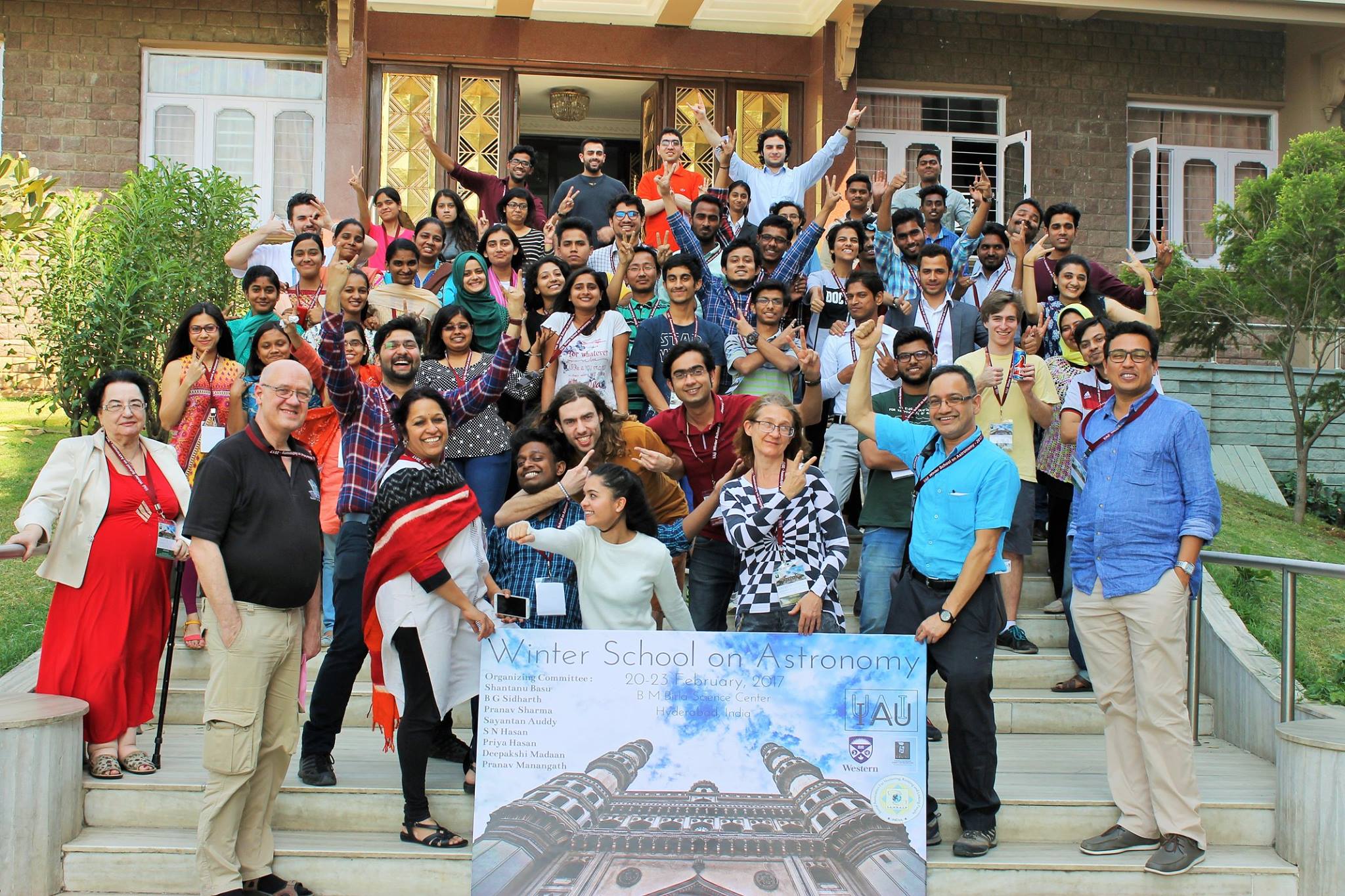
The Astronomy Winter School in India, or Astrowin, was held in Hyderabad, India, on February 20-23, 2017. This was the second in a series of schools, the first of which was held in February 2016, in Agra, India. The Astrowin events are actually a combination training school for Bachelors and Masters degree level students, a research workshop, and a cultural experience. Accessibility to participants from diverse backgrounds is a founding principle of the schools. The diversity of the school reached new heights in 2017, with a fully gender-balanced participant list and 11 different countries
represented by the students and speakers. These countries were Bangladesh, Canada, Egypt, India, Indonesia, Iran, Malaysia, Nepal, Philippines, the UAE, and the USA. The largest contingent among the 70 students was from India, followed by Canada. The Indian students also represented the length and breadth of the subcontinent, from Maharashtra to Manipur, and Punjab to Tamil Nadu. The 2016 school had been sponsored by generous funding from Anand College, Agra, India, and Western University, Canada. In 2017 the school was funded by the International Astronomical Union – Office of Astronomy for Development (IAU-OAD), giving it a greater international profile. The event was held at the B M Birla Science Centre in Hyderabad, and many thanks go to its Director, Dr. B. G. Sidharth.
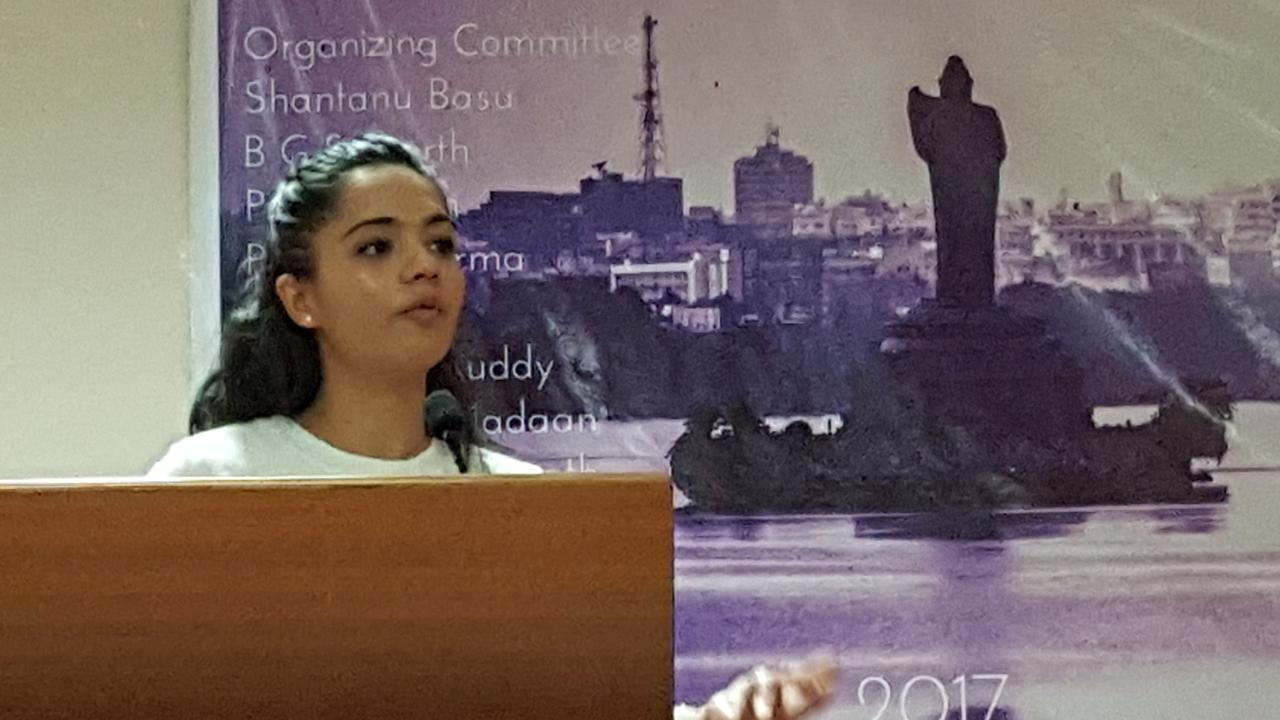
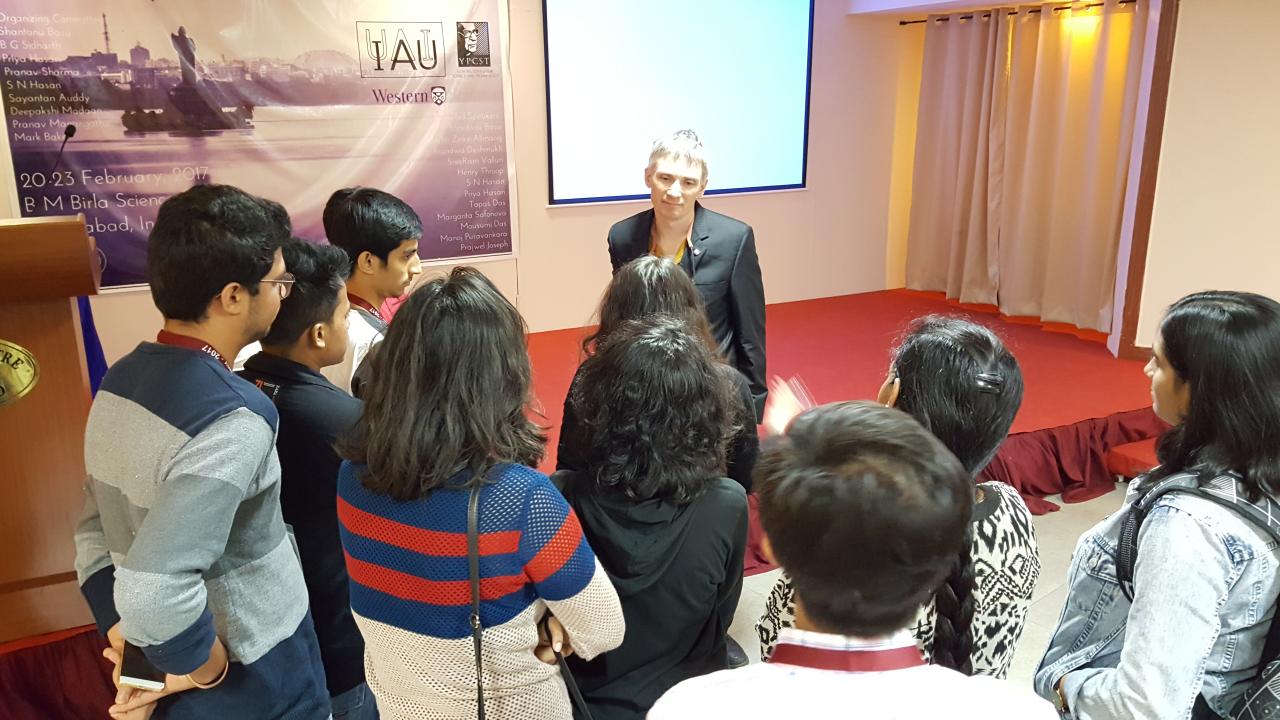
Deepakshi Madaan leads the hands on session on the stellar initial mass function.Henry Throop engages with the audience.
The school segment of the event featured two hands-on astronomy sessions. Priya Shah Hasan (Maulana Azad National Urdu University, India) led an interactive session on GAIA telescope data analysis, and Sayantan Auddy and Deepakshi Madaan of Western University teamed up to lead a workshop on the use of the Python programming language with an application to measuring the mass function of stars in a stellar cluster. Other school highlights included Henry Throop (Planetary Science Institute, USA) speaking on the New Horizons mission to Pluto, Pranav Manangath (Western) speaking on the Theory of Planet Formation, Pranawa Deshmukh (IIT-Tirupati) speaking on Precession of Planetary Orbits in General
Relativity, Ajith Parameswaran (ICTS Bangalore) on Binary Black Hole Detection by LIGO, and Tapas Das (HRI Allahabad) speaking on Accretion onto Supermassive Black Holes.
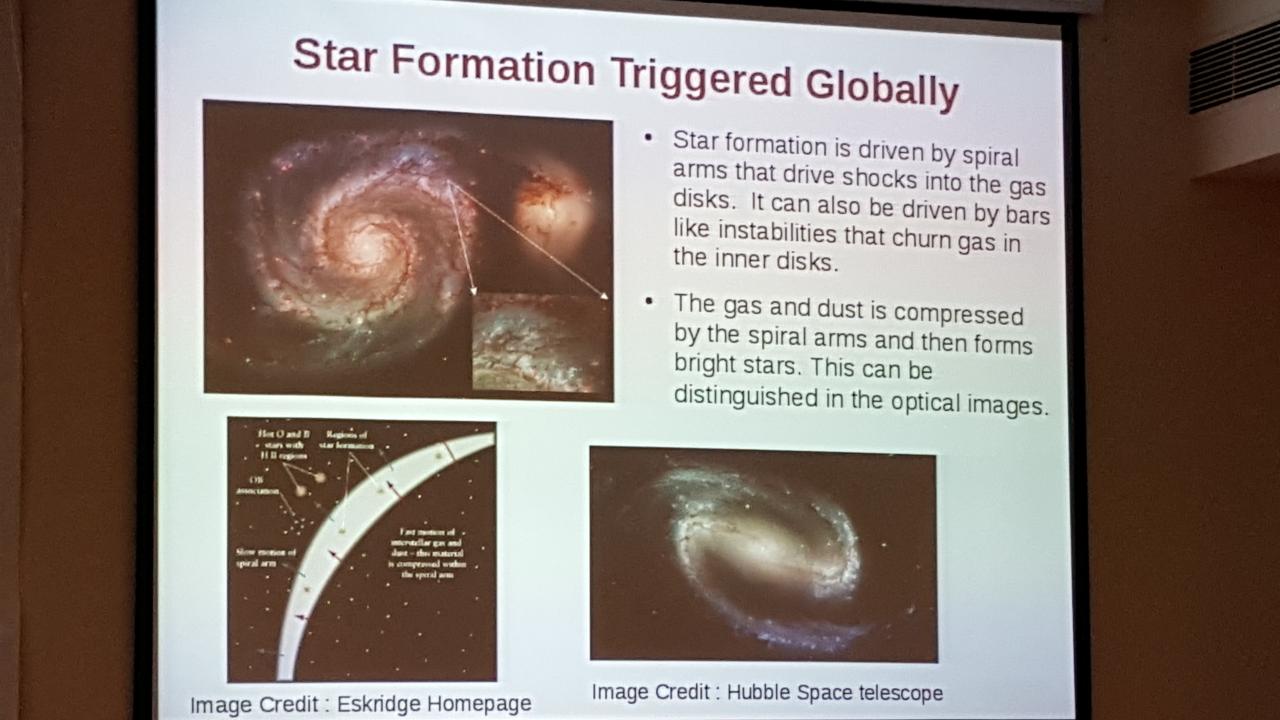
A slide from Mousumi Das’s talk on extragalactic star formation.
The final day was a research workshop on various aspects of stellar clusters and star formation, where students experienced a research presentation environment, with plenty of opportunity to interact with the speakers. In addition to talks by many of the school lecturers, there were several invited talks including by Mousumi Das (IIA Bangalore), Manoj Puravankara (TIFR Mumbai), and Margarita Safonova (IIA Bangalore).
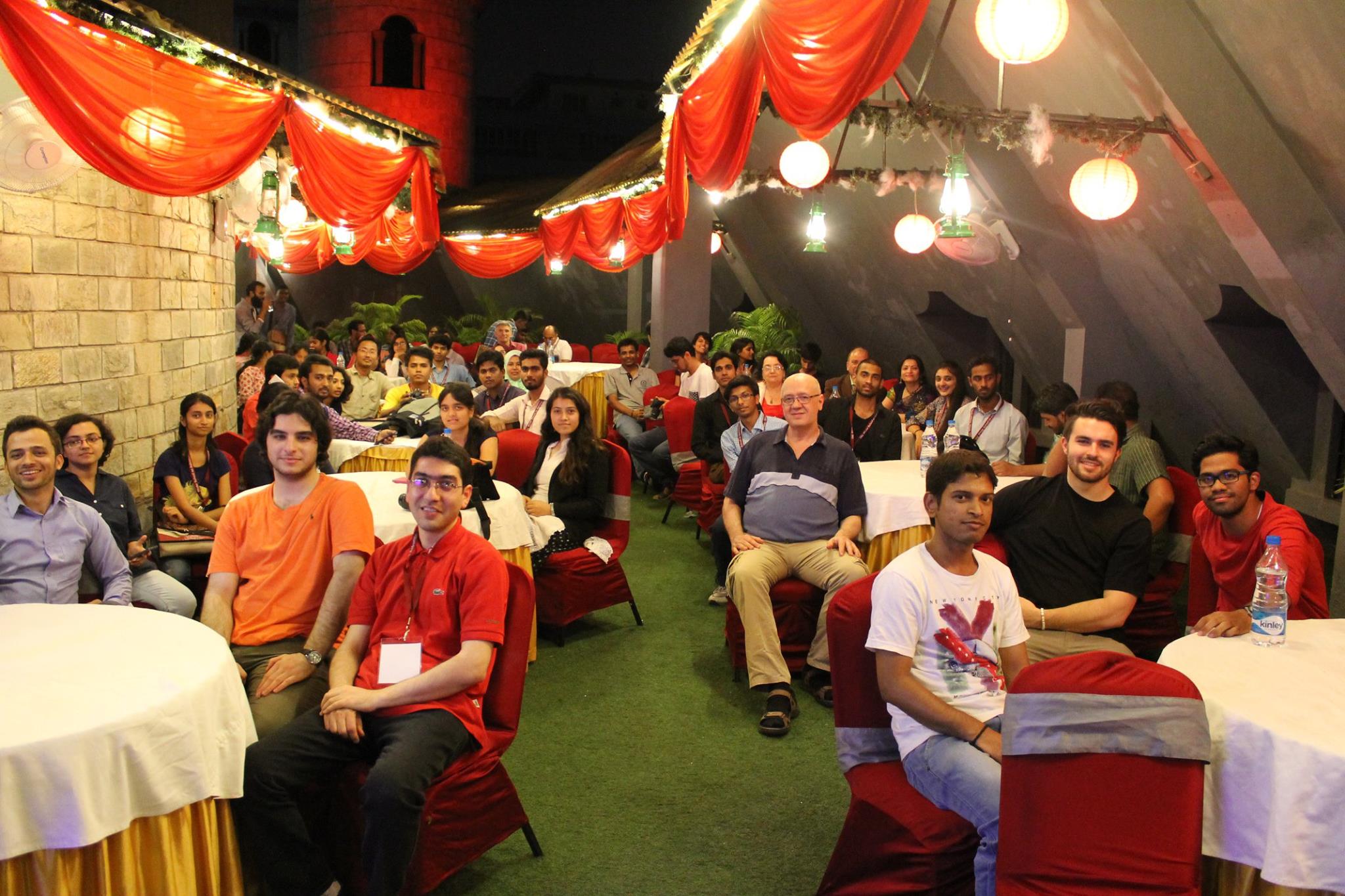
All relaxed at the banquet.
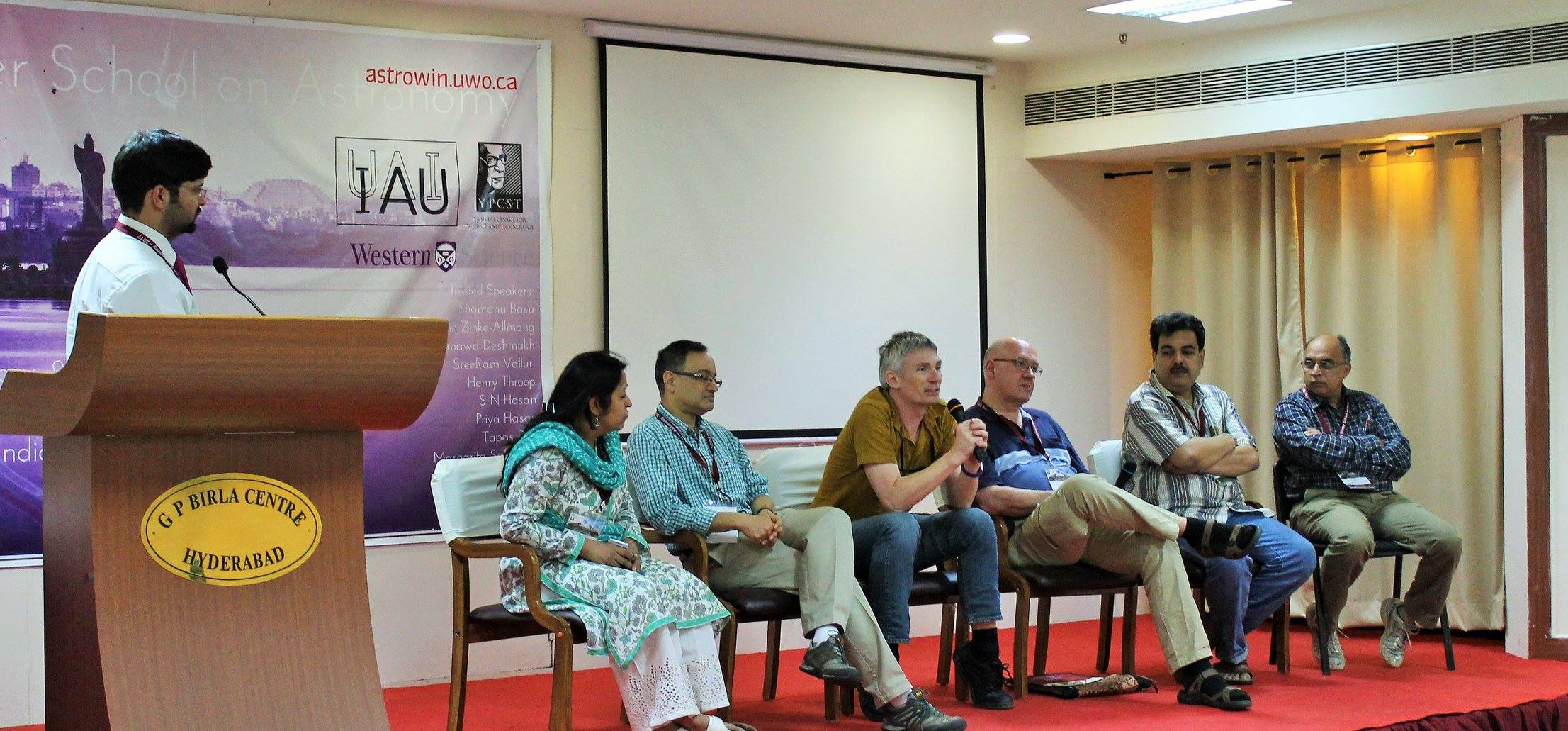
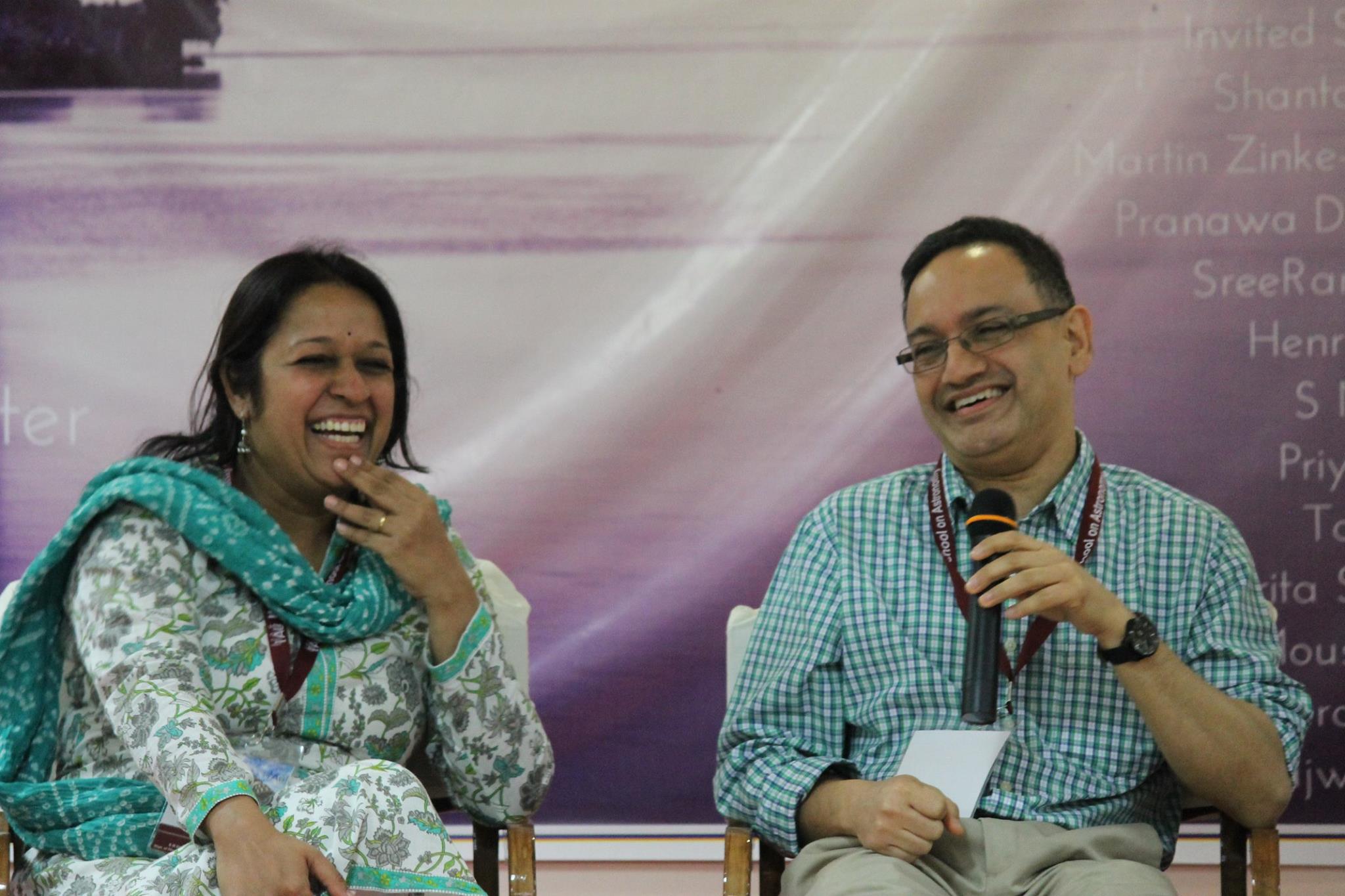
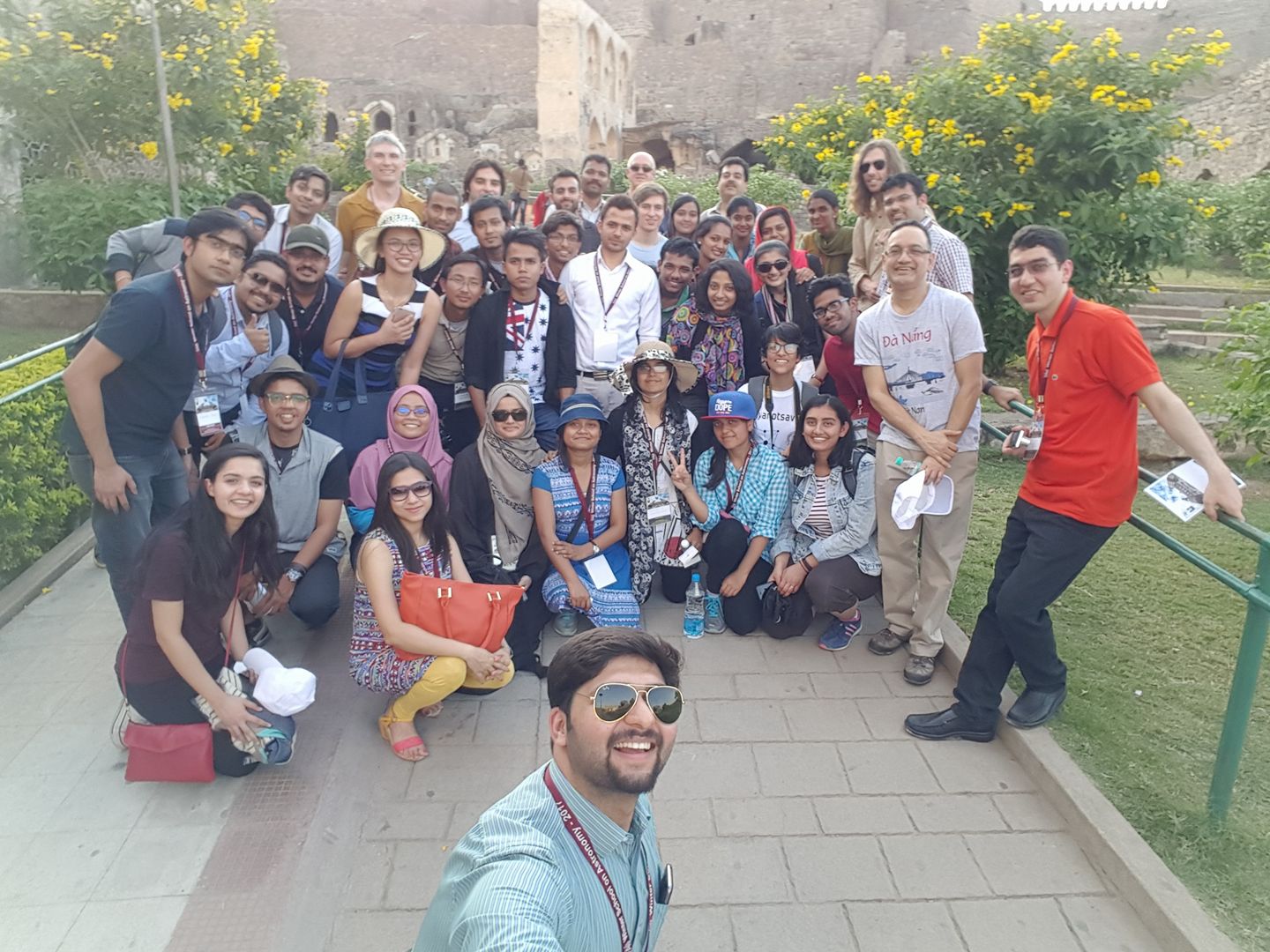
A special feature of the Astrowin series is simply bringing a diverse group of people together and letting them interact. Relationships are developed and cross-cultural awareness is gained. On the second day, there was a group excursion to the historic Golconda Fort, located just outside Hyderabad and overlooking the city. The fort dates back to about the 12th century and has been in use by many successive dynasties. In recent centuries its international fame had come from its association with nearby diamond mines that yielded the largest and most famous diamonds in the world, notably the Koh-i-Noor diamond and the Hope diamond. Participants made the trek to the top of the hill while developing fellowship with each other, and the group stayed till the evening light show. Another part of the school was a panel discussion on careers in astronomy, with students asking very frank questions about what it takes to get a PhD position, and a conversation about the international nature of astronomy research.
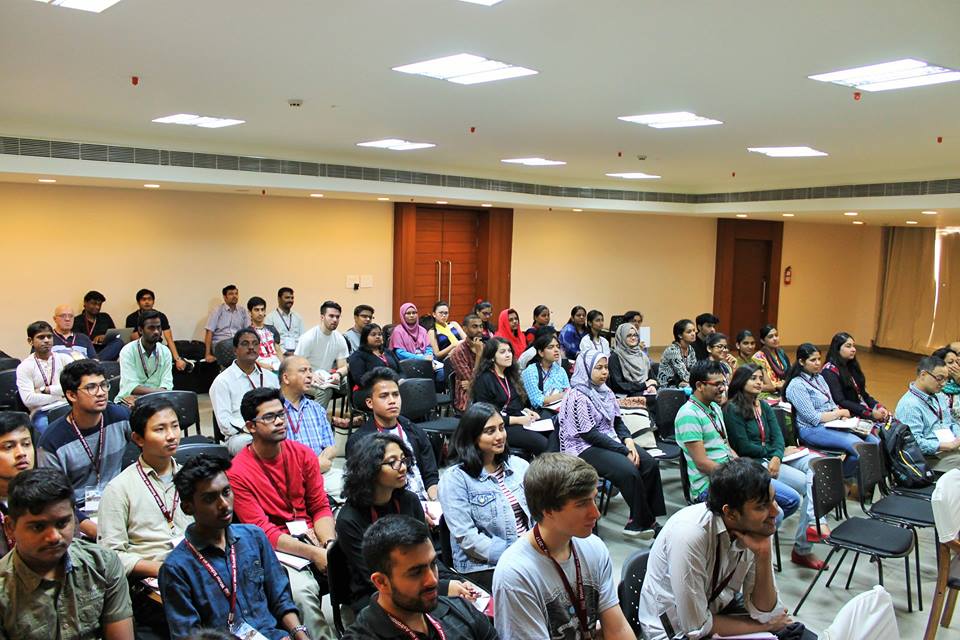
The panel discussion addressing careers in astronomy.
Astrowin provided an opportunity for education, travel, and cross-cultural interaction. It allowed Canadian students (from Western University, Wilfrid Laurier University and the University of Toronto) to meet international students in a study abroad event while experiencing India. For Indian students and those from other Asian countries, it provided a valuable opportunity to interact with leading scientists from many countries in a relaxed and inquisitive environment. The very large number of applicants for the Astrowin schools means that there is a strong demand for these kind of events and surely there will be more to come.
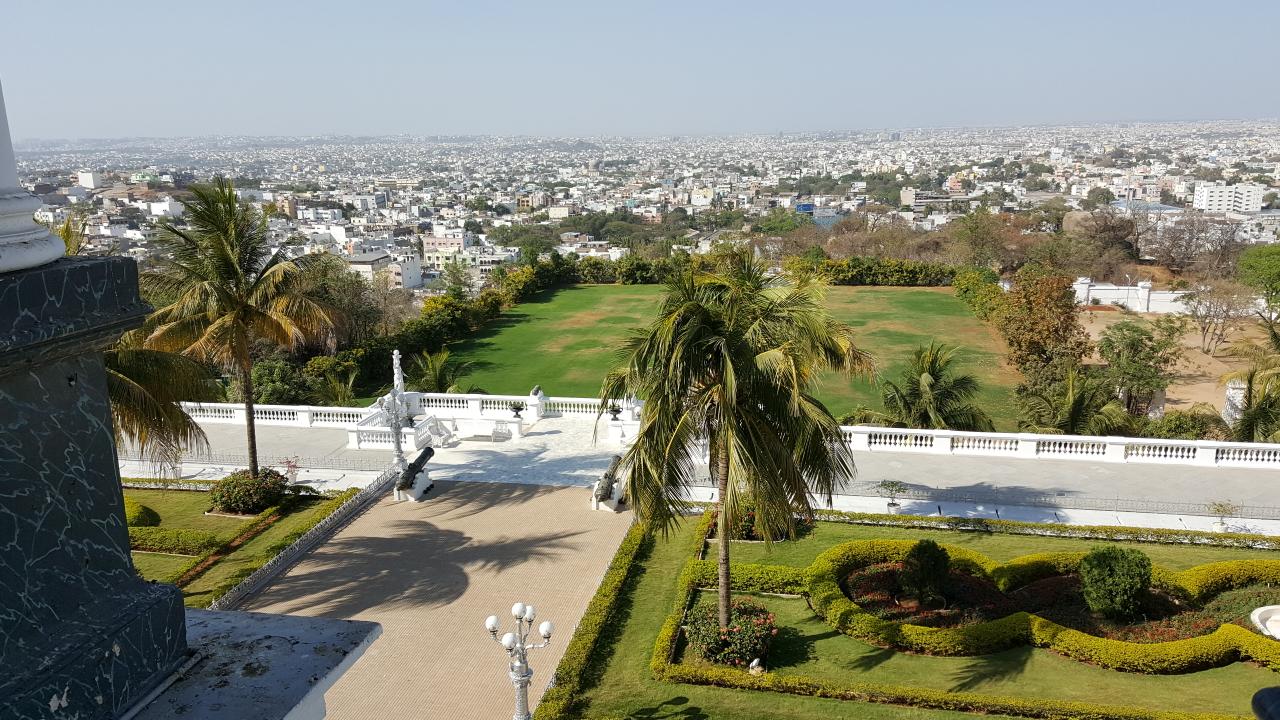
The group at Golconda Fort. Pranava Sharma holds the selfie stick!A view of Hyderabad from the opulent Taj Falaknuma Palace, residence of the former Nizam of Hyderabad.
Earlier this year I visited the United Arab Emirates (UAE) and spent part of my time there as a visitor at Sharjah University. Sharjah is one of the seven emirates that make up the UAE. I also visited the more well known emirate of Dubai. This was a very enlightening trip for me to a part of the world I had never visited before, and I found many opportunities emerging there.
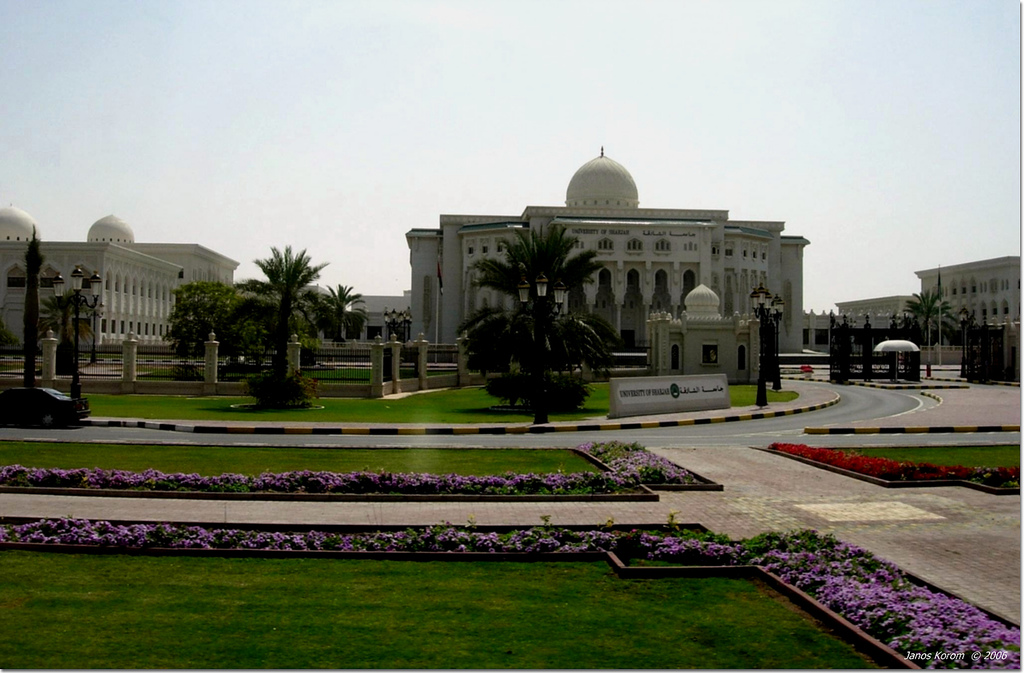
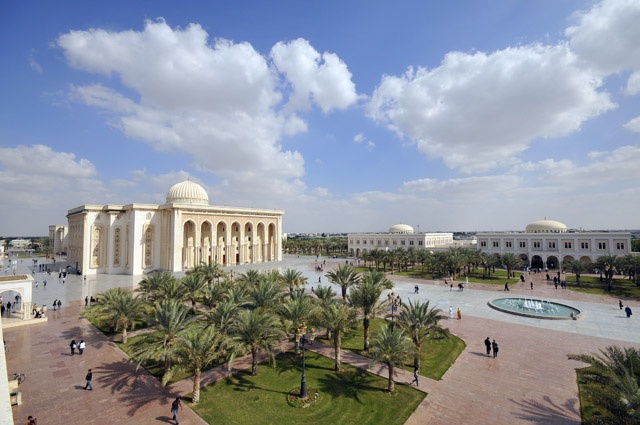
I was a guest of the Department of Applied Physics (now renamed to Department of Applied Physics and Astronomy – more on that later). Sharjah has historically been a hub for education in the UAE, and one cannot help but be in awe of the sprawling campuses and imposing white arabesque architecture of Sharjah University and the neighboring American University of Sharjah.
Sharjah UniversityAmerican University of Sharjah
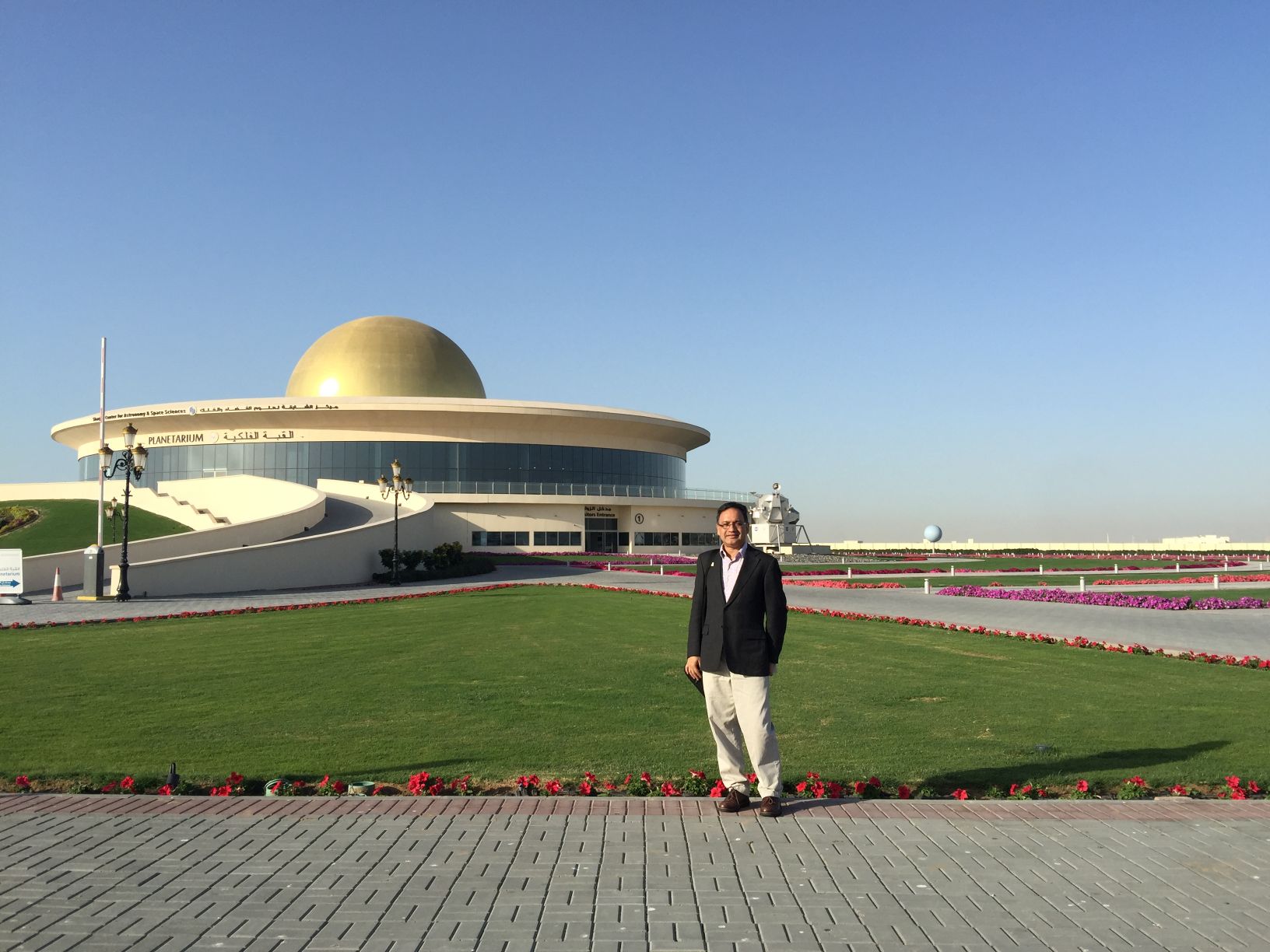
Hospitality to guests is an important part of the culture in this part of the world and I truly appreciated the warm greetings from a wide range of people, including Dean of Science Dr. Majid Merabti, Chair of Applied Physics Dr. Gaffar Attaelmanan, and many other faculty and some very eager students. Dr. Merabti highlighted how Sharjah University is trying to make the transition to a research intensive university. The highlight of my stay was to visit the newly built and sparkling Sharjah Center for Astronomy and Space Sciences, which houses a planetarium and space science museum. I was hosted by its Manager Dr. Ilias Fernini and gave a public lecture on The Life and Death of Stars. This was a first-time experience for me in two ways – I was speaking inside a planetarium with my slides projected onto a side of the dome, and my talk was being translated in real time as I spoke! The translation into Arabic was done very ably by the Planetarium Manager Marwan Shwaiki. About half the audience was listening to me directly and the other half had headphones and listened to Marwan’s translation. I also learned that many of the faculty and staff members are in the UAE on work visas and originate from other countries. I met faculty members from Algeria, Egypt, Jordan, Palestine, Sudan, and even…Canada! There are several citizens or PR holders of Canada amongst the faculty members.
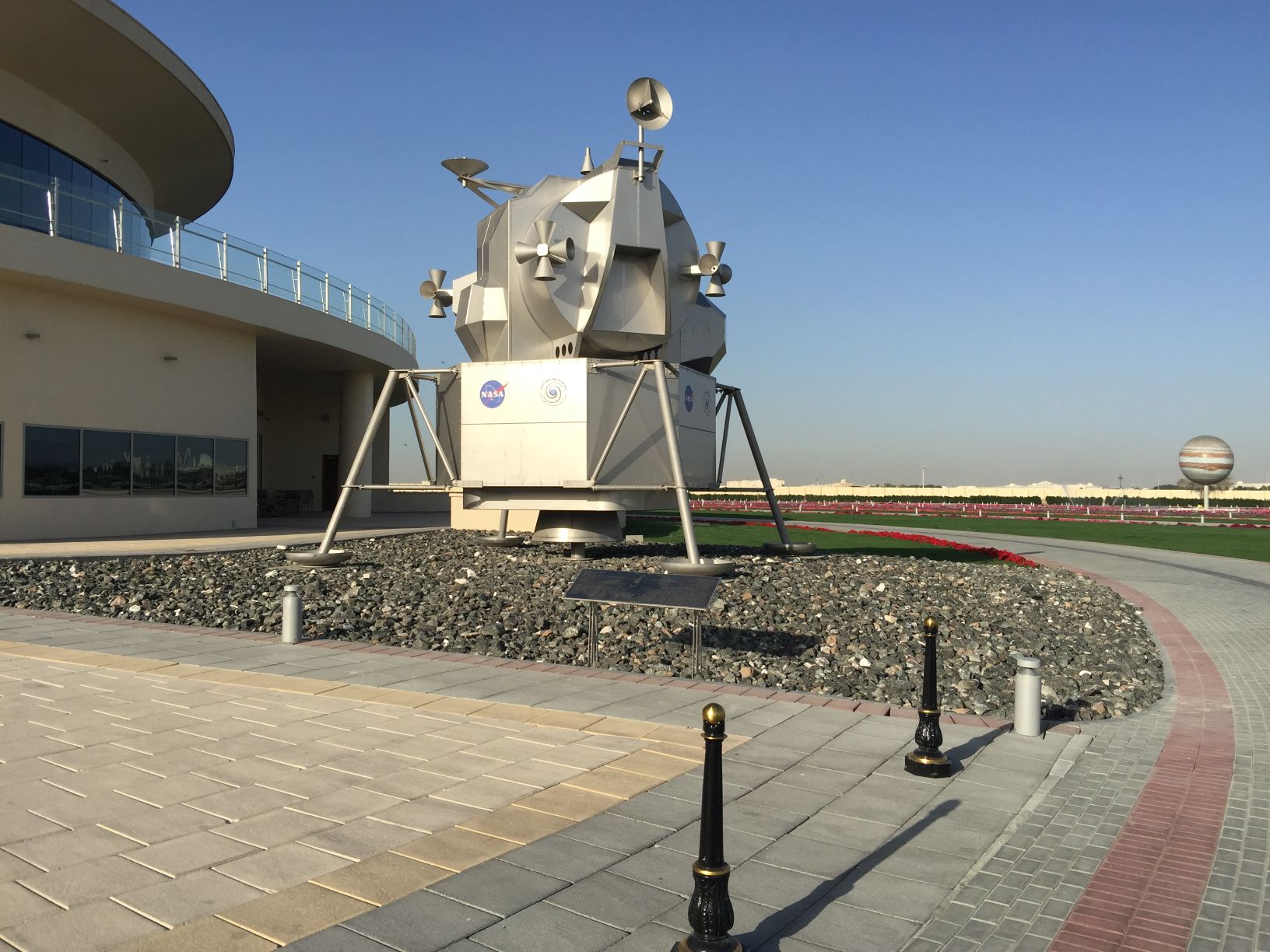
The Sharjah Center for Astronomy and Space SciencesThe replica moon lander outside SCASS looks eerily at home on a desert landscape
I toured the Advanced Material Research Laboratory, which is available for 4th year physics undergraduate students and houses an x-ray diffraction system, a scanning electron microscope, and a Fourier Transform Infrared Spectrometer. Quite impressive, and I wish we could offer equivalent instructional facilities at Western University. But why is there a space science museum and planetarium? The answer seems to lie with a major new initiative in the UAE: the Emirates Mars Mission. I have to admit I had not heard about this before my visit. The Sheikhs of the UAE have decided that they would like to send a Mars orbiter that will arrive at the Red Planet in 2021, to mark the 50th anniversary of the founding of the UAE. The scientific value added in this mission is the plan to make the most extensive map of the Martian atmosphere and to track weather on the Red Planet. This initiative has led to a surge in engineering and aerospace activity and also an interest in funding both space science and astronomy research. The planetarium is but one manifestation of this new focus. Even the Department of Applied Physics at Sharjah University has now added Astronomy to its department name. New faculty positions are to come. New research funding opportunities are available for those who can make the right connections, and basic astronomy research is also being funded. It’s a wise decision for foreign researchers to see if they can collaborate with UAE scientists for mutual benefit. Furthermore, there are additional opportunities in the region. Next door to UAE there are impressive funds available through the Qatar Foundation, and Saudi Arabia is dramatically increasing funding of higher education and science and technology research, evidenced by the King Abdullah University for Science and Technology.
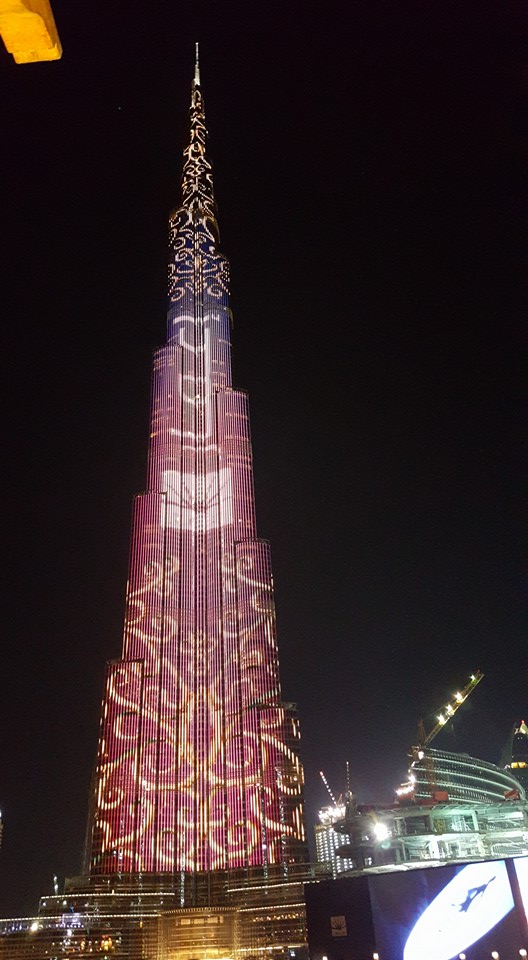
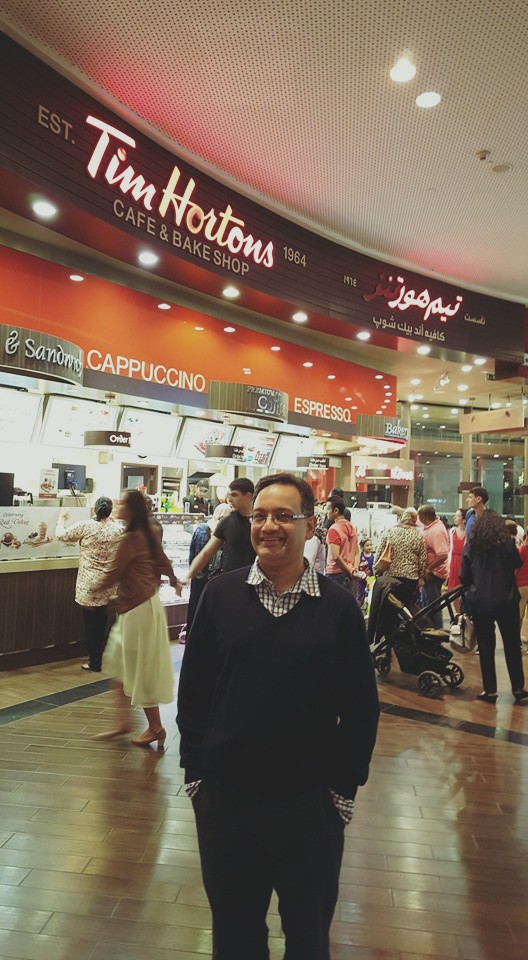
I spent a few days in Dubai, which is now one of the world’s great multicultural hubs, with a large expatriate population that significantly outnumbers the local population. Walking around the city center amongst gleaming skyscrapers one can hear a multitude of languages, e.g., Arabic, Bengali, English, French, German, Hindi, Malayalam, Russian, Tagalog, or Urdu. People seem to be enjoying themselves with extensive options for shopping, dining out, and nightlife. Some but not all restaurants have liquor licenses. Men and women seem to dress as they might back in their home countries and women drivers are a common sight, unlike in neighboring Saudi Arabia. Enjoying the temperate February evening breeze at an outdoor cafe by the Burj Khalifa, the world’s tallest building, I was experiencing something completely new. I could order a meal in Bengali while sitting under skyscrapers on a riverfront resembling Chicago, and watch a night fountain and light show set to iconic American themes like the soundtrack of The Magnificent Seven and Michael Jackson’s Thriller. Gasp, there was even an outlet of Tim Hortons nearby. I was getting confused about where I was. But wait, this is exactly the uniqueness of the UAE experience! Wherever you are from, you may find a bit of your background here, and learn about that of others, with Arabia as your backdrop.
Although I also spent part of my leave year at powerhouse places like Harvard and JPL/Caltech, and organized a winter school in India, this may be the most interesting story to share, for its novelty to many readers and at a time when when much of the news reporting from west Asia (yes, that’s preferable to a colonially inspired name like middle East) focuses on the grim events happening in other countries in the region.
The UAE has come a very long way in just half a century, from a sleepy outpost for date-growing and pearl-diving in the hottest part of the Arabian penisula where few people wanted to live, to a gleaming (and highly air-conditioned) center of international commerce. Some eighty-five percent of people in the UAE are foreigners living on work visas. The world has literally come to the UAE, from the armies of workers who power the construction and service industries, to the businesspeople looking to make their fortune, to those who have already made a fortune elsewhere and are enjoying the lifestyle here. The world is dealing with many effects of globalization, both good and bad, and a more complete perspective on global affairs can be obtained by visiting the unique hub that is the UAE. An interesting read on the history and current situation there can be found in the book Dubai, The Story of the World’s Fastest City, by Jim Krane, which takes a critical look at both the successes and the problems of the emirate. The UAE is now becoming an education hub for students from across Asia, and it wants to foster major engineering/science projects like the Mars Mission. It will be very interesting to track the UAE’s progress in these areas in the next decade and beyond.
The Burj Khalifa lit up at nightTim Hortons in Dubai, where you can order cardamom chai
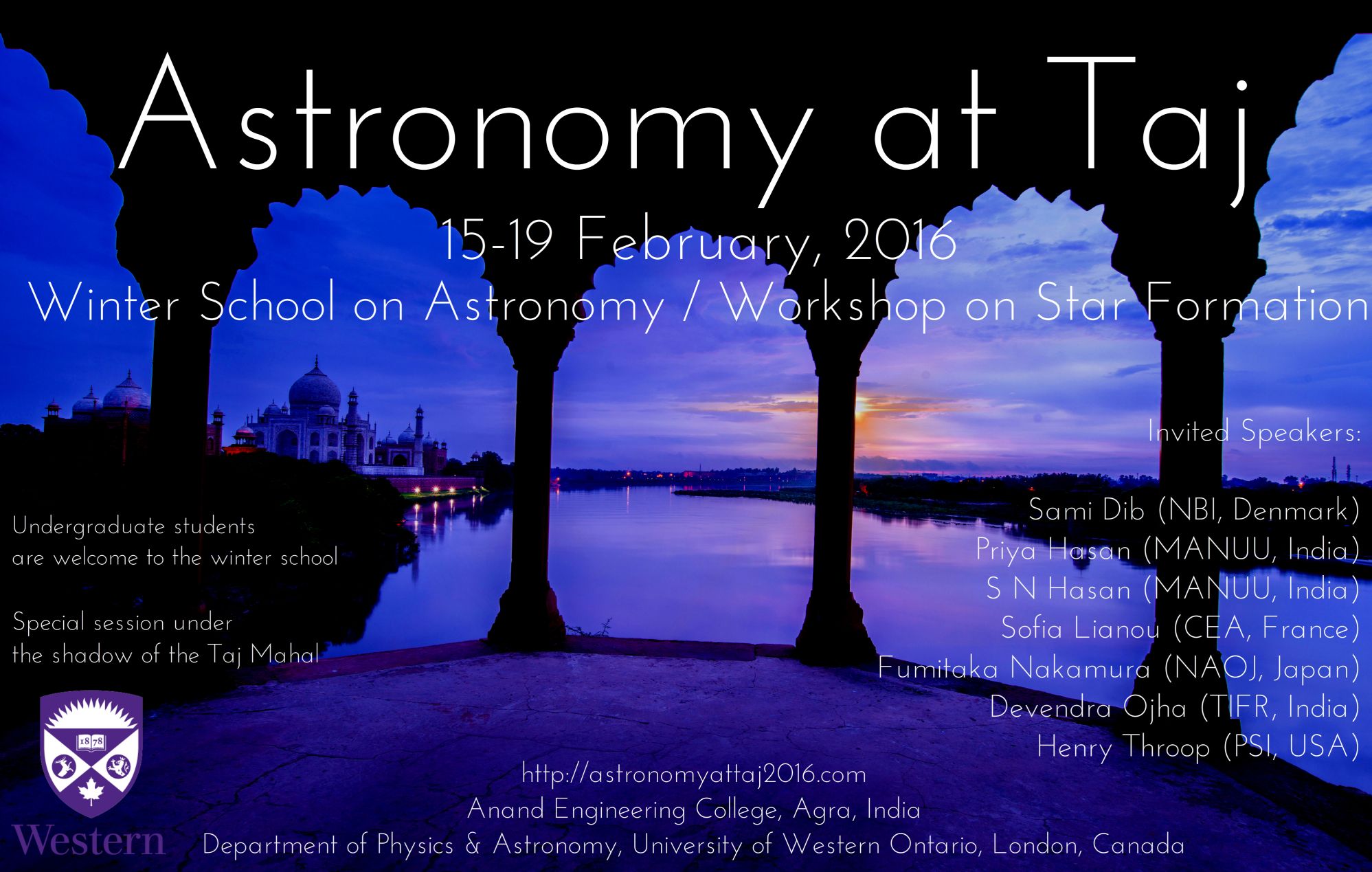
Situated on the banks of the Yamuna River, Agra, India is a former capital city of the Mughal Empire. Millions of tourists visit the city yearly in order to see monuments like the Agra Fort, Fatehpur Sikri palace complex, and the famed marble mausoleum known as Taj Mahal. During February 15-19, 2016, Agra also hosted a unique educational and cultural event, known informally as “Astronomy at Taj”. This was a joint effort between Anand Engineering College, Agra, and Western University of London, Canada.
This unconventional event combined several initiatives. It was an educational event, as a winter school in astronomy for college undergraduate students. It was also a focused research workshop in star formation research with speakers from six countries. Finally, it represented a cultural exchange and interaction between students from India and Canada. For Canadian students it represented a valuable study abroad opportunity organized by Western University’s Department of Physics and Astronomy, and conveniently occurring during Reading Week at Western. Another goal was to bring astronomy and science awareness to the general public in Agra.
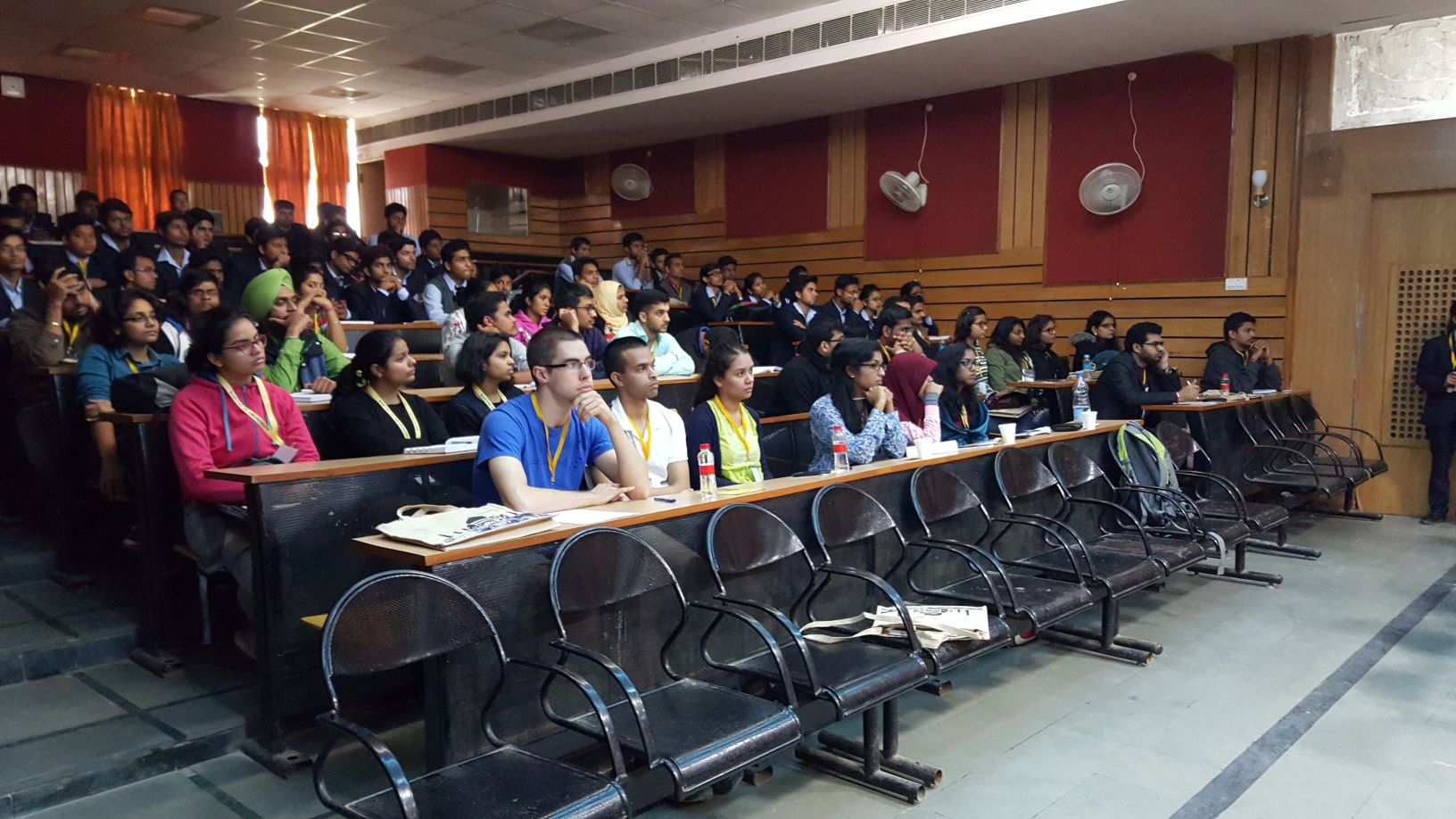
About 65 students from India participated in the school, representing the vast range of the country, from Jammu and Punjab in the north, Gujarat and Maharashtra in the west, Kerala and Tamil Nadu in the south, and West Bengal to the east. There were 12 delegates from Western, plus their friends and spouses. There were 8 Canadian students at the event, which was open to students from all disciplines as long as they had an interest in astronomy, and these included Western students enrolled in Astronomy, Physics, Anthropology, Engineering, English, and Political Science programs. One student from Indonesia also made an admirable effort and attended the school. The 40% female student participation rate was higher than the typical North American average for Physics or Astronomy undergraduate programs. There were ten internationally renowned invited speakers, from India, Canada, Denmark, France, Japan, and the USA. The organizing committee consisted of Prof. Shantanu Basu (Western), Pranav Sharma (Anand College), Prof. Priya Shah Hasan (MANUU, India), and Western graduate students Sayantan Auddy, Mark Baker, and Pranav Manangath from the Department of Physics and Astronomy, and Deepakshi Madaan from the Department of Applied Mathematics. The Director of Anand College, Prof. Anil Kishore Saxena, and the Dean-Academics of Anand College, Prof. Amit Sharma, also contributed immensely to the support and organization of the event.
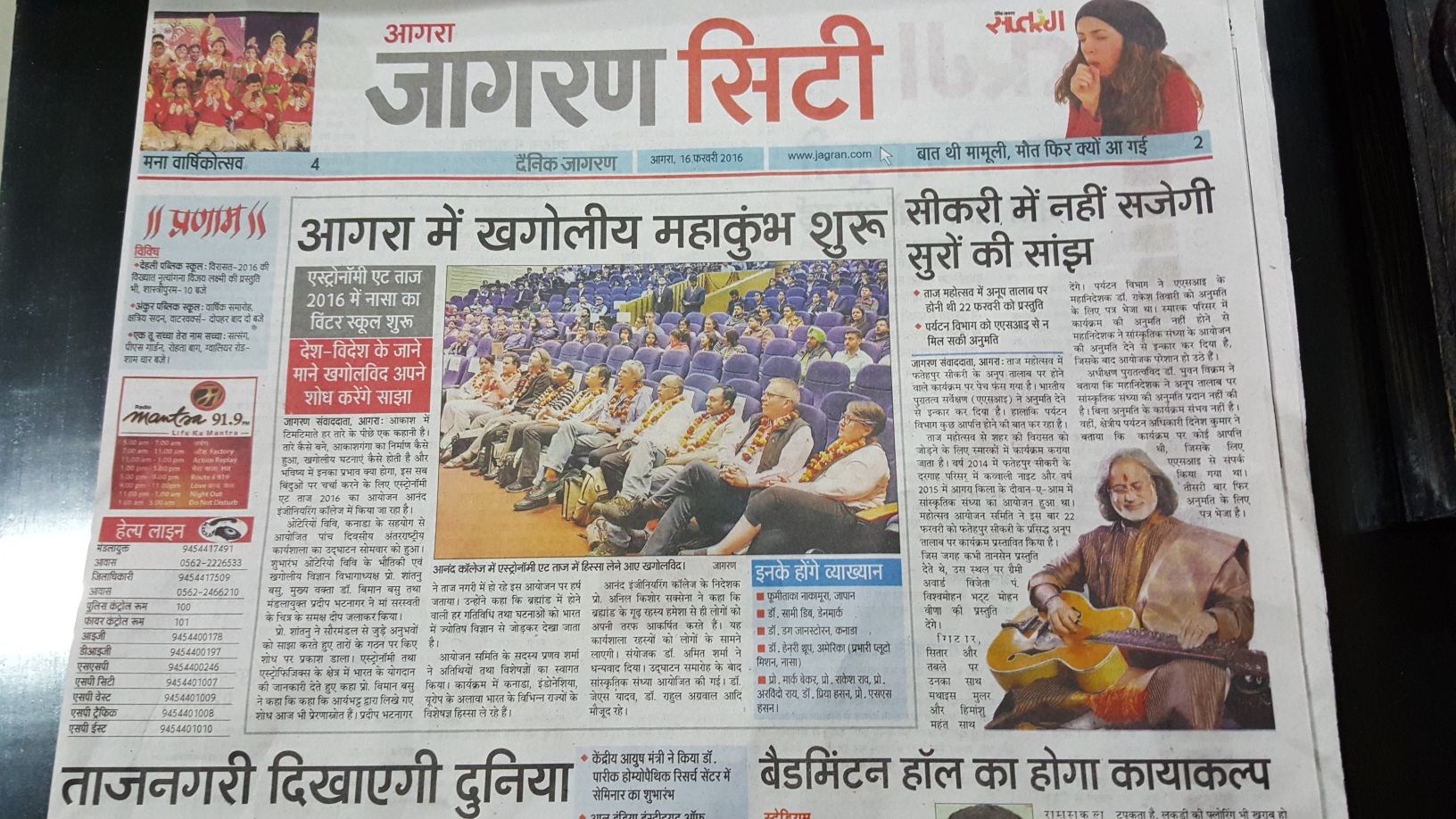
Local media coverage of the opening ceremony
From the start, the event combined fellowship with science, exhibiting Indian hospitality and exuberance. The official opening saw the traditional Indian lamp lighting ceremony, and a beautiful exposition of the Indian traditional dance form Mohiniattam, by renowned dancer Vijayalakshmi. Prof. Anil Kishore Saxena pointed out that he was supporting the event because it would allow his students to diversify their learning, examine new career options, and broaden their contacts. Prof. Shantanu Basu pointed out that Astronomy at Taj had gone from conception to execution in a mere four months time. The opening research workshop talks highlighted the role of new global observatories Atacama Large Millimeter/Submillimeter Array (ALMA) and Herschel Space Observatory in revealing the initial conditions of star formation. The winter school participants heard lectures about the recent NASA New Horizons mission to Pluto, the possibility of extraterrestrial life and the search for its existence. In this context, the first day also saw the screening of the 1997 movie Contact, based on a novel by Carl Sagan. This movie led to an open discussion the following day on both the accurate and inaccurate portrayals of science in the movie, as well as important issues touched on in the movie, such as the position of women in astronomy, the relationship between religion and science, and the efficacy of doing conventional versus unconventional science. The opening day also saw a keynote talk by science journalist Biman Basu on “Indian contributions in shaping astronomy and astrophysics”, which expounded on ancient as well as more recent Indian contributions, with very interesting insights like the development of the Indian calendar that incorporates both lunar and solar cycles.
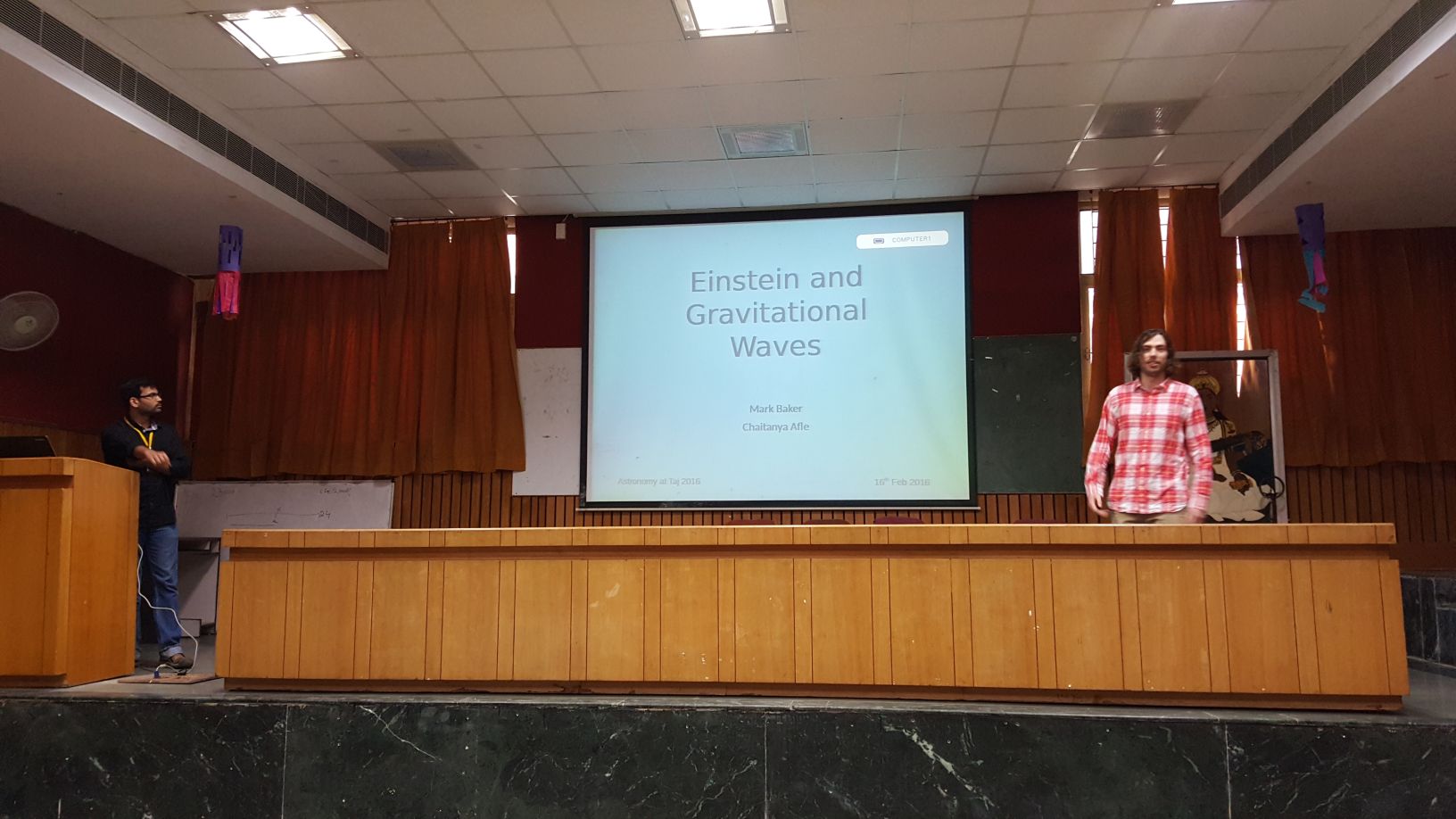
Chaitanya Afle and Mark Baker give a joint talk.
The second day witnessed a slew of science talks at the star formation workshop, as well as talks in the winter school about relativity and the recent detection of gravitational waves. The latter was an excellent collaborative effort led by an Indian and a Canadian student. There was also a special session for hundreds of students from local public schools in Agra. The workshop talks illustrated the fast moving nature of research, with results presented about the masses of stars. New results showed that the mass distribution of stars in clusters can vary significantly from one to the other, and particularly in the low mass end of the distribution. A constant universal distribution of stellar masses was definitely not favored by workshop participants and their data. This variability was also true for the mass distribution of prestellar cores, the precursors of stars, as seen with new ALMA data. Student talks also illustrated new approaches to characterizing the stellar mass function, and also a prediction for the numbers of very low luminosity stars, still undetected, that may exist throughout our Galaxy.
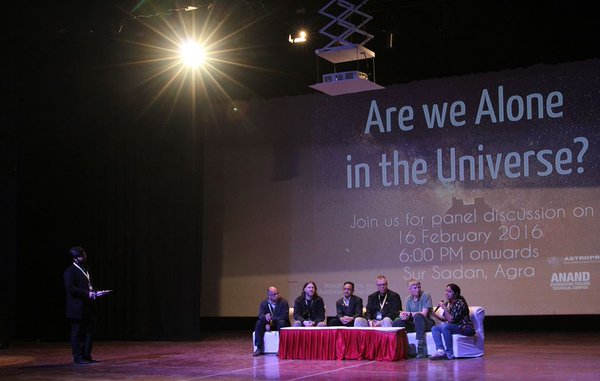
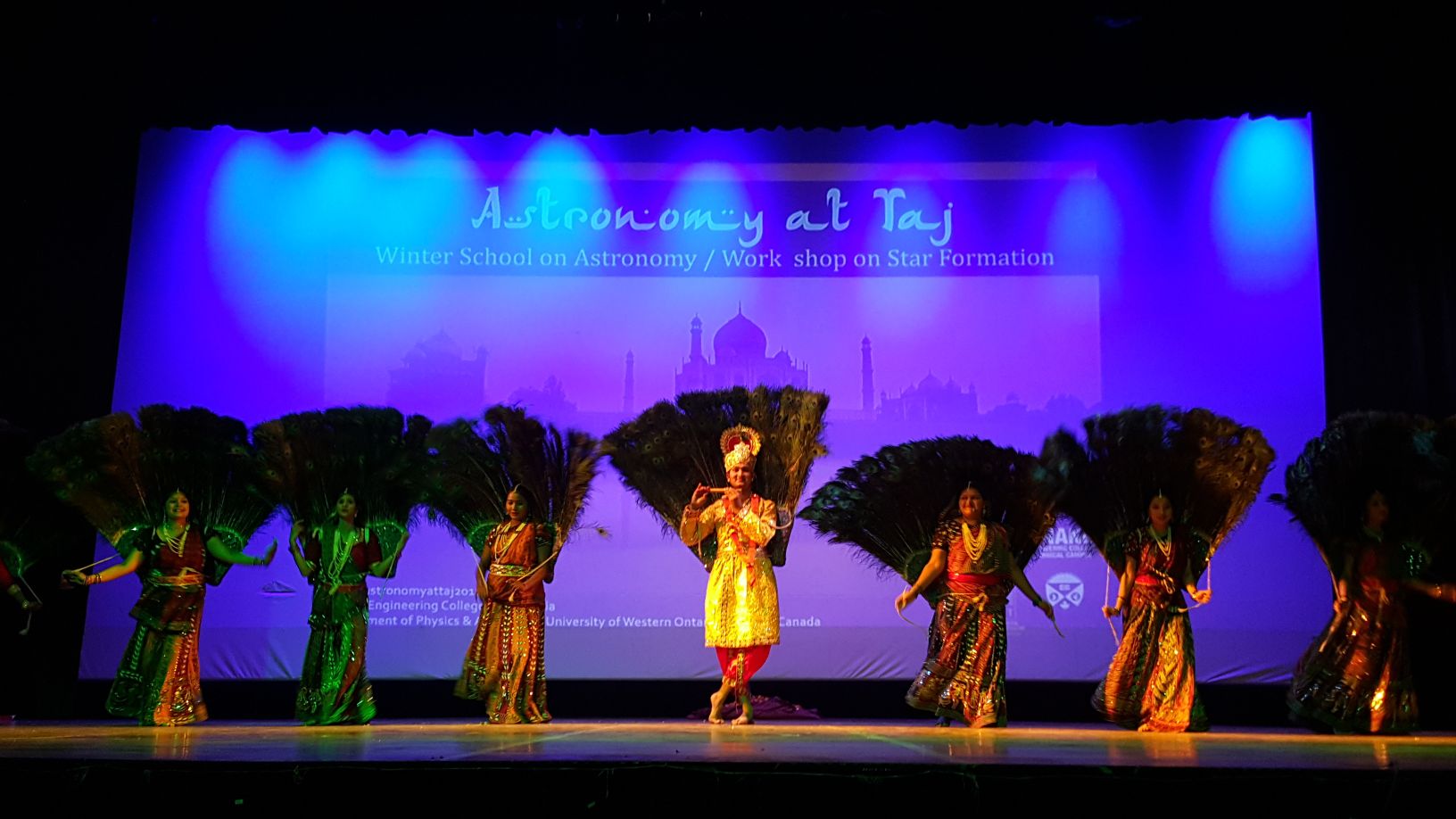
On the second evening, the conference participants shifted from Anand College to the public lecture hall Sur Sadan in Agra city, for a public event with Agra citizens. The evening got off to a rocking start with a series of Indian dance performances representative of many different regions of India. All performers were students of Anand College, part of a very talented student body indeed! This was followed by the main event, a public lecture on the new global observatory the Thirty Meter Telescope (TMT), by Prof. Devendra Ojha of the Tata Institute for Fundamental Research (TIFR) in Mumbai. India has recently joined the consortium as a partner, alongside Canada, China, and Japan, as well as Caltech and the University of California. Following the public lecture was a panel discussion on the subject “Are we Alone in the Universe?”, moderated by Mr. Pranav Sharma of Anand College, with panelists Prof.’s Shantanu Basu and Chris Essex from Western, Prof.’s Priya Hasan and Najam Hasan from MANUU, India, Dr. Doug Johnstone from NRC, Victoria, Canada, and Dr. Henry Throop from Planetary Science Institute, USA. Does life exist elsewhere in the universe? If so, where? Why have we not found it yet or why has it not yet found us? Questions were taken from many of the several hundred attendees of the Agra citizenry, and a freewheeling discussion ensued. Prof. Najam Hasan also summarized the discussion in Hindi.
The cultural program ended with the enthralling Holi dance featuring Lord Krishna and gopis. Click on image for video.
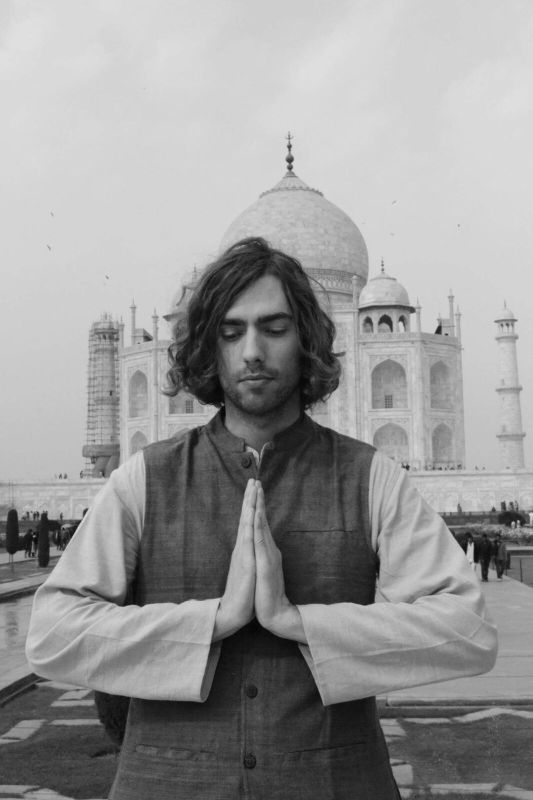
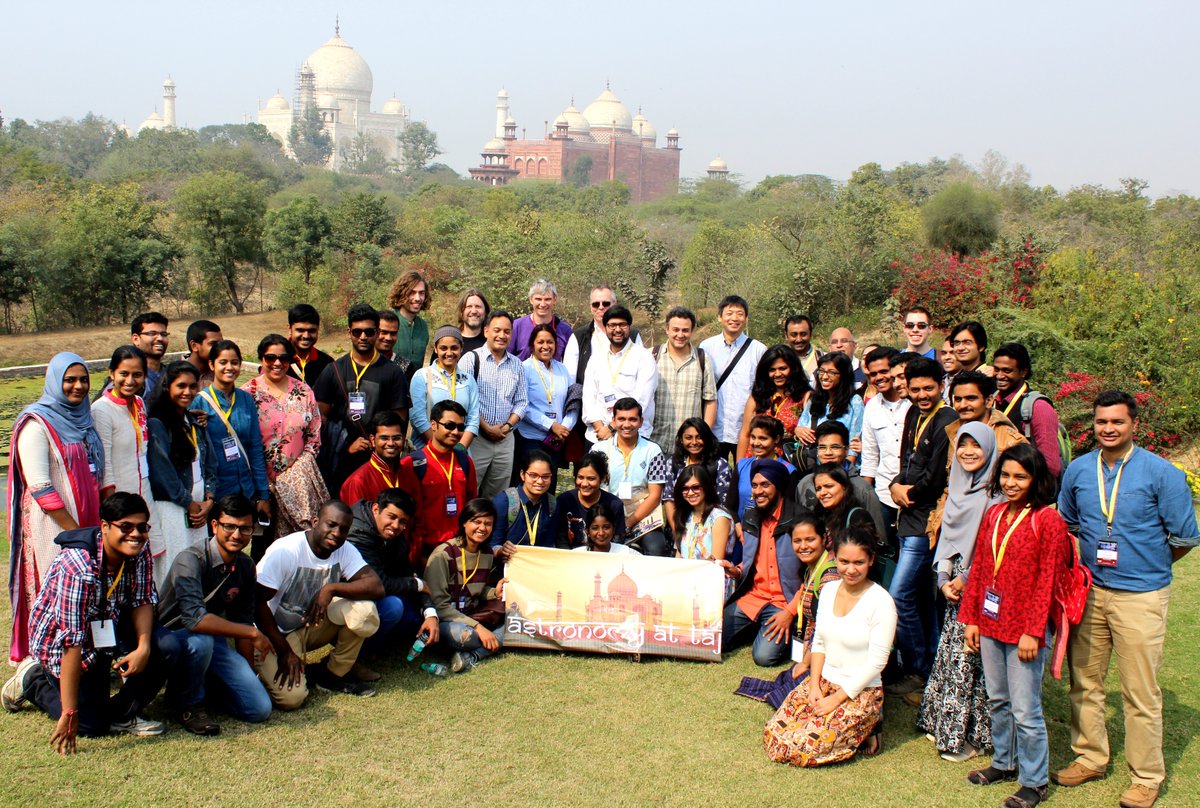
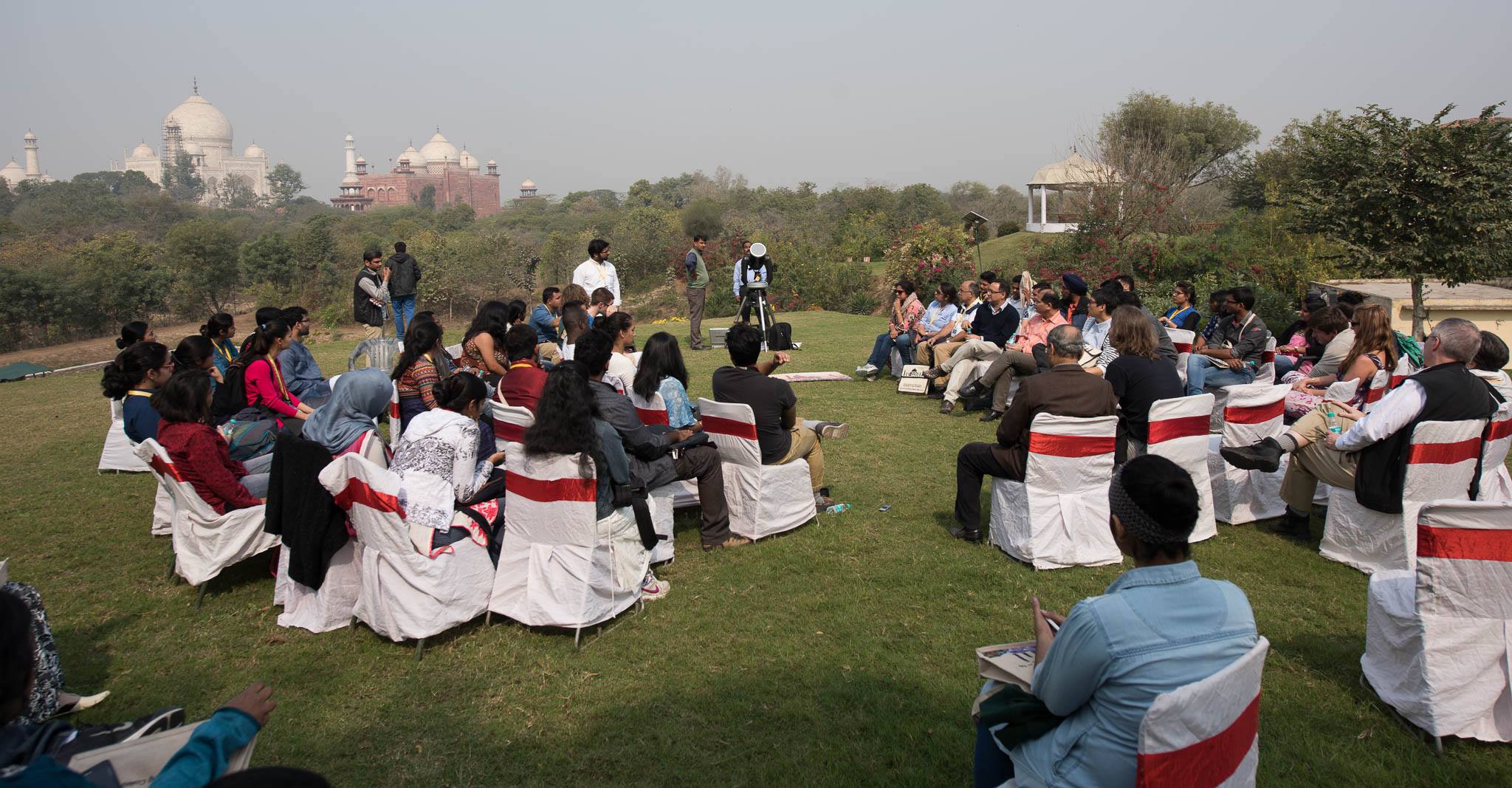
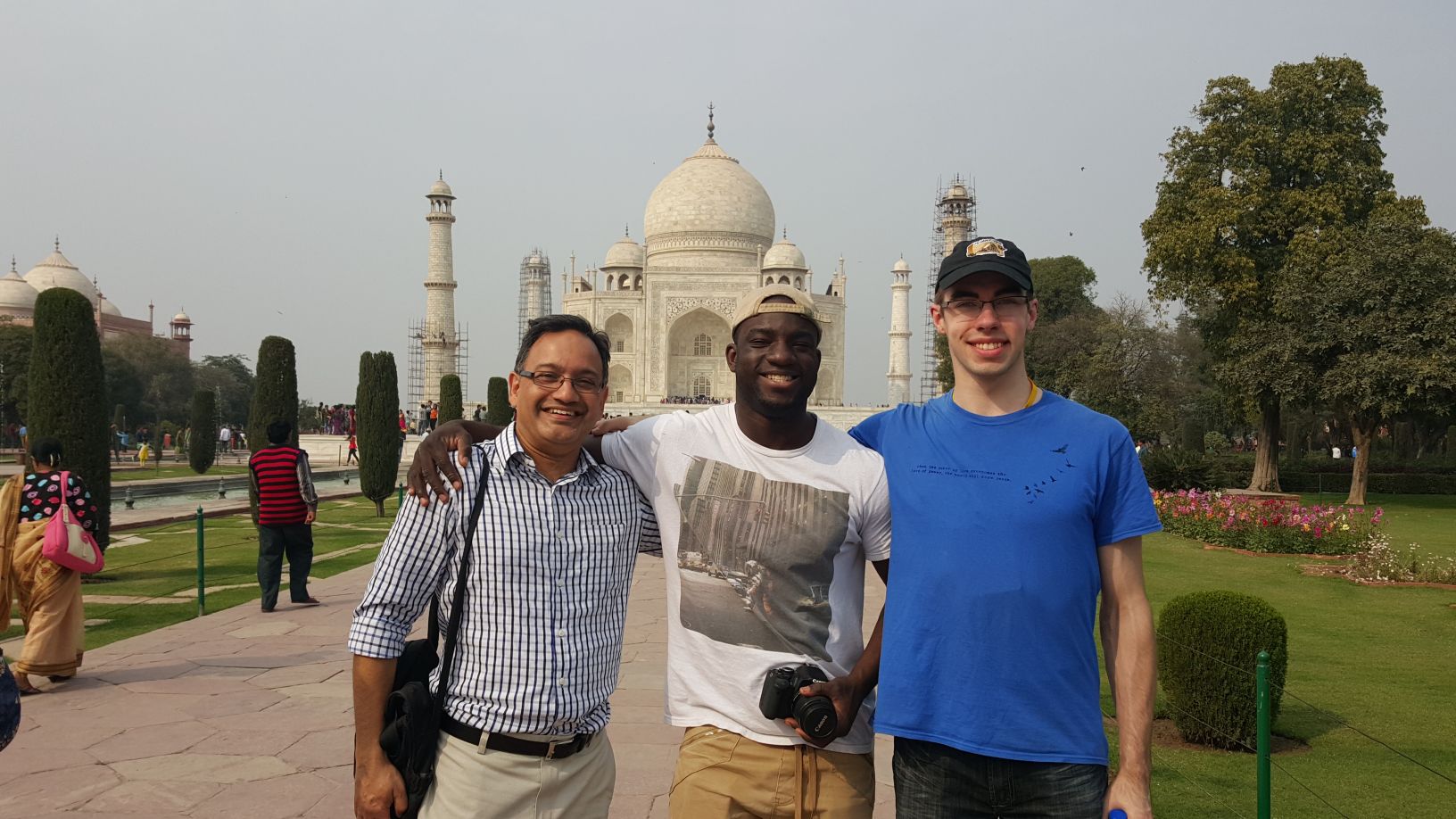
The third day was spent entirely outdoors, at one of the world’s most spectacular settings. The morning session took place at the Taj Nature Walk, a short distance from the Taj Mahal, and with a majestic view of the Taj from a hilltop. The Archaeological Survey of India had granted special permission to hold the event at this protected location. In the marvelous surroundings, a group discussion took place about careers in astronomy while a solar telescope was set up to view the sun and its sunspots (only one visible that day). The wide-ranging discussion dealt with very practical questions from students about strategies to get accepted into graduate Astronomy programs both in India and in Europe and North America. With free interaction and the presence of so many senior astronomers from many countries available to comment, many students found this to be one of the most valuable sessions of the winter school. The afternoon was reserved for a tour of the Taj Mahal, and participants made the most of the many hours on a beautiful sunny day to view the Taj from many angles, each one spectacular in its own way, to go inside, and to enhance fellowship with their fellow participants. Back at Anand College in the evening, there was outdoor night sky viewing with an 8-inch Celestron telescope, as well as a session on astrophotography hosted by filmmaker and astronomy enthusiast Rakesh Rao.
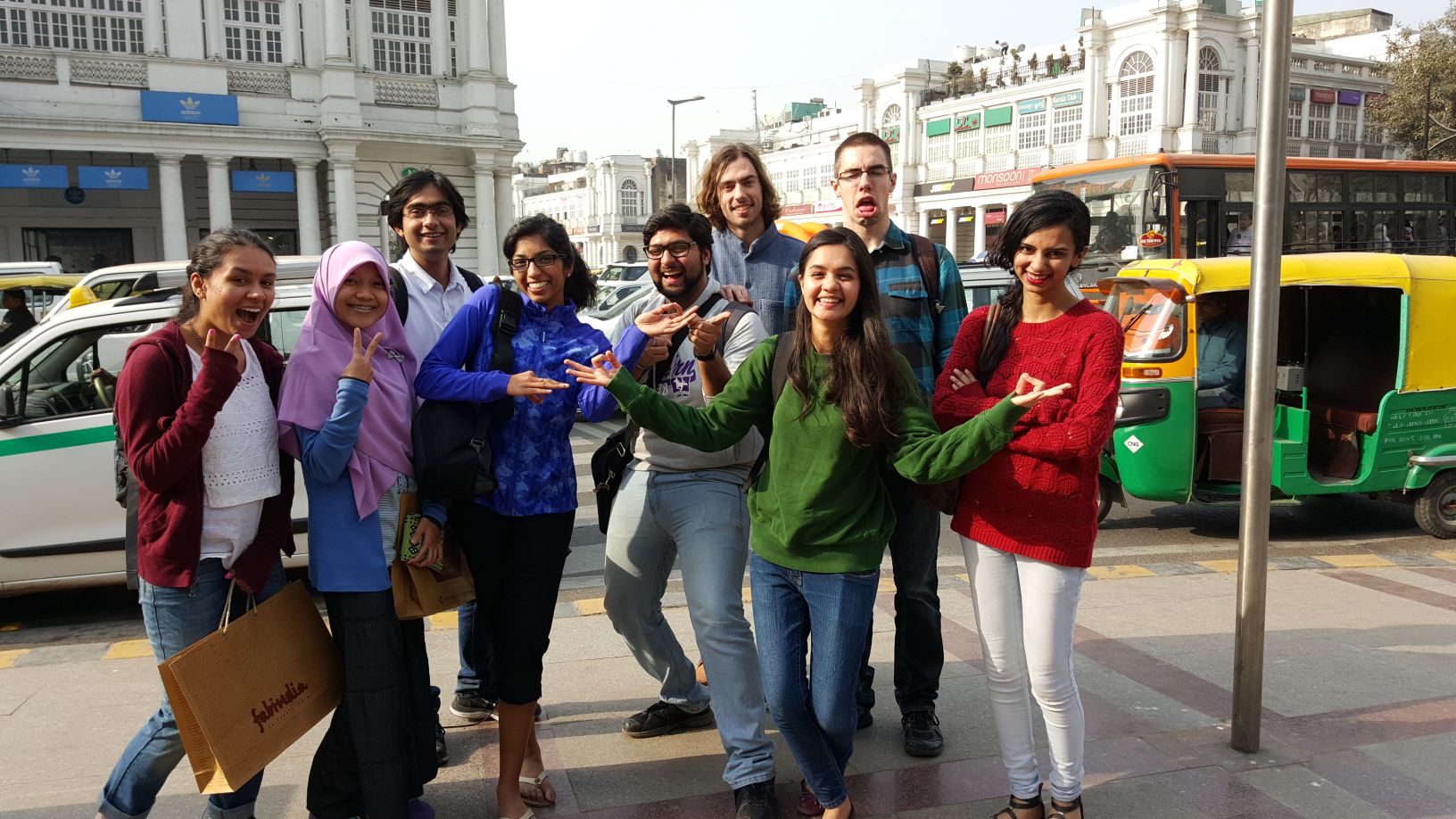
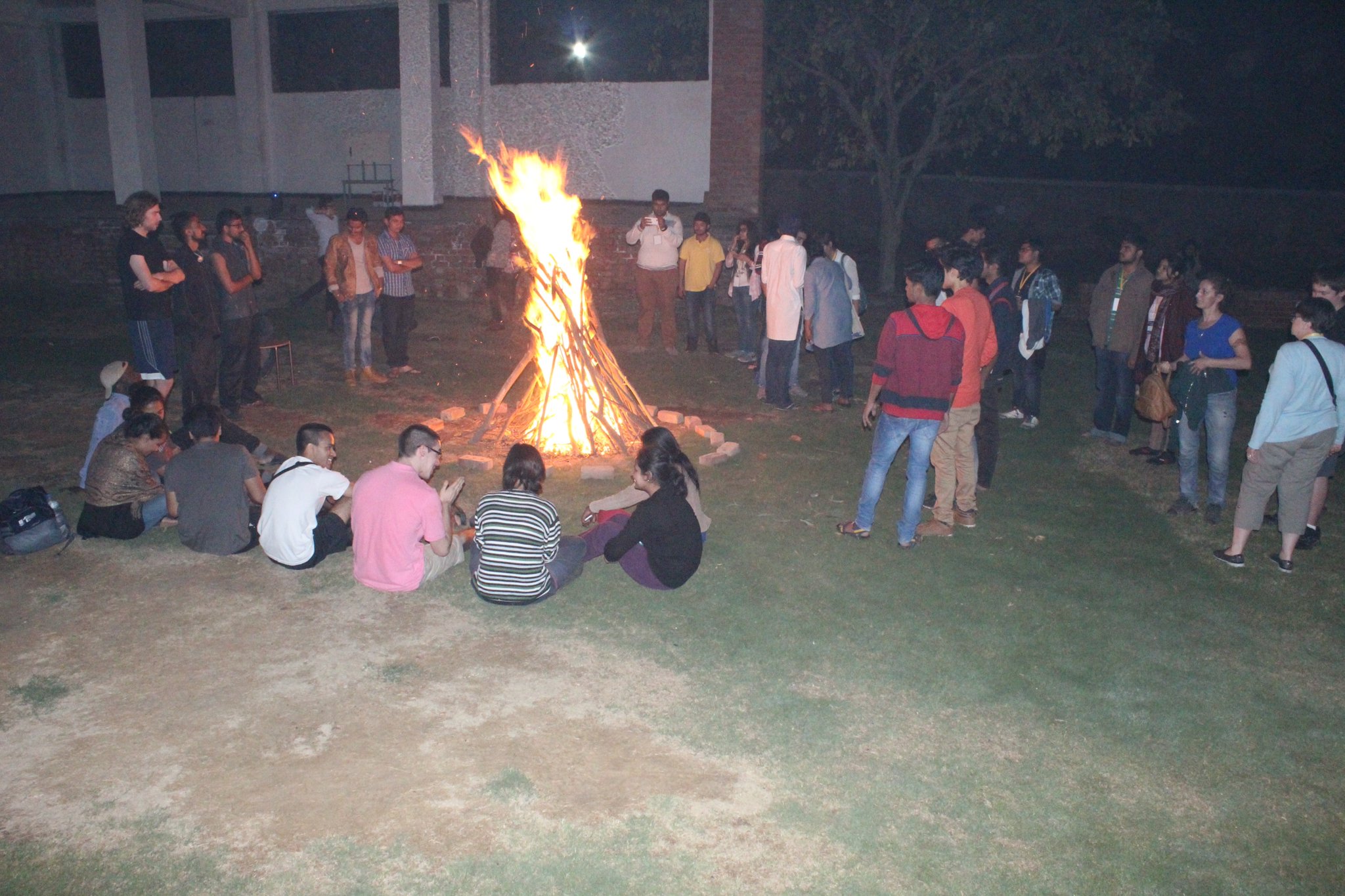
The fourth day saw more workshop talks in the morning, on planet formation and time variability in stellar mass accumulation. The afternoon was spent on a tour of the famed palatial complex at Fatehpur Sikri, home of Mughal emperor Akbar and his wives. Participants got a view of the complex architecture that combined Persian and Indian elements, the palaces of the emperor and queens, and the awe-inspiring 55 m tall gateway, the Buland Darwaza. As the week drew to a close, the participants had bonded well with each other. Many experiences had been shared, including communal meals at the Anand College cafeteria. Freshly-made delicious North Indian vegetarian food was served each day, and this was itself another cultural experience for the Canadian students. The last evening was spent socializing around a communal bonfire. An impromptu soccer match also broke out, utilizing the large sports arena of Anand College. By the time the last day arrived, emotions were running high as students, professors, and Anand College volunteers and staff all realized how much they had bonded together, but that they would soon be going their separate ways. This event required that approximately 100 people, including the Anand College volunteers and staff, lived together and shared learning and cultural experiences for a week. Many new friendships were forged, that span the breadth of India as well as Canada to India. There is no underestimating the camaraderie that was established, and the age of social media means that these ties will be maintained and nurtured. The closing ceremony saw an open microphone session where participants spoke from the heart about their experience and how it had changed them. The overwhelming conclusion was: this was a wonderful idea and event, and let’s do it again!
Canadian and other international delegates also spent the day before or after the conference touring Delhi. Sites like the Akshardham temple, Humayun’s Tomb, Jantar Mantar (ancient astronomical observatory), and Red Fort were visited, along with much shopping at Connaught Place.
Few of us heard the named awards for our undergraduate students:
Don Hay award for the student with the best fourth year thesis,
Maude Holt-Kingston award Gold Medal award for the highest achieving student in honour specialization in Astrophysics, and
Raymond Compton Dearle Gold Medal for the highest achieving student in honour specialization in Physics
Even fewer know the history of the people behind these named awards. Thankfully, our late Don Moorcroft has documented the history of the Physics & Astronomy department and contained valuable information.
Prior to 2015 award ceremony, I had the opportunity to get in touch with Diane Coffin, daughter of Donald Hay. I asked about Don Hay and history, and here’s her reply:
Donald Ross Hay received his Bachelor of Science and Masters of Science from U.W.O. in 1946 & 1947. He then went on to receive his Phd from McGill University in 1952. In 1952, he was hired by the Department of Defence Research Board in Ottawa, Ontario as a scientist.

In 1958, he was offered a position at U.W.O. as a professor of Physics, and established a research program in lower atmospheric physics, particularly micrometeorology, which he continued until his death in April, 1985. Throughout his career, dad published 96 articles, and one is currently archived in the Library of Congress in Washington, D.C. From 1963 until 1971, he was commissioned by the North American Treaty Organization (NATO) to attend annual meetings throughout Europe and Asia, and give lectures about his research.

Dad and mom were married in 1952, and his wife, Jean, still lives in London. She'll be 89 years old this year. My parents have two children - John and Diane - and three grandchildren - Ryan, Matthew, and Charlie.
This would be the 30th year anniversary of Don Hay’s passing, and the donation is given each year by Don’s wife Jean Hay.
That, to me, showed how deep Jean loved her husband, and the unwavering commitment to honour him. I wanted all, not just the award winners, to know this.
Maude Holt-Kingston was an endowed award in Astronphysics established by Prof Harold Kingston. According to Moorcroft,
Harold Reynolds Kingston [1921-47] (Queens, MA, 1908; Chicago, PhD, 1914) arrived from the University of Manitoba and took over as Head of the Department of Mathematics. He took a great, although largely amateur, interest in astronomy, and following his arrival at Western the name of the department was changed to the Department of Mathematics and Astronomy, a name which remained until 1958-59.
You read that correctly. Prof Kingston was a Mathematician, but when he got interested in Astronomy, he renamed the department to Mathematics and Astronomy!
The award was endowed by Prof Kingston in memory of his wife Ethel Maude Holt. This time, it is love from the husband for his wife.
(For some reasons, on the official handbook, Maude Holt-Kingston’s name was left out of this Gold Medal award, so I will need to followup with this.)
Last but not least, we have the Raymond Compton Dearle Gold Medal award for Physics. According to Moorcroft, Prof Raymond Compton Dearle [1919-58] (Toronto, MA, 1917, PhD, 1919), became the second Head of the department of Physics in 1919 and held the position for 30 years. In spite of the evident difficulties at Western, which that year had only 44 freshmen in the entire faculty of Arts, Dr. Dearle saw the opportunities for the Physics department.
It was Prof Dearle that helped plan the new Sciences Building (now, the Physics and Astronomy Building). Construction began in 1922, and into which all the science departments moved starting in 1924. It was renovated recently into this brand new Physics & Astronomy building that you now enjoy.
This award has been presented in the past number of years by Rev. Paul Ross, grandson of Prof Dearle. When I spoke to Rev Ross, I sensed the immense respect for Prof Dearle, and the love for his grandfather.
If you endured this lengthy blog, thank you. I hope you will find the human stories behind the men and women of these awards inspirational. I did. We scientists have long been trained to be “robotically” objective, and the human side may not shine through in our daily work.
Ten years later, I felt that it is still relevant and I have shared that with the TAs of this class.
Active learning strategies can be implemented in different scales. It can be just one class out of the entire term, to every class, 5 minutes to 50 minutes of class time. I hope this helps give some insights to improve our teaching.
Last week I went to a reunion for Harvard astronomy PhD graduates. This was kind of an unusual event — Harvard does lots of reunions, but they are usually for people who were undergrads there, and whom the university hopes will donate lots of money. The astronomy department was also attempting to raise money from this event, although one might think that soliciting scientists would be fairly futile. (Certainly my initial reaction to getting a fundraising letter was that surely Harvard astronomy professors could write grant proposals, just like the rest of us academics.)
You might find it interesting to know, however, that people with PhDs in astronomy from Harvard are not all astronomy professors, not by a long shot. There is a complete list of all alumni here, and you can see that there is a variety of careers, from professor to medical doctor (!) to lawyer (!!), with quite a number of people now working in the financial industry. Presumably the fund-raising effort was aimed more at these folks.
At the reunion itself I shook hands with an astronaut, rubbed elbows with a Nobel Prize winner, and caught up with classmates who are now Harvard and MIT professors. I also talked to many of my colleagues who (like me) fill out the fainter end of the luminosity function. I think most of us are happy in our fields, even if there is the occasional pang when our mothers ask us why we’re not famous too.
The two panel discussions covered the hot topics in astrophysics — cosmology and exoplanets — and featured both alumni and profs. I found both to be a bit bittersweet, with justifiable excitement about recent accomplishments but worries that we might not be able to follow up on this excitement. Nobody, even rich Harvard astronomers, is without funding problems, it seems; as I have opined here before, we may have to get used to doing more with less. On a grander scale, Frank Shu noted that the Fermi paradox is a deep mystery and possibly does not bode well for the future of human civilization. Geez, just as we figure out all of cosmology, our descendants won’t last long?
At this particular reunion, two groups were represented that are not ordinarily at a reunion: current astronomy professors—not all Harvard alumni, although there are many—and current grad students. I was interested to see that the current grad students seem to be just as concerned about future jobs in astronomy as students I have seen elsewhere. The faculty didn’t seem to be particularly worried about this and it’s also interesting to note that the size of the grad student class has expanded by about a factor of 2 since I started in 1995. This PhD-training-versus-jobs disconnect is something that I plan to talk about more here; it was addressed nicely in a recent Globe and Mail op-ed piece.
All in all, it was an interesting day, providing a nice snapshot of how the field of astronomy has changed over the past few decades and ideas about where it will possibly go in the future. Actually I find it pretty difficult to imagine what the field will be like in 20 years; I wonder if this blog post will still be around then for comparison!
Don’t worry, nothing too personal here; just an interesting phenomenon. We have a soap dispenser in the shower, which usually has white liquid soap in it. For some reason we bought clear liquid soap recently. To refill the dispenser I poured about 500 ml of clear soap on top of about 50 ml of white soap. This was the result, 24 hours or so later:
Looks like the white soap is a little less dense so it’s slowly rising to the top, although I wonder if the action of the pump at the bottom may have also influenced the mixing. (Anyone with less rusty fluid dynamics want to comment?)
Amusingly, as an undergrad I had a co-op job at the Canadian Space Agency, where my project was to design an experiment to look at mixing of different-density fluids in microgravity! And the person I worked for was astronaut Bjarni Tryggvason, who is now at Western. Small world.
I’m off to buy some more opaque soap so I can do some more mixing experiments.
Last week I went to a workshop called “Take the Final Step” which was designed to help and encourage female science & engineering professors to apply for promotion to professor. For people who don’t know what this means, at most North American universities there are 3 ranks of professor. Assistant professors are the newbies, who don’t have tenure. Associate professor is the rank that usually goes along with getting tenure. Then “professor” (or “full professor”) is the highest rank.
It’s pretty obvious why assistant professors want to become associate professors: in general, it’s an “up-or-out” situation: you either get promoted or you are looking for another job. But “why would anyone want to be a full professor?” is a question often discussed around the dinner table at my house. At some universities, the promotion comes with a pay raise. At many, being a full professor is a prerequisite for holding higher academic positions or committee memberships. At most places it’s some kind of recognition that one is known and respected in one’s field.
In lots of science and engineering fields there are very few women full professors. Our department has just one, and lots of physics departments don’t have any. Even in astronomy, which has a much higher percentage of women compared to physics, I saw a recent data point [can’t find the reference] saying that the fraction of full professors who are women is only about 11%. Part of this is a time lag (roughly 15 years from PhD to full prof) combined with lower participation by women in the past, but that’s not the whole story. In general, women tend to spend longer as associate professors than men. They’re less likely to request promotion and more likely to be told they’re not ready. The Council of Canadian Academies recently did a report on this topic which covers all of academia, not just science and engineering.
The workshop was geared to answering practical questions: what are the criteria for promotion? [“Excellence”, apparently. Universities aspire to be like Lake Wobegon, where all the students and all the faculty are above average.] How to acquire an international research reputation? [Go to the right conferences, among other things.] How to manage a lab’s worth of techs, post docs and students? [Pick the right people to start; set clear expectations.] How to balance research with teaching and service? [Might as well focus on research; sad to say, not many people get promoted on the basis of teaching.] How to navigate academic politics? [with your eyes open.] How to balance the rest of your life with a job that can be all-consuming? [No one had a good idea for this one, sadly.].
I thought about it and realized that I was taught by exactly two female profs over my entire undergrad and graduate career. Not exactly a ton of role models. So it was inspiring to see the many speakers at this workshop who were female (full) professors. A few of them brought their “promotion dossiers” for us to look at, and they were impressive.
But the professors themselves made strong claims that they weren’t superhuman, which I think is also important to know.
The take-home message from the workshop was that promotion to full professor is certainly not impossible, but it doesn’t just happen — it takes thought and planning. But it should be within our grasp, and we owe it to those who will come after us to at least try.
Some of the best science writing I have read recently was in the novel Red Plenty: Inside the Fiftie’s Soviet Dream by Francis Spufford. There is a passage on the behaviour of electrons in a vacuum tube that is vivid and beautiful (Part Two, Chapter 2), and a rather frightening description of lung cells mutating under the influence of carcinogens (Part Six, Chapter 1). The novel overall is a fascinating treatment of science and economics at the height of the Cold War in the USSR.
Yuri Gagarin’s daughter answers the phone. ‘No, mummy and daddy are out,’ she says. ‘Daddy’s orbiting the earth, and he’ll be back tonight at 7 o’clock. But mummy’s gone shopping for groceries, so who knows when she’ll be home.’
This link is to an actuarial tool.That means that it tries to figure out what the probabilities of your living a certain length of time is, based upon how long people have lived in the past.I invite you to try it, and then see how long you might live.It pegged me at 89 which in many ways was encouraging.
This is useful.It gives you some feedback.It makes you think.But, is it right?
Things are changing fast.On any day in which you were to take the time you would find many headlines about scientific research that has the potential to massively extend life spans, along with good health.Currently, the actuaries amongst us do not seem to pay too much attention to that, but there is a significant chance they are wrong.
Today I looked at some head lines….. (Today was a bad day, there was not a lot of health science news but there were still some)
Things are changing.Massive leaps in both understanding and practical ability are taking place.People are growing hearts using patients DNA (still not quite good enough to keep the blood pumping but heading that way).Blood has been cloned and transplanted into people. The mechanisms of aging are being understood.So it begs the question. How long do you think you will live?

 By the time the last day arrived, emotions were running high as students, professors, and Anand College volunteers and staff all realized how much they had bonded together, but that they would soon be going their separate ways. This event required that approximately 100 people, including the Anand College volunteers and staff, lived together and shared learning and cultural experiences for a week. Many new friendships were forged, that span the breadth of India as well as Canada to India. There is no underestimating the camaraderie that was established, and the age of social media means that these ties will be maintained and nurtured. The closing ceremony saw an open microphone session where participants spoke from the heart about their experience and how it had changed them. The overwhelming conclusion was: this was a wonderful idea and event, and let’s do it again!