Look at the horizon in this picture….
! 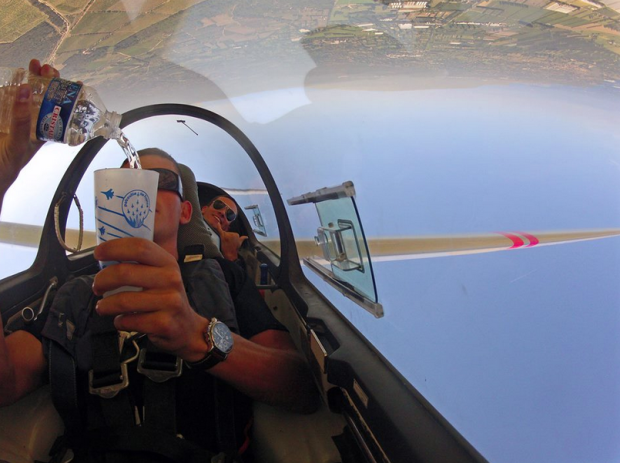
My son showed me this picture; it comes from http://richardwiseman.wordpress.com/2013/09/10/can-anyone-explain-this-2/

Look at the horizon in this picture….
!
My son showed me this picture; it comes from http://richardwiseman.wordpress.com/2013/09/10/can-anyone-explain-this-2/
This article from gizmodo.com confirms my belief that your average bug (or Mother Nature, at least) is way smarter than we are: http://gizmodo.com/this-insect-grows-its-own-microscopic-gears-to-move-abs-1302488227
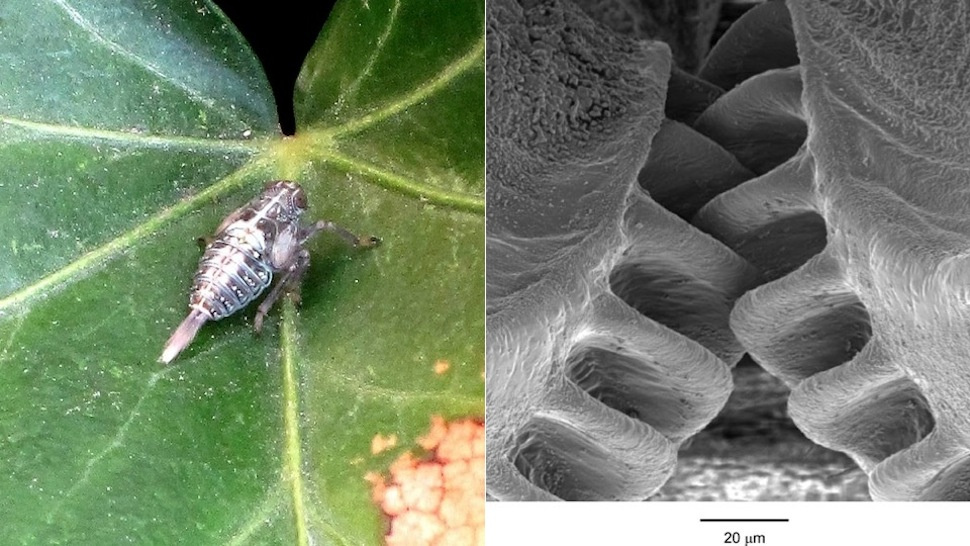
Seems that this particular kind of teenage bug has evolved bio-gears to help it jump, giving it an acceleration of a whopping 400 g! Pictures are from the website above. The adults are more responsible, of course.
The fraction of Americans who “believe in” global warming has dropped from 70% to 63% over the last six months, according to this article:
Only 42% of those surveyed believed that there is consensus among scientists about climate change. To quote from the article, “This is a problem – both because it is so at odds with reality, and because it likely helps prevent more Americans from recognizing and accepting some pretty straightforward scientific realities.”
Clearly, some of these builders of interior residential architecture could have used some instruction in mechanics, as well as a better understanding of materials.
Preparing classes would probably be the sensible thing to do right now, but instead, I decided to travel to Asia. I’ll be attending the 28th General Assembly of the International Astronomical Union (IAU) in Beijing, China from tomorrow on (more about that in a later post), but while “in the neighbourhood”, I also took up an earlier invitation for a work visit to the Institute for Astronomy and Astrophysics at the Academia Sinica (ASIAA) — say the equivalent of the National Academies. The institute has a staff of about 170 people under the directorship of Paul Ho, and is operated from a new and modern building on the campus of the National Taiwan University.
A key element in the operational model of the ASIAA are active
collaborations with some of the world’s leading institutes, facilities
and researchers. My visit came after an invitation from my friend and
collaborator Ciska Kemper. I’ve known Ciska since I was a Masters
student at the Leiden Observatory in the Netherlands in 1996, and we
both got our PhD from the University of Amsterdam in 2002. After a
Spitzer fellowship at UCLA and faculty positions at the University of
Virginia in Charlottesville and the University of Manchester, she took
up her current position at the ASIAA, where she is the ALMA project
manager.
After 29 hours of traveling (there is a 12 hour time difference
between London and Taipei, so it’s quite far away…), I arrived in
Taipei on Tuesday evening. It has been a fruitful visit, resulting in
several new collaborative projects about fullerenes, dust formation
and AGB stars. As it generally goes for work visits, I also gave a
colloquium, and had a very nice chat with Paul Ho (the ASIAA
director). In addition, there was ample time for social contacts, and
for exploring parts of Taipei and the surroundings. In Taipei,
appartments tend to be fairly small, and often do not include a proper
kitchen, and thus people go out for dinner pretty much every
evening. There’s a large number of restaurants and food stalls; at
street level, almost all building space is used for restaurants or for
shops. I enjoyed all sorts of different cuisines — Korean, Japanese,
Chinese, Shanghai-ese, … all very very yummy! I also gave a guest
lecture about Belgian beer in a pub that was all stocked up with such
liquid delights.
On Saturday, we took the Maokong gondola up to the Chi Nan temple, and
then on to the teahouses where we enjoyed the views, and fresh tea and
a few bites. Later that day, we visited the Taipei 101 — the second
tallest building in the world. Quite impressive! On Sunday, we decided
to go hiking in Yangmingshan National Park, up to the peak of Mount
Qixing which is the highest point in the park. It was — how shall we
say this — a fairly strenuous hike for a person of my fitness
level. In fact, it was brutal. The trail went up steeply at times —
apparently nobody around here believes in switchbacks and thus trails
go up steeply. And the tropics are great, but not so much when you’re
hiking. The temperature was about 36 degrees with a high humidity;
even higher up, it was still much hotter than is comfortable for a
normal human being….As if that wasn’t hot enough, the area is
volcanic and the trail passes over several very hot fumaroles. Along
the path were lots of pretty lizards, butterflies and a lonely
poisonous snake in a landscape of bamboo and other tropical plants and
flowers. I made it to the top, and probably had about 20 less liters
of body fluids to carry down the hill. But the views of the city and
out to the ocean were worth it! After hiking down and taking a very
wild busride back home, a cold shower and a good Japanese dinner by
the water made us forget most of the painful muscles.
And so the week has gone by quickly! Tomorrow I’m off to Beijing and
the IAU GA, but that’s for another time!

Jim Cole took this amazing photo of the beginnings of the solar eclipse of May 20, 2012.
The photo shows the sun setting over the town of Orillia, across Lake Simcoe from Jim’s cottage.
Poster: http://www.physics.uwo.ca/colloquia/Colloquia%20Notices/2011_2012/HOUDE%20Colloquium.pdf
Western University
DEPARTMENT OF PHYSICS AND ASTRONOMY
PHYSICS & ASTRONOMY COLLOQUIUM
Date: Thursday, 24th May 2012
Time: 1:30 p.m.
Location: Physics & Astronomy Seminar Room 22
Dr. Martin Houde
Department of Physics & Astronomy
Western University
“Non-Zeeman Circular Polarization Measurements of Astronomical Molecular Lines”
ABSTRACT
I will discuss unexpected results recently obtained with the Four-Stokes-Parameter Spectral Line Polarimeter (FSPPol), developed here at Western, on the polarization properties of rotational molecular lines. I will explain why, although small amounts of linear polarization are expected to be present in their spectral profiles, it is usually ascertained that no circular polarization signals could be detected in rotational transitions of Zeeman insensitive molecules like carbon monoxide (CO). Our recent circular polarization observations of the (J = 2 à 1) rotational transition of CO with FSPPol clearly show that this belief was unfounded. I will present a physical model that seeks to explain these observations, and discuss its implications for the characterization of magnetic fields in molecular clouds.
One of the biggest misconceptions that I see from students early in their careers (and from the public at large) is that to make contributions to science you have to have a PhD. This cannot be more wrong. There are lots of contributions to astronomy (and science in general) that come from non-PhD scientists — and no, I’m not talking about grad students on their ways to PhDs.
Let me give you an example of what one can do without a doctorate. When I first graduated from the University of Florida with a B.S. in astronomy, I applied to every graduate program I could think of and hoped for the best. Now, I don’t want you, dear reader, to think me naïve after just saying that many young students have the aforementioned misconception about PhDs and science. In fact, to do what I truly want to do in life (teach professionally and conduct scientific research), a PhD is really a crucial stepping stone in my career.
However, the graduate programs I applied to all rejected me because, though the rest of my record was excellent, my standardized test scores weren’t the best. I was left in a predicament, because I had a bachelor’s degree in astronomy, and to my knowledge that didn’t bode well for job prospects. So, I looked into the matter, and found that there were in fact jobs I could apply for to keep me in astronomy while I improved my grad school applications (though the list of jobs available was rather short). So, I applied to everything I thought I had a reasonable chance at and waited.
The first job, observing for the University of Wyoming, fell through after a decent phone interview. I was the second choice from the list of applicants, which was heartening, but it still left me without a job. The second job I heard from asked me for another phone interview and then, a week later, invited me for an in person interview all the way in Baltimore, Maryland. This particular job was working on the famed Hubble Space Telescope at the Space Telescope Science Institute (STScI), so I was rather keen to land that one (what I thought was the longest shot job I had applied for). There were two more applications I was waiting to hear about, but it would be some time before I heard anything if at all from these. The interview in Baltimore went well, and the woman from human resources gave me the run through of the benefits package and starting salary — a good sign! I went back to my mother’s house in Florida and waited the week or so before they said they would have a response. Finally, after waiting a few more days, I called one morning to find out that the human resources woman I had talked with had just gotten the word to offer me the job, and she was putting together all of the details of the offer to call me that afternoon. Huzzah! After being professional and listening to all of the fine print, I accepted the job and told her that I would be ready to start in two weeks (after a fairly large move for a person of 21 years to make alone). Incidentally, of the remaining two jobs I had applied for, I found out that one had been filled and it took five weeks to receive a rejection letter and the other never contacted me (I later came to find out from others who had applied that while the ad stated a minimum of a bachelor’s degree was required, the people in charge ignore anyone without a master’s…somewhat against the theme of this post, but there you have it).
Working at STScI was one of the best experiences of my career thus far. I’ve made many friends and learned about a multitude of technical skills that I wouldn’t have necessarily picked up if I had dived right into grad school. Do I think I would have done well if I had gone straight to the next level of education? Without a doubt. The experience would have certainly been different, though. I think that my time at STScI has made me a more unique young scientist than most of my contemporaries and I appreciate that experience. Besides, how many people can say that they worked for NASA on the repair of the Hubble Space Telescope? And how many did that before their 23rd birthday? Not many, I can tell you.
From my personal example, I hope you can come away feeling that you don’t have to have a PhD to contribute to science. Anyone can do it! In fact, without the dedicated work of non-PhD astronomers, we wouldn’t know as much as we do. Groups such as the Royal Astronomical Society of Canada and other local astronomy clubs work hard in the areas of observational techniques and instrumentation. Data analysts such as those at STScI (properly titled Research and Instrument Analysts, for the record), the Harvard-Smithsonian Center for Astrophysics, and Gemini Observatory provide dedicated and invaluable support to the astronomers who use their facilities. And everyday people who have any number of careers (teacher, fireman, banker, etc.) participate in online projects to mine the immense volumes of data that we have collected in just the past few decades (the Galaxy Zoo project, for example). There are the coders, the telescope technicians, the political lobbyists who fight for science funding, and even the janitors without whom our facilities would fall into disarray. Every one of these people is crucial to the advancement of astronomy and all other scientific fields. So, the question you should be asking isn’t can you contribute without a PhD, but how can you contribute.
Poster: http://www.physics.uwo.ca/colloquia/Colloquia%20Notices/2011_2012/BARMAN%20Colloquium.pdf
The University of Western Ontario
DEPARTMENT OF PHYSICS AND ASTRONOMY
PHYSICS & ASTRONOMY COLLOQUIUM
Date: Thursday, 8th March 2012
Time: 1:30 p.m.
Location: Physics & Astronomy Seminar Room 22
Dr. Travis Barman
Lowell Observatory
Flagstaff, Arizona
“Direct Imaging and Spectroscopy of Young Giant Planets”
ABSTRACT
Several young gas giants in wide orbits (> 10 AU) have now been directly imaged. These exciting discoveries provide new insights into the formation and early atmospheric properties of giant planets. This talk will focus on recent attempts to measure the near-infrared spectra of two planets orbiting the star HR8799. These data have aided in the characterization of the planets’ cloud and chemical properties, but also highlight the many difficulties we face when modeling planet atmospheres.
The few planets imaged so far are just the beginning. New instruments, tailor made for high-contrast imaging, are coming online this year and will reveal dozens of young planets. These instruments will also provide low resolution near-IR spectra of each new planet, revealing a wealth of information across a wide range of planet masses and ages. Given the lessons we are learning from systems like HR8799, interpreting these data will not be easy and significant observational and planet modeling obstacles must be overcome.
Coffee & Cookies will be available.