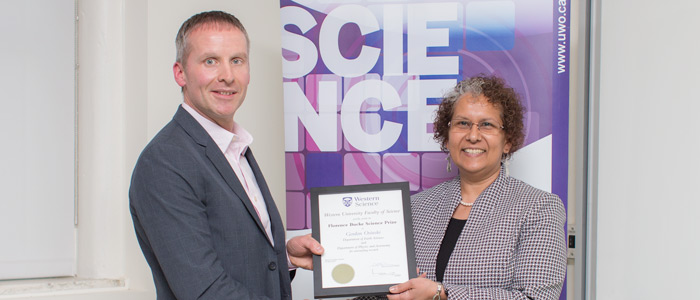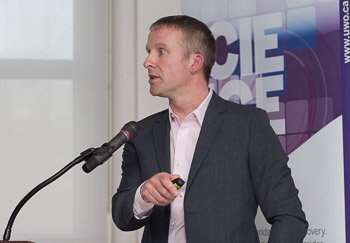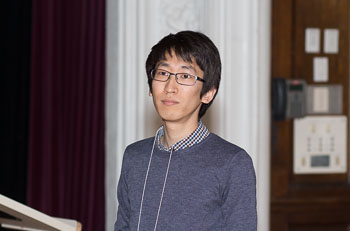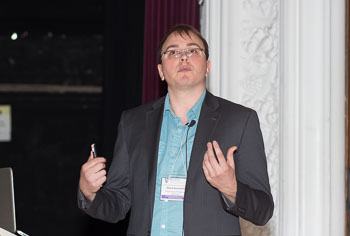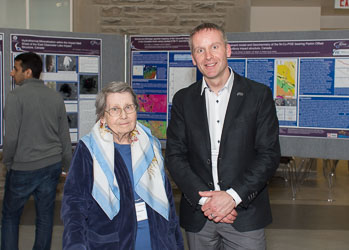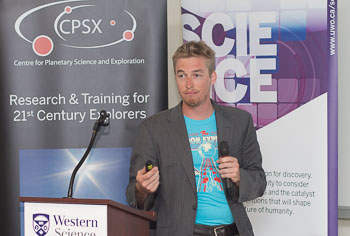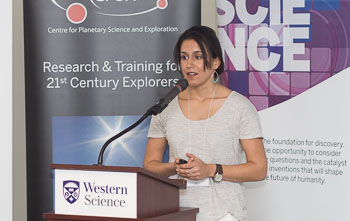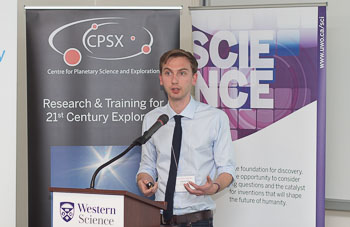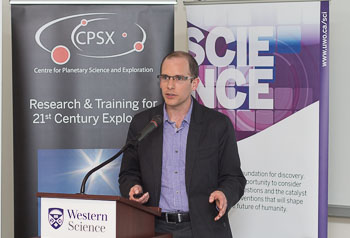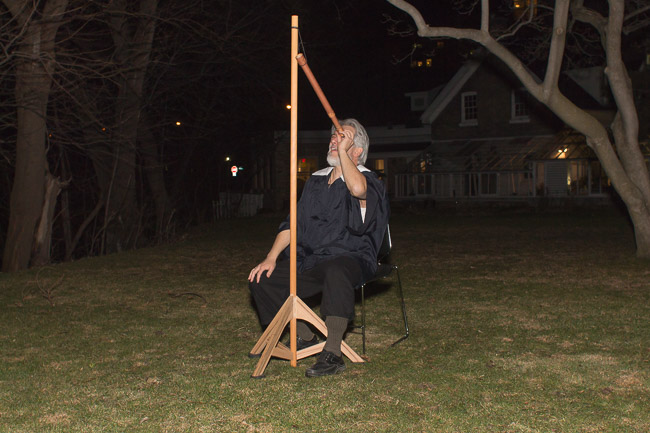
Gordon Osinski presented the 2015 Florence Bucke Science Prize lecture

Bucke_Prize_lecture_2015_a
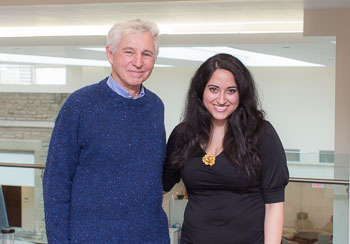
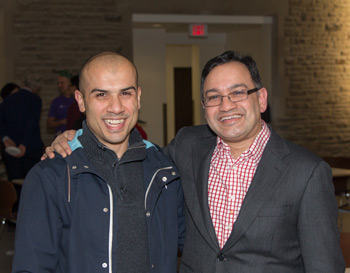
Dean of Science Charmaine Dean (right) presents Gordon Osinski with the 2015 Florence Bucke Science Prize

For the second consecutive year, a Physics and Astronomy faculty member has won the Florence Bucke Science Prize.

Professor Gordon Osinski is the winner for 2015.

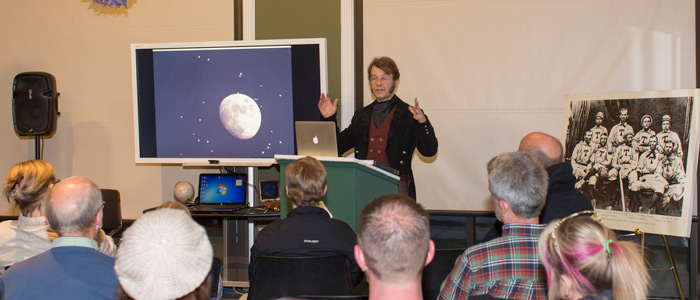
Gordon, or Oz to those who know him, gave the Bucke Prize lecture on April 30, 2015. Bucke_2015_350px-1His presentation was titled “The Beneficial Effects of Meteorite Impact Events”.

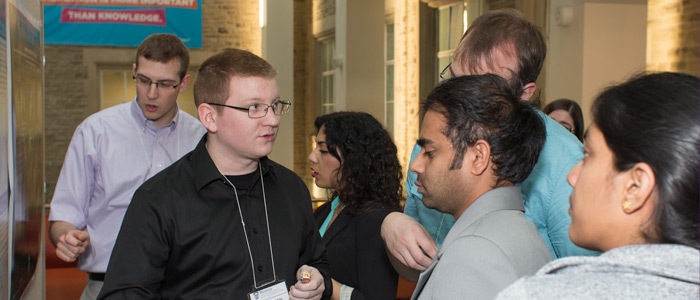
A reception was held in the Physics and Astronomy atrium after the talk.

[Lightroom slides] [ images on Flickr ]

[related news  – Gordon Osinski receives the 2015 Florence Bucke Science Prize]

CAMBR 2015 Distinguished Lecture and Research Showcase

CAMBR_2015_a

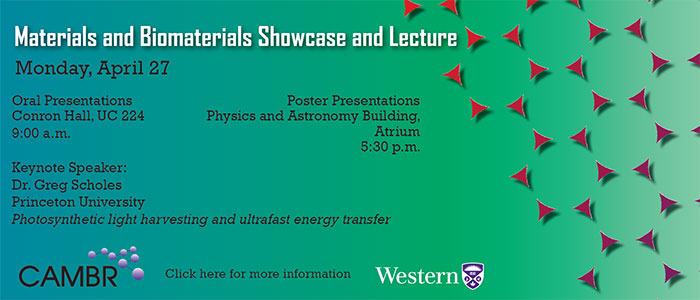
The Centre for Advanced Materials and Biomaterials Research (CAMBR) at Western held the 2015 Distinguished Lecture and Research Showcase on Monday, April 27, 2015.

Prof. Gregory D. Scholes

The day began at Conron Hall with the keynote lecture given by Professor Gregory D. Scholes of Princeton University. His presentation was titled “Photosynthetic light harvesting and ultrafast energy transfer“.

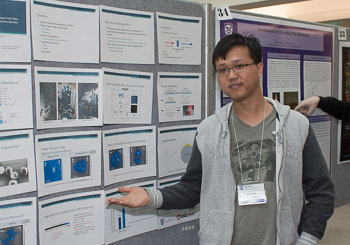
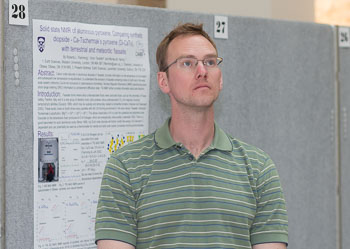
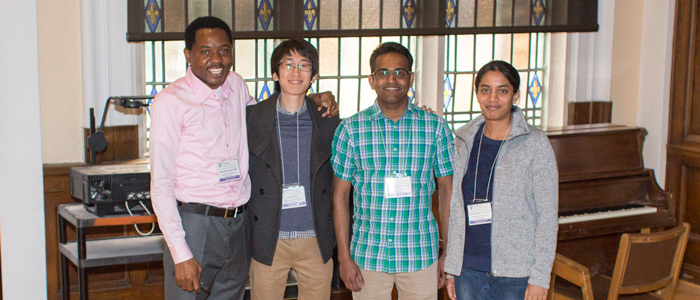
Three sessions of oral presentations were followed by a reception and poster presentations in the atrium of the Physics and Astronomy building.

The Department of Physics and Astronomy was well represented during the course of the event.

[photo slideshow] [Flickr]


Physics and Astronomy presentations:

Presenter: Jaewoo Park Research Paper: "Synthesis of graphene nanoribbon thin films from graphene ridges decorated with copper nanoparticles" by Jaewoo Park, Arash Akbari-Sharbaf, Sabastine Ezugwu, Reg Bauld ,Giovanni Fanchini.
Presenter: Jaewoo Park
Research Paper: “Synthesis of graphene nanoribbon thin films from graphene ridges decorated with copper nanoparticles” by Jaewoo Park, Arash Akbari-Sharbaf, Sabastine Ezugwu, Reg Bauld ,Giovanni Fanchini.


Presenter: Ruiping Ge Research Paper: "Efficiency enhancement of Si solar cells enabled by growth of lateral Si wire" by Ruiping Ge, Sergey N. Dedyulin, Shuyu Ding, Winnie Ye, Lyudmila V. Goncharova.
Presenter: Ruiping Ge
Research Paper: “Efficiency enhancement of Si solar cells enabled by growth of lateral Si wire” by Ruiping Ge, Sergey N. Dedyulin, Shuyu Ding, Winnie Ye, Lyudmila V. Goncharova.
CAMBR_2015_350px-6
Presenter: Sabastine Ezugwu Research Paper: “Three-dimensional scanning near field optical microscopy imaging of random arrays of copper nanoparticles and their use for plasmonic solar cell enhancement” by Sabastine Ezugwu, Hanyang Ye, Giovanni Fanchini.
Presenter: Carolyn Cadogan Research Paper: "The effect of annealing temperatures on the luminescence of silicon quantum dots in hydrogenated silicon nitride " by Carolyn Cadogan, Peter J. Simpson, Lyudmila V. Goncharova, Zhiqiang Wang, Tsun-Kong Sham.
Presenter: Carolyn Cadogan
Research Paper: “The effect of annealing temperatures on the luminescence of silicon quantum dots in hydrogenated silicon nitride ” by Carolyn Cadogan, Peter J. Simpson, Lyudmila V. Goncharova, Zhiqiang Wang, Tsun-Kong Sham.
Presenter: Marek Brzozowski Research Paper: "Quenching of photoluminescence in quantum dots, metallic nanoparticles and graphene hybrid nanomaterials" by Marek Brzozowski and Mahi R. Singh.
Presenter: Marek Brzozowski
Research Paper: “Quenching of photoluminescence in quantum dots, metallic nanoparticles and graphene hybrid nanomaterials” by Marek Brzozowski and Mahi R. Singh.
Presenter: Renjie Hou Research Paper: "Second harmonic generation microscopy from non-centrosymmetric gold-coated polystyrene spheres" by Renjie Hou and Francois Lagugné-Labarthet.
Presenter: Renjie Hou
Research Paper: “Second harmonic generation microscopy from non-centrosymmetric gold-coated polystyrene spheres” by Renjie Hou and Francois Lagugné-Labarthet.
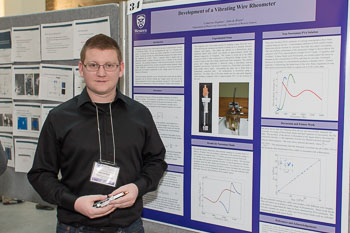
Presenter: Cameron Hopkins Research Paper: "The development of a vibrating wire rheometer" by Cameron Hopkins and John R. de Bruyn.
Presenter: Cameron Hopkins
Research Paper: “The development of a vibrating wire rheometer” by Cameron Hopkins and John R. de Bruyn.
Presenter: James Gaudet Research Paper: "Controlling the synthesis of ion-implanted Si quantum dots in SiO2" by James Gaudet, Lyudmila V. Goncharova and Peter. J. Simpson.
Presenter: James Gaudet
Research Paper: “Controlling the synthesis of ion-implanted Si quantum dots in SiO2” by James Gaudet, Lyudmila V. Goncharova and Peter. J. Simpson.
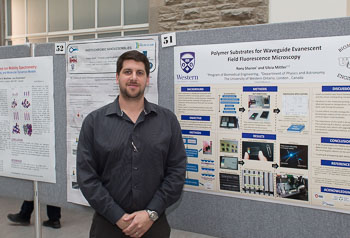
Presenter: Rony Sharon Research Paper: "Development of polymer substrates for waveguide evanescent field fluorescence microscopy" by Rony Sharon and Silvia Mittler.
Presenter: Rony Sharon
Research Paper: “Development of polymer substrates for waveguide evanescent field fluorescence microscopy” by Rony Sharon and Silvia Mittler.
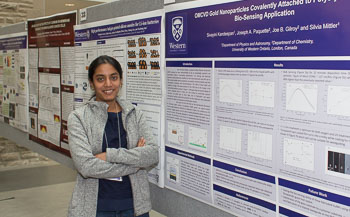
Presenter: Sivayini Kandeepan Research Paper: "OMCVD gold nanoparticles covalently attached to polystyrene for bio-sensing application" by Sivayini Kandeepan, Joseph A. Paquette, Joe B. Gilroy, Silvia Mittler.
Presenter: Sivayini Kandeepan
Research Paper: “OMCVD gold nanoparticles covalently attached to polystyrene for bio-sensing application” by Sivayini Kandeepan, Joseph A. Paquette, Joe B. Gilroy, Silvia Mittler.
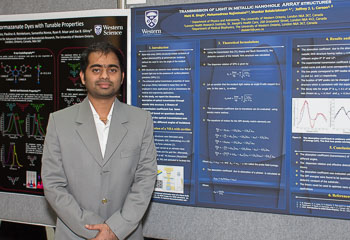
Presenter: Shankar Balakrishnan Research Paper: "Transmission of light in metallic nano-hole array structures" by Mahi R. Singh, Mohamadreza Najiminai, Shankar Balakrishnan, Jeffrey J. L. Carson.
Presenter: Shankar Balakrishnan
Research Paper: “Transmission of light in metallic nano-hole array structures” by Mahi R. Singh, Mohamadreza Najiminai, Shankar Balakrishnan, Jeffrey J. L. Carson.

CAMBR_2015_b

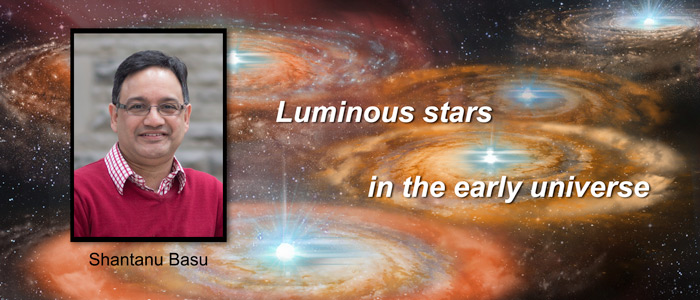
Luminous star clusters in the early universe

early-universe_banner_2015_700x300

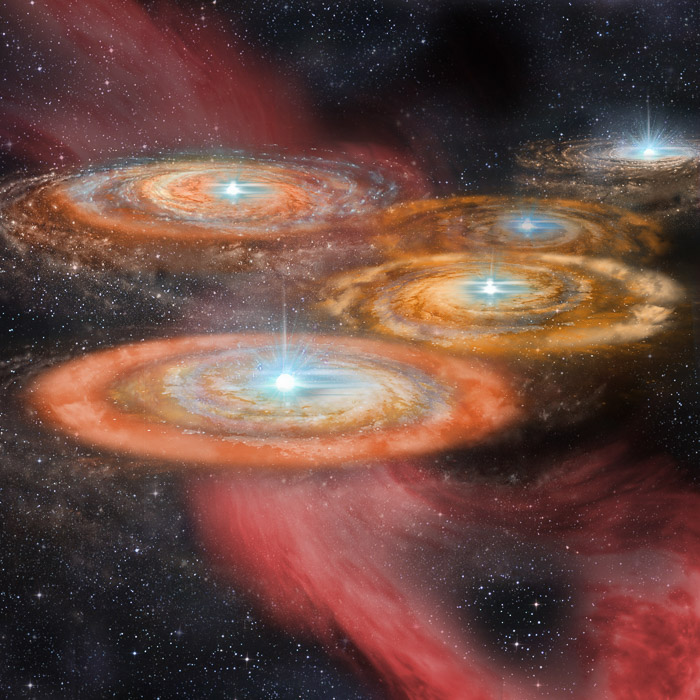
Models of the early universe made by Western astronomers show a period in which the very first stars could have formed into small, chaotic, superluminous clusters.

The work is by Shantanu Basu and his former doctoral student Alexander DeSouza. The paper is published in the Monthly Notices of the Royal Astronomical Society.

Alex DeSouza (left) and Shantanu Basu

When the James Webb Space Telescope (JWST) launches in 2018, it will point its infrared detectors towards objects in the early universe.  The models by Basu and DeSouza indicate that the early universe may have contained small clusters of stars which, through accretion burst activity, could have reach luminosities on the order of 100 million times that of our Sun. These clusters may potentially be visible to the Webb telescope.

In Shantanu Basu’s words, “Seeing the very first stars is a key science goal for JWST and part of astronomers’ quest to track the history of the cosmos. If we’re right, then in just a few years’ time, we could see these enigmatic and dazzlingly bright objects as they came into being, and lit up the universe around them.”

[R.A.S. press release]  [astrobites article] [Western media release]

Image credit for below: Shantanu Basu, The University of Western Ontario

basu_early_universe_700-1


Planetary delights at last weekend’s 19th century stargazing

Eldon_House_Apr2015

[view slideshow] [images on Flickr]

There exist some of those occasions when, both literally and figuratively, all of the planets align.

The 19th Century stargazing night held at Eldon House on Sunday evening, April 12, 2015, was blessed with such timing, or what some would call very good planning.
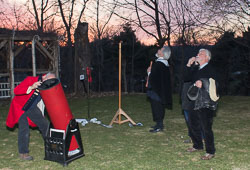
eldon_house_news_250-2The night was hosted by Eldon House, the Royal Astronomical Society of Canada’s (RASC) London Centre, The Department of Physics and Astronomy’s Exploring the Stars program, and The Centre for Planetary Science and Exploration (CPSX) at Western.

Eldon House board and RASC member Mark Tovey was the mastermind behind this coming together of several worldy and other-worldly events, all of which were orchestrated for the eyes of a group of approximately 50 lucky registered visitors.

April 12, 2015 was Yuri’s Night, a night of worldwide celebration of humankind’s accomplishments in space, named for the famed Soviet cosmonaut Yuri Gagarin, the first person is space. This was the seed for the occasion. In addition, this Eldon House event is one of many that celebrate its 180th birthday.
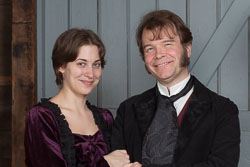
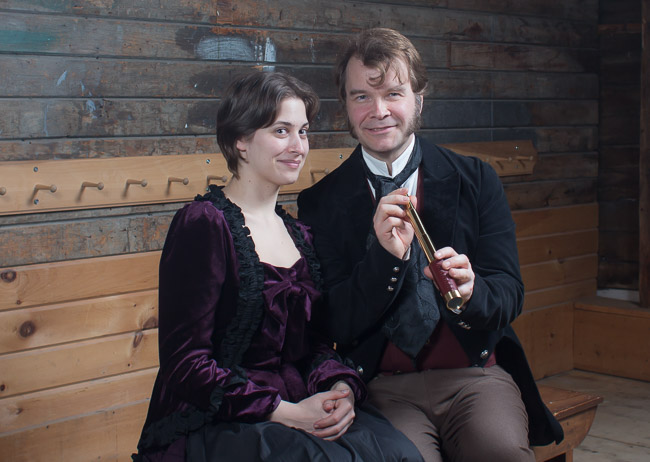
eldon_house_news_250-3Mark Tovey and fellow RASC member Tricia Colvin dressed as John and Amelia Harris.  Eldon House was built for John Harris in 1834 after he had become Treasurer for London District. Harris, a veteran sailor in the War of 1812, had been asked to help survey the Great Lakes after the war.  Thus, historic navigation would be the evening’s theme.  In addition, the recently discovered telescope of John Harris was on display in the lecture hall.
eldon_house_news_250-1

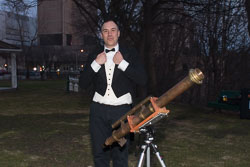
Mark began things with a slide presentation. He described how, in John Harris’ survey work, there was a need to determine latitude and longitude by the observation of heavenly bodies. On this very evening there would indeed be such a fortuitous occultation of Jupiter’s moon Io. An event such as this occultation would have been observed and timed by sailors like Harris for the purpose of finding their east-west location on the globe, namely their longitude. On this particular evening in April, the visitors would themselves be able to witness such an occultation through telescopes on the back lawn of Eldon house.

Mark also descibed how the sextant was used to find the navigator’s north-south position on the globe, in other words their latitude. Mark relived some wonderful historic quotes by navigator Henry Bayfield who was also a member of the Great Lakes survey.  Bayfield’s records show us that navigating by the stars on a frigid, windy, winter night is romantic only in history books. Professor Paul Wiegert, dressed smartly as Bayfield himself, would later show visitors how to use a sextant in much more benign conditions.

After the talk, the visitors were free to wander the grounds and take in the displays.

CPSX members Haley Sapers, Bianca D’Aoust, and Professor Phil McCausland, all dressed in period garb, showed off a large array of planetary items, maps, and models, along with real meteorites, including rare ones of the Martian and Lunar variety.  Phil is Western’s meteorite curator, while Haley is CPSX’s outreach co-ordinator.

Outside, along the sidewalk on Ridout St., Haley took visitors on a planet walk, demonstrating the relative distances between the planets.

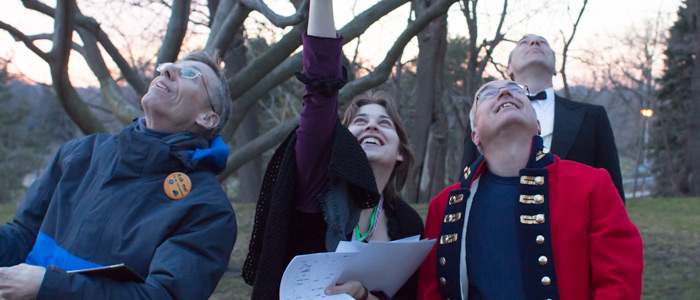
On the back lawn of the house, nine telescopes were set up for various views of the planets Venus and Jupiter, which were shining brightly through the haze of an approaching frontal system.
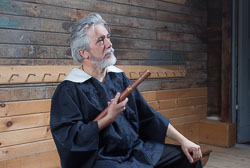
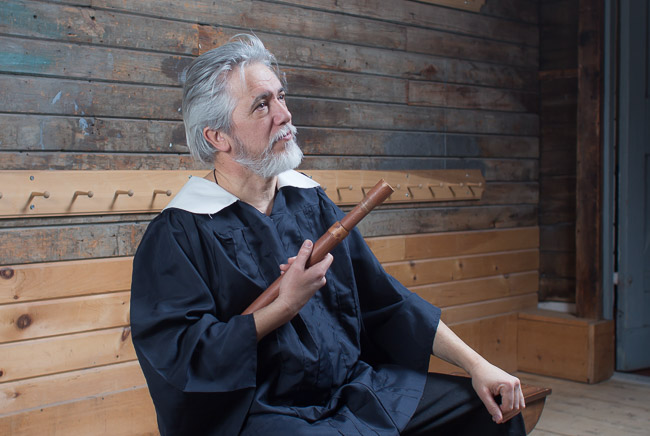
eldon_house_news_250-4A model of Galileo Galilei’s first telescope, built by RASC member Dave McCarter was displayed by Physics and Astronomy PhD student Tony Martinez, who was dressed splendidly as Galileo himself. A few guests actually saw Jupiter and one of its moons through this telescope, which is quite a feat, given its poor field of view.

A 1920’s era brass telescope, provided by Physics and Astronomy, and operated by RASC members Steve Gauthier and Peter Jedicke, provided an interesting historical perspective, giving better views than the telescope of Galileo.

A replica brass spyglass, not unlike the one used by John Harris, and a 40mm Tasco refractor from the 1960s, both supplied by London RASC member Patrick Whelan, were also available. The remaining complement of telescopes were of the modern variety.
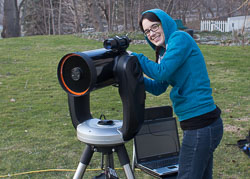
eldon_house_news_250-5Physics and Astronomy PhD student Emily McCullough, in period dress, and using a Celestron 20cm scope, showed visitors Jupiter through both the eyepiece and through an imaging camera on a laptop computer. Emily also gave a sky tour with a laser pointer.
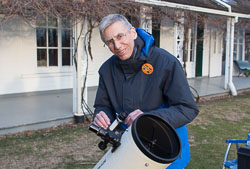
eldon_house_news_250-6RASC member Bob Duff used his Meade scope on Dobsonian mount to view Jupiter, while Roman Dubinski pointed at Venus with his 127mm Maksutov scope. Prior to bringing out his 80mm refracting scope, RASC member Joseph O’Neil took some drone videos of the site. RASC member Patrick Whelan, in bright military red-coat, brought his 4.5 inch Bushnell Voyageur scope.

The clouds held off beautifully, and the backyard of Eldon House was filled with sky watchers. The evening was pleasant, but a bit of dampness cooled things off. Much hot chocolate was consumed.

During the course of the evening, Rogers TV came out for an interview with Mark Tovey.

At approximately 9:12pm local time, some of the visitors were fortunate enough to view moon Io reappear from eclipse by the Jupiter’s shadow, just as surveyors John Harris or Henry Bayfield could have done 200 years ago. Thus the evening’s theme on navigation by the stars and planets came full circle.

The dedicated group of Eldon House volunteers worked along with the astronomers and planetary scientists to make the evening a resounding success.

Eldon_House_Apr2015_2

Inaugural Space Day at Western

space_day_banner_mitch

The Centre for Planetary Science and Exploration (CPSX) hosted Western University’s inaugural Space Day on Monday, April 13, 2015.

The Physics and Astronomy building was the venue for the event.  It is envisioned as a celebration of Western University’s past contributions to the Canadian space program, as well as a showcase of the the research done by the bright new minds within CPSX, as well as the collaboration with the burgeoning commercial space industry in Canada, along with the Canadian Space Agency.

David S. Chapman
David S. Chapman

Hosting the event was CPSX Acting Director Gordon Osinski.  Dean of Science Charmaine Dean gave the formal welcome. Following the welcome, Western history professor and London Library board member Jonathan Vance presented a brief biography of Western physicist Dr. John Herbert Chapman, considered the father of the Canadian space program.

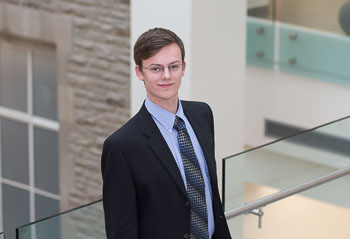
In the audience, representing his family, was new Western law student David S. Chapman, who is John Herbert’s grandson. David is completing his studies in Mathematical Physics at The University of Waterloo.

Also in attendance was Janet Hunten, class of ’50 in Chemistry and Physics. The Huntens  were friends with the Chapmans, and Janet was also a classmate of John Herbert at Western.

Janet Hunten with Gordon Osinski

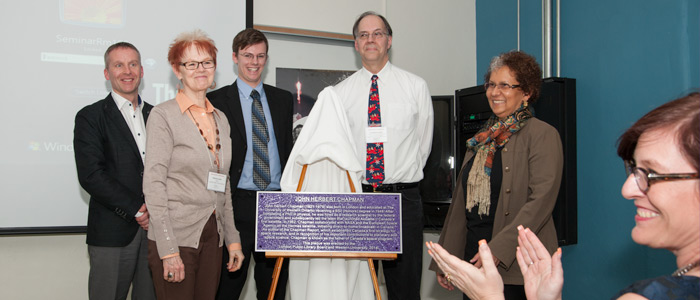
Marilyn Steinberg, Director of Communications for the Faculty of Science writes, “The Historic Sites Committee of the London Public Library Board recently selected John H. Chapman, a Western Science alumnus and the developer of the Alouette satellite which, on the day of its launch, ensured Canada’s position as the third country to reach orbit, as a Londoner of note to be commemorated in the unveiling of a plaque in his honor.”

London Public Library Board Chair Gloria Leckie said a few words before the formal unveiling of the plaque that commemorates John Chapman’s contribution to the Canadian space program and Western University.

The plaque will take a place of honour in the atrium of the Physics and Astronomy building.

Michael Vergalla of Moon Express

Keynote speaker for the event was Michael Vergalla, Project Engineer of Moon Express.  Michael gave an inspirational presentation which highlighted his company’s efforts in commercializing space travel to the moon, along their collaboration with NASA and other groups.  Moon Express is one of the teams hunting for the Google Lunar XPrize.

After the keynote presentation it was time for some of Western’s CPSX students to show off their leading edge research, each giving a 10 minute summary talk.

A reception in the atrium followed.

[more images of the event] [view on Flickr]


Summary of Science Talks:

Bianca D'Aoust spoke on  "Mapping Central Uplifts in Martian Craters"
Bianca D’Aoust spoke on “Mapping Central Uplifts in Martian Craters”
Patrick Hill spoke on  "Analysis of Lunar meteorites morphology"
Patrick Hill spoke on “Analysis of Lunar meteorites morphology”
Matt Cross spoke on "Rover navigation on Mars"
Matt Cross spoke on “Rover navigation on Mars”
Ian Pritchard spoke on "Crater detection and planetary image analysis"
Ian Pritchard spoke on “Crater detection and planetary image analysis”
Emily McCullough spoke on  "Lidar measurements of the atmosphere over the arctic"
Emily McCullough spoke on “Lidar measurements of the atmosphere over the arctic”

Tonight – 19th Century Stargazing at Eldon House

The weather forecast calls for crystal clear skies today and tonight with only the possibility of a few clouds.  It will also be the warmest day so far this spring.

Eldon_House_Apr11_650-3
Look at Jupiter and its moons along with Galileo Galilei himself, using his first telescope.

Consider registering for this evening’s 19th Century stargazing event at Eldon House.

Space music will lend atmosphere. Hot chocolate will be served.

Space-themed attire is encouraged, and please dress warmly!

Date:  Sunday, April 12, 2015, beginning at 8:00p.m.

Registration is required.

Cost : $15.00 (incl. HST) per person.

To register please call 519-661-5169.
481 Ridout Street N.
London, ON, N6A 1P6
www.eldonhouse.ca

 John and Amelia Harris, with his telescope.
John and Amelia Harris, with his telescope.


Speak with Galileo Galilei himself.