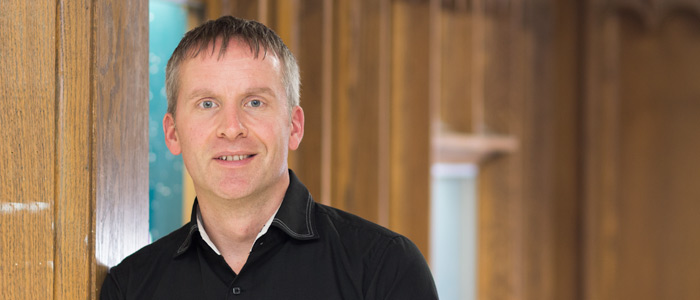
Canada renews its Space Advisory Board, and a new sitting member Western’s Professor Gordon Osinski.

Canada renews its Space Advisory Board, and a new sitting member Western’s Professor Gordon Osinski.
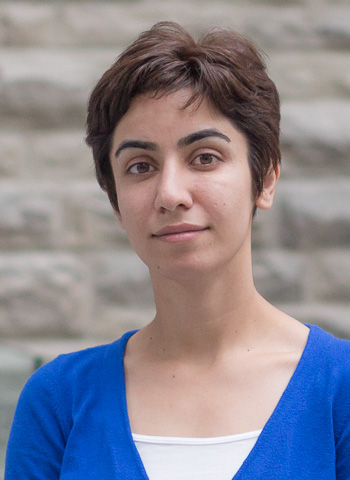
The J.S. Plaskett Medal of the Canadian Astonomical Society (CASCA) is awarded yearly to the very best astronomy PhD thesis in the country.
We are so proud to announce that recent Western graduate Dr. Fereshteh Rajabi is the recipient of the 2017 Plaskett Medal.
Under the supervision of Dr. Martin Houde, Fereshteh did groundbreaking work in her thesis titled, “Dicke’s Superradiance in Astrophysics”.
The official citation reads as follows,
“CASCA is pleased to announce Dr. Fereshteh Rajabi as the 2017 recipient of the J. S. Plaskett Medal.
Dr. Rajabi completed her doctoral studies at the University of Western Ontario under the supervision of Dr. Martin Houde. Her thesis entitled “Dicke’s Superradiance in Astrophysics” extends the mathematical description of this intriguing physical process to many phenomena of astrophysical interest. Superradiance is a quantum mechanical and coherent behaviour between closely spaced atoms or molecules (i.e., several within a wavelength) that makes them, when certain conditions are met, emit radiation that is much more focused and intense than expected. Dr. Rajabi used superradiance to elegantly explain anomalous fluxes in the 21cm line of hydrogen atom and unexplained maser flares and bursts in the envelopes of evolved stars. She made fundamental physical advances that brought superradiance out of the lab and into an ever more surprising Universe. Her work has attracted worldwide attention not only in astrophysics, but also in the field of quantum optics.”
Fereshteh is now the third Western astronomer to be so honoured, following in the footsteps of Grant Hill (1994) and Peter Brown (2001).
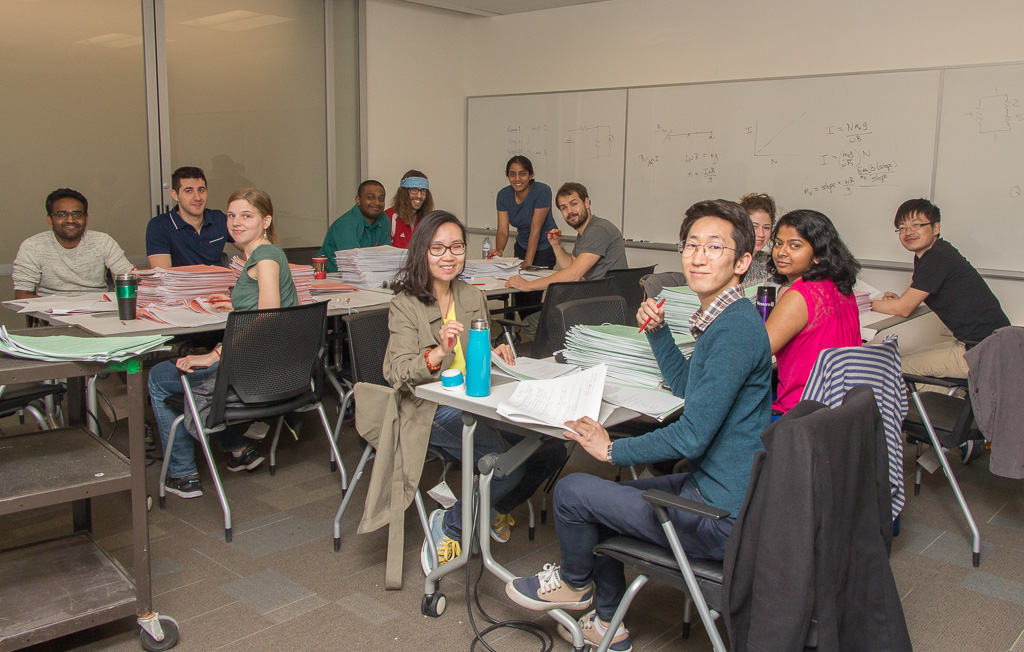
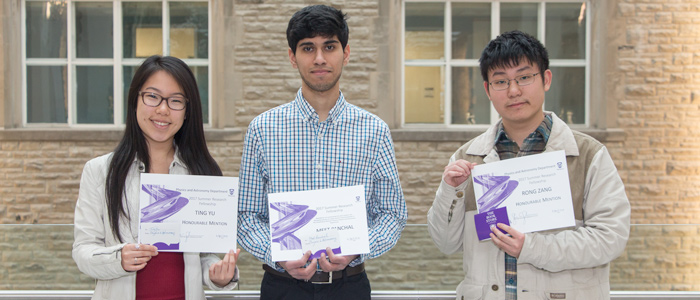
The inaugural Physics and Astronomy Summer Research Internship Prize had many wonderful applicants.
The winners for the summer of 2017 are:
First prize winner Meet Panchal will be doing research with Dr. Sarah Gallagher in the field of active galaxies and black holes.
Both runner ups have also landed summer research positions with Physics & Astronomy faculty members.
Dr. Gallagher hosted the presentation ceremony which took place on Thursday, April 6, 2017.
Space Day @ Western was celebrated for 2017 on Wednesday, April 6.
It was a long eventful day full of energy and activity.
During the morning, two sections of Gordon Osinski’s class presented their poster papers in the Physics and Astronomy atrium. These were judged by a select panel of graduate students and faculty members.
Visiting keynote speaker, Dr. Bernard Foing of the European Space Agency, strolled amongst the undergraduates and took a great interest in their projects. The students, some of whom had cited Dr. Foing in their research results, were thrilled by his presence.
After lunch, the afternoon began with the graduate students displaying their poster papers. Dr. Foing also seemed to enjoy chatting to this group about their own research.
Following this everyone adjourned to PAB100 where the oral presentations were conducted.
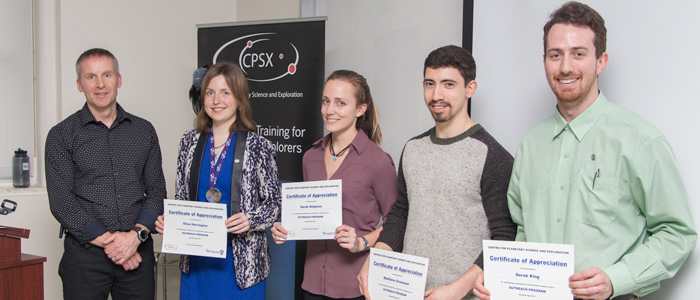
Prior to the talks, Gordon Osinski welcomed everyone and also made a surprise presentation of volunteer appreciation certificates to students Elise Harrington, Sarah Simpson, Matthew Svensson, Derek King, and Danny Bednar.
The talks by local students and researchers went as follows:
Keynote speaker Dr. Bernard Foing of the European Space Agency gave a talk titled, “European Space Agency (ESA) Research and Moon Village Initiative”. Bernard Foing was introduced by Faculty of Science Associate VP of Research Mark Daley.
A reception followed, during which Adjunct Professor in Earth Sciences Livio Tornebene, along with grad students Jon Kissi and Gavin Tolometti gave tours of the Mars Mission Control room where they were taking part in an Mars rover photography mission.
The successful event was organized by a hard working group of volunteers led by Jennifer Thompson, Zachary Morse and Paul Weigert.
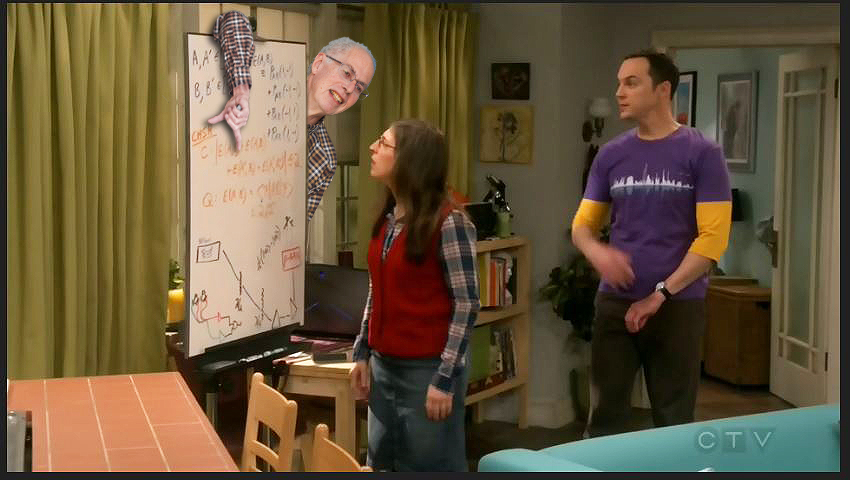
The CHSH Inequality, explored in Dick Holt’s PhD research at Harvard, along with his three collaborators John Clauser, Mike Horne, and (the late) Abner Shimony (hence CHSH) , was used in the Big Bang Theory episode titled, “The Collaboration Fluctuation“, which, as Dick points out, aired exactly one week after his colloquium of March 23.
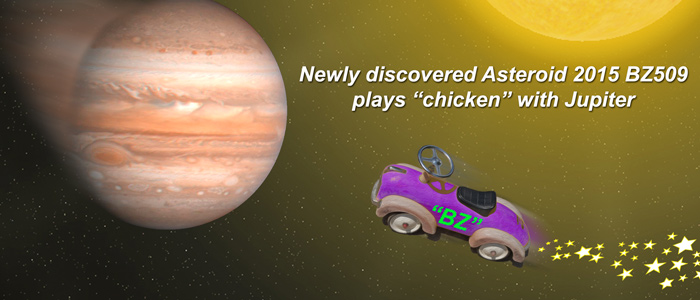
It’s not unusual for the Panoramic Survey Telescope And Rapid Response System to detect new asteroids in our solar system.
However, when Paul Wiegert and collaborating astronomers Martin Connors, and Christian Veillet looked more carefully at the orbital path taken Asteroid 2015 BZ509, nicknamed “BZ”, they were taken aback.
Paul Wiegert jokingly likens this asteroid’s behaviour to a clown car playing chicken with oncoming traffic at a circus.
What the team discovered was an asteroid that not only has retrograde (against the flow!) motion, but more interestingly the tiny asteroid inhabits the same orbital path as Jupiter itself. To find out more about how this little David survives against mighty Jupiter, read further on Paul Wiegert’s web pages, “http://www.astro.uwo.ca/~wiegert/2015BZ509/“.
The story appears in the March 30, 2017 issue of Nature.
Canadian comet hunter David Levy spoke in the Dept. of History on Feb. 16, 2017.
The video is now on Youtube. (Apologies that the slides from the presentation were not available).
Dick Holt’s talk of 23 March 2017, titled, “Some Random Thoughts on Quantum Mechanics”, is now available on the Western Physics and Astronomy Youtube channel.
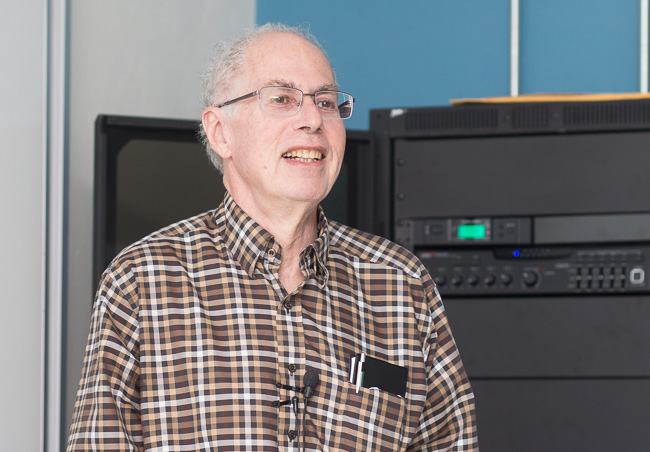
On Thursday, March 23, 2017, Professor Emeritus Richard (Dick) Holt gave a wonderful colloquium titled, “Some Random Thoughts on Quantum Mechanics”. Dick’s PhD thesis at Harvard University included a calculation that showed Quantum Mechanics could violate the CHSH Inequality, an experimental test using entangled pairs of photons.
Thus, Dick’s presentation was filled with deep insight into the enigma that is quantum mechanics.
Proceedings began with a very witty introduction by John de Bruyn.