Special Astronomy Public Night – Saturday, September 1, 2012

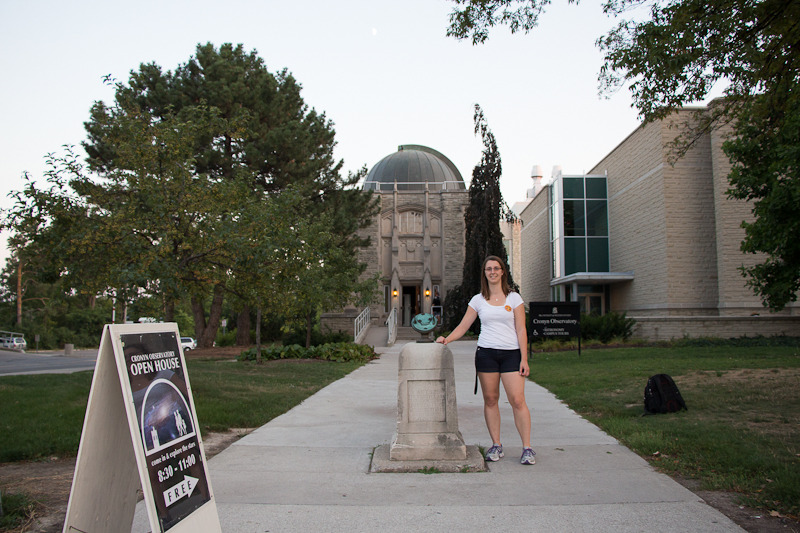
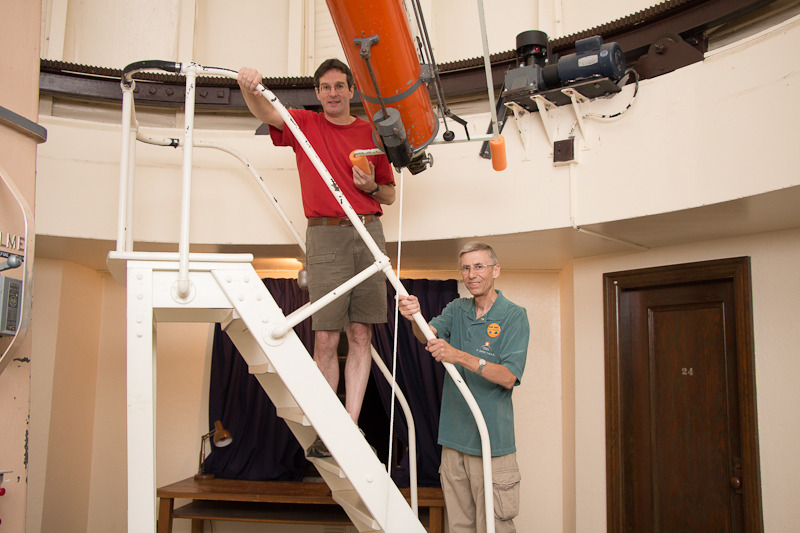
We are pleased to present an evening of star and planet gazing at The Hume Cronyn Memorial Observatory.

This will take place on Saturday, September 1, 2012.

Doors open at 20:30 (8:30pm) and close at 23:00 (11:00pm).

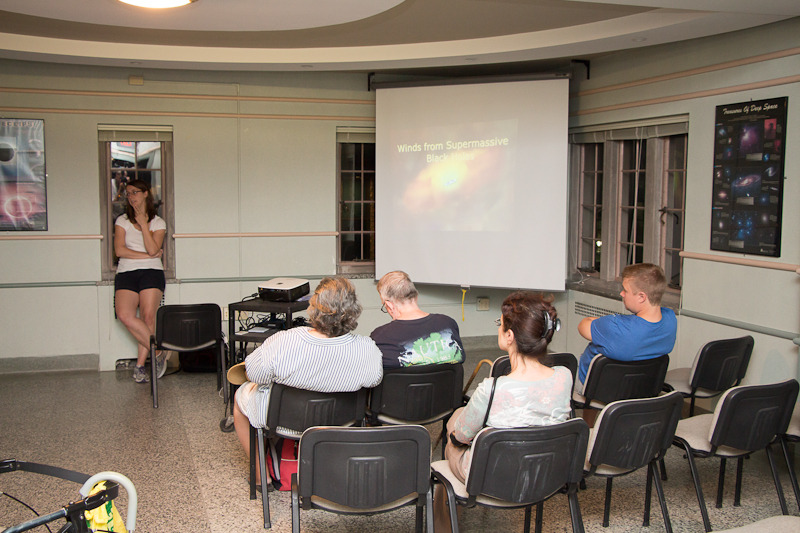
In addition to star gazing, there will be a presentation on a relevant astronomical topic downstairs in the main hall.

See Cronyn Observatory public nights.

Physics & Astronomy Colloquium – THURS. 13th Sept. – DR. MICHAEL CUSHING, U TOLEDO

Poster: http://www.physics.uwo.ca/colloquia/Colloquia%20Notices/2012_2013/CUSHING%20Colloquium.pdf


Western University
DEPARTMENT OF PHYSICS AND ASTRONOMY


PHYSICS & ASTRONOMY COLLOQUIUM


Date:           Thursday, 13th September 2012
Time:          1:30 p.m.
Location:    Physics & Astronomy
*New* Seminar Room 100

Dr. Michael Cushing
Ritter Astrophysical Research Center
University of Toledo


“The Discovery of Y Dwarfs with WISE”


ABSTRACT


One of the primary science goals of the Wide-field Infrared Survey Explorer (WISE)—a NASA mission that surveyed the sky at four mid-infrared wavelengths—is to identify very cold (Teff < 1000 K) brown dwarfs. With atmospheric conditions similar to that of giant planets, brown dwarfs are ideal exoplanet analogs that can be observed free from the contaminating light of host stars. The study of these cold brown dwarfs will also provide constraints on the low-mass stellar mass function and on the lower mass limit of star formation, two critical constraints on theories of star formation. To date, we have identified roughly 170 new brown dwarfs with WISE, 13 of which are so cold (Teff < 500 K) that the creation of a new spectral class—dubbed ‘Y’—was required. I will discuss the discovery of the Y dwarfs as well as our initial constraints on the substellar mass function.

Physics & Astronomy Colloquium – THURS. 6th Sept. – DR. PAULINE BARMBY, Western

Poster: http://www.physics.uwo.ca/colloquia/Colloquia%20Notices/2012_2013/BARMBY%20Colloquium.pdf


Western University
DEPARTMENT OF PHYSICS AND ASTRONOMY

PHYSICS & ASTRONOMY COLLOQUIUM

Date:           Thursday, 6th September 2012
Time:          1:30 p.m.
Location:    Physics & Astronomy *New* Seminar Room 100

Dr. Pauline Barmby
Department of Physics and Astronomy
Western University

“Andromeda’s coat of many colours”

ABSTRACT

Andromeda is the nearest large galaxy and provides the best view of what our own Milky Way might look like from the outside. Although Andromeda’s nearness makes it possible to see the fine details of its internal structure and stellar populations, only recently have observational facilities been able to also provide a global portrait at many wavelengths. Finally we can begin to compare and contrast Andromeda and the Milky Way on both large and small scales in order to understand how local environment shapes a galaxy’s history. I will discuss how multi-wavelength observations of Andromeda’s stars, star-forming regions, and stellar clusters are shaping our picture of this touchstone galaxy.

Last Cronyn Observatory public night for the summer was a success.

A good crowd showed up to view the stars on the final summer public night of the year.

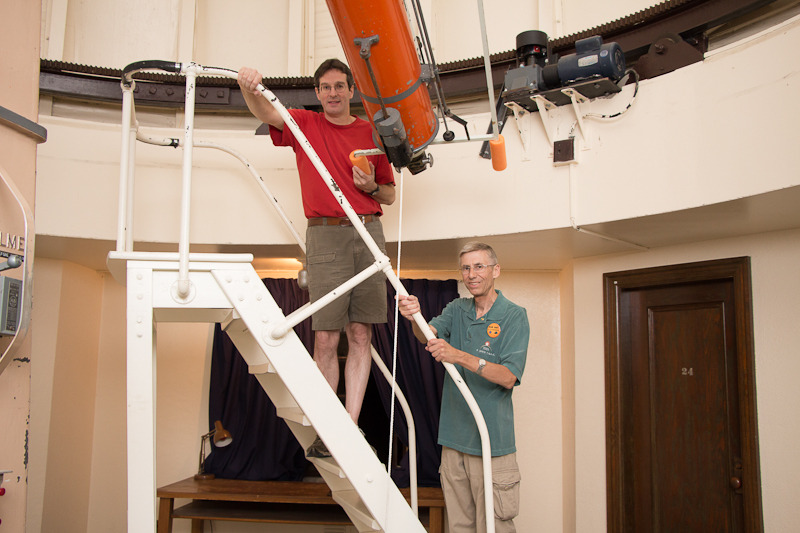
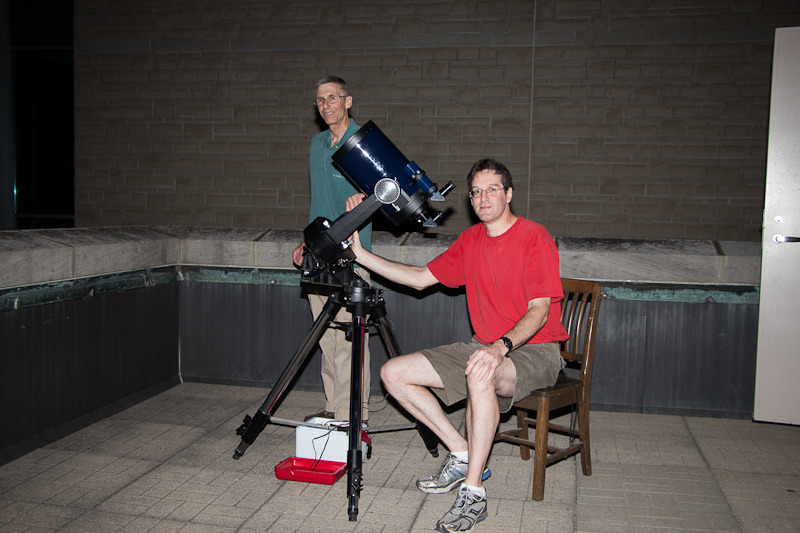
Allison Hill gave a presentation in the lecture hall, while Matt Abado along with RASC members Bob Duff and Dale Armstrong operated three telescopes for star and planet viewing. The star viewing started out with observations of the first quarter moon on the 25cm refractor. The two smaller telescopes were pointed at various interesting objects, including the double star Albireo and the planet Neptune.

The fall and winter public programs at Cronyn Observatory will soon begin.


One Small Step

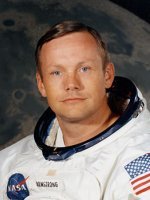
Everyone else and their cousin has discussed Neil Armstrong and  the influence of his life and work. I hope many of you took the chance to wink at the Moon over the weekend — I did while waiting to watch the International Space Station pass overheadon Saturday night, wondering what those six people were thinking and feeling.


I can’t give the usual story of being woken up to watch Armstrong and Aldrin’s moonwalk and deciding that I was going to be an astronaut. Profs may seem older than dirt, but in fact the most recent(more optimistic than “last”) moon mission ended a few days before I was born. Instead I want to talk about the famous words: “one small step”.


Great Big Sea, the most famous band from Newfoundland that our esteemed former chair has never heard of, had a recent song called “Walk on the Moon.” While I quibble with some of their orchestration choices (chimes? glockenspiel?), I really like the lyrics, which talk about the moon landing as a metaphor for being afraid to do something and doing it anyway. I apologize in advance if you hear me singing this in the hallways this week:


I don’t care, my foolish fear
Won’t get the best of me …
I’m alive; I’ve come to realize
Not a moment too soon
This is my one small step
This is my walk on the Moon

Besides winking at the Moon, I think the best thing we can do to honour the legacy of Armstrong and others like him is to each take our own small steps. We can hope that eventually they add up to giant leaps.

I’m going to declare my own planned small steps here, in the hopes that making them public will hold me accountable for not giving up on them. In my teaching, I’m going to solicit feedbackfrom my students after each and every class. In my research, I’m going to spend a few minutes every day thinking not about the tiny slice of the project I’m now working on, but about the big picture. In my service work, I’m going to organize at least one off-campus outreach event this year. And in my personal life I’m going to bike at least half as many kilometres as I drive.


We’re about to start a new school year, so it’s a time of new pencil crayons, new beginnings, and new ideas. What are your new small steps going to be?

Neil Armstrong dies at the age of 82

The first man to step on Moon has passed away today at the age of 82. He passed away after the complications from a heart surgery earlier this month.

He will be remembered for one line that rings in everyone’s ear every time anyone talks about the first step on Moon “One small step for man, a giant leap for mankind”. He inspired many and will always be remembered for his contributions to human race!


RIP Neil Armstrong!