BOLT! (of Usain) Physics of sprinting #westernu

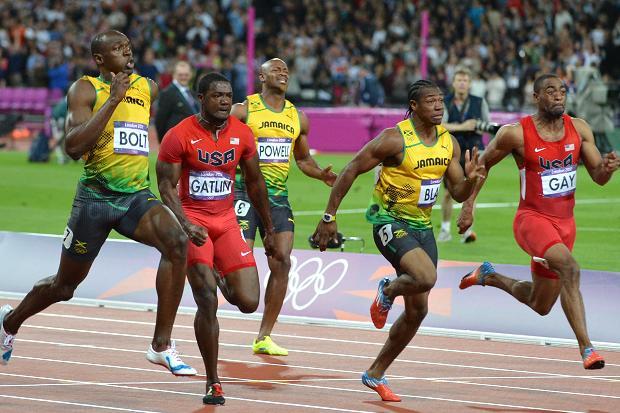
Sprinting has evolved since the first Olympics in 1896 to the point where humans are running the 100 m dash 2.41 s faster [see the article below-nice graph & video]. Projections peg the fastest 100 m time at a possible 9.21 s.

In homage to the Olympics and the new era of sprinting [tall & lanky], lets look at some different attributes required in this sport:

-Large centre of gravity

-Large force exertion on track [~2.5 body weight]

-Reaction time

-Height [fewer strides]


Currently, there are certain limits to what humans can do [i.e.-it takes about 1/3 of a second to lift and put your leg down while sprinting]. The 400 m double-amputee Oscar Pistorius improves on this limit by ~20% because his carbon fibre legs are half the mass.

Whether humans can go below 9 s may be beyond exploiting physics [http://www.bbc.com/future/story/20120712-will-we-ever-run-100m-in-9-secs/1].


Article: http://www.nytimes.com/interactive/2012/08/05/sports/olympics/the-100-meter-d…

SPACE EXPLORATION: Western researchers, Canadian astronaut head north to study crater, help NASA ready for deep space

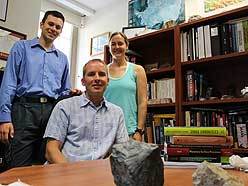
Gordon Osinski sits in his office at Western University with students Raymond Francis and Cassandra Marion. Sitting on his desk in the foreground is a shatter cone, similar to the ones discovered by the team on Victoria Island. (ALEX WEBER, The London Free Press)

While NASA’s Curiosity rover was en route to Mars hurtling through space at 20,900 km/h, a Western University research team and a local astronaut were packed in a Twin Otter float plane making their way to Canada’s west Arctic.

A joint effort between Western’s Centre for Planetary Science and Exploration and the Canadian Space Agency, the team spent nearly two weeks on Victoria Island conducting a geological survey on a newly discovered meteor impact crater.

Their mission was twofold: to examine the crater and to help Canadian astronaut Jeremy Hansen prepare for his next mission.

Just like Curiosity, which touched down early Monday on Mars, Hansen, 36, is expected to one day land on Mars, the moon or a meteor as NASA prepares its astronauts to journey deeper into space.

“As somebody who might be on the moon chipping a rock, it’s interesting for me to see how the work is done,” Hansen said.

The Arctic, being dry, cold and deserted, is also the closest environment on Earth to what Hansen and other astronauts can expect to experience when exploring another planet.

“The idea is to learn how to explore places you haven’t been to before,” said Gordon Osinski, director of Western’s planetary- sciences centre. “You can’t teach that in a classroom.”

Hansen joined Osinski and four Western University students in exploring a crater 30 km in diameter and more than 230 km away from any form of human civilization.

The crew landed on Victoria Island, roughly 21/2 times the size of Great Britain and nestled between Nunavut and Canada’s Northwest Territories, on July 1.

For the next 10 days they explored the crater created more than 300 million years ago — though its exact age is yet to be determined — when an asteroid about two kilometres wide slammed into an ocean bed.

Never before seen by humans, the crater was discovered in 2010 during a regional geological survey of Canada.

By analysing the composition of the rocks inside the crater, geologists can learn about deep space, other planets and how asteroids are formed.

Among some of the fascinating rocks the team uncovered were shatter cones, a rare geological discovery only found beneath impact craters and nuclear test sites.

“It was pretty spectacular,” said Cassandra Marion, a PhD student on the expedition.

Though many of the students on the team have backgrounds in geology, Raymond Francis studies robotics engineering. He hopes to one day build robots, such as NASA’s Curiosity, that will venture into deep space and report findings on its own.

“I have to know how to do these experiments in geology because I have to teach a computer how to do them,” Francis said.

But exploring the crater and taking samples were only part of the job, now that the team is back from the Arctic they’re busy analyzing the data they gathered.

Hansen, who was born in London and raised in Ailsa Craig and Ingersoll, is also back at home in Houston, Tex.

Though NASA has yet to set a date for its next mission with astronauts, Hansen is optimistic he’ll be venturing out of this world in the not too distant future.

In fact, breakthroughs in technology and the development of commercial space flights have Hansen excited not just about his own chance to visit space, but other people’s as well.

“I’m quite optimistic, not just for myself, but for other Canadians as well.

“When the time is right and the economy is right we’re going to have all the pieces together and be ready to go.”

— — —

The crater


  • There are about 180 known impact craters on the Earth’s surface
  • At 30km in diameter, the Victoria Island crater is considered medium-sized
  • Chicxulub crater in Mexico, caused by the asteroid scientists believe killed the dinosaurs, is the largest at 180km in diameter.

E-mail alex.weber@sunmedia.ca, or follow AlexatLFPress on Twitter.

Your Comments


How to submit a Paper #westernu

From a recent post on astrobites, general submission guidelines and checklists for the Astrophysical Journal and arXiv. Most useful was a program linked through the article that takes an input latex file, bib (.bbl) file, and its figures and does the following:

-Removes all commented text

-Places bib items in latex file

-Renames figures sequentially IN latex file and creates new files

-Arranges all material in a tarball


http://astrobites.com/2012/08/06/how-to-submit-a-paper/

Ten things I learned from the Mars Curiosity landing

Hopefully one of our planetary-science types will soon be strong-armed persuaded to write a blog post telling us about their perspective on the Mars Science Laboratory mission. In the mean time, here is what I learned from the landing event. All of these were things that I really should have known already, but now I’ve really got them.

10. London, Ontario has no shortage of people willing to sit in a stuffy room with strangers in the middle of the night to watch an Internet feed (see Figure 1). And no shortage of fantastic amateur astronomers who will operate telescopes and show people stars and planets while they wait for the middle of the night.

9. The RASC London Centre‘s Bob Duff will valiantly attempt to count all of these people (see Figure 2). He thinks there were about 70 people in addition to the somewhat-expected Western and RASC types (see Figure 3).

8. When you get people together in the middle of the night, they drink quite a bit of coffee. It’s a good idea to bring extra cups.

7. When you forget to bring extra cups, we have great grad students who are willing to go on a mission to find the nearest grocery store open at midnight on a holiday. Thanks Tony!

6. When you bring people together to watch an Internet feed (thanks Neil and Mat for running cables down hallways and through windows), it’s a good idea to find out if your computer has the right software to actually show the live stream.

5. When you forget to do #6, we have great grad students who bring their own laptops and are happy for them to be pressed into service. Thanks Emily!

4. When organizing a public event, it’s possible to spend too much time worrying about which nerdy T-shirt to wear (see Figure 4).

3. Some things are worth staying up past one’s bedtime for. (See Figure 5. As an astronomer I should really have had a better appreciation for this one!)

2. Being on camera forced me to make up my mind about whether I thought the landing would actually be a success. (There may be implications here for teaching and/or politics.) If the interview actually made the Weather Network (!) you’ll see that I did in fact say that it would work.

1. Science WORKS.  It’s not just a bunch of tedious, meaningless symbol manipulation, regardless of what students think as they grind through their problem sets. Those folks in the blue shirts, and plenty of their colleagues who were not on camera, made it through those problem sets, and they figured out how to land a nuclear-powered laser car on another planet. Pretty awesome.