

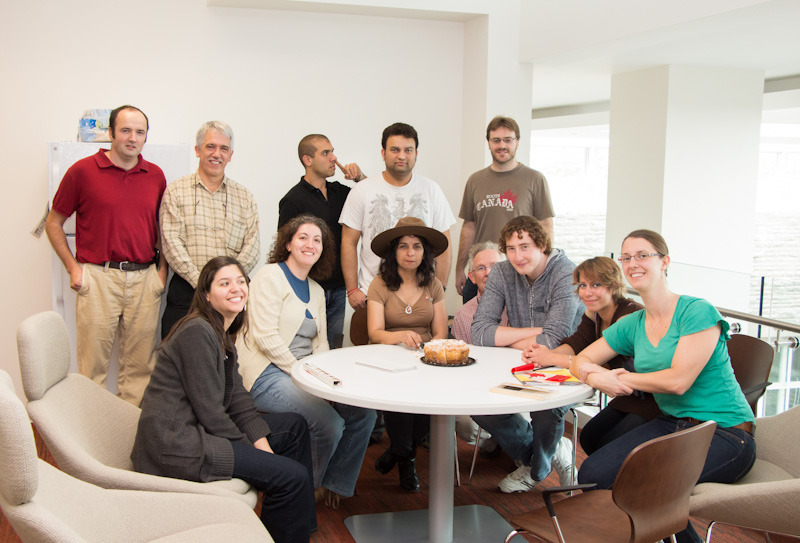
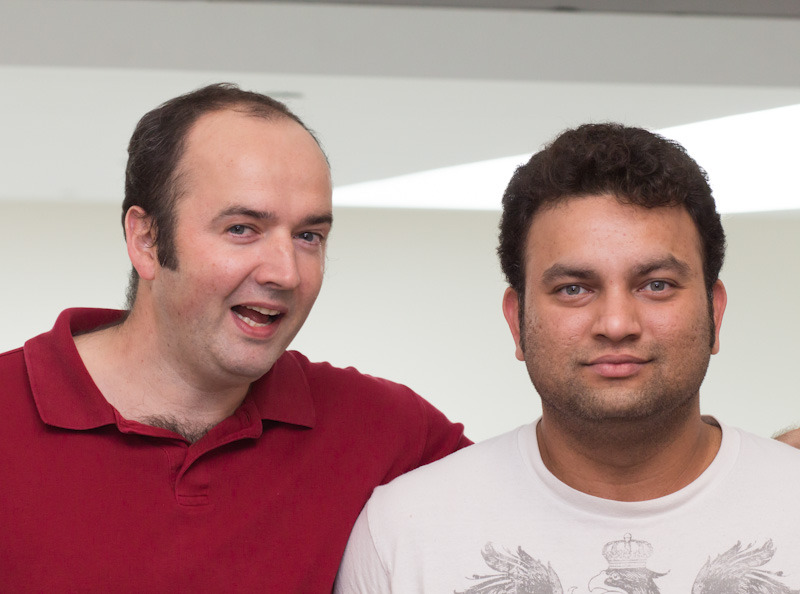

A small but cheery group gathered to celebrate Bushra Hussain’s new Canadian citizenship.
Monthly Archives: September 2012
Canada excels in Physics and Astronomy
Here is a link to a press release about a new report from the Canadian Council of Academies on the state of science and technology in Canada. It says that Physics and Astronomy is one of six areas in which Canada excels. It also says that Canada’s scientific research was ranked 4th in the world in a survey of “leading international scientists.”
The Uses and Abuses of University
Here’s a provocative article from The Walrus about the mismatch between the Canadian university system and the needs of the economy: http://thewalrus.ca/the-uses-and-abuses-of-university/
Physics & Astronomy Colloquium – THURS. 11 October – DR. FRED ADAMS, U Michigan
Poster: http://www.physics.uwo.ca/colloquia/Colloquia%20Notices/2012_2013/ADAMS%20Colloquium.pdf
Western University
DEPARTMENT OF PHYSICS AND ASTRONOMY
PHYSICS & ASTRONOMY COLLOQUIUM
Date: Thursday, 11th October 2012
Time: 1:30 p.m.
Location: Physics & Astronomy Seminar Room 100
Dr. Fred C. Adams
Department of Physics
University of Michigan
“Constraints on the Birth Environment of the Solar System”
ABSTRACT
Most stars—and hence most solar systems—form within groups and clusters. The first objective of this talk is to explore how these star forming environments affect solar systems forming within them. The discussion starts with the dynamical evolution of young clusters with N = 100 – 3000 members. We use N-body simulations to study how evolution depends on system size and initial conditions. Multiple realizations of equivalent cases are used to build up a robust statistical description of these systems, e.g., distributions of closest approaches and radial locations. These results provide a framework from which to assess the effects of clusters on solar system formation. Distributions of radial positions are used in conjunction with UV luminosity distributions to estimate the radiation exposure of circumstellar disks. Photoevaporation models determine the efficacy of radiation in removing disk gas and compromising planet formation. The distributions of closest approaches are used in conjunction with scattering cross sections to determine probabilities for solar system disruption. The result of this work is a quantitative determination of the effects of clusters on forming solar systems. The second objective of this talk is to use these results to place constraints on the possible birth environments for our solar system.
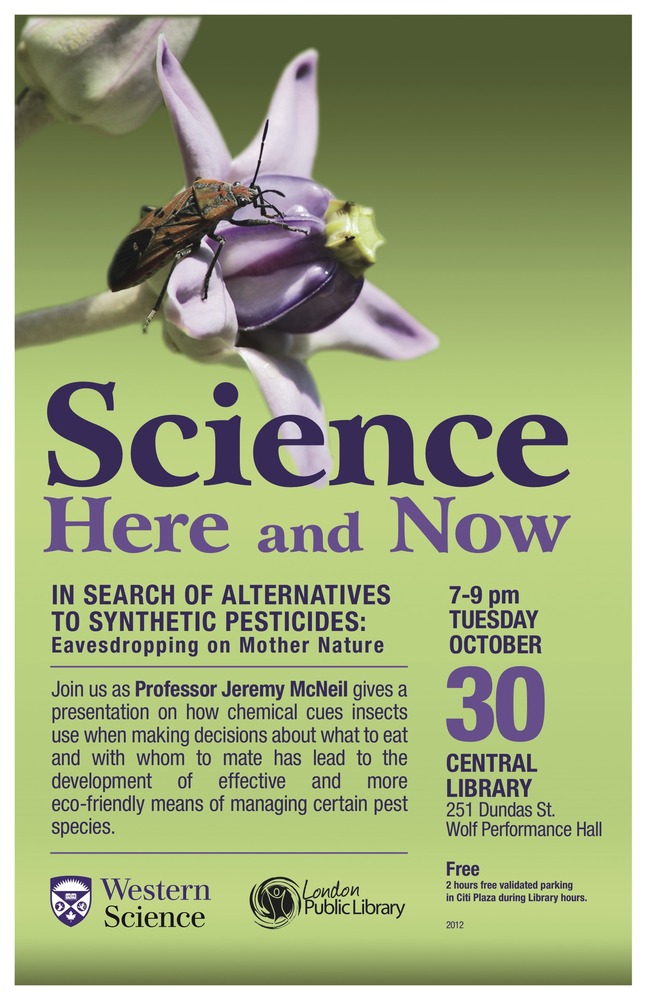
Elizabeth Laird Memorial Lecture – next THURS. 4th Oct. @ 5 p.m. – DR. ROCKY KOLB, U Chicago
Poster & Speaker Bio: http://www.physics.uwo.ca/colloquia/Colloquia%20Notices/2012_2013/LAIRD%20Lecture%20-%20Rocky%20KOLB.pdf
Alternate poster attached.
Western University
DEPARTMENT OF PHYSICS AND ASTRONOMY
ELIZABETH LAIRD MEMORIAL LECTURE
Thursday, 4th October 2012
5:00 p.m. (doors open @ 4:30) in Conron Hall (University College rm. 224)
Dr. Edward W. “Rocky” Kolb
Department of Astronomy and Astrophysics
The University of Chicago
“Mysteries of the Dark Universe”
Ninety-five percent of the universe is missing!
Astronomical observations suggest that most of the mass of the universe is in a mysterious form called dark matter and most of the energy in the universe is in an even more mysterious form called dark energy. Unlocking the secrets of dark matter and dark energy will illuminate the nature of space and time and connect the quantum with the cosmos.
Brief Bio: Edward W. Kolb, known to most as Rocky, is the Arthur Holly Compton Distinguished Service Professor of Astronomy & Astrophysics and the Chair of the Department of Astronomy & Astrophysics at the University of Chicago, as well as a member of the Enrico Fermi Institute and the Kavli Institute for Cosmological Physics. In 1983, he was the founding head of the Theoretical Astrophysics Group and, in 2004, the founding Director of the Particle Astrophysics Center at Fermi National Accelerator Laboratory in Batavia, Illinois. His field of research is the application of elementary-particle physics to the very early Universe. In addition to over 200 scientific papers, he is a co-author of The Early Universe, the standard textbook on particle physics and cosmology.

Bugs!
It’s always good to know what our colleagues are up to.
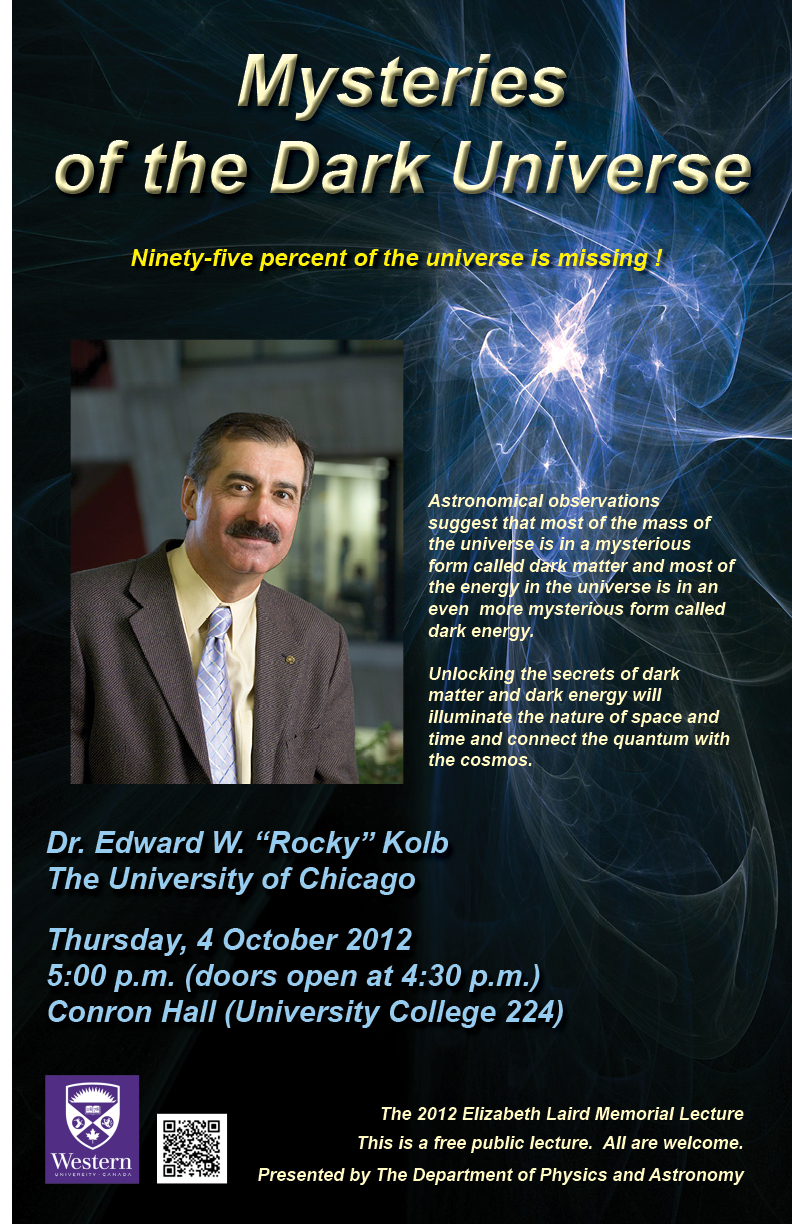
Science research at Western is vast, cutting edge and fascinating. Come to the London Public Library, downtown branch, on October 30th at 7pm to hear Dr. Jeremy McNeil, an entomologist at Western, give us some insight into his research on insects and what alternatives are available to replace synthetic insecticides. His talk is entitled: “Eavesdropping on Mother Nature: In search of alternatives to synthetic insecticides”
This talk is aimed at a general audience and will contain many of the spectacular insect photographs that Dr. McNeil has taken while travelling the globe. You will likely see a few bugs that you have never encountered before! At the end of the talk Dr. McNeil will take questions from the audience
Geron Bindseil named Learning Development Fellow for Faculty of Science.

Geron Bindseil has been selected as one of three Learning Development Fellows in the Faculty of Science.
Joint Seminar – CPSX/Physics & Astronomy – TUES. 9th October – DR. JAY MELOSH
JOINT SEMINAR—the Department of Physics and Astronomy and the Centre for Planetary Science and Exploration (CPSX)
Date: Tuesday, 9th October 2012
Time: 1:30 p.m.
Location: Physics & Astronomy Room 100
Dr. Henry (Jay) Melosh
Department of Earth and Atmospheric Sciences
Purdue University
“Tiny Worlds of Ice and Grit: Results from NASA’s Most Recent Comet Missions”
ABSTRACT
NASA’s most recent successes in exploring new worlds took place on November 4, 2010 and February 14, 2011 when two spacecraft made close passes by comets Hartley 2 and Tempel 1. Although small, Hartley 2 turned out to be a feisty customer, blasting huge quantities of CO2 gas and water vapour into space, along with dust and tarlike organic material. Images from the spacecraft show an elongated nucleus about 2.0 km long, shaped like a peanut. It is divided into two major lobes separated by a smooth collar. The lobes are sources of powerful jets of gas and dust that loft chunks of material into space. Its surface is pitted, ridged and littered with blocks of ice and dust tens of metres in diameter. Tempel 1—the target of the Deep Impact collision in 2005—is much larger, seems to lack clumps of material and appears to be composed of a fine, weak powder. It nevertheless possesses a complex geologic history, with layers, crater-like depressions and what appear to be several “volcanic” flow deposits. In this presentation I will show images of these comets’ surfaces and discuss what these observations mean, so far as we currently understand them. Many of the observed phenomena, such as the jets of gas and dust, defy current understanding of how gas and dust interact in a vacuum under low gravity. The ices present in the comets are yielding important clues to conditions in the nebula from which the comets, and our own planet, originally formed.
Turn the crank
The first thing that likely comes to a physicist’s mind when I say “turn the crank” is problem sets, and the student desire to find an equation or set of equations into which one can plug numbers and then, well, turn the crank. More about that some other time.
But what about the other kind of crank who turns up in physics: a person with an alternative theory of gravity who is convinced that he [I have yet to hear of a female physics crank] is right and Einstein was wrong? I’m talking about people typically without an academic background in the subject, whose ideas are, shall we say, non-mainstream. They often want their ideas to be validated by professionals in the field, and sometimes feel persecuted when they are not.
Since becoming a professor in a Physics & Astronomy department, my level of contact with cranks has definitely gone up. In the past year I have chatted on the phone with a pleasant older man who earnestly informed me that there was a “spirit world” hiding on the other side of Jupiter, talked in my office to a young man with a new theory of quantum spacetime, and deleted (mostly unread) more odd e-mails than I care to count. Their e-mails or treatises often have some physics-related vocabulary in them, and sometimes even equations, but put together in ways that make no sense. Certainly I haven’t yet seen a case where one of these folks proposed an experimental test of his ideas.
My question is – how should we, as members of the establishment, deal with such folks? Many of them are very thoughtful, polite people, and I think it’s only reasonable to treat them with courtesy. (If nothing else, they are fellow members of the society which supported our many years of training and now funds our research.) In general they are harmless, unlike cranks in medically-related fields, who can do serious damage to themselves or others. And of course there is the off chance that one of them will be right; there certainly have been cases in the history of science where “what everybody knows” turned out to be incorrect. But I think it is fair to say that most of these people are expending their energies on something that is unlikely to ever pan out. Should we tell them this? Attempt to set them straight about the scientific method? Or ignore them and just be happy that they are interested enough in [their idea of] science to spend their time on it?
Discuss.
The nature of scientific evidence
The photo series here has to be the cutest way I’ve ever seen to contrast the scientific method with the “I was told by a higher being and I already have all the answers” way of understanding the world. The point may be too subtle for some, sadly.
