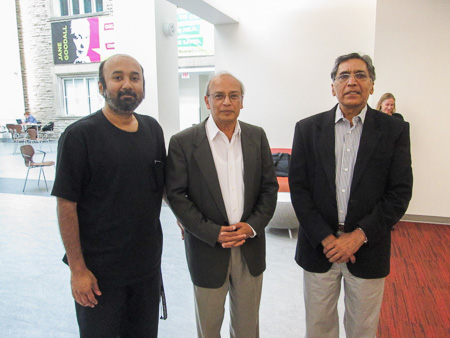
 Iftekhar Haque has successfully completed his PhD.
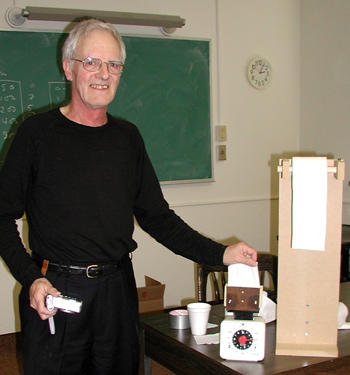
Iftekhar is shown at left in the above photo, along with PhD supervisor Prof. Mahi Singh at far right, and external examiner Dr. Shayamal Bose of Brock University in the center.

Iftekhar Haque has successfully completed his PhD.
Iftekhar is shown at left in the above photo, along with PhD supervisor Prof. Mahi Singh at far right, and external examiner Dr. Shayamal Bose of Brock University in the center.
If you haven’t seen it, you must view this incredible video of asteroid 2004 BL86 and its moon. I am not an astronomer or physicist. What puzzles me is that the asteroid seems quite round, seen with what appears to be good visual resolution. Well, so round for being an estimated roughly 300m in diameter.
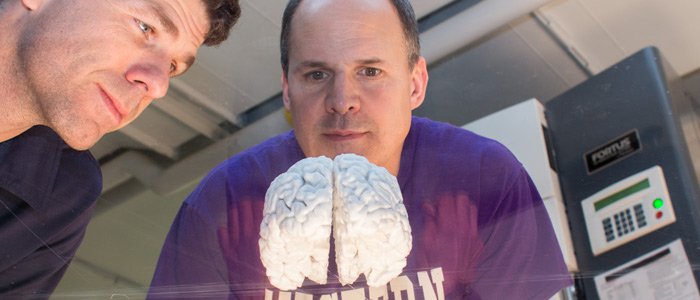
If, a year ago, you would have asked Brian Dalrymple (left in photo) or Frank Van Sas (at right), what equipment they would love to have in the machine shop, they would have said 3d printer.
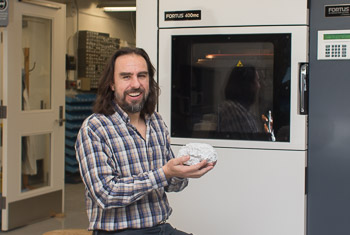
Incredibly, after much diligent work on behalf of the Department of Physics and Astronomy, their dream has come true.
Delivered just before the new year, the Stratasys Fortus 400mc large format 3d printer forms the new centerpiece of the Physics and Astronomy machine shop.
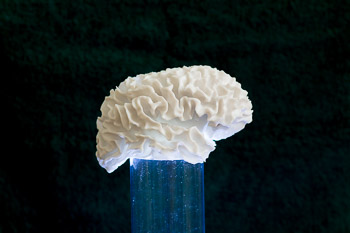
Shown in these images are models of a human brain, made from MRI images of a live brain. The client for this model was introduced to these new facilities by Physics and Astronomy Professor Andrea Soddu, who is also a member of the Brain and Mind Institute here at Western.
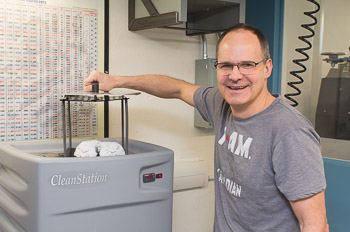
The Fortus 400mc is capable of using up to 11 different printing materials. Presently, the supported material is white polycarbonate plastic, which is ideal for MRI compatibility, with Blaine Chronik’s medial physics MR Systems Group being a large client of the shop
Here is a photo (set of stacked images) of Comet Lovejoy, taken on January 12th, 2015 from the Hawk Cliff Road (County 22) east of Port Stanley. The photographer was Allan Leparskas. His dad was there, and the temperature was 20 below zero. We lasted about 45 minutes before the body’s survival instincts kicked in, signalling a hasty retreat.
Equipment used was a Canon 7D, 50mm f 1.4 lens, ISO 3200.

I was looking for interesting images of capacitors to use in an upcoming lecture, and found this.
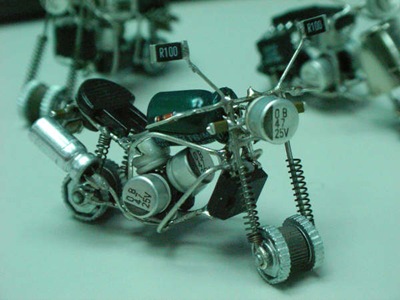
There are others here: http://www.amusingplanet.com/2008/09/capacitor-bikes.html
Splashdata has once again compiled the top 25 worst passwords for the year.
For the second year in a row, the password ‘123456’ tops the list.
In remembrance of our colleague and friend Professor Emeritus Donald R. Moorcroft, we have a tribute below, co-authored by one of Don’s former students Prof. Eric Donovan, of the University of Calgary, and ex-colleague Prof. Jean-Pierre St. Maurice of the University of Saskatchewan.
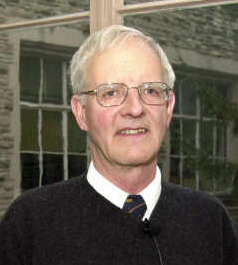 “It is with great sadness that we inform you that Don Moorcroft passed away on January 14.
Don was drawn to space physics after doing a summer internship with Colin Hines in Ottawa. He went on to an MSc and PhD at the University of Saskatchewan and in 1961 joined the Radioscience Laboratory at Stanford University for a postdoc. These years marked the beginning of his lifelong fascination with radar echoes from the ionosphere. He was one of the first to zero in on plasma instabilities as the source of radio aurora. These were the early years of Incoherent Scatter Radar, and at Stanford Don was at the epicenter of an exciting new field. His early JGRs on radio wave scattering and the effects of ion composition on the ISR spectrum were foundational, and exemplified the type of profound yet careful work that characterized his entire research career. In 1963 he joined the UWO Department of Physics, where he remained until retiring in 2000.
Curious to the core, intelligent and clever, and a true “renaissance man”, he endlessly dug into all kinds of questions. This made him shine as a professor and teacher… he taught courses in all areas of Physics, and was widely respected for his unusual breadth and depth that spanned the entire discipline. In the late 70s and early 80s he and a few UWO colleagues developed and delivered a second year independent study program.
 Faculty members today would recognize this as “the flipped classroom”, but Don was three decades ahead of that bandwagon. He was centrally important in creating the unique intellectual atmosphere in the UWO Physics department in the 70s, 80s and 90s that made it “the best years of our academic lives” for the hundreds of us who were lucky enough to enjoy it. For this and many other reasons, he was a true innovator in education and pedagogy. He brought a sparkling sense of humor to all this as well. His now famous April 1st talk, where he bent all the laws of physics to prove that the earth was flat, was a point of particular pride for Don. In February 2014, he uploaded the slides and narrative of “Why the World is Flat by Don Moorcroft” to YouTube, and it has since been viewed more than 27000 times. Rightly so, he loved that. We love it too… he was a star!
Not surprisingly, his academic career was only a part of him. He was respectful and generous of spirit. He loved his family, nature, and the arts. Music was clearly a passion, one that he shared with his wife Regine and children Annemarie, Cecilia, and Marc. In later years he and Regine created their off-the-grid wilderness retreat on Manitoulin Island, and Don further developed his talents through photography. If you want to be inspired by how those around him experienced Don beyond just work, then perhaps watch the YouTube rendition of Bridge over Troubled Water that his daughter Cecilia posted last year for Don and Regine’s 50th wedding anniversary, check out “Why the Earth is Flat”, or do a web search for “Don Moorcroft photography”.
Don Moorcroft was a quiet leader, and a great mentor. There are many of us, all around the world, and in all walks of life, for whom he was this and more. Maybe the best thing we can offer is that viewed against the backdrop of a life rich in family, culture, and creativity, his tenure as Department Head and his stellar professorial career seem but a footnote.”
[ed. note: See Don’s videos on Vimeo] [Don’s Western web page]
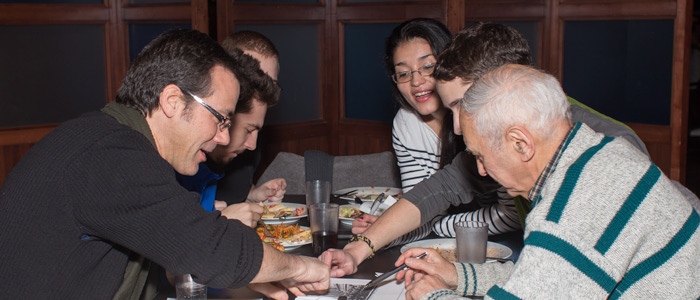
The Pasta Wave Function is an annual fun evening hosted by PASA, the Physics and Astronomy Student Association.
About 40 students, staff, and faculty met at local eatery The Wave on campus for a dinner of scrumptious pasta. The group was split into about 5 teams of 8 members, whose goal was to win the annual trivia challenge.
Winning for the second year in a row was the John deBruyn team, “The Quantum Hops”.
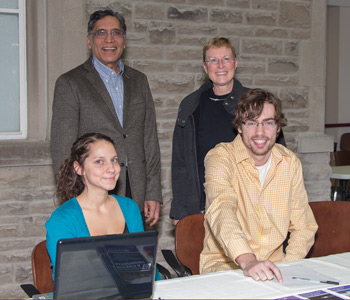
The Physics and Astronomy atrium was the venue for the Science graduate fair, at which undergraduates are invited to see what Science at Western has to offer them.
The Department of Physics and Astronomy was well represented by Graduate Chair Silvia Mittler, Recruitment Chair Mahi Singh, building manager Phin Perquin, and graduate student volunteers Mark Baker, Marek Brzozowski and Amanda DiCarlo. The display would not have been possible without Graduate Assistant Clara Buma and staff members Brian Davis, and Peter Frank.
I was preparing for my first year classes and reread this “original” article from physicist Carl Weiman that was published in 2005 in Physics Today.
http://scitation.aip.org/content/aip/magazine/physicstoday/article/58/11/10.1063/1.2155756
Ten years later, I felt that it is still relevant and I have shared that with the TAs of this class.
Active learning strategies can be implemented in different scales. It can be just one class out of the entire term, to every class, 5 minutes to 50 minutes of class time. I hope this helps give some insights to improve our teaching.
Eugene