Surprise cake and coffee on Shantanu Basu’s last day as Chair

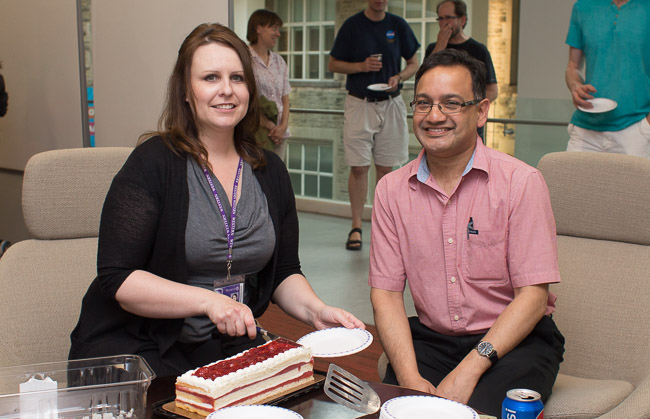
Shantanu_last_day-1A surprise afternoon coffee and cake get together for Chair Shantanu Basu’s last day was held on the 2nd floor of the atrium. Thanks to the front office staff, led by Keri Knox, for putting the event together.  Shantanu came in from off campus, and as he rounded the stairs of the atrium he was greeted by applause and cheers from the large group of well-wishers.
It was a good chance for Shantanu to reminisce with colleagues and friends on his 5 years of dedication to the department.

[more images on Flickr]

New table tennis table arrives

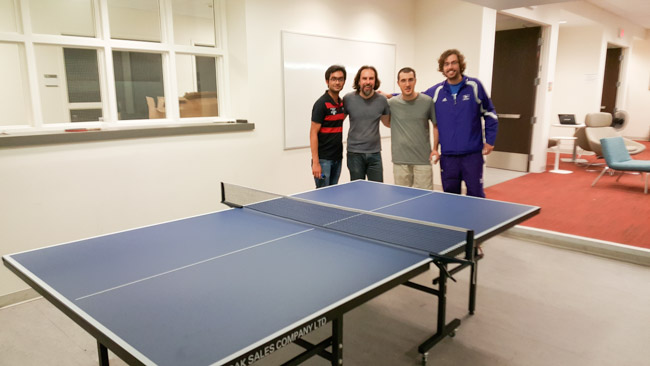
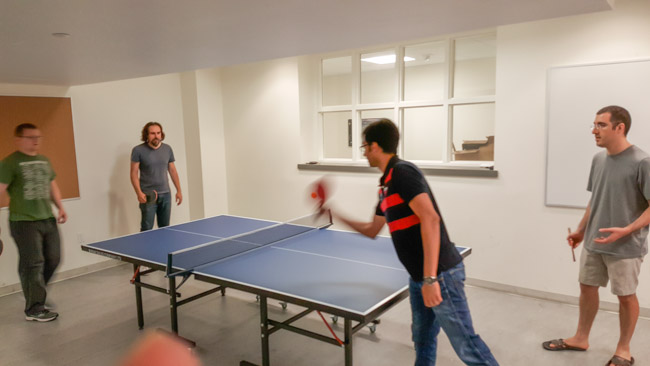
new_tt_table-2The graduate student lounge is now home to a new table tennis table.

This was once again an initiative of Shantanu Basu, who was quite taken aback by the overwhelming popularity of the original table that had been donated by retired staff member Michel (Mike) Debruyne.

With the generous funding by Shantanu Basu and Martin Zinke-Allmang, a high quality table arrived on Sunday, June 28.

The new setup was rigorously tested for about three hours by a crack team of ever-improving table tennis athletes, namely Sina, Mark, Andrea, Cameron, Sayantan, and Shantanu.  Aside from a bit of perspiration left on its top, the table survived the test with flying colours.  The players were all wearing smiles of appreciation.

With the addition of this second table, the faculty, staff, and students will be well equipped for future tournaments.

new_tt_table-1


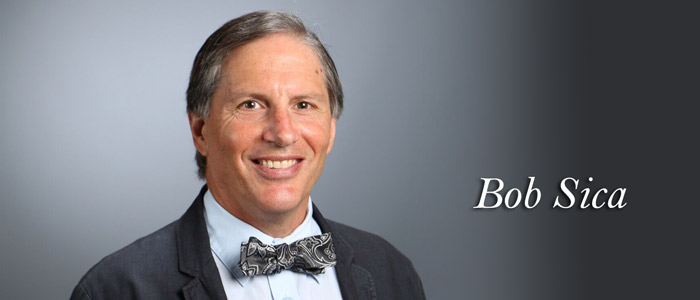
Bob Sica is the new Chair of the Department of Physics and Astronomy

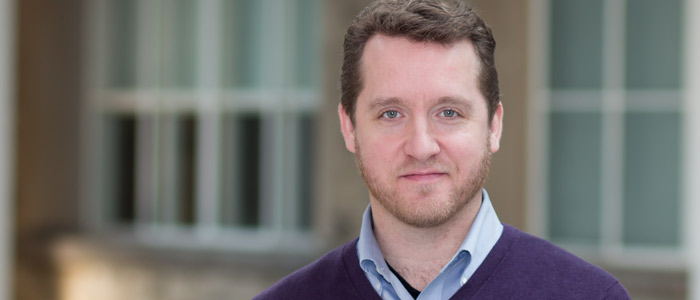
Bob_Sica_June2015_banner_c

Professor Robert (Bob) Sica has been appointed as the new Chair of The Department of Physics and Astronomy, starting on September 15, 2015.

Bob is an internationally renowned atmospheric physicist and founder of the Purple Crow Lidar facility at Western. He joined the department in 1988.

While Bob finishes his sabbatical at Meteoswiss, Professor Martin Houde will be Acting Chair, starting on July 1, 2015.

The Dean of Science, Charmaine Dean, made the following announcement:

“I am very pleased to announce Bob Sica’s appointment as Chair of the Department of Physics and Astronomy starting September 15, 2015, until June 30, 2020.

Robert (Bob) Sica is an atmospheric scientist who studied physics as an undergraduate at Columbia University in the City of New York. He earned his PhD from the Geophysical Institute of the University of Alaska in 1985, where he made some of the first measurements of atmospheric coupling between the aurora (Northern Lights) and winds in the upper atmosphere. He joined Western as an Assistant Professor of Physics in 1988 and in subsequent years expanded his studies of atmospheric coupling from the upper atmosphere to the surface.

At Western, Professor Sica and his group built one of the world’s most powerful lidars to measure dynamics, thermodynamics and composition of the atmosphere from the surface to the edge of space. This system, the Purple Crow Lidar, operates at the Environmental Sciences Western Field Station. Professor Sica’s national and international collaborations include the Canadian Network for Detection of Atmospheric Change in Eureka, Nunavut, the Network for the Detection of Atmospheric Composition Change lidar working group and the Swiss Weather Service, Meteoswiss.  He is currently working with Meteoswiss on the application of optimal estimation methods to the retrieval of temperature and composition from lidars.  In the area of teaching, Professor Sica was notably an early adopter and pioneer on using technology to enhance lectures.

Physics is one of the core areas of science, and its basic principles are the backbone of all university astronomy and physics departments. Professor Sica’s goal as Chair is for Western to establish a long-term plan based on differentiation and adaptation to keep the Department agile and strong. His aim is to keep the Department excelling in the basic areas of astronomy and physics, but he also anticipates leading it into new directions which complement its many existing strengths. As well, he hopes the Department will benefit from further collaborations with other Departments.

Please join me in welcoming Bob Sica to his new role as Chair of Physics and Astronomy.”

Celebrating the end of term for Chair Shantanu Basu

Shantanu_Basu_Chairs_farewell
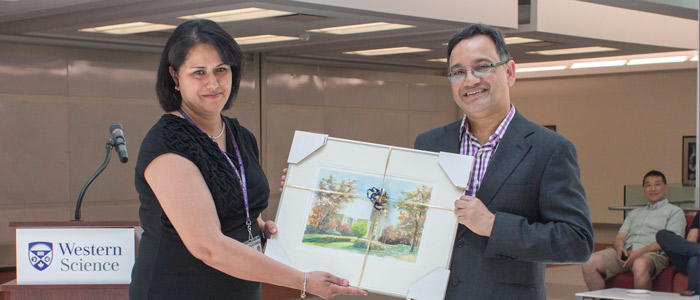
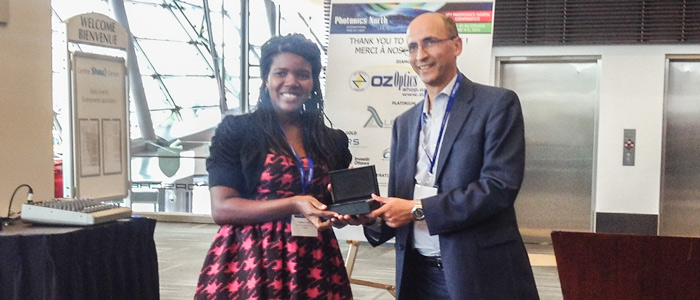
Loveleen Gill presents Shantanu Basu with a watercolour.

[more images on Flickr] [images via Lightroom]

The Faculty of Science and the Department of Physics and Astronomy hosted a celebration marking the end of term for Chair Shantanu Basu.

The event was held in the Physics and Astronomy building atrium on Wednesday, June 24, 2015.

Opening remarks were made by Administrative Office Loveleen Gill, who presented Shantanu with a commemorative watercolour landscape portrayal of Middlesex College.

Basu_flowers_350-1
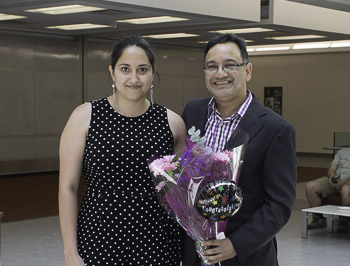
Sanaz Golriz presents Shantanu Basu with a bouquet of flowers.

Newly graduated PhD student Sanaz Golriz presented Shantanu with a beautiful bouquet of flowers.

Shantanu spoke of how he was proud of many accomplishements within the Department during his term, and he highlighted the wonderful graduate student community that has developed over the past several years.

Many of Shantanu’s friends from across campus, including President Amit Chakma, were on hand to celebrate with him.

As of July 1, 2015, Professor Bob Sica takes over as the new Chair of the Department of Physics and Astronomy.


The moon, Jupiter, and Venus on 21 June 2015

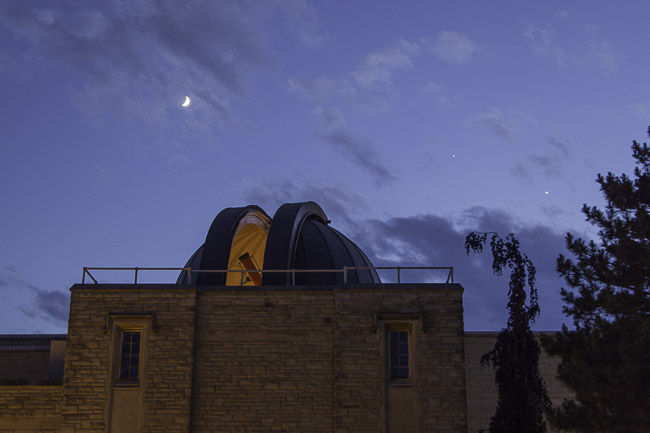
Cronyn_Obs_21June2015_650-1

[images on Flickr]

After many of us were treated to the wonderful conjunction of the moon with planets Venus and Jupiter at last night’s Cronyn Observatory public night (June 20, 2015), I decided to see what things looked like one day later.

The skies were completely clear as I set up to take photos of the Cronyn Observatory dome in front of the western sky. I was excited in finding a new vantage point on the loading dock behind Alumni Hall.

A short time into my photo taking, ominous dark clouds started to appear in the west.  I continued to concentrate on my photos, when to my surprise the observatory dome started rotating! That was quite a shock. It turns out the Jan has brought is mother and uncle up to try to view Jupiter and Venus through the 25cm scope. It was unfortunate that the clouds stayed around long enough to end our views of the these two planets until they had set.

Cronyn Observatory Public Night of 20 June 2015

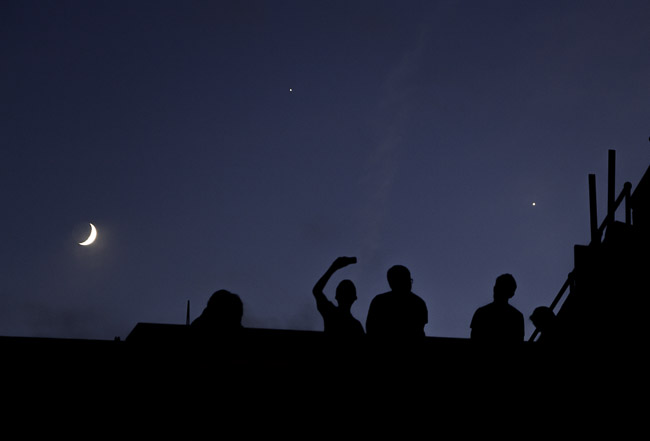
Cronyn_Obs_20June2015_650-1

[images on Flickr]

On this evening of June 20, a group of about 50 optimistic stargazers ignored the weather forecast to come out to one of the summer’s Cronyn Observatory public nights.

June has been a fantastic month for planetary observers.  On this evening, lucky viewers were treated to a spectacular conjunction between the planets Venus and Jupiter and the moon. The trio formed a beautiful triangle in the cobalt blue twilight sky.

Four telescopes were deployed on the observatory’s upper deck, where the visitors were treated to closeup views of Venus, Jupiter, the moon, the rising Saturn,  Vega, and the star complex of Mizar and Alcor.  The night air was muggy, and a steady breeze made for great seeing. Volunteers on the observing floor were Peter, Bob, Dale, Emily, Dilini, Matt, Henry, Heather, Paul, Mark, and Tricia.

In the lecture theatre, Sahar gave two talks titled “The Life Cycle of Stars”.

After a long wonderful evening of astronomy, if to say enough is enough, the clouds finally decided to roll in at closing time.

Cronyn Observatory public night of Saturday, 13 June 2015

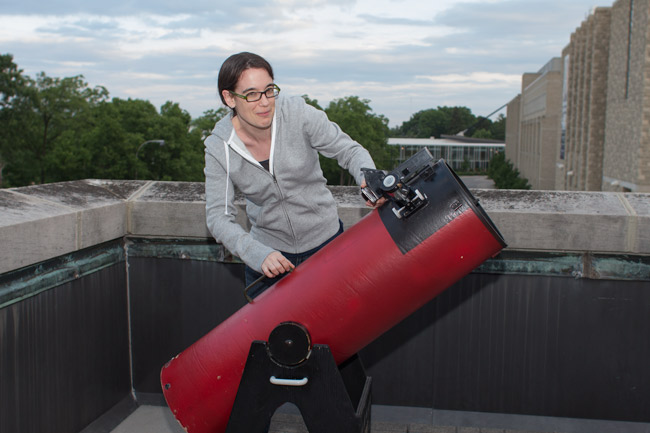
Cronyn_13June2015
Emily aiming the 25.4 cm Dobsonian towards Jupiter and Venus.

[images on Flickr]

With the weather forecast calling for increasing clouds, with rain beginning after midnight, an optimistic group of approximately 40 stargazers came out to the Saturday public night of June 13, 2015.

The winds were non existent, and the skies generally parted for most of the fairly humid evening.  Such sultry conditions can be excellent for observing planets, and this night was no exception.

Neil gave his classroom presentation twice during the evening. It was titled “Decoding Starlight”.

Shannon showed visitors the crescent Venus at very high power in the 25.4 main refractor.

Outside on the deck, Emily, when not working inside the dome, was using the 25.4 cm Dobsonian, pointing at Venus and later Saturn.

Tricia and Mark used the 20 cm Meade to look at the planets.

Later in the evening, as Saturn rose, there were unprecedented views in all telescopes, including views of the atmospheric bands and the Cassini division.

Amateur Heather also had her 90mm Celestron NexStar on the observing deck, and showed visitors both Jupiter and Saturn.


Stories of love and commitment behind our awards

Few of us heard the named awards for our undergraduate students:

  • Don Hay award for the student with the best fourth year thesis,
  • Maude Holt-Kingston award Gold Medal award for the highest achieving student in honour specialization in Astrophysics, and
  • Raymond Compton Dearle Gold Medal for the highest achieving student in  honour specialization in Physics

Even fewer know the history of the people behind these named awards.  Thankfully, our late Don Moorcroft has documented the history of the Physics & Astronomy department and contained valuable information.

Prior to 2015 award ceremony, I had the opportunity to get in touch with Diane Coffin, daughter of Donald Hay.  I asked about Don Hay and history, and here’s her reply:

Donald Ross Hay received his Bachelor of Science and Masters of Science from U.W.O. in 1946 & 1947. He then went on to receive his Phd from McGill University in 1952. In 1952, he was hired by the Department of Defence Research Board in Ottawa, Ontario as a scientist. 

In 1958, he was offered a position at U.W.O. as a professor of Physics, and established a research program in lower atmospheric physics, particularly micrometeorology, which he continued until his death in April, 1985. Throughout his career, dad published 96 articles, and one is currently archived in the Library of Congress in Washington, D.C. From 1963 until 1971, he was commissioned by the North American Treaty Organization (NATO) to attend annual meetings throughout Europe and Asia, and give lectures about his research.

Dad and mom were married in 1952, and his wife, Jean, still lives in London. She'll be 89 years old this year. My parents have two children - John and Diane - and three grandchildren - Ryan, Matthew, and Charlie.

This would be the 30th year anniversary of Don Hay’s passing, and the donation is given each year by Don’s wife Jean Hay.

That, to me, showed how deep Jean loved her husband, and the unwavering commitment to honour him.  I wanted all, not just the award winners,  to know this.

Maude Holt-Kingston was an endowed award in Astronphysics established by Prof Harold Kingston.  According to Moorcroft,

Harold Reynolds Kingston [1921-47] (Queens, MA, 1908; Chicago, PhD, 1914) arrived from the University of Manitoba and took over as Head of the Department of Mathematics. He took a great, although largely amateur, interest in astronomy, and following his arrival at Western the name of the department was changed to the Department of Mathematics and Astronomy, a name which remained until 1958-59. 

You read that correctly. Prof Kingston was a Mathematician, but when he got interested in Astronomy, he renamed the department to Mathematics and Astronomy!

The award was endowed by Prof Kingston in memory of his wife Ethel Maude Holt. This time, it is love from the husband for his wife.

(For some reasons, on the official handbook, Maude Holt-Kingston’s name was left out of this Gold Medal award, so I will need to followup with this.)

Last but not least, we have the Raymond Compton Dearle Gold Medal award for Physics. According to Moorcroft, Prof Raymond Compton Dearle [1919-58] (Toronto, MA, 1917, PhD, 1919), became the second Head of the department of Physics in 1919 and held the position for 30 years. In spite of the evident difficulties at Western, which that year had only 44 freshmen in the entire faculty of Arts, Dr. Dearle saw the opportunities for the Physics department.

It was Prof Dearle that helped plan the new Sciences Building (now, the Physics and Astronomy Building). Construction began in 1922, and into which all the science departments moved starting in 1924. It was renovated recently into this brand new Physics & Astronomy building that you now enjoy.

This award has been presented in the past number of years by Rev. Paul Ross, grandson of Prof Dearle. When I spoke to Rev Ross, I sensed the immense respect for Prof Dearle, and the love for his grandfather.

If you endured this lengthy blog, thank you. I hope you will find the human stories behind the men and women of these awards inspirational. I did. We scientists have long been trained to be “robotically” objective, and the human side may not shine through in our daily work.

Thank you.

Eugene