Administrative Office Jackie McLean retires

jackie_retire_banner2

Department faculty, staff, and students said goodbye to Jackie McLean, who is retiring as Administrative Officer as of Thursday, October 31, 2013.

Jackie started work at Western within the Finance Department, after which she spent 12 years with us in the Department of Physics and Astronomy.

A few informal lunches were enjoyed during the week, at which time Jackie was presented with some small gifts to help her with a few of her hobbies, which include gardening.

We wish Jackie all the best in her new found freedom.

[some images]

Shooting of promotional video

aerial_promo_shoot_2

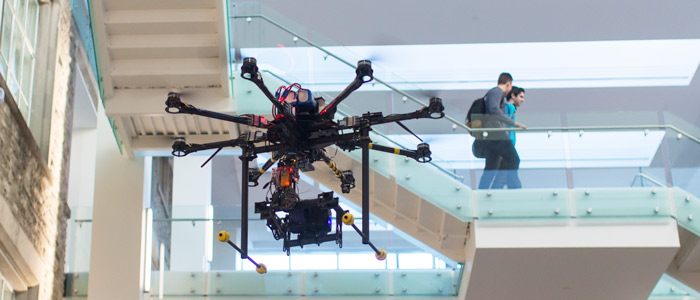
McLellan Group of Toronto, along with Sky Eye Media, visited the department on October 22 for the shooting of a promotional video. Shown in the photo is Morgan McLellan.

The video, to have its premier screening at the Grand Opening celebrations on November 29, 2013, will highlight the beauty of the existing building structure, along with the transformation created by the renovations, these having been completed in the fall of 2012.

Chris Bacik, of Sky Eye Media, is a Western graduate in both business and mechanical engineering, and it is his flying video camera which will give the production unprecedented aerial views of both the inside and outside of the Physics and Astronomy building.

Also to be highlighted in this new video production are some of the physics and astronomy laboratories within the newly renovated structure.

This production was orchestrated by Marilyn Steinberg and Mitch Zimmer of the Faculty of Science.

[ images of the video shoot ]

Andrei Venter wins CUPC 2013 poster paper first prize

andrei_venter_award

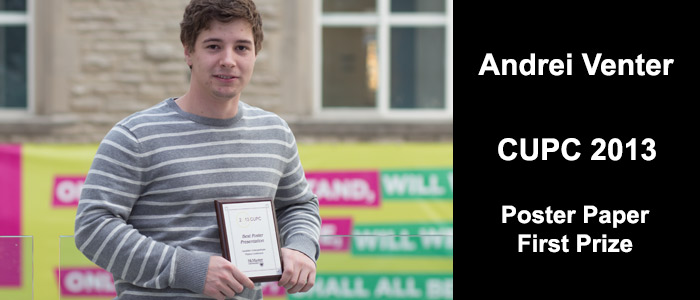
Undergraduate student Andrei Venter has won the First Poster Prize at the 2013 Canadian Undergraduate Physics Conference (CUPC) that was organized last week by McMaster University in Hamilton http://www.physics.mcmaster.ca/cupc/about/

As you may know, CUPC is the largest undergraduate non-profit physics conference in North America. It provides undergraduate students with the opportunity to share their research experiences with their peers and explore the various study areas in Physics. Our Department was also present at the conference with a graduate recruitment desk and a demo-lab on organic solar cell fabrication.

Andrei has been a summer student in our Physics and Astronomy Department this summer, co-supervised by Giovanni Fanchini and Mark Workentin (Chemistry Department), after receiving an Advanced Materials and Biomaterials Interdisciplinary (AMBI) Award offered by the Western Centre for Advanced Materials and Biomaterials Research (CAMBR).

Andrei’s presentation on “Facile nucleation of gold nanoparticles on graphene-based thin films from Au144 molecular precursors” was the product of his work this summer.

Well done, Andrei!

International Observe the Moon Night 2013 – a report

inomn2013_people_5

Here is a report on the International Observe the Moon Night activities, written by Bob Duff of the London Centre of the Royal Astronomical Society.

[images of the event]

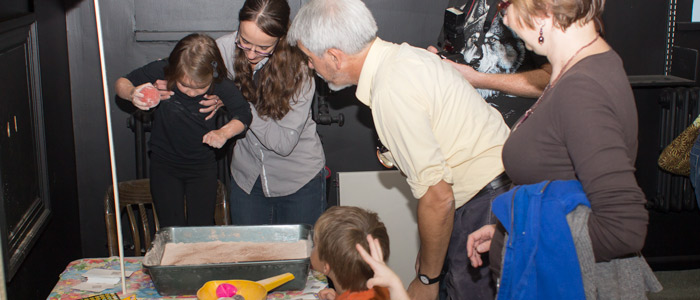
“Despite mostly cloudy skies, the Cronyn Observatory enjoyed an excellent turn-out of visitors for the International observe the Moon Night, Saturday, October 12th, 2013, 5:00—10:00 p.m. People enjoyed fun activities, public talks and a panel discussion for space enthusiasts of all ages. Faculty members present included Dr. Jan Cami, Dr. Phil Stooke and computer support Henry Leparskas, who took pictures [ed. Annemarie and Ethan also took photos].

Dr. Phil Stooke presented videos of the Apollo Moon landings. Postdoctoral Fellow Dr. Bhairavi Shankar (CPSX/CLRN) joined Dr. Phil Stooke on the panel discussion moderated by graduate student Neil Bhatt. Graduate students conducted various activities, including the Art Contest, supervised by Kendra Kellogg and Ethan Luo; the Impact Cratering Experiment, Tony Martinez; Meteorites and Information Desk, Shannon Hicks and Dilini Subasinghe; and Moon Landing Sites, Parshati Patel and Dimuthu Hemachandra.

Graduate student Ted Rudyk operated the big 25.4cm refractor in the dome showing people the Moon (52mm Erfle eyepiece, 84X) between clouds, throughout the evening. Emily McCullough answered questions. Maryam Tabeshian looked after crowd management and there were other graduate students who assisted.

RASC London Centre was represented by 7 members, including Everett Clark, who arrived early at 3:00 p.m. and set up all 3 telescopes including the big 25.4cm refractor in the dome. Everett and Steve Imrie took charge of the London Centre’s 25.4cm Dobsonian and showed people the Moon using the 17mm Nagler eyepiece (66X). Everett and Bob Duff also showed people the Moon, between clouds, in the Meade 8-inch (20.3cm) Schmidt-Cassegrain, using the 20mm Plossl eyepiece (100X). Harold Tutt set up his Stellarvue 80mm refractor in the parking lot early in the evening, showing some visitors the Moon. Peter Jedicke and Dave McCarter talked to visitors and Mike Jager also arrived with his family and left early.

Certificates of Participation were awarded by the graduate students to people who had observed the Moon through a telescope. There were prizes including the book by Apollo astronaut Harrison Schmitt, “Return to the Moon” and a Galileoscope. Everett handed out 3 “Star Finder” planispheres. In all it was an excellent evening despite the clouds with an estimated visitor turn-out of around 200 people.”

Bob Duff
Higher Education Liaison
RASC London Centre

[see Cronyn Observatory web page]

What has astronomy done for you?

I do science because it’s exciting and fun and challenging.  I particularly like supermassive black holes because they are extreme and energetic, and I can study physics that people can’t see “in the lab”.  These aren’t the sorts of motivations that go over well with business-oriented, bean-counting government agencies, however.  So here’s what I would share with them to justify supporting people like me:

Why is Astronomy Important?

(Full disclosure:  One of the authors of this article, Marissa Rosenberg, worked with me as an undergrad at UCLA.  She will be visiting to give an Astronomy Seminar in early December.)


Frozen Thunder – Only in Canada !

frozen_thunder_1_15Oct2013[photo by Bob Truman skihere.ca]

While those of us in London consider raking leaves,  the Canmore Nordic Centre in the Alberta Rockies is already thinking snow.

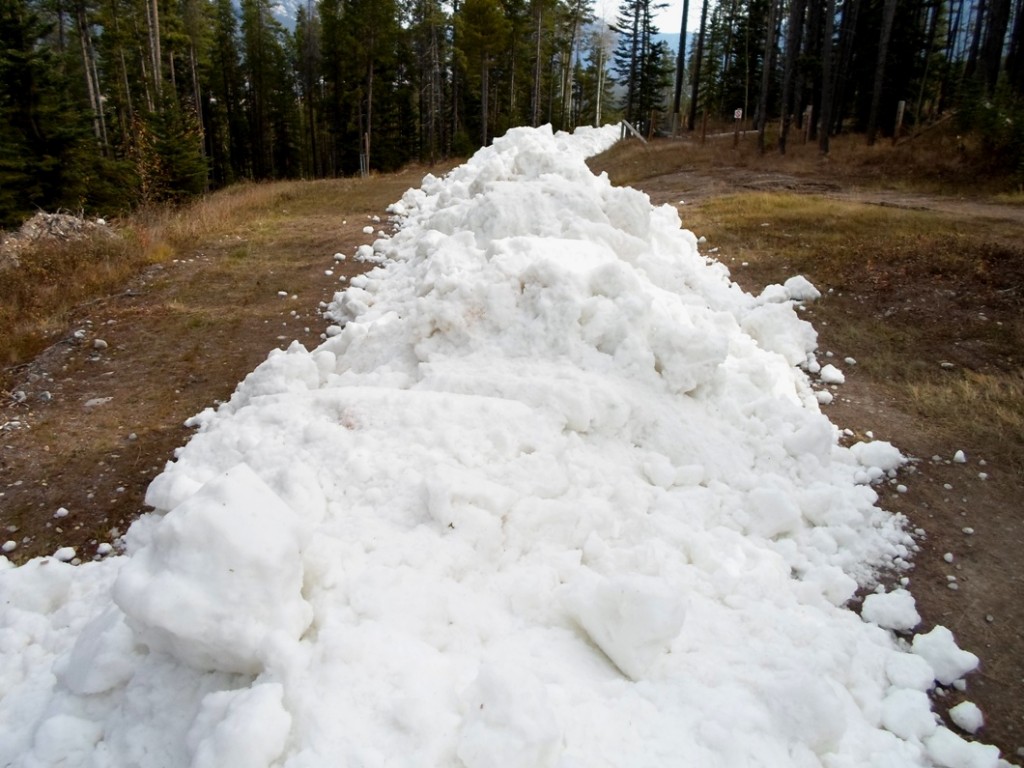
On Oct. 15, construction  began, for the 5th consecutive year, on the Frozen Thunder ski trail.

This trail provides about one extra month of access to a real snow for Canada’s national nordic ski team, as well as for teams from Europe and the U.S.

Recreational skiers can also purchase a pass for Frozen Thunder.

Where does the snow come from?  During the winter, artificial snow is blown into a large  pit. In the spring this snow is then covered with sawdust, and is opened up in October of the following year.

Video 1 – dumping the snow. (video by Bob Truman  skihere.ca)

Video 2 – early season skiing (2010) (video by xcgeek)

Video 3 – Oct. 26, 2011 ( Bob Truman)

Video 4 – The real deal ( Ray Schmidt)

Only in Canada, eh !