I do science because it’s exciting and fun and challenging. I particularly like supermassive black holes because they are extreme and energetic, and I can study physics that people can’t see “in the lab”. These aren’t the sorts of motivations that go over well with business-oriented, bean-counting government agencies, however. So here’s what I would share with them to justify supporting people like me:
(Full disclosure: One of the authors of this article, Marissa Rosenberg, worked with me as an undergrad at UCLA. She will be visiting to give an Astronomy Seminar in early December.)
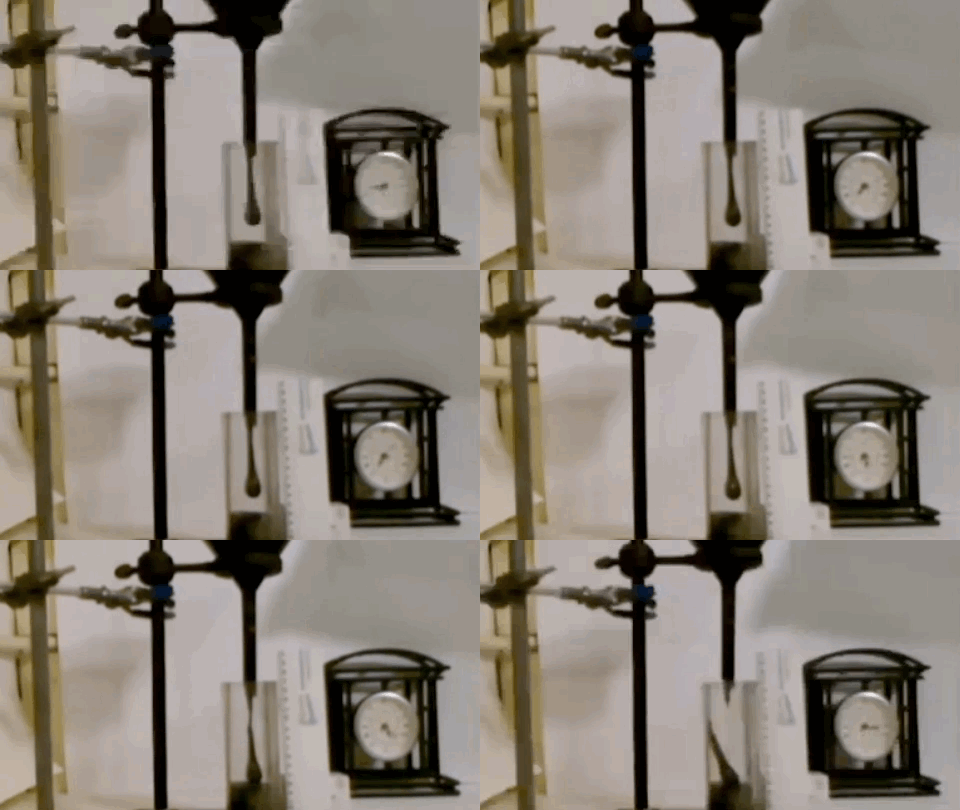
Here is a nice description of an experiment on-going since 1944 to capture the once-in-a-decade events when a drop of pitch falls through a funnel. Last Thursday, it happened, and webcam technology meant that the pitch drop was finally documented. Pitch is an example of a non-Newtonian fluid – a material whose flow properties are weird (to use the technical lingo — cornstarch in water is the classic example). Research in non-Newtonian fluids is happening in our Department.
Non-Newtonian fluid (briefly) in action. Credit: Trinity College/Chris Heller
I am glad to see Rhett Allain of Wired doing the necessary work of figuring out the mass of Darth Vader such that he doesn’t tip over while “interrogating” a subordinate in the original Star Wars. According to his calculations, Vader has to be about 200 kg in order to keep the centre of mass of the Vader-peon system over his toes. This seems unreasonably large. However, I think the trick is that Vader’s cape is REALLY heavy.
This post by Chad Orzel is a great meditation on what is useful and powerful about physical reasoning, and also a cautionary tale on the quality of science writing in some popular books. Best quote: “There’s a discussion of neutrinos that’s so awful I don’t even know how to correct it enough for it to be wrong”.
Some of the best science writing I have read recently was in the novel Red Plenty: Inside the Fiftie’s Soviet Dream by Francis Spufford. There is a passage on the behaviour of electrons in a vacuum tube that is vivid and beautiful (Part Two, Chapter 2), and a rather frightening description of lung cells mutating under the influence of carcinogens (Part Six, Chapter 1). The novel overall is a fascinating treatment of science and economics at the height of the Cold War in the USSR.
Yuri Gagarin’s daughter answers the phone. ‘No, mummy and daddy are out,’ she says. ‘Daddy’s orbiting the earth, and he’ll be back tonight at 7 o’clock. But mummy’s gone shopping for groceries, so who knows when she’ll be home.’
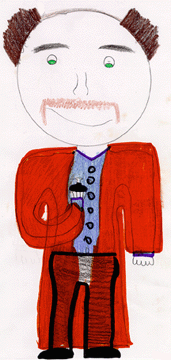
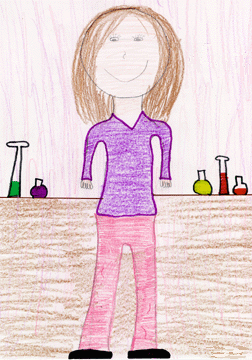
Grade 7 students living near Chicago drew pictures of how they imagined scientists looked. There were a lot of lab coats! Crazy hair! And glasses! And not too many women, either. Then they visited the US Department of Energy’s Fermilab and met some actual scientists. The before and after drawings are definitely worth checking out, as well as the explanations of what a scientist does.
Left: before visiting Fermilab; Right: after visiting Fermilab. Image credit: Rachel
Bard Canning took the original 4 frames/second NASA video of the descent and applied some ninja editing moves to create an “interpolated” HD video of the descent posted on YouTube.
As the summer winds down, there are still a few more potential beach days before classes get going again. Be prepared for those sand castle competitions: getting the optimal ratio of water-to-sand is the key to building taller sand castles. Apparently most of us use sand that’s too moist! See the original article for more specifics.