
A “black hole hunter”, NuStar is the first hard X-ray space telescope with focussing optics. Watch the launch video.
All posts by Sarah Gallagher
Dragons in Space
SpaceX has successfully docked the Dragon spacecraft with the International Space Station in a first for a commercial vehicle. When do we go to Mars?
Astronomical Success at the London Science Olympics
Our “Extrasolar Systems” science olympics event was expanded into an Astronomy Triathlon and incorporated into the Grade 9 Pentathlon in Thursday Science Olympics. We went from 5-6 teams per year to 17! Event organizer Allison Hill did an excellent job revising the event to take into account the new Ontario grade 9 astronomy curriculum. Thanks are also due to Alex DeSouza, Tyler Desjardins, Robbie Halonen, Matt Abado, and Laura Lenkic for contributing to the planning and execution of the event.
Cautionary tale
Bad things can happen in the twilight years of a physicist. Here is one example.
Found sundial on the Adriatic Sea
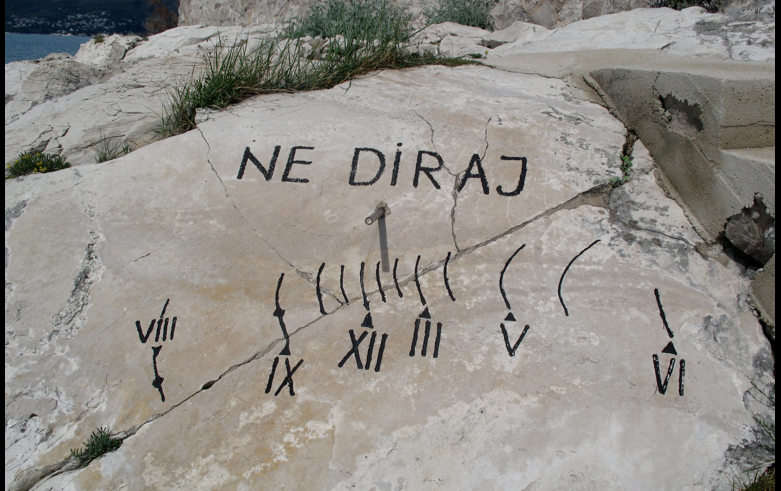
While at a conference in Dubrovnik, Croatia, I came across this sundial on the beach in a nearby town. The photo was taken in mid-April, 2012 – what time is it? (Don’t forget that most sundials aren’t set to daylight savings time!)
Happy Birthday to Margaret Knight & Fritz Zwicky
For those of you not in the mood for Valentine’s Day, here’s to two originals born on February 14th — the inventor Margaret Knight (1838-1914) and the astronomer Fritz Zwicky (1898-1974).


New Vega rocket for small payloads launched by ESA.
The rocket deployed 9 small satellites into orbit, including three built by university students in Poland, Romania, and Hungary.
More details on the launch. Video of yesterday’s launch.
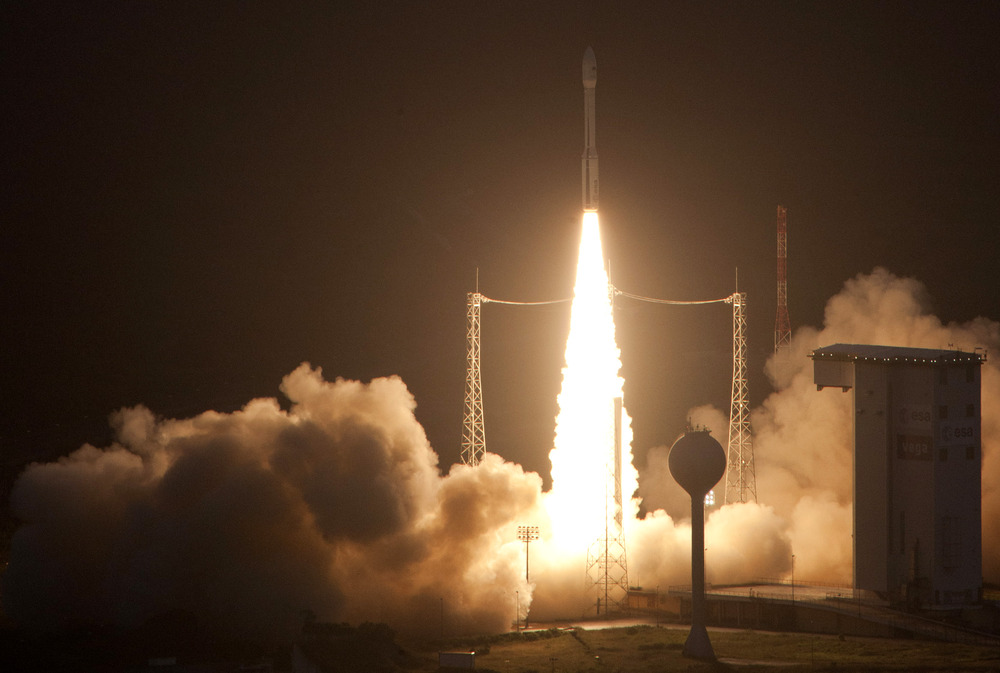
Image credit: ESA – S. Corvaja
Romance, mathematically speaking
Dancers (apparently) defying the laws of physics @jordanmatter
Photos by Jordan Matter from the project “Dancers Among Us” are made with no digital manipulation.


Star system with three rocky planets found by @Kepler #exoplanets
The known population of exoplanets is getting smaller, rockier, and more numerous. See the full release. The largest system of small planets known to date is still the first discovered, but they were a bit different. In 1992, Alex Wolczan and Dail Frail found the first pulsar planets.