2015 CAP Lecture – Dr. Gabor Kunstatter – March 5

CAP_2015_kunstatter_700x300

2015 Canadian Association of Physicists (CAP) LECTURE TOUR

Date:              THURSDAY, 5th March 2015
Time:              3:30 p.m.
Location:       Physics & Astronomy Room 106

Dr. Gabor Kunstatter
Department of Physics
University of Winnipeg

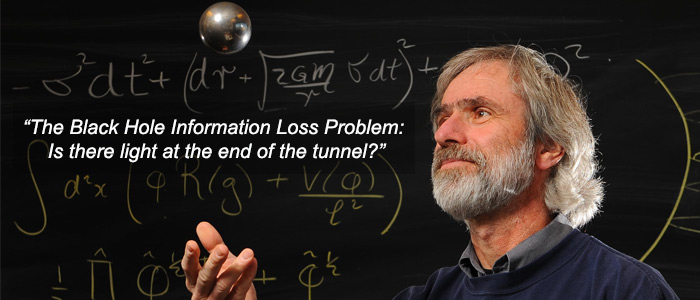
“The Black Hole Information Loss Problem: Is there light at the end of the tunnel?”

ABSTRACT

There is substantial evidence that black holes exist in binary star systems and at the center of most galaxies, including our own. Hawking’s famous calculation of the mid 1970’s proved that black holes evaporate by emitting radiation that does not contain any information about the state of the matter that formed the black hole. This leads to one of the deepest conundra of modern theoretical physics: what happens to this information once the evaporation is complete? Is it lost forever to the outside world or does it somehow emerge at the final stages of evaporation?


After a brief review of black holes and the evidence for their existence, I will describe in more detail the nature of the black hole information loss paradox. I will then list several proposed resolutions. Finally I will offer a different, more mundane solution to the problem based on the fact that the singularity which is thought to lurk at the center of all black holes and lies at the heart of the conundrum cannot be realized in nature. I will use a simple phenomenological model to argue that taming the singularity resolves the conundrum by allowing the information to emerge at the end of the evaporation process.


Short Bio of the Speaker:

Gabor Kunstatter is a well-known Canadian theoretical physicist who has done significant work on Black Holes and Quantum Gravity. He received his PhD from the University of Toronto. He did postdoctoral work at the Imperial College of London and was a visiting scientist at the Massachusetts Institute of Technology before becoming a professor of Physics at the University of Winnipeg. Gabor is a recent past President of the Canadian Association of Physicists.
The Physics and Astronomy building has been re-opened following a water leak

Effective immediately, on February 19, 2015, the Physics & Astronomy Building has been re-opened to normal access.

Limited access to the 1st floor west wing and 2nd floor west wing remains in effect. Only those with offices in those areas access the areas.

Ground Floor, 1st floor, and 2nd floor Atrium Areas remain closed to all.

Please use the exterior stairwells or the elevators to travel between floors.

Those whose offices have been directly affected by water damage will be contacted individually as to when they can return to their respective offices. Clean-up efforts have progressed ahead of schedule allowing for this earlier re-opening of the building. Just the same, clean-up efforts continue in some limited areas.

Physics and Astronomy building closed to general public for remainder of the week of Feb. 16, 2015

Following an unexpected water leak on the morning of Tuesday, Feb. 17, 2015, the following is a note from Chair Shantanu Basu,

“Here is the plan going forward for the rest of the week.

1. All rooms listed (in private email) are closed for the week. If you need to arrange to recover valuables from any of them, please contact Phin Perquin, phin@uwo.ca.

2. The building as a whole is locked for the rest of the week. However, anyone with card access can still enter the building.

3. While the atrium areas and rooms listed above are closed, people with card access may continue to use other parts of the building. Staff members are expected to report for duty, and graduate courses or research are expected to continue. Graduate students should check with their supervisors. All graduate student offices are still accessible.

4. The front office will remain open this week and on reduced hours 10 am – 12 pm, 1 pm – 3 pm. Loveleen is the only front office staff person on duty this week so we ask for your understanding to bring forward only essential issues.”

Inaugural table tennis / chess session – Let the Wellness begin !

table_tennis_650px-3
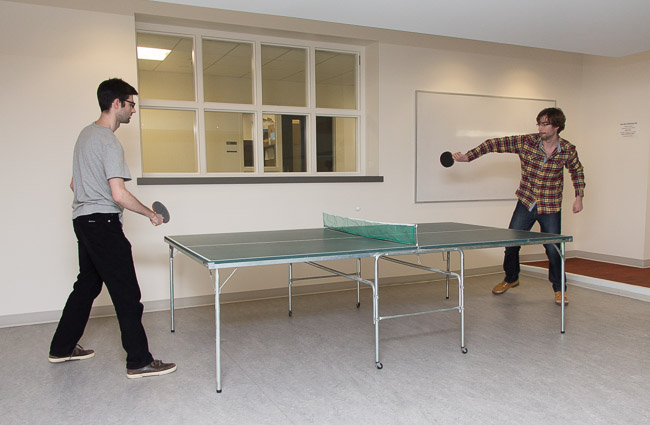
Scott (left)  plays Mark

Thanks to an initiative by Chair Shantanu Basu, the department has acquired a second mental wellness apparatus, (the first unofficial one being the grad chess set).  The apparatus was donated by retired staff member Michel Debruyne, who was quoted as saying that because his mental wellness level was quite satisfactory, he felt that he could part with his old  table tennis table.

Many thanks go to Brian D. and Frank V. for transporting the beast.

The inaugural session was arranged by Mark Baker, who took on wily veteran Henry in the very first game.  This was closely followed by a more serious match between Mark and Scott, followed by  Dave, Richard, Amanda, Onaiza, and Matt (ed. sorry if I missed the late comers).

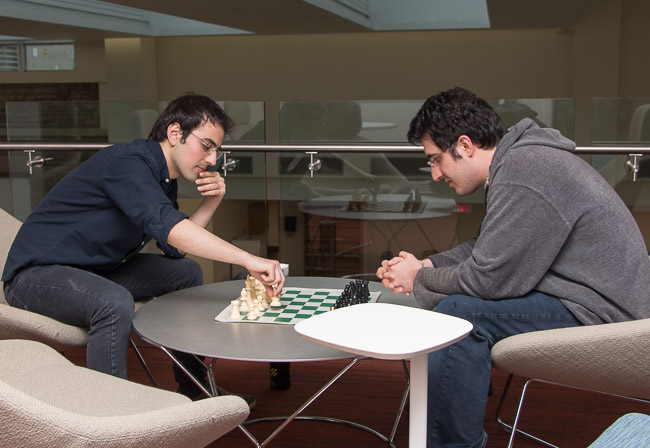
The really good news is that the noise level is much lower than expected, and in fact, chess players Sina and Masoud were able to continue their game during the potential distraction going on behind them.

[more images]

table_tennis_650px-2
Masoud (left) plays Sina


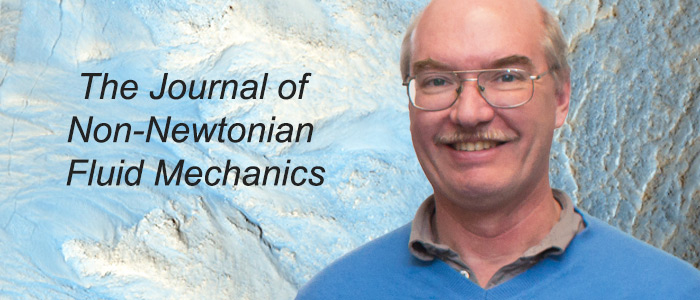
John de Bruyn appointed to editorial board of The Journal of Non-Newtonian Fluid Mechanics

deBruyn_Journal_Fluid_Mechanics

Physics and Astronomy Professor John R. de Bruyn has been appointed to the editorial board of  The Journal of Non-Newtonian Fluid Mechanics.

This appointment recognizes John’s contributions to the field, where he specializes in experimental condensed matter physics, including research on soft materials, complex fluids, biological physics, granular flows, and applied physics.

[Background image: gullies on Mars, photographed by NASA’s HiRise, could have formed by flowing water, liquid carbon dioxide, or dry granular flows.]

Coffee and tea break – for the body and the soul

coffee_10feb2015_650px-1The newly slotted departmental coffee/tea break time is starting to grow legs.

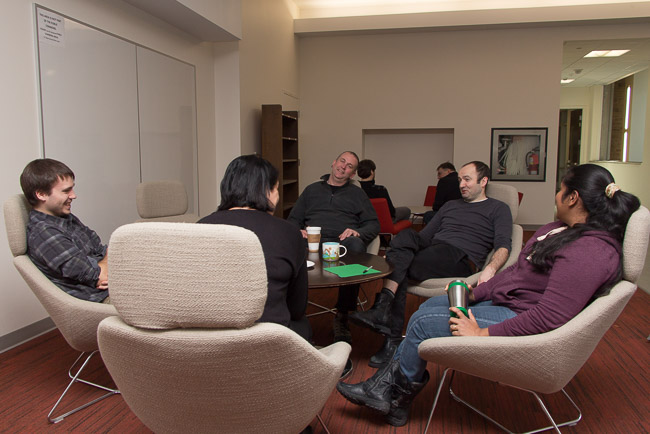
There was a good turn out this past Tuesday morning, and cheery banter ensued from all tables.

Organizing the refreshments again were Tony Martinez and Dave Stock.  The challenge for these novitiates was how to concoct a good rich urn of coffee that would satisfy the Tim Hortons addicted masses.  Last week’s attempt to proportion the coffee grounds and water according to Bodes Law proved unsuccessful, and today’s brew ratio, based on stellar diffusion theory, showed that the task is no simple matter. Apparently next week’s effort will involve radiative transfer theory, with a guest barista ready in the wings to make a surprise appearance.

coffee_10feb2015_350px-2As Will Handler was heard saying, “Bring it on baby !”

[more images]

“Snow day, no way!” says graduate student

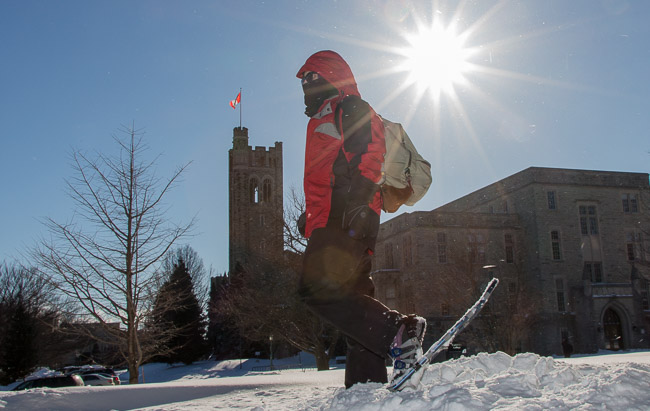
beth_snowshoes_650px-1Astronomy graduate student Bethany Grzenia is an avid snowshoer, so this post-blizzard morning was like a dream come true for her, as she made good use of her ‘racquets’  to navigate to campus.

The following came to Beth’s mind as she communed with nature;

“Neither snow, nor rain, nor heat, nor gloom of night, stays these couriers from the swift completion of their appointed rounds.” – Herodotus, 503 B.C. (Inscribed on the General Post Office facility on 33rd Street and 8th Avenue in New York City.) (Source: USPS)”