Applied Optics and the Jumping Spider

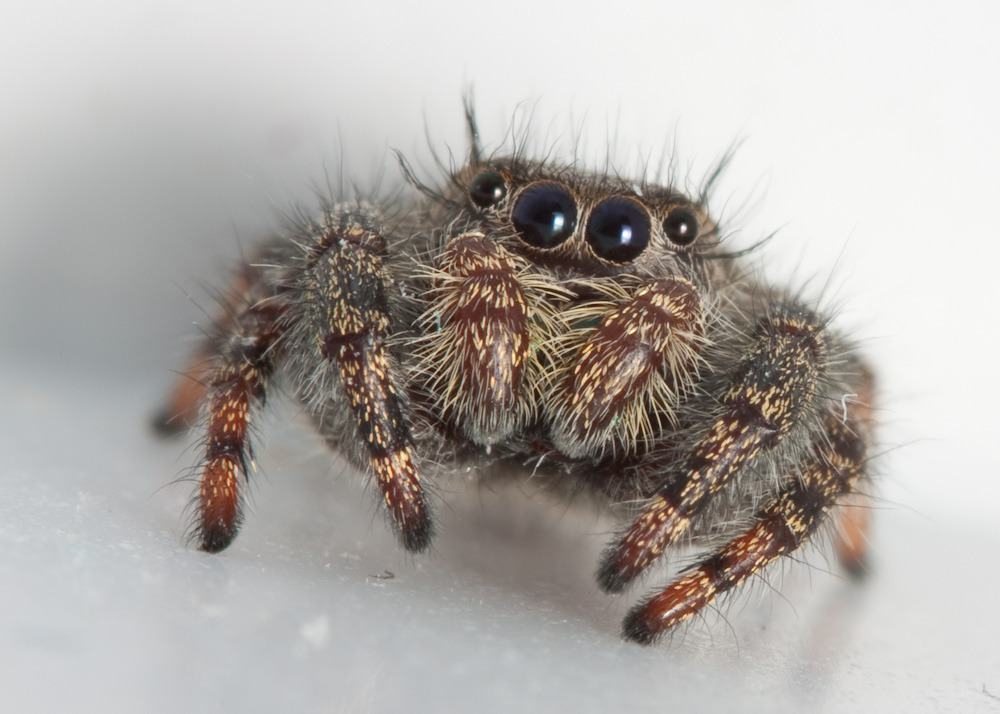
I recently ran across an article in Wired Science that described a way cool experiment on how jumping spiders hunt.

Jumping spiders capture their prey by – you guessed it – jumping, rather than by building webs.  One mystery has apparently been how their tiny brain is able to accurately judge the distance to their prey.  The claim in the article is that it involves an unusual form of depth perception.  Jumping spiders have retinas consisting of four layers of light-sensitive cells, rather than a single layer like ours.  As a result, if the image of a tasty fly is in focus on one layer of the retina, it must be out of focus on the others.  The spiders use the difference in sharpness to judge the distance to the target.

To test this hypothesis, Nagata, et al., put spiders in a jar with some fruit flies and watched the ensuing hunt.  They found that under green light, the spiders were able to catch flies, but under red light, they would systematically miss by ~10%.  Their interpretation: due to dispersion in the spiders’ lenses, red images are not as blurry on the defocused layers as a green image would be for the same distance, thus fooling the spiders into thinking they were closer to their target.  Of course this would not be an issue if their 3D perception arose from binocular (octonocular?) vision.  For more details, read the Science paper.

Kind of a nice combination of simple optics and biology.

The Wiredarticle has a better spider picture than the one below, but I took this one myself.  If you were a fruit fly, this might be the last thing you ever see …

CAP University Prize Exam

Any undergraduate students interested in writing the Lloyd G. Elliot University Prize Exam sponsored by the Canadian Association of Physicists should contact Prof. Jeff Hutter as soon as possible to make arrangements.  This year’s exam will be held on Tuesday, February 7 at 1 pm.

The University Prize Exam takes place each February and is designed to provide an interesting as well as challenging experience.  The exam content includes all of the core areas of undergraduate physics, and their applications to both familiar and unfamiliar situations.

The exam website contains more information, as well as sample exams from previous years.  Note, however, that the exam guidelines were changed beginning in 2011 to make the exams less impossible, so don’t be too traumatized by what you see.

What’s in it for you?  The top student at each university is listed on the CAP site, and there are cash prizes available for the top three in the overall competition.


Physics & Astronomy Colloquium – This THURSDAY, 2nd Feb. – DR. ANDREA SODDU, University of Liège

Poster: http://www.physics.uwo.ca/colloquia/Colloquia%20Notices/2011_2012/SODDU%20Research%20Talk.pdf

The University of Western Ontario
DEPARTMENT OF PHYSICS AND ASTRONOMY

PHYSICS & ASTRONOMY COLLOQUIUM

Date:           Thursday, 2nd February 2011
Time:          1:30 p.m.
Location:    Physics & Astronomy Seminar Room 22

Dr. Andrea Soddu
University of Liège
Liège, Belgium

“Neuroimaging in patients with disorders of consciousness: listening to a shy brain when the heart is shouting”

ABSTRACT

Patients who survive a severe brain injury, patients in coma, vegetative state, minimally conscious state and locked in syndrome represent a problem in terms of diagnosis, prognosis, treatment and daily management. The use of appropriate standardized behavioural scales at the bed side has been proven to be a relevant step for a proper diagnosis but chances to miss signs of consciousness are still not marginal. The possibility to support behavioural evaluations with neuroimaging techniques offers an additional tool to reduce the chances of misdiagnosis. Multimodal approaches combining different neuroimaging data sets are very promising and the importance of centres offering different techniques appears nowadays to be strategic for the studies of these disorders.

Beware: 16 reasons why people fail

I recently came across this list of 16 reasons why people fail in their careers. It is really a review (by Harvey Schachter) in the Globe and Mail Business section on the book “Why People Fail” by Simon Reynolds, but in summarizing the book, it provides a concise and insightful list.

My favorite is really a rewording of the old adage ‘brain over brawn’: Not enough thinking: An obsession with doing, doing, doing will ultimately do you in. Instead, you must think, think, think.

http://www.theglobeandmail.com/report-on-business/careers/management/morning-…


Ski waxes – from TAR to NANO


Ski waxing has always been about two things – make the ski glide faster, and make a wax that can last longer. And this doesn’t include the special needs for ‘grip’ or ‘kick’ wax for the classical nordic skier.

The first glide waxes were made of pine tar. Glide wax needs to be hydrophobic so that it can repel water. A coating of pine tar over the old wooden skis fit the bill, and was already available from the ship building industry.

Modern waxes now tout the ‘NANO’ slogan, and can come if powder, hard, or liquid form.Their manufacturers (Holmenkol, the oldest ski wax maker in the world) claim to have improved not only the chemistry, but the physics of the wax,

They keep some of this research secret, but the physics may well pertain  to improving not only the gliding properties of a ski but the texture and surface structure of the ski base, which is important with respect to reducing suction on wet snow, for example.

Interestingly, modern ski waxes vary their hydrophobic properties by varying the amount of fluorocarbon in the mix.  This has turned out to be a potential health risk for those subjected to the smoke and fumes associated with ski waxing.

See: History of ski waxes (source for the above)

See also: Ski wax and the environment

How to thesis: Focus

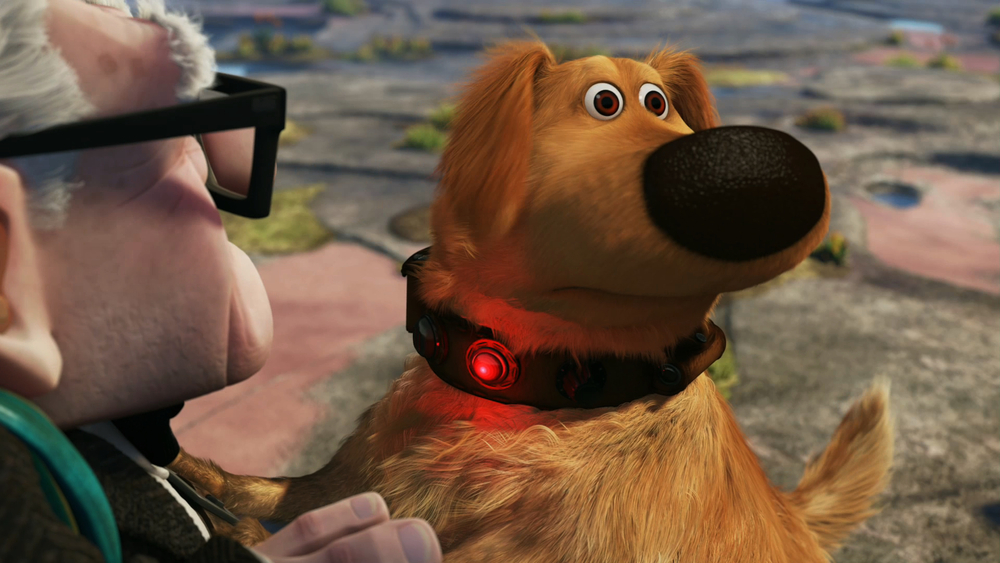
Focusing on one task for a long period of time is somewhat important for writing a thesis (or doing any task that requires sustained concentration in general).  However, it has never been a strong suit of mine.  Sometimes I feel a lot like that dog from the movie Up.

Fortunately, I have picked up some tricks that help me concentrate and perhaps this information can be helpful to others who might still be having problems with this.  Here they are:

Sleep

Now, this may sound obvious, but keeping a regular sleep schedule can be difficult sometimes and a lot of the time, sleep gets set aside in favour of more time to do work.   However, getting a solid x hours of sleep a night (where x is the number of hours you require to feel rested) is really key to working well.

There’s even science to back this up.  People who are sleep deprived experience more difficulty in performing tasks requiring a lot of attention as well as doing things like forming new memories (if you needed another reason to avoid staying up all night cramming for midterms the night before).

Of course, it’s also an entirely different thing to forgo sufficient sleep in the days just before a deadline than it is to make a habit of it.

Exercise

Regular physical activity not only helps with sleep quality and reduces stress, but personally, I find it makes me a lot less restless during the day.  If I’m less restless, I can get more work done.  It also has a lot of health benefits, so it’s a good thing to do aside from helping you pay attention.

Caffeine

If you’re the sort of person who has a lot of negative effects from caffeine, this won’t help.  But there are studies indicating that caffeine does help improve focus and attention span.  This may seem a bit counterintuitive (e.g. shouldn’t it make you more restless?), but it does make sense when you consider that a well-rested person can focus better than one that is sleep deprived/tired and that caffeine is a stimulant, which will temporarily make you feel less tired.

Scheduling

I think I’ll write more on this point in another post, but in short: Make a schedule and try to stick to it.  If you make a series of small goals throughout the day (or mini-deadlines, if you prefer to think of it that way) and make a sincere effort to accomplish the tasks you set by the time in which you set out to do them, it can be easier to focus on that one task that you want to finish by a certain time.  Don’t beat yourself up if you fail to meet your schedule, just do your best (you can never anticipate the difficulties that might crop up during a particular task if you haven’t done it).

Take Breaks

By this, I don’t mean that you should randomly take some time out of your day to browse youtube.  I mean you should schedule some breaks throughout the day (say 10 minutes every hour) in which you do something that takes you away from the task you were performing.  So if you were working on your computer, go for a walk, have a snack somewhere that isn’t your desk, make some coffee/tea, do some dishes, whatever.

Working in small chunks makes it easier to focus (you don’t have to do it for nearly as long) and doing something different from your previous task really gives you a break from it.  If you go from sitting at the computer working to sitting at the computer checking your email, this isn’t quite the same effect (your body isn’t getting a break from its previous task).  You may also find that taking a walk can give you time to mull over any issues you were having with your work and perhaps you can think of a few solutions by the time you get back to your desk.

Music

This definitely doesn’t work for everyone.  It does work for me (and I know I’m not alone in this), but listening to music or having some background noise (nothing too loud, just enough that it’s not absolute silence) helps me pay attention to my work a lot.  It might come from growing up in a fairly noisy house and doing most of my homework in front of the television when I was in high school, but I really just can’t focus when it’s quiet (nor can I focus with construction noises).

I hope that my tricks to stay focused are helpful.  If you have any tricks that you employ, feel free to leave comments because perhaps what works for you will work for other people too.

Until next time…

SQUIRREL!


Sarah is in the final year of her PhD.  “How to thesis” is a series in which she imparts various (hopefully) useful things she has learned during her graduate career.

Kepler finds more planets

Yesterday, NASA announced that Kepler has found 11 planetary systems with a total of 26 new planets.  This triples the number of stars known to have multiple planets in orbit.

Additionally, each of these new planetary systems contains between two and five planets with close enough orbits that the gravitational interaction between the planets accelerate their orbits.  This acceleration changes the orbital periods of the planets, which allows astronomers working with Kepler a new way to verify the existence of these planetary systems (check the link for a video explaining this).