All posts by Jeff Hutter

Applied Optics and the Jumping Spider

I recently ran across an article in Wired Science that described a way cool experiment on how jumping spiders hunt.

Jumping spiders capture their prey by – you guessed it – jumping, rather than by building webs.  One mystery has apparently been how their tiny brain is able to accurately judge the distance to their prey.  The claim in the article is that it involves an unusual form of depth perception.  Jumping spiders have retinas consisting of four layers of light-sensitive cells, rather than a single layer like ours.  As a result, if the image of a tasty fly is in focus on one layer of the retina, it must be out of focus on the others.  The spiders use the difference in sharpness to judge the distance to the target.

To test this hypothesis, Nagata, et al., put spiders in a jar with some fruit flies and watched the ensuing hunt.  They found that under green light, the spiders were able to catch flies, but under red light, they would systematically miss by ~10%.  Their interpretation: due to dispersion in the spiders’ lenses, red images are not as blurry on the defocused layers as a green image would be for the same distance, thus fooling the spiders into thinking they were closer to their target.  Of course this would not be an issue if their 3D perception arose from binocular (octonocular?) vision.  For more details, read the Science paper.

Kind of a nice combination of simple optics and biology.

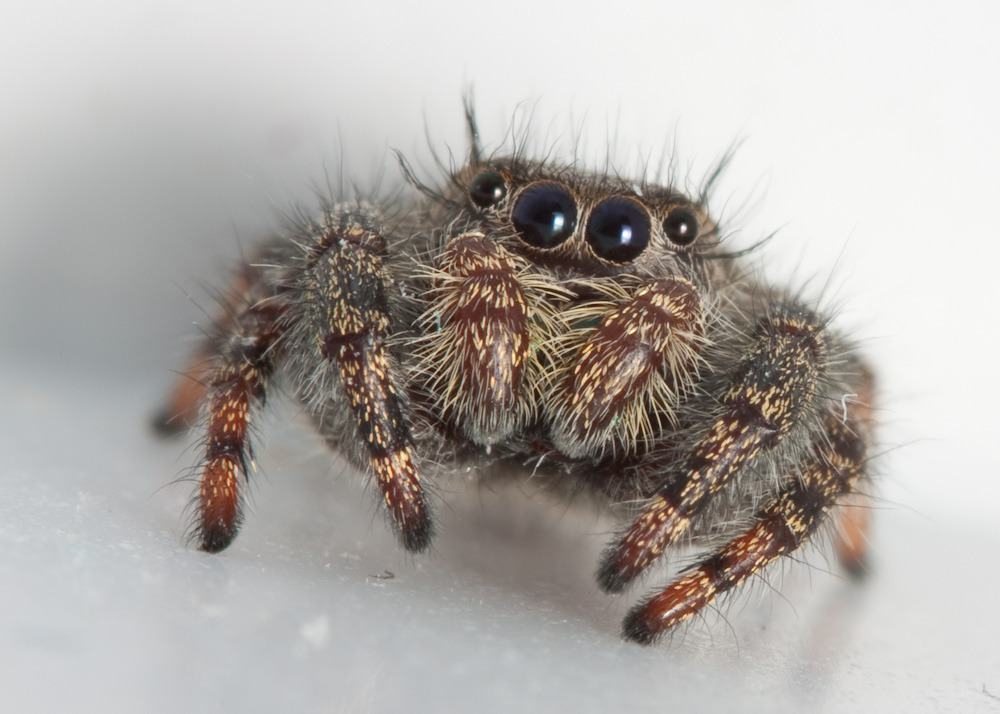
The Wiredarticle has a better spider picture than the one below, but I took this one myself.  If you were a fruit fly, this might be the last thing you ever see …
CAP University Prize Exam

Any undergraduate students interested in writing the Lloyd G. Elliot University Prize Exam sponsored by the Canadian Association of Physicists should contact Prof. Jeff Hutter as soon as possible to make arrangements.  This year’s exam will be held on Tuesday, February 7 at 1 pm.

The University Prize Exam takes place each February and is designed to provide an interesting as well as challenging experience.  The exam content includes all of the core areas of undergraduate physics, and their applications to both familiar and unfamiliar situations.

The exam website contains more information, as well as sample exams from previous years.  Note, however, that the exam guidelines were changed beginning in 2011 to make the exams less impossible, so don’t be too traumatized by what you see.

What’s in it for you?  The top student at each university is listed on the CAP site, and there are cash prizes available for the top three in the overall competition.


Graduate Opportunities in Economics

For undergrads interested in applying their skills outside of physics, the Dept. of Economics offers graduate programs that you may be interested in.  They admit enough students with backgrounds in physics that they have made a poster and brochure aimed specifically at physics students.

They suggest that if you are even mildly interested, you should contact them soon as they have already started admitting students for Fall 2012.


International Astronomical Youth Camp 2012

I have received an email from the International Astronomical Youth Camp advertising their program and looking for participants.  I don’t know much about this, except that it will be held this year in Germany from August 5-25, and that it is really expensive.

If any undergrads or young grad students are interested (the age cut-off is 24), you can find more information on their web site.

More snowflakes

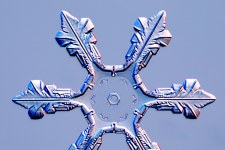
Not to steal Cameron’s post from yesterday, but in addition to studying snowflakes, physicist Kenneth Libbrecht has published a number of books of snowflake pictures.  These are very good quality “coffee-table books” and make nice Christmas gifts.

You can poke around his site to learn the answers to questions like:

  • Why are snowflakes symmetric?  (They aren’t, exactly, but are close because all six arms are exposed to nearly the same conditions at the same time.)
  • Is it true that no two snowflakes are alike?  (Basically yes.)
  • Why are no two snowflakes alike?  (As each snowflake swirls around on a chaotic path to the ground, it experiences a different sequence of temperature/humidity conditions than every other snowflake, leading to a unique pattern of growth.)

I’ll have to try some snowflake pictures myself this winter.  If it works, I’ll let you know (but it is apparently tricky to get right).

For other science-geek Christmas present ideas, try:

Puzzle Master

Grand Illusions (I haven’t bought from them, but they have some cool looking stuff)

NSERC USRAs

Just in case any undergrads are following this, don’t forget that the Departmental deadline for the NSERC Summer Undergraduate Research Awards is January 17, 2012.  This doesn’t leave much time after classes resume on the 9th, so if you are planning to apply, make sure you have a supervisor lined up soon so you can have your proposal in place by the 17th.

You can get more information about USRAs in Physics & Astronomy at http://www.physics.uwo.ca/undergraduate/nserc-usra.html.