All posts by Pauline Barmby

TMT! TMT!

We got the big news last night that Canada has signed on to the Thirty Meter Telescope. This is exciting stuff; Canadians have been involved with the project for quite some time and have done quite a bit of the preliminary design work. But the only mechanism for funding such a large project in Canada is to go directly to the relevant federal government department, and while the Coalition for Canadian Astronomy had been working hard on making the case, it wasn’t clear whether we would be able to sell the project or not. It’s a big deal: the TMT is one of three Extremely Large Telescopes currently in the planning stages. These facilities will be at the forefront of astronomical research in the 2020s and beyond.

So what will Canadians get for their quarter-billion dollars? Much of it will go to Dynamic Structures who will build the building that holds the telescope, aka the “enclosure” or “dome”. Some will go to companies building other components including the adaptive optics system. And of course, for our money we also get access to telescope time, although I expect this to be extremely competitive just like ALMA is. As the CASCA press release notes, TMT “will examine the first stars to form in the universe, the black hole at the centre of the Milky Way and the atmospheres and other properties of planets within the habitable zones of other stars.” Pretty cool stuff, and as Ray Jayawardhana noted many of us are hoping that TMT will be an inspiration to all Canadians, not just the few who are priveleged to get to do astronomy on a regular basis.

I suddenly find myself with lots more to think about. It’s an exciting day!

[Republished from Pauline’s blog.]
 

An unusual reunion

Last week I went to a reunion for Harvard astronomy PhD graduates. This was kind of an unusual event — Harvard does lots of reunions, but they are usually for people who were undergrads there, and whom the university hopes will donate lots of money. The astronomy department was also attempting to raise money from this event, although one might think that soliciting scientists would be fairly futile. (Certainly my initial reaction to getting a fundraising letter was that surely Harvard astronomy professors could write grant proposals, just like the rest of us academics.)

You might find it interesting to know, however, that people with PhDs in astronomy from Harvard are not all astronomy professors, not by a long shot. There is a complete list of all alumni here, and you can see that there is a variety of careers, from professor to medical doctor (!) to lawyer (!!), with quite a number of people now working in the financial industry. Presumably the fund-raising effort was aimed more at these folks.

At the reunion itself I shook hands with an astronaut, rubbed elbows with a Nobel Prize winner, and caught up with classmates who are now Harvard and MIT professors. I also talked to many of my colleagues who (like me) fill out the fainter end of the luminosity function. I think most of us are happy in our fields, even if there is the occasional pang when our mothers ask us why we’re not famous too.

The two panel discussions covered the hot topics in astrophysics — cosmology and exoplanets — and featured both alumni and profs. I found both to be a bit bittersweet, with justifiable excitement about recent accomplishments but worries that we might not be able to follow up on this excitement. Nobody, even rich Harvard astronomers, is without funding problems, it seems; as I have opined here before, we may have to get used to doing more with less. On a grander scale, Frank Shu noted that the Fermi paradox  is a deep mystery and possibly does not bode well for the future of human civilization. Geez, just as we figure out all of cosmology, our descendants won’t last long?

At this particular reunion, two groups were represented that are not ordinarily at a reunion: current astronomy professors—not all Harvard alumni, although there are many—and current grad students. I was interested to see that the current grad students seem to be just as concerned about future jobs in astronomy as students I have seen elsewhere. The faculty didn’t seem to be particularly worried about this and it’s also interesting to note that the size of the grad student  class has expanded by about a factor of 2 since I started in 1995. This PhD-training-versus-jobs disconnect is something that I plan to talk about more here; it was addressed nicely in a recent Globe and Mail op-ed piece.

All in all, it was an interesting day, providing a nice snapshot of how the field of astronomy has changed over the past few decades and ideas about where it will possibly go in the future.  Actually I find it pretty difficult to imagine what the field will be like in 20 years; I wonder if this blog post will still be around then for comparison!

Shower physics

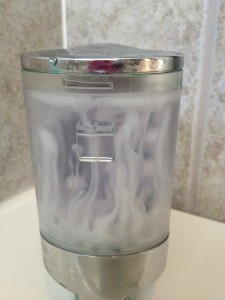
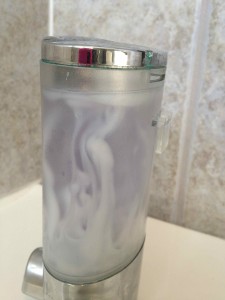
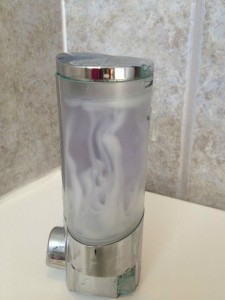
Don’t worry, nothing too personal here; just an interesting phenomenon. We have a soap dispenser in the shower, which usually has white liquid soap in it. For some reason we bought clear liquid soap recently. To refill the dispenser I poured about 500 ml of clear soap on top of about 50 ml of white soap. This was the result, 24 hours or so later:

IMG_1086 IMG_1087 IMG_1089

Looks like the white soap is a little less dense so it’s slowly rising to the top, although I wonder if the action of the pump at the bottom may have also influenced the mixing. (Anyone with less rusty fluid dynamics want to comment?)

Amusingly, as an undergrad I had a co-op job at the Canadian Space Agency, where my project was to design an experiment to look at mixing of different-density fluids in microgravity! And the person I worked for was astronaut Bjarni Tryggvason, who is now at Western. Small world.

I’m off to buy some more opaque soap so I can do some more mixing experiments.

ALMA inauguration

OK, our blog posting is a little behind. What can we say; it’s a busy time of year. But there is big news in longer-wavelength astronomy: the ALMA telescope had its official inauguration 10 days ago. It is not quite complete yet: the last 7 of 66 antennas are still being tested. But it is taking data and some science results have even appeared. Hooray!

The European Southern Observatory has a video (which seems to be mercifully free of speeches) if you want to know more.

Planck cosmology results are out

The big astrophysics news of the week is that the cosmology results from ESA’s Planck satellite have been released. According to the official ESA press release, they reveal “An Almost Perfect Universe“. (Clearly Planck can’t see the current state of my lawn, far from perfect). There has been lots of reaction, including in such unlikely places as The Economist, io9, and the Sheboygan Press. As usual, Andy Lawrence has a funny take, funnier if you know some of the people involved. Personally, I am left with 2 questions:

  • was organizing the simultaneous upload of more than 20 papers to arXiv more or less difficult than actually analyzing the data?
  • how many of the 4 “post-Planck data” papers now on arxiv (that’s pretty impressive, folks) will actually get published?

The Final Step

Last week I went to a workshop called “Take the Final Step” which was designed to help and encourage female science & engineering professors to apply for promotion to professor. For people who don’t know what this means, at most North American universities there are 3 ranks of professor. Assistant professors are the newbies, who don’t have tenure. Associate professor is the rank that usually goes along with getting tenure. Then “professor” (or “full professor”) is the highest rank.

It’s pretty obvious why assistant professors want to become associate professors: in  general, it’s an “up-or-out” situation: you either get promoted or you are looking for another job. But “why would anyone want to be a full professor?” is a question often discussed around the dinner table at my house. At some universities, the promotion comes with a pay raise. At many, being a full professor is a prerequisite for holding higher academic positions or committee memberships. At most places it’s some kind of recognition that one is known and respected in one’s field.

In lots of science and engineering fields there are very few women full professors. Our department has just one, and lots of physics departments don’t have any. Even in astronomy, which has a much higher percentage of women compared to physics, I saw a recent data point [can’t find the reference] saying that the fraction of full professors who are women is only about 11%. Part of this is a time lag (roughly 15 years from PhD to full prof) combined with lower participation by women in the past, but that’s not the whole story. In general, women tend to spend longer as associate professors than men. They’re less likely to request promotion and more likely to be told they’re not ready. The Council of Canadian Academies recently did a report on this topic which covers all of academia, not just science and engineering.

The workshop was geared to answering practical questions: what are the criteria for promotion? [“Excellence”, apparently. Universities aspire to be like Lake Wobegon, where all the students and all the faculty are above average.] How to acquire an international research reputation? [Go to the right conferences, among other things.] How to manage a lab’s worth of techs, post docs and students? [Pick the right people to start; set clear expectations.] How to balance research with teaching and service? [Might as well focus on research; sad to say, not many people get promoted on the basis of teaching.] How to navigate academic politics? [with your eyes open.] How to balance the rest of your life with a job that can be all-consuming? [No one had a good idea for this one, sadly.].

I thought about it and realized that I was taught by exactly two female profs over my entire undergrad and graduate career. Not exactly a ton of role models. So it was inspiring to see the many speakers at this workshop who were female (full) professors. A few of them brought their “promotion dossiers” for us to look at, and they were impressive.
But the professors themselves made strong claims that they weren’t superhuman, which I think is also important to know.

The take-home message from the workshop was that promotion to full professor is certainly not impossible, but it doesn’t just happen — it takes thought and planning. But it should be within our grasp, and we owe it to those who will come after us to at least try.

First annual Physics & Astronomy curling night – January 26

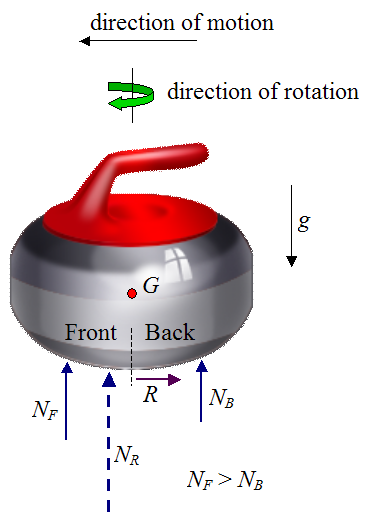
Do you want to try a truly Canadian activity? One which combines ice, lots of physics and licensed beverages, and is safer than hockey? Of course you do!

The first annual Physics & Astronomy curling night is tentatively scheduled for Saturday, January 26 at 7pm. Watch this space for more information. And start watching curling when you go to the Grad Club, so you’ll know what to do!