via youtube.com
What will the moon look like at every hour of 2013? Now you can find out courtesy of NASA. It’s really easy to see the libration here, which is cool.

What will the moon look like at every hour of 2013? Now you can find out courtesy of NASA. It’s really easy to see the libration here, which is cool.
Are you worried about December 21, 2012? Get the full story!
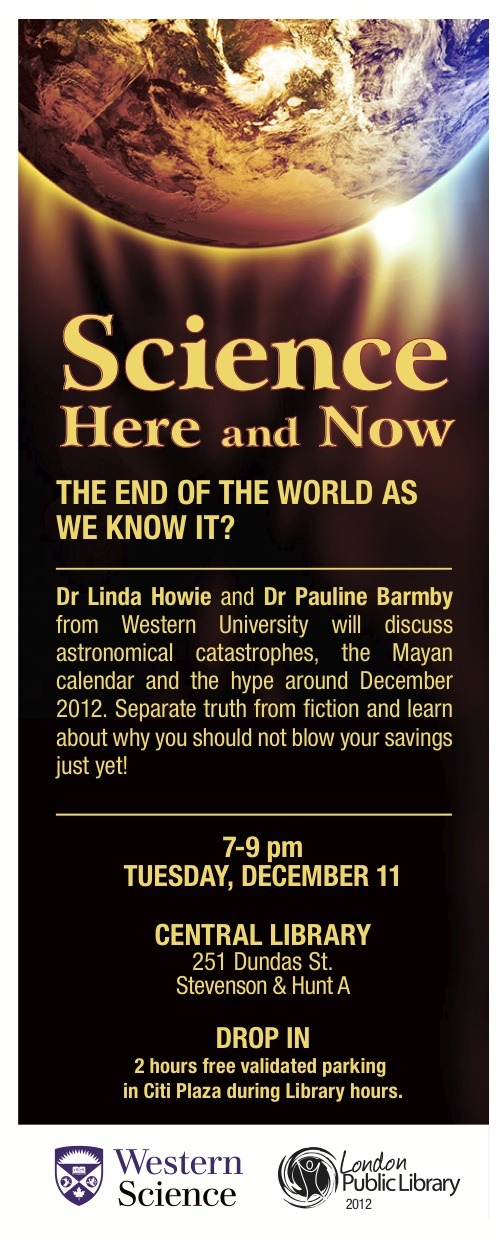
If you don’t want to wait until December 11, check out 2012hoax.org

While I never used Twinkies when I was teaching high school physics, perhaps I should have.

OK, not the physics of how the website works (although that would be interesting too) but “what kind of interesting physics videos can I find on YouTube?” I was thinking about this as I was trying to find videso about motion in a non-point-mass potential and kept finding things about how to paint your fingernails with a galaxy design. Really.
But there are gems out there, and surely what I could turn up in half an hour only scratches the surface. Of course there are course videos from universities and the like. Check out the first-year course taught by Walter Lewin from MIT, and Leonard Susskind’s Modern Physics course at Stanford. There are lots of videos of galaxy collisions and some scary ones about MRI safety.
There are several YouTube channels which have good stuff: there’s Minute Physics, the University of Nottingham has Sixty Symbols, “videos about the symbols of physics and astronomy”, and the American Physical Society has a Physics Central channel.
And then a few random ones that I found amusing:
Space telescope physics (not for cat lovers)
Ruben’s Tube (most of us should not try this at home)
Spitzer Space Telescope — the Musical
Add your own!
A new bit of research shows that sterotypes about gender differences in physical reasoning are not true, and gives a way to erode them. The statistics are not great yet, the research is not conclusive, but it is definitely interesting. Maybe we should get this kind of thing in first and second year classes!
It’s always good to know what our colleagues are up to.
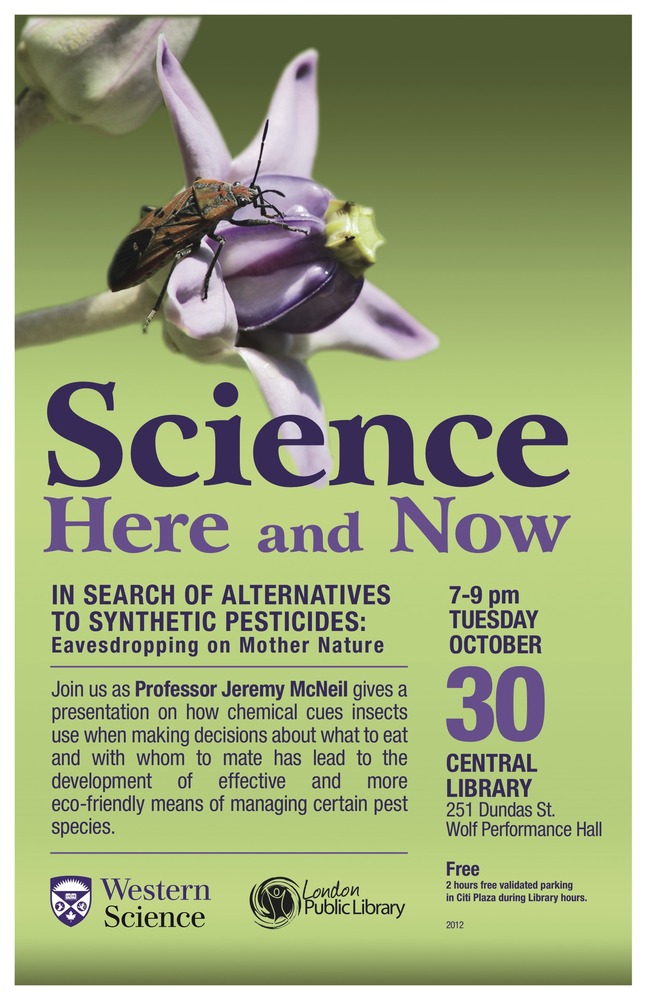
Science research at Western is vast, cutting edge and fascinating. Come to the London Public Library, downtown branch, on October 30th at 7pm to hear Dr. Jeremy McNeil, an entomologist at Western, give us some insight into his research on insects and what alternatives are available to replace synthetic insecticides. His talk is entitled: “Eavesdropping on Mother Nature: In search of alternatives to synthetic insecticides”
This talk is aimed at a general audience and will contain many of the spectacular insect photographs that Dr. McNeil has taken while travelling the globe. You will likely see a few bugs that you have never encountered before! At the end of the talk Dr. McNeil will take questions from the audience
The first thing that likely comes to a physicist’s mind when I say “turn the crank” is problem sets, and the student desire to find an equation or set of equations into which one can plug numbers and then, well, turn the crank. More about that some other time.
But what about the other kind of crank who turns up in physics: a person with an alternative theory of gravity who is convinced that he [I have yet to hear of a female physics crank] is right and Einstein was wrong? I’m talking about people typically without an academic background in the subject, whose ideas are, shall we say, non-mainstream. They often want their ideas to be validated by professionals in the field, and sometimes feel persecuted when they are not.
Since becoming a professor in a Physics & Astronomy department, my level of contact with cranks has definitely gone up. In the past year I have chatted on the phone with a pleasant older man who earnestly informed me that there was a “spirit world” hiding on the other side of Jupiter, talked in my office to a young man with a new theory of quantum spacetime, and deleted (mostly unread) more odd e-mails than I care to count. Their e-mails or treatises often have some physics-related vocabulary in them, and sometimes even equations, but put together in ways that make no sense. Certainly I haven’t yet seen a case where one of these folks proposed an experimental test of his ideas.
My question is – how should we, as members of the establishment, deal with such folks? Many of them are very thoughtful, polite people, and I think it’s only reasonable to treat them with courtesy. (If nothing else, they are fellow members of the society which supported our many years of training and now funds our research.) In general they are harmless, unlike cranks in medically-related fields, who can do serious damage to themselves or others. And of course there is the off chance that one of them will be right; there certainly have been cases in the history of science where “what everybody knows” turned out to be incorrect. But I think it is fair to say that most of these people are expending their energies on something that is unlikely to ever pan out. Should we tell them this? Attempt to set them straight about the scientific method? Or ignore them and just be happy that they are interested enough in [their idea of] science to spend their time on it?
Discuss.