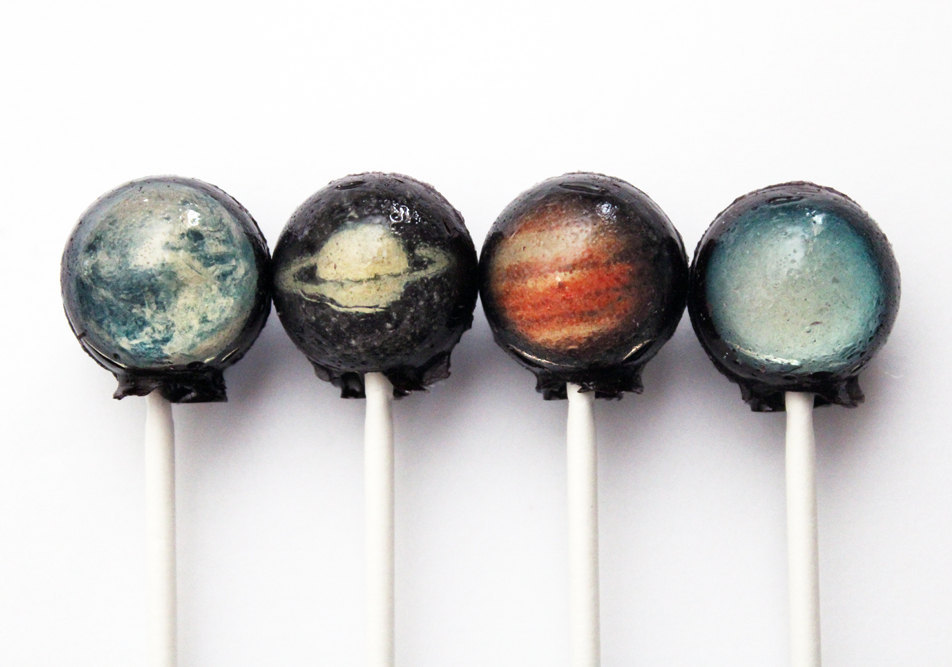
via etsy.com
You can get people to buy nearly anything with the right picture on it (for an example, see “lighthouse collectibles”). So we planet-liking folk should have our own slightly crazy stuff too, and here it is.

You can get people to buy nearly anything with the right picture on it (for an example, see “lighthouse collectibles”). So we planet-liking folk should have our own slightly crazy stuff too, and here it is.
Everyone else and their cousin has discussed Neil Armstrong and the influence of his life and work. I hope many of you took the chance to wink at the Moon over the weekend — I did while waiting to watch the International Space Station pass overheadon Saturday night, wondering what those six people were thinking and feeling.
I can’t give the usual story of being woken up to watch Armstrong and Aldrin’s moonwalk and deciding that I was going to be an astronaut. Profs may seem older than dirt, but in fact the most recent(more optimistic than “last”) moon mission ended a few days before I was born. Instead I want to talk about the famous words: “one small step”.
Great Big Sea, the most famous band from Newfoundland that our esteemed former chair has never heard of, had a recent song called “Walk on the Moon.” While I quibble with some of their orchestration choices (chimes? glockenspiel?), I really like the lyrics, which talk about the moon landing as a metaphor for being afraid to do something and doing it anyway. I apologize in advance if you hear me singing this in the hallways this week:
I don’t care, my foolish fear
Won’t get the best of me …
I’m alive; I’ve come to realize
Not a moment too soon
This is my one small step
This is my walk on the Moon
Besides winking at the Moon, I think the best thing we can do to honour the legacy of Armstrong and others like him is to each take our own small steps. We can hope that eventually they add up to giant leaps.
I’m going to declare my own planned small steps here, in the hopes that making them public will hold me accountable for not giving up on them. In my teaching, I’m going to solicit feedbackfrom my students after each and every class. In my research, I’m going to spend a few minutes every day thinking not about the tiny slice of the project I’m now working on, but about the big picture. In my service work, I’m going to organize at least one off-campus outreach event this year. And in my personal life I’m going to bike at least half as many kilometres as I drive.
We’re about to start a new school year, so it’s a time of new pencil crayons, new beginnings, and new ideas. What are your new small steps going to be?
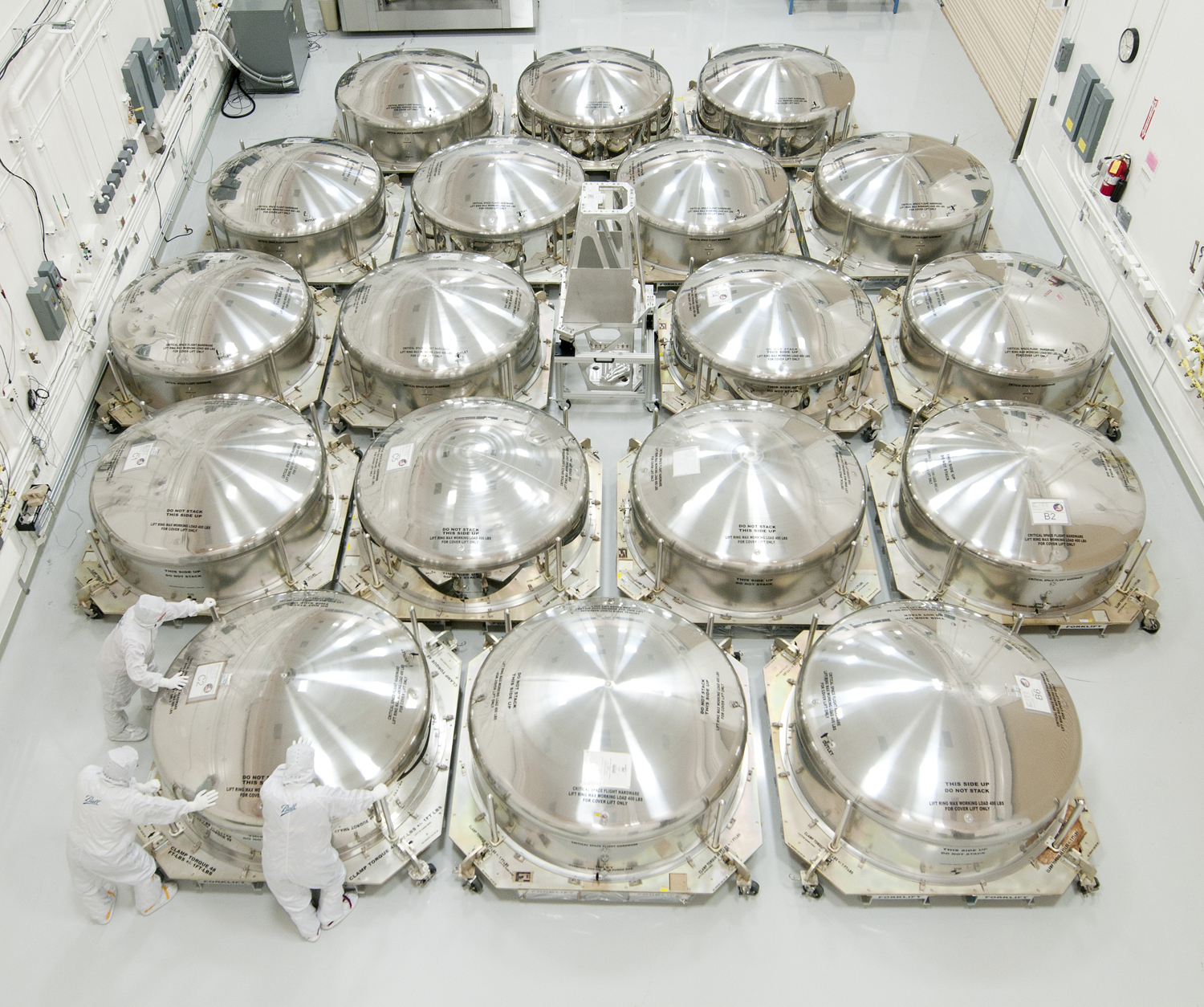

You have probably heard of the James Webb Space Telescope. But did you know that two of its instruments were made in Canada?
As you know, Bob, the telescopes used by observational astronomers are almost always shared facilities. Many of these are public: owned and/or paid for by governments of one or more countries, through their science funding agencies. In Canada, the main funding agency is the National Research Council (NRC), with some money also from the Natural Sciences and Engineering Research Council (NSERC). In the US, the federal science funding agency for ground-based telescopes is the National Science Foundation, NSF. No prizes for guessing what the one for space-based telescopes is.
Since we spend public money on telescopes, and there is never enough money to do all the nifty things we can think of, we have to set priorities somehow. In Canada the astronomical community writes a Long Range Plan every 10 years. In the US the astronomical community does a Decadal Survey every 10 years as does the planetary sciencecommunity. As inputs to these reports, scientists write “white papers” which explain Why Their Science is Cool and what facilities are needed to do it. Scientists representing new or existing facilities also write white papers explaining why their thing is the best thing since sliced bread. The committee in charge of writing the Long Range Plan/Decadal Survey/whatever takes all these white papers, plus input from “Town Hall” meetings and whatever other channels are available. They then try to figure out what new facilities will give the biggest bang (the most exciting new science) for the (hopefully reasonably estimated) buck. And produce a report that makes at least some people happy, and probably some angry.
Both the Canadian and US communities have had some issues to deal with after their most recent decadal reports. The problem, as usual, is money. The previous Long Range Plan report in Canada had lots of great ideas, but only about half of them were funded. The current plan recommended phasing out funding for the James Clerk Maxwell Telescope, which has finally got its long-awaited SCUBA-2 camera working but has no current prospects for funding after 2014. Some Canadian astronomers are trying to figure out how to keep it going for longer. In the US, it became clear that the budget envelope used by the 2010 Decadal Survey was, shall we say, optimistic. So a new committee got convened to tell the NSF what existing facilities should be shut down in order to fund new ones. They released their report last week and, unsurprisingly, many people were unhappy with the results, which called for closing most of the Kitt Peak optical telescopes as well as the Green Bank and VLBA radio telescopes. Similar things happened in the UK a couple of years ago when they joined the European Southern Observatory; my understanding is that in fact the JCMT closure is related to both this and to the inception of the ALMAtelescope.
How did we get ourselves into this mess? Part of the problem, and a part which is not unique to science funding, is that it is easier to sell a shiny new facility than to sell refurbishing or maintaining an existing one. Another part, which may well be astronomy-centric, is that the last decade or two have been a “golden age”, with many wonderful facilities like HST, Spitzer, Keck, Gemini, etc — and when one is at the top like this, there’s nowhere to go but down. [I think I heard this argument first from Bob Kirshner at the CfA.] Andy Lawrence said it well on his blog: “the US has done such wonderful things in the past, that if we keep them all going – especially the very newest things like ALMA – that uses up all the money forever”. And of course science with these golden facilities leads to new questions that can only be answered with platinum facilities, which maybe the citizens of Earth just can’t afford. Martin Elvis recently had something to sayabout the virtue of asking “answerable” questions.
And how do we get out of the mess? If I knew, I would run for CASCA and AASpresident and fix it myself. Creative public-private financing, better outreach efforts so the public understands why we want to build big telescopes, more efficient operations — all of these look to me like drops in the bucket. Maybe our fields is going to have to contract. That would stink.
But it could be worse! Every so often, I pull out my copy of Greg Egan’s Quarantine: a science-fiction novel that has as its premise the idea that the solar system has been surrounded by a giant opaque bubble (Why? Read the book.) Inexplicably, Egan doesn’t discuss the effects of the Buuble on observational astronomers, but it would of course mean there’d be no point in building more telescopes, because there would be no more new photons. Not that I think this scenario is likely to come to pass, but I wonder just how creative we could be with our petabytes of existing astronomical data, if we knew there were never going to be any more. Maybe it’s this kind of out-of-the-box science-fictional thinking which can make things work for astronomy.
I sure hope so.
Hopefully one of our planetary-science types will soon be strong-armed persuaded to write a blog post telling us about their perspective on the Mars Science Laboratory mission. In the mean time, here is what I learned from the landing event. All of these were things that I really should have known already, but now I’ve really got them.


10. London, Ontario has no shortage of people willing to sit in a stuffy room with strangers in the middle of the night to watch an Internet feed (see Figure 1). And no shortage of fantastic amateur astronomers who will operate telescopes and show people stars and planets while they wait for the middle of the night.
9. The RASC London Centre‘s Bob Duff will valiantly attempt to count all of these people (see Figure 2). He thinks there were about 70 people in addition to the somewhat-expected Western and RASC types (see Figure 3).
8. When you get people together in the middle of the night, they drink quite a bit of coffee. It’s a good idea to bring extra cups.
7. When you forget to bring extra cups, we have great grad students who are willing to go on a mission to find the nearest grocery store open at midnight on a holiday. Thanks Tony!
6. When you bring people together to watch an Internet feed (thanks Neil and Mat for running cables down hallways and through windows), it’s a good idea to find out if your computer has the right software to actually show the live stream.
5. When you forget to do #6, we have great grad students who bring their own laptops and are happy for them to be pressed into service. Thanks Emily!
4. When organizing a public event, it’s possible to spend too much time worrying about which nerdy T-shirt to wear (see Figure 4).
3. Some things are worth staying up past one’s bedtime for. (See Figure 5. As an astronomer I should really have had a better appreciation for this one!)
2. Being on camera forced me to make up my mind about whether I thought the landing would actually be a success. (There may be implications here for teaching and/or politics.) If the interview actually made the Weather Network (!) you’ll see that I did in fact say that it would work.
1. Science WORKS. It’s not just a bunch of tedious, meaningless symbol manipulation, regardless of what students think as they grind through their problem sets. Those folks in the blue shirts, and plenty of their colleagues who were not on camera, made it through those problem sets, and they figured out how to land a nuclear-powered laser car on another planet. Pretty awesome.
In case you went to bed at at reasonable hour and somehow missed it: here is the news. More on our local angle shortly.

