Fereshteh Rajabi awarded Mitacs Globalink Research Award

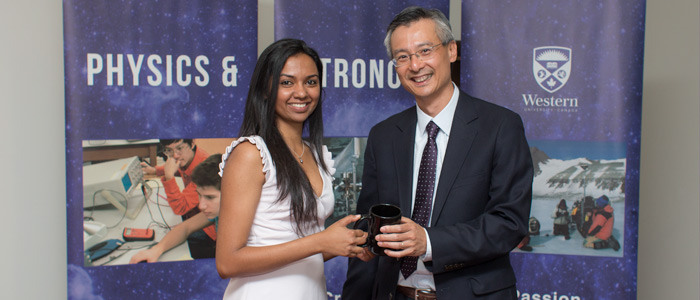
Fereshteh Rajabi was recently awarded a Mitacs Globalink Research Award (Sorbonne Universités) that will allow her to conduct research at the prestigious Laboratoire Kastler-Brossel (LKB) at the Collège de France, in Paris.

Researchers at the LKB are world renowned leaders in the field of fundamental physics of quantum systems, and the laboratory has had three of its members awarded the Nobel Prize in Physics since its inception (A. Kastler 1966, C. Cohen-Tannoudji 1997, and S. Haroche 2012).

During her stay at the LKB Fereshteh will be working in the Cavity Quantum Electro Dynamics group led by Prof. Serge Haroche, under the direct supervision of Prof. Jean-Michel Raimond. Her research project, entitled “Generating Large-scale Schrödinger Cat States and Exploring the Quantum to Classical Boundary,” is aimed at obtaining an understanding of the transition between the classical and quantum worlds.

Fereshteh is a PhD student in Physics under the supervision of Prof. M. Houde.  Her research projects at Western are concerned with the application to the interstellar medium of quantum mechanical effects observed in the laboratory.  She has recently submitted a paper to the Astrophysical Journal on “Dicke’s Superradiance in the ISM – The 21 cm Line“.
Reception for Graduating Students

graduation_jun_2015

A reception was held in the atrium of the Physics and Astronomy building for our graduating students and their families.  Master of ceremonies was undergraduate Chair, Eugene Wong.

[images on Flickr] [images via Lightroom]

Undergraduates who received their degrees:

Brian Duong Physics with Honors Specialization
Stephanie Kerkvliet Physics Major
Sina Khajehabdollahi Astrophysics with Honors Specialization
Jeremy Locke Physics Major
Chad Simpson Physics Minor
Ryan Stewart Physics Major
David Uren Physics with Honors Specialization
Edith Yeung Physics with Honors Specialization

Undergraduate award winners:

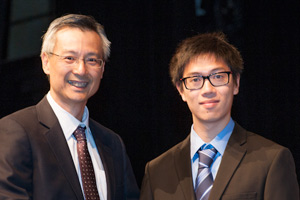
Raymond Compton Dearle Gold Medal in Physics
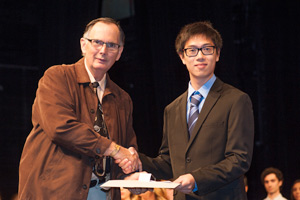
(ret. Rev. Paul Ross presenting)
Brian Hau Duong Brian_Duong_Paul_Ross_300
Don Hay Prize in Physics
(Dr. Eugene Wong presenting)
Brian Hau Duong Brian_Duong_Eugene_Wong
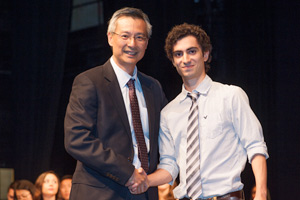
Maude Holt Kingston Gold Medal in Astronomy
(Dr. Eugene Wong presenting)
Sina Khajehabdollahi Sina_K_Eugen_Wong
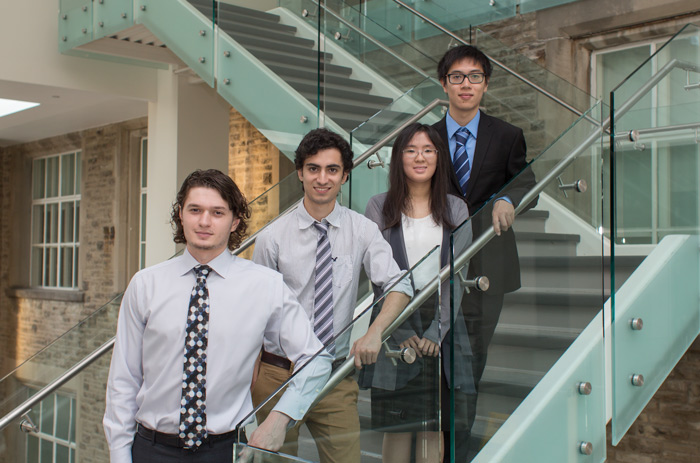
undergrads_2015
Undergraduates attending reception

Graduate students receiving their PhD

Arash Akbari-Sharbaf Physics
Reginald Bauld Physics
Konstantin Fedotov Astronomy
Sanaz Golriz Astronomy
Iftequar-Ul Haque Theoretical Physics
Scott Jones Astronomy
Faranak Sharifi Physics
Jesse Silaj Astronomy
Edward Stokan Physics – Planetary Science
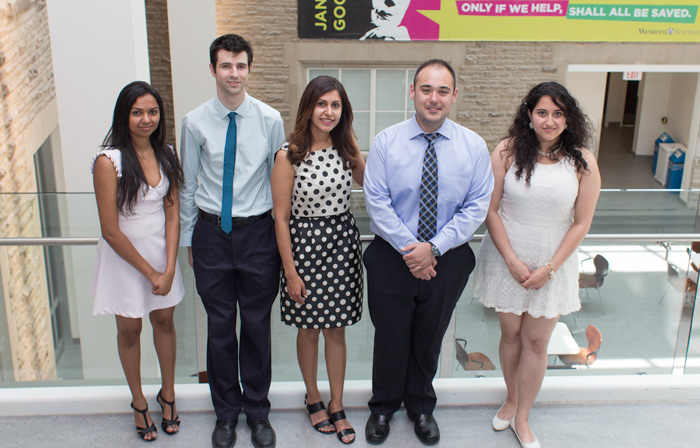
grad_students_2015
Graduate students attending reception

Graduate students receiving their MSc

Ali Jalali Physics
Shayamila Mahagammulla Gamage Physics
Masoud Rafiei-Ravandi Astronomy
Joseph Trollo Astronomy
Melanie Wright Physics

Cronyn Observatory Public Night of June 6, 2015

Cronyn_6Jun2015_650px
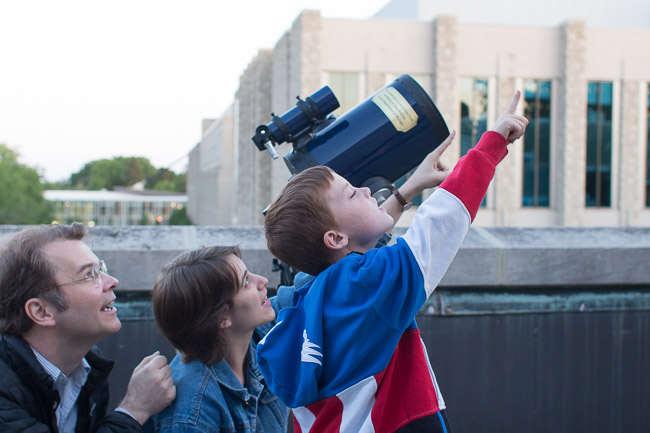
Young Mason was the first person to spot Jupiter in the twilight sky.

The few late afternoon clouds drifted away as the sun set, and thus clear skies greeted visitors to one of the regular Saturday summer Cronyn Observatory Public Nights on June 6.

It turned out to be a wonderful evening of sky watching.

Three telescopes were situated on the observing deck, operated by members of the local London Centre of the Royal Astronomical Society of Canada (RASC). Another RASC telescope was set up on the lawn behind Alumni Hall.  The historic 25.4cm Cronyn refractor was operated by a Physics and Astronomy graduate student Nina Ivkovich.

Early in the evening, the telescopes were trained on the setting Venus and Jupiter.  As darkness settled in, Saturn also rose high enough in the east for it to become the primary target.

In the lecture theatre, Physics and Astronomy graduate student Neven Vulic gave a talk titled “The X-ray Universe, No Lead Required“.

Late in the evening, the public were treated to a very bright Iridium flare in the west, and also got a chance to view globular cluster M13, the Ring Nebula M57, the Dumbbell Nebula M27, and double star Albireo.

Approximately 110 people attended.

[images from the evening on Flickr]

Prof. Stanimir Metchev is on CBC Radio’s Quirks and Quarks science show

CBC Radio’s Quirks and Quarks weekly science show of June 6, 2015 featured  their annual “Quirks Question Road Show” hosted by the Perimeter Institute for Theoretical Physics in Waterloo.

[listen to the show on CBC radio]

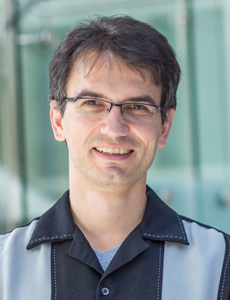
metchev_230x300Western astronomer Stanimir Metchev was asked an audience question as to whether hypothetical astronomers on a planet 1000 light years away from Earth would be able to see Earth. The answer was that with present day technology, Earth astronomers could directly image a planet only if it was closer than about 5 light years from Earth. Thus, in order to see us at 1000 light years distance, these fellow Milky Way astronomers would need technology that is more advanced than what is available to us today on Earth.


Networking lunch for summer research award winners

summer_student_lunch_28May2015

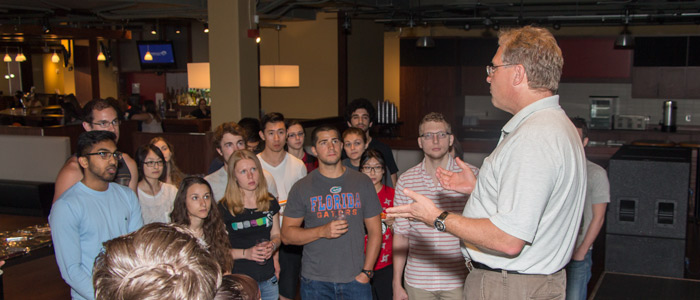
Physics and Astronomy NSERC USRA summer research students joined their counterparts from across the Faculty of Science for a networking lunch at The Wave on May 28, 2015.

The event was hosted by the Faculty of Science, and presiding was Associate Dean of Science Programs, Jeff Hutter. The group also included CAMBR AMBI and Pre-thesis award winners.

This event was conceived by USRA student Jagan Sivakumaran and Dr. Jeff Hutter.

[Flickr]  [Lightroom slideshow]