Falling Into a Galaxy Cluster

You may not know it, but we’re on a collision course. This course will make us and our nearby neighbour galaxies in the Local Group members of the Virgo Cluster. But what happens when galaxies fall into galaxy clusters like Virgo? The process is called ram pressure stripping: cold gas in the galaxies is ripped away as the galaxies themselves slam into the hot gas that pervades the cluster (the “intracluster medium”). This cold gas is what gets used to make future generations of stars; without the gas, the galaxies become red and dead.

In studying the process of galaxies entering clusters, astronomer Tom Scott at the Instituto de Astrofísica de Andalucía in Granada, Spain has discovered two long tails of cold gas streaming behind the future cluster members. This isn’t entirely unexpected, except that the galaxies themselves live in tiny groups (RSCG 42 and FGC 1287) on the very outskirts of the cluster Abell 1367. They’re too far away to be interacting with the intracluster medium yet! So how is the cold gas being stripped away? And why is it happening so early before the galaxies even enter the cluster? This could be telling us something more about the importance of the cluster and group environments and how these environments affect the evolution of the individual galaxies.

Astronomers here at The University of Western Ontario are part of a large, international collaboration to study the evolution of galaxies in certain types of groups called “compact groups” (such as RSCG 42 above). Professor Sarah Gallagher and graduate students Konstantin Fedotov and Tyler Desjardins investigate the evolution of the galaxies and the group environment, from star formation to the gas content, of these systems to better understand the relationship between environment and evolution.

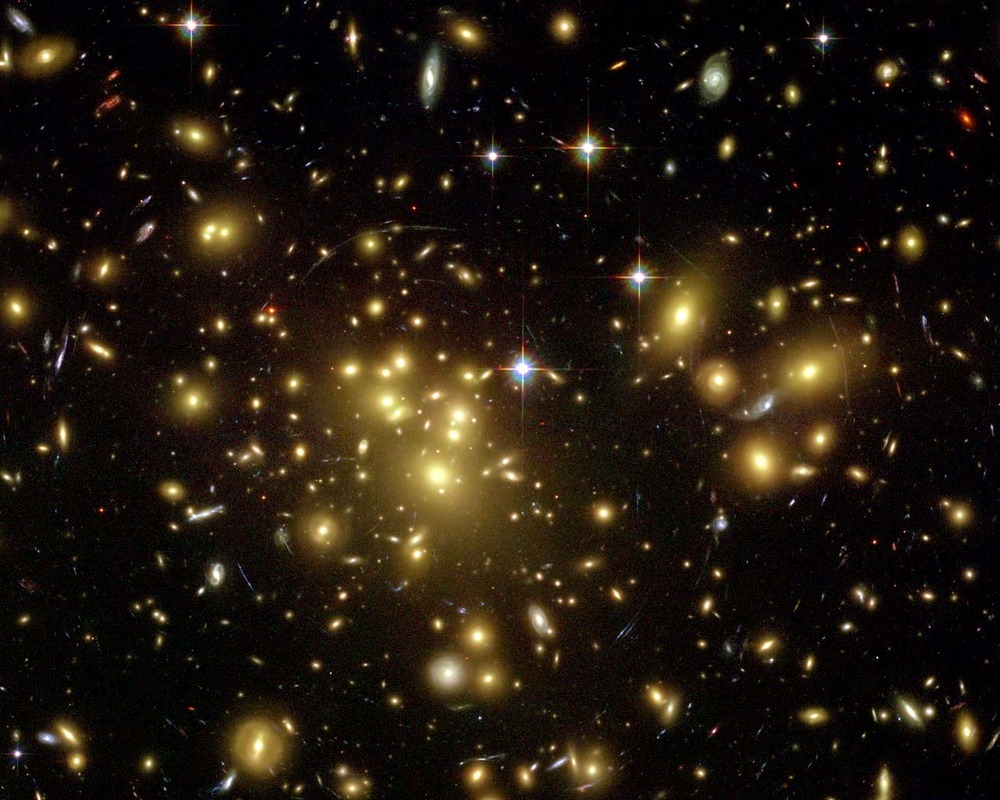
The full article on Tom Scott’s discovery of the long gas tails can be found here. Picture: Hubble Space Telescope image of Abell 1689, one of the most massive galaxy clusters known, which lies 2.2 billion light-years away towards the constellation Virgo. (Image Credit: NASA, N. Benitez (JHU), T. Broadhurst (Racah Institute of Physics/The Hebrew University), H. Ford (JHU), M. Clampin (STScI),G. Hartig (STScI), G. Illingworth (UCO/Lick Observatory), the ACS Science Team and ESA)
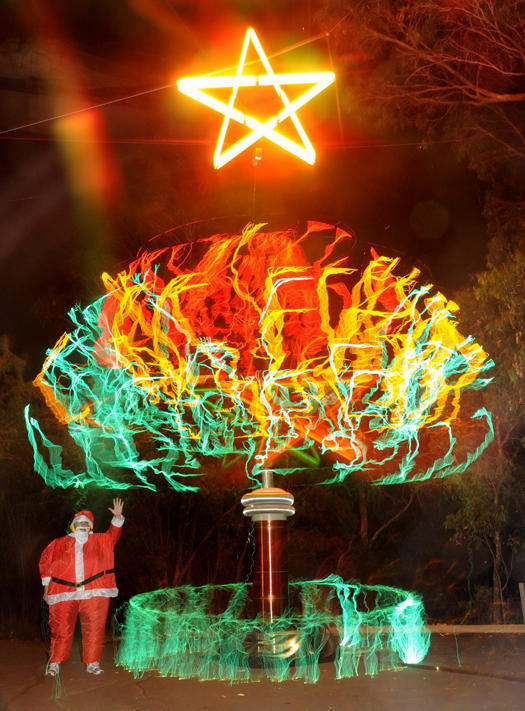
An Electrifying Christmas Light Display, Courtesy of Nikola Tesla | Popular Science

By Clay DillowPosted 12.22.2009 at 1:11 pm

13 Comments


Merry ChristmasDr. Peter Terren

A physics fanatic down under is having a very Tesla Christmas this year, creating a 30-foot electrifying display of yuletide cheer by attaching a rotating rod to the top of a Tesla coil, making for quite the colorful Christmas tree. Using such specialized science tools as a fishing rod and sinker, household power, and a Nikon D300, physician and Tesla buff Peter Terren manipulated 500,000 volts at a time to produce the images seen here.

Using what he calls “electrickery,” Dr. Terren — known for a few other Tesla coil adventures including an electro-colorful remake of Rodin’s “Thinker” — used a really long exposure on his camera, several different lens filters and his knowledge of physics to create the high-voltage scene, manipulating the rod to create different visual effects.

Nothing in the images is Photoshopped, but someone watching Dr. Terren create the images would see something quite different than the image itself. Rather than a fiery display of colorful plumage, a passerby would see two minutes of intense sparking at the coil while Dr. Terren scrambled about switching filters on the camera from green to yellow to red and so on while gradually raising the rod atop the Tesla coil. But when the camera shutter finally snaps shut 120 seconds later, what’s captured is the bright white light, filtered into Christmas wavelengths.

A Discovery Channel segment about Dr. Terren’s tree is in the works, but you can catch more images in our accompanying gallery, and find pics of his creative process here.

[Tesla Down Under, WA Today]

Pondering mammography for breast cancer screening over the Christmas holidays

I attended the first annual Canadian Cancer Research Conference in November which brought a diverse group of cancer researchers together.  In one of the plenary session, Dr. Martin Yaffe, a medical physicist whose expertise is in breast cancer and mammography, gave a talk on the recent recommendation on the guidelines from the Canadian Task Force on Preventive Health Care for women with an average risk of developing breast cancer. The controversy is this:  women who do not have increased risk of breast cancer due to BRAC gene mutations or family history of breast cancer, under age 50, no longer recommended mammography.  Even more controversial is that self-examination does not have any benefits in any age group.


This guideline was first brought to media attention by the Globe and Mail:

http://www.theglobeandmail.com/life/health/new-health/conditions/cancer/breast-cancer/new-breast-cancer-screening-guidelines-inflame-debate-add-to-confusion/article2243503/ 


Subsequenty, Martin Yaffe wrote why he rejected the new screening recommendation: 

http://www.theglobeandmail.com/life/health/new-health/conditions/cancer/breast-cancer/why-i-reject-most-of-the-new-breast-cancer-screening-recommendations/article2252072/


In his talk, he provided additional reasons for the screening program: a)  recommendations were not based on phase 3 randomized clinical trials b) current technologies of digital mammography have even better image signal to noise than those used in randomized trials, and c) the task force did not consult the scientific experts at large prior to understand all the nuances of non-randomized versus randomized trials. 


Being a medical physicist, when I visit friends and families during this time of the year, I do ask if they had done their annual health check. Maybe you should do the same so I won’t be so strange, but one must think through this task force recommendation to make sure that it made sense.