
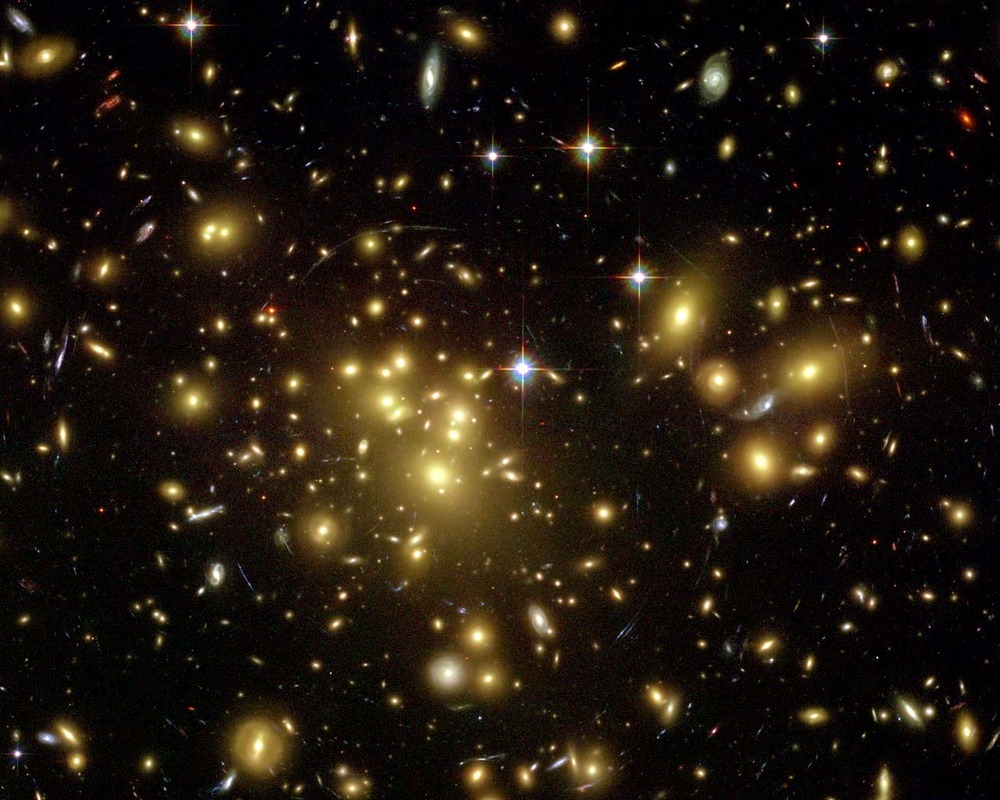
You may not know it, but we’re on a collision course. This course will make us and our nearby neighbour galaxies in the Local Group members of the Virgo Cluster. But what happens when galaxies fall into galaxy clusters like Virgo? The process is called ram pressure stripping: cold gas in the galaxies is ripped away as the galaxies themselves slam into the hot gas that pervades the cluster (the “intracluster medium”). This cold gas is what gets used to make future generations of stars; without the gas, the galaxies become red and dead.
In studying the process of galaxies entering clusters, astronomer Tom Scott at the Instituto de Astrofísica de Andalucía in Granada, Spain has discovered two long tails of cold gas streaming behind the future cluster members. This isn’t entirely unexpected, except that the galaxies themselves live in tiny groups (RSCG 42 and FGC 1287) on the very outskirts of the cluster Abell 1367. They’re too far away to be interacting with the intracluster medium yet! So how is the cold gas being stripped away? And why is it happening so early before the galaxies even enter the cluster? This could be telling us something more about the importance of the cluster and group environments and how these environments affect the evolution of the individual galaxies.
Astronomers here at The University of Western Ontario are part of a large, international collaboration to study the evolution of galaxies in certain types of groups called “compact groups” (such as RSCG 42 above). Professor Sarah Gallagher and graduate students Konstantin Fedotov and Tyler Desjardins investigate the evolution of the galaxies and the group environment, from star formation to the gas content, of these systems to better understand the relationship between environment and evolution.
The full article on Tom Scott’s discovery of the long gas tails can be found here. Picture: Hubble Space Telescope image of Abell 1689, one of the most massive galaxy clusters known, which lies 2.2 billion light-years away towards the constellation Virgo. (Image Credit: NASA, N. Benitez (JHU), T. Broadhurst (Racah Institute of Physics/The Hebrew University), H. Ford (JHU), M. Clampin (STScI),G. Hartig (STScI), G. Illingworth (UCO/Lick Observatory), the ACS Science Team and ESA)
Tweet