Category Archives: Physics and Astronomy at Western Blog

Opinions from the community at The Department of Physics and Astronomy of Western University.

Who is a scientist?

A couple of days ago, the twitterverse was abuzz with discussion of a video which is supposed to promote girls’ interest in science by implying that science is not incompatible with wearing high heels and lipstick. Astrophysicist blogger Peter Coles calls it “patronising drivel“. For more, have a look at #itsagirlthing and #realwomeninscience.

The women-in-science business is, of course, important, and it’s what I was originally going to write about. But it’s also been done to death and I don’t have much new to add.  So instead I want to discuss “who is a scientist” in a more general way.

Let’s assume that whether a person can be a scientist does not depend on whether they have a Y chromosome, or wear lipstick, or have messy white hair. Are there other characteristics that mean a person is well-suited to be a scientist? This is something that I think about every so often, since I have to evaulate potential graduate students; it also comes up when I talk to school-age kids about being a scientist.

Of course the inter-tubes can tell us the answer: here is one list of “character traits and attitudes of a scientist”. Another extensive list is here (this is a chapter in a larger book which looks like it might be interesting summer reading), and Mike Brotherton — SF writer and astronomy prof — has a more concise list here. (Check out his fiction too!)

Brotherton’s list of “raw brain power”, “stick-to-it-iveness”, “communications skills”, “curiosity”, “attention to detail” covers most of what I think is important. Let’s look at some of the items in more detail to see what they don’t say.

Smarts: as he says, I think you need some base level of smartness to be a successful scientist. You have to be able to follow a logical argument relatively quickly, to think through the implications of things, and you need a decent working memory to be able to keep track of what you’re doing. But from my experience and contrary to popular belief, most scientists are not geniuses. I sometimes wonder if the “portraits of famous scientists” you find in textbooks can discourage people from going into science because they think they’re not brilliant enough.

Communications skills: while scientists know that you need these to be a succesful scientist, we obviously need to, er, communicate this better. We haven’t been able to break the stereotype that a scientist works alone in the lab and communicates only through scribbled equations, or that there are “math people” and “language people” with only the former suited to be scientists. Some of this is rooted in pop-psychology “left brain versus right brain” ideas — my limited understanding is that the real brain is a lot more complicated, and that you really need both halves to be good at anything, including science.

Curiosity: this is the big motivator for most scientists. Why else would you be in this job, if it wasn’t for the interest in finding out how the world works? You’re probably not going to get rich or famous, but most of us don’t think that’s a bad thing. When astrophysicist Sidney van den Bergh was recently inducted into the Canadian Science and Engineering Hall of Fame, which we got to watch from the recent CASCA meeting, he mentioned in his speech that one of the joys of our field is that you get to work with people who aren’t in it for the money. And while a few scientists are famous, most are not. Again, I wonder about the textbook thing here: is it clear enough to potential scientists that you don’t have to be a superstar — or want to be one — to be a scientist?

Aside from these traits and the others Brotherton discusses, is there a “scientist personality”? I don’t think so. In my colleagues in astrophysics, I know people who are extremely gentle and mild-mannered, and people who are extremely brash and assertive; people who are the life of the party and people who are most comfortable in a small group. Scientists are people, just like anybody else; we are merely fortunate enough to be able to work at something we love. I hope we can get beyond worrying about appearances and promote the message that if you are a human being, then you too are a potential scientist.
How I spent my year’s leave, part 5

Ah, Vancouver in the spring. I grew up here, and there are some things about Vancouver that just seem to me to be perfect: the skyline of the mountains on the North Shore, for example, or the dark, damp green of the coastal forests. When these things register on my senses, my brain just pushes a button that says “home.” I moved away for good (so far, at least) after I got my Ph.D. in 1987. I’ve been back several times since then, but since none of my family lives here anymore, I’ve not stayed long. This time we are here for a month, which will give me a chance to get to know the place again. As with any friend you haven’t seen for 25 years, there have been some changes. One is obvious as soon as you arrive – it used to be a real pain to get from the airport to downtown by public transit, but now there is a quick and easy rapid transit link.

We are living on the 29th floor of an apartment building in a trendy part of downtown called Yaletown. We have a nice view of lots of other tall apartment buildings, and if we lean the right way we can see Mt. Seymour. Yaletown didn’t exist when I was a kid, as far as I know. What is now Yaletown used to be a wasteland of light industry and warehouses; it was a part of town one never had any reason to visit. In the mid-80s is became the site of Expo 86, the World’s Fair. After the fair, they sold the area to a developer who tore down everything and built lots and lots of hi-rise apartments. It is now the most densely populated area of the city. I wasn’t sure what to expect, but in fact it is very pleasant. We are a couple of blocks from the waterfront, where there is a great sea-wall walk and bike path. There are dozens of restaurants within a 10 minute walk of our apartment, most of which are quite reasonably priced. Transit is close and convenient. There are parks. It would have been nice if our apartment had been dusted before we arrived, but otherwise we have no complaints.

I’m working at UBC while I’m here. That’s another place where there have been many changes. I haven’t counted, but I am sure that more than half the buildings on campus have been built since I left, and most of the others have had bits added to them. There is ongoing construction at half a dozen sites, and I gather this has been the norm for the last 20 years. I guess I am technically visiting the Math Department. My office is in what used to be the Computer Science Building; it has a new name and new occupants, including the Institute for Applied Mathematics, which is where I am sitting as I type this. Downstairs is the Complex Fluids Laboratory, where I have been spending a fair bit of my time. My hosts are Neil Balmforth, who is Director of the aforesaid Institute, and Ian Frigaard, who divides his time between Math and Mechanical Engineering. Both do research on yield-stress fluids. Neil is interested in geophysical flows, like landslides and lava flows and such, while a lot of Ian’s research has applications in the oil industry.  I will be spending part of my time working on an experiment that is supposed to model what happens when water flows beneath a glacier. Not only does the water lubricate the flow of the glacier, in some cases it can also cause the ice sheet to lift up significantly. Neil and his postdoc Ian Hewitt have been working on a mathematical model of this process, including the forces on the water due to the elastic deformation of the ice. The experiments will involve syrup flowing under a rubber sheet; the rubber sheet will exert forces on the fluid that mimic those due to the ice. At present we are at the “looking for stuff” stage of the experiments, but hopefully we’ll get everything set up this week. Meanwhile, I am enjoying the west-coast spring weather!


Conference Posters?

Making a poster for an upcoming conference this summer?

Here are some hints I got from a recent workshop:

-Less is more [don’t write an essay]

-Colour is a must [black & white is boring]

-Creativity [throw in a cool picture or quote]

-Font size [don’t need a magnifying glass]

-Images/plots should be the focus

-Delineate sections with titles or borders [organization/structure]

-Would you stop to read it if you were at a conference?


Feel free to add your suggestions/comments!

Jokes from the desk of a grad student: Vol 6 #westernu

Why is an astronaut like a football player?
They both want touchdowns!

Q. What’s the most popular snack on Mars?

A. Marshmallows.

How do you know that Saturn is married more than once? Because he has lots of rings.

How does Jupiter hold up his trousers? With an asteroid belt.

The Heineken Uncertainty Principle says “You can never be sure how many beers you had last night.”

Harper Government to Close Only High Arctic Ozone Monitoring Site @saveEC #AprilFool ?

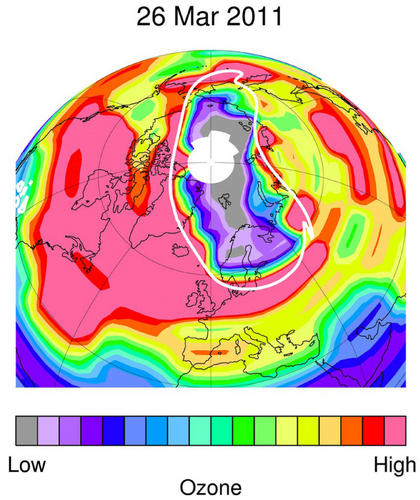
The Harper Government is proceeding with its plan to close Canada’s only high Arctic research station for atmospheric measurements including ozone. In last week’s budget they (re) announced that one of these days they would be building a new facility. Unfortunately they have insisted on building it so far south it would have likely be unable to monitor events like last winter’s Arctic Ozone Hole. No plans for filling in the data record for the years until the new facility is available were given, nor what expertise would remain of the current generation of young Canadian atmospheric scientists to operate it.

OK, I’ve been April Fooling you all morning. But it’s afternoon now and THIS IS REAL! For further information or to help out please go to the CANDAC website or Save Environment Canada websites.

Image from the article Record Ozone Loss Over the Arctic in the Toronto Star.

Jenkins report partially implemented in federal budget

Back in December, I created a post to bring your attention to the Jenkins Report:

http://uwophysastroblog.posterous.com/federal-rd-panel-reports-with-six-major…

When you look at the Federal budget, you can now see the major recommendations of the Jenkins Report implemented (partially of course).

I still haven’t figured out the concrete impact on funding levels within the tri-councils, but as I do I’ll post more for you. As I mentioned yesterday, the immediate impact is on the R&D funding/support mechanisms for industry.

– Blaine

How Astronomers Get Their Data – Part 2

So, last time we left off with astronomers writing proposals to get access to state of the art facilities. This time, we’ll look at a much different way to gather data: archival data.

There are two instances when astronomers use archival data for their research: when their science goals can exploit previous observations without the need for new ones and as part of large survey programs. Now, the former is pretty self-explanatory. Data taken as part of observing programs, which had to be proposed by some astronomer(s) (see Part 1), are stored in vast data archives for access by anyone. These data are accessible after a certain proprietary period during which only the astronomers who requested the data in the first place have access to them (usually about a year). Some popular archives are the Multimission Archive at STScI (MAST) and the Canadian Astronomy Data Centre (CADC).

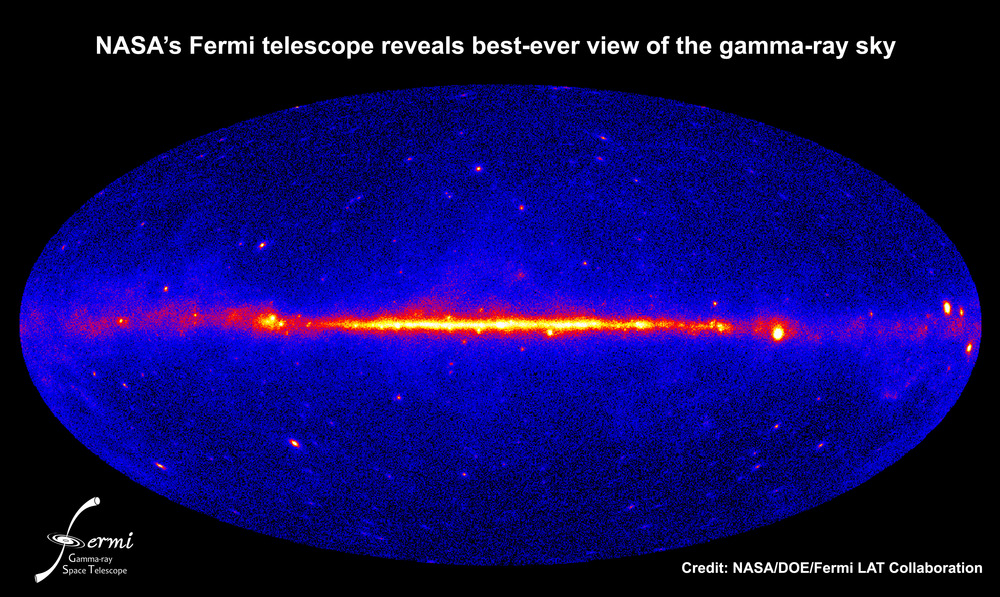
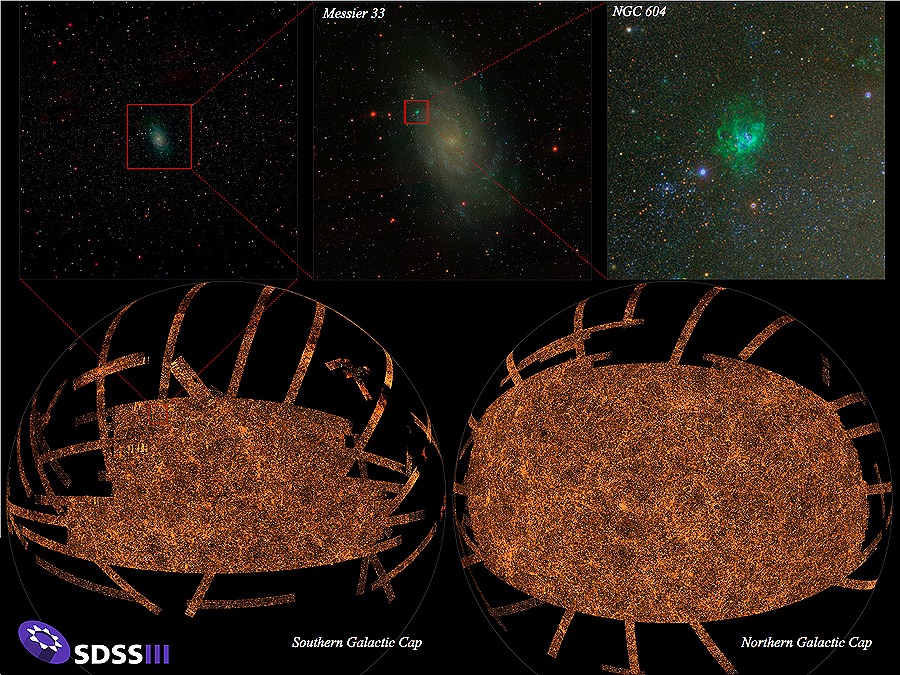
Survey data, on the other hand, are part of large programs to study particular kinds of objects or sections of the sky. It’s been argued that these surveys are the future of astronomy — that astronomers will no longer vie for time on telescopes and sit there taking their data. Rather, dedicated telescopes will be built to acquire the most versatile data sets possible to meet the needs of the scientific community. One such example is the Sloan Digital Sky Survey (SDSS), which operates with a 2.5-meter telescope and consists of several smaller survey programs. In addition to the optical imaging data, targets are selected by a software pipeline for spectroscopic followup. Futhermore, the performs rudimentary analysis on the data and creates a database entry for each source it finds with all the relevant measurements. There have been many surveys over the years, some of the most popular being the Two Micron All-Sky Survey (2MASS), ROSAT All-Sky Survey (RASS), and the more recent all-sky survey using the Fermi Gamma-ray Space Telescope instrument named the Large Area Telescope (LAT).

The bottom part of the image shows the sky coverage of the Sloan Digital Sky Survey (SDSS). Each orange dot represents a galaxy in the survey. The top panels show zoom ins on a star forming nebula in the nearby galaxy M33, a member of the Local Group of galaxies of which the Milky Way is a member. Image credit: SDSS. 

The first three months of data from the Fermi Gamma-ray Space Telescope’s Large Area Telescope (LAT) instrument. The LAT is performing an all-sky survey, scanning the entire sky once every three hours (two orbits). The bright horizontal stripe in the center of the image is the plane of the Milky Way Galaxy. Fermi has now been operating for nearly four years. Image credit: NASA/DOE/Fermi LAT collaboration.

How Astronomers Get Their Data – Part 1

One of the misconceptions I often run into is that astronomers just sit at telescopes all night long and get all the data they need. Another is that every school with astronomy programs has state of the art observatories at their command. Unfortunately, the latter is not true — I wish it was! As observing proposal season is wrapping up, I thought it would be interesting to give this insight into the process of how astronomers get data.

Here at Western, we have two observatories affiliated with the observatory: the Hume Cronyn Memorial and Elginfield Observatories (actually, there’s a third, the Purple Crow Lidar at Echo Base Observatory, but that’s designed for atmospheric physics, not astronomy). Cronyn Observatory was opened in October 1940 and was, at the time, a state of the art research facility with a 25.4-centimeter refracting telescope and a Schmidt camera. However, that changed over the next three decades as advancements in technology came faster and faster. Today, Cronyn is used for public education and outreach programs, currently led by Prof. Jan Cami.

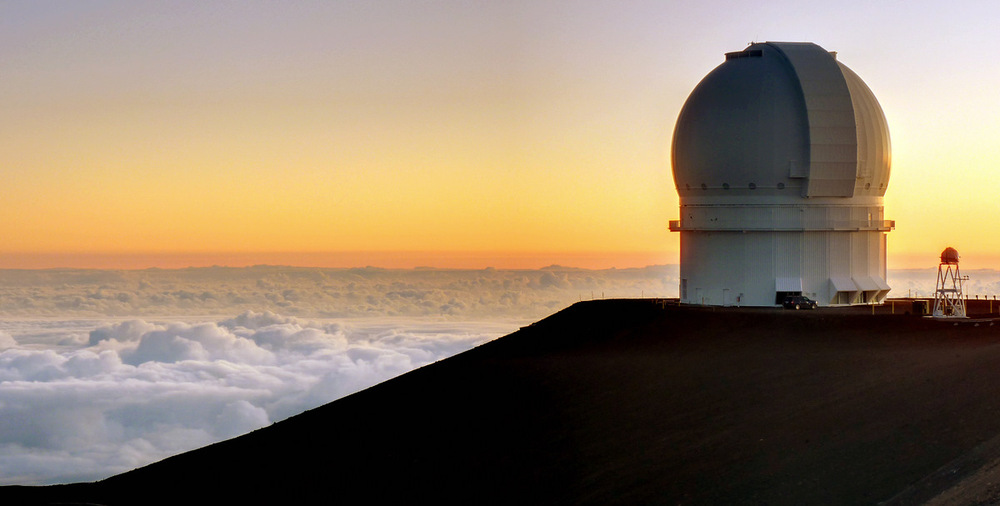
In the late 1960s, it was clear that Cronyn no longer met the research needs of the faculty, and so a new observatory was commissioned and the Elginfield Observatory and its 1.2-meter telescope were built in the early 1970s. The Elginfield project was possible thanks to funding from the Natural Sciences and Engineering Research Council of Canada, primarily secured due to the efforts of Emeritus Professor William H. Wehlau (1926-1995). Prof. Wehlau was also a driving force behind the building of the Canada France Hawaii Telescope (CFHT), a 3.6-meter telescope on Mauna Kea in Hawaii. Elginfield Observatory was officially closed in 2011 due to lack of use (the majority of the faculty require much different instruments for their research that not available at the observatory) and the yearly costs involved in keeping the facility open.

So, where do astronomers get their data from? Telescopes like the CFHT! Large, national and international projects like CFHT have the funding to back them that individual (and usually even groups of) universities cannot afford. However, we don’t all have free access to these facilities, or even access to some at all depending on certain circumstances. Not all observatories are open for anyone to use, though — you have to have some kind of affiliation with the observatory (such as the the European Southern Observatory).

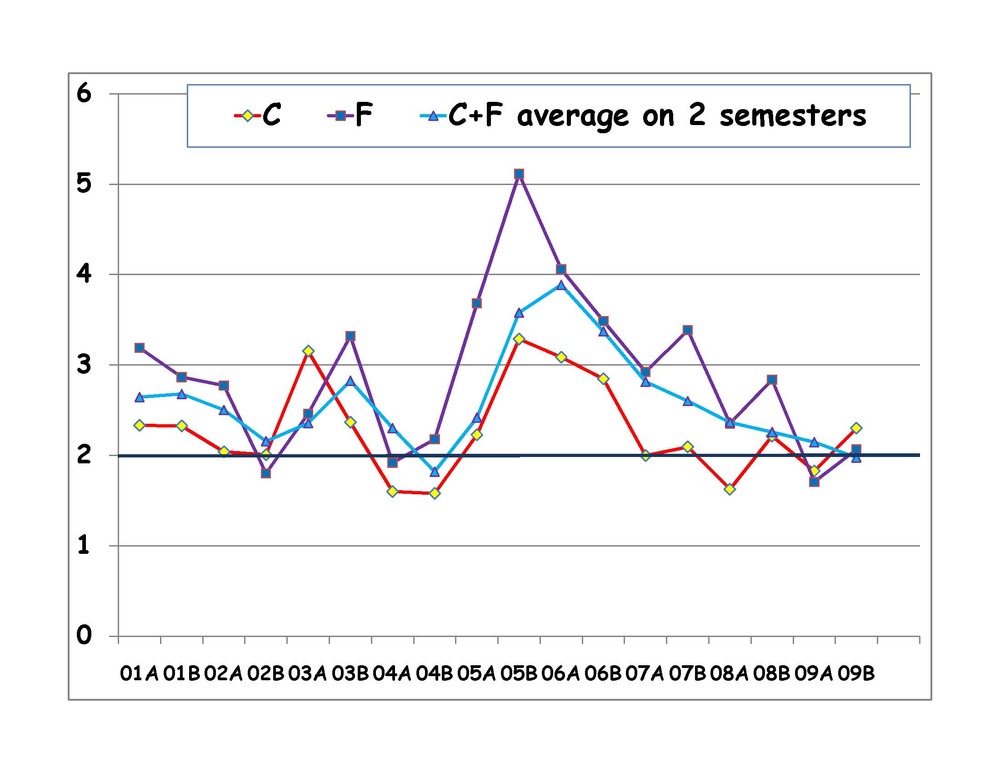
When asking for time with one of these facilities, you have to write an observing proposal (usually twice a year corresponding to two observing semesters). These proposals have to demonstrate your science goals for your observations (and you should usually demonstrate the scientific versatility of the data to make your case even stronger) and explain why the facility that you’re applying to is the only one or the best one for you to use. These proposals are then collected and examined by a Time Allocation Committee (TAC). For example, in divvying up time that Canada receives on various national and international facilities, the CanTAC (including Western’s Prof. Sarah Gallagher) makes the decisions. You may get all of the time you ask for, you may get some of it, or you make get none of it at all depending on the merit of your proposal and how it is ranked against others. For various observatories, the time allocation process is very competitive with many more requests than time is available (this is called “oversubscription”; Hubble has an oversubscription rate of about 4 to 1). And even if you get the time, your accepted proposal only gets you one shot…if you get clouded out for example, then you just have to reapply next time.

Next time, we’ll look at what other observational astronomers can do without having to gain access to all of these observatories around the world (and even those above the world!).

Image source: CFHT. The plot shows the ratio of the time requested to the time available at CFHT in a given observing semester (the first half of 2009 is labeled 09A, the second half 09B, etc.). The red line indicates Canadian time, the purple line French time, and the blue line is the average of Canadian and French time.

The Dangers of Space Junk

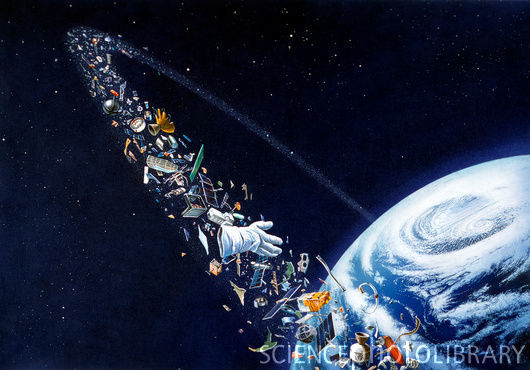
Recently, astronauts aboard the International Space Station (ISS) were ordered to take refuge in the emergency Soyuz spacecraft in case it became necessary to evacuate. The reason? You probably guessed from the title: space junk. The debris in question passed within 9 miles of the ISS! Now, 9 miles might not sound like a near collision to you, but (as the article linked below points out) when you’re orbiting the Earth at about 17,500 miles per hour, that’s a pretty close call. Furthermore, the debris became problematic because it wasn’t detected until it was much too late to move the ISS into a different orbit. The issue of debris in orbit of the Earth has become a real concern over the past decade as the amount of debris seems to be increasing with no end in sight. Various space agencies and private companies have discussed methods for removing the debris safely and cleaning up the neighbourhood so to speak, but in the meantime the best we can do is track it and make sure that near misses (or worse) don’t happen.

News source: The Telegraph

You Need a PhD to do Astronomy…Right? Wrong!

One of the biggest misconceptions that I see from students early in their careers (and from the public at large) is that to make contributions to science you have to have a PhD. This cannot be more wrong. There are lots of contributions to astronomy (and science in general) that come from non-PhD scientists — and no, I’m not talking about grad students on their ways to PhDs.

Let me give you an example of what one can do without a doctorate. When I first graduated from the University of Florida with a B.S. in astronomy, I applied to every graduate program I could think of and hoped for the best. Now, I don’t want you, dear reader, to think me naïve after just saying that many young students have the aforementioned misconception about PhDs and science. In fact, to do what I truly want to do in life (teach professionally and conduct scientific research), a PhD is really a crucial stepping stone in my career.

However, the graduate programs I applied to all rejected me because, though the rest of my record was excellent, my standardized test scores weren’t the best. I was left in a predicament, because I had a bachelor’s degree in astronomy, and to my knowledge that didn’t bode well for job prospects. So, I looked into the matter, and found that there were in fact jobs I could apply for to keep me in astronomy while I improved my grad school applications (though the list of jobs available was rather short). So, I applied to everything I thought I had a reasonable chance at and waited.

The first job, observing for the University of Wyoming, fell through after a decent phone interview. I was the second choice from the list of applicants, which was heartening, but it still left me without a job. The second job I heard from asked me for another phone interview and then, a week later, invited me for an in person interview all the way in Baltimore, Maryland. This particular job was working on the famed Hubble Space Telescope at the Space Telescope Science Institute (STScI), so I was rather keen to land that one (what I thought was the longest shot job I had applied for). There were two more applications I was waiting to hear about, but it would be some time before I heard anything if at all from these. The interview in Baltimore went well, and the woman from human resources gave me the run through of the benefits package and starting salary — a good sign! I went back to my mother’s house in Florida and waited the week or so before they said they would have a response. Finally, after waiting a few more days, I called one morning to find out that the human resources woman I had talked with had just gotten the word to offer me the job, and she was putting together all of the details of the offer to call me that afternoon. Huzzah! After being professional and listening to all of the fine print, I accepted the job and told her that I would be ready to start in two weeks (after a fairly large move for a person of 21 years to make alone). Incidentally, of the remaining two jobs I had applied for, I found out that one had been filled and it took five weeks to receive a rejection letter and the other never contacted me (I later came to find out from others who had applied that while the ad stated a minimum of a bachelor’s degree was required, the people in charge ignore anyone without a master’s…somewhat against the theme of this post, but there you have it).

Working at STScI was one of the best experiences of my career thus far. I’ve made many friends and learned about a multitude of technical skills that I wouldn’t have necessarily picked up if I had dived right into grad school. Do I think I would have done well if I had gone straight to the next level of education? Without a doubt. The experience would have certainly been different, though. I think that my time at STScI has made me a more unique young scientist than most of my contemporaries and I appreciate that experience. Besides, how many people can say that they worked for NASA on the repair of the Hubble Space Telescope? And how many did that before their 23rd birthday? Not many, I can tell you.

From my personal example, I hope you can come away feeling that you don’t have to have a PhD to contribute to science. Anyone can do it! In fact, without the dedicated work of non-PhD astronomers, we wouldn’t know as much as we do. Groups such as the Royal Astronomical Society of Canada and other local astronomy clubs work hard in the areas of observational techniques and instrumentation. Data analysts such as those at STScI (properly titled Research and Instrument Analysts, for the record), the Harvard-Smithsonian Center for Astrophysics, and Gemini Observatory provide dedicated and invaluable support to the astronomers who use their facilities. And everyday people who have any number of careers (teacher, fireman, banker, etc.) participate in online projects to mine the immense volumes of data that we have collected in just the past few decades (the Galaxy Zoo project, for example). There are the coders, the telescope technicians, the political lobbyists who fight for science funding, and even the janitors without whom our facilities would fall into disarray. Every one of these people is crucial to the advancement of astronomy and all other scientific fields. So, the question you should be asking isn’t can you contribute without a PhD, but how can you contribute.