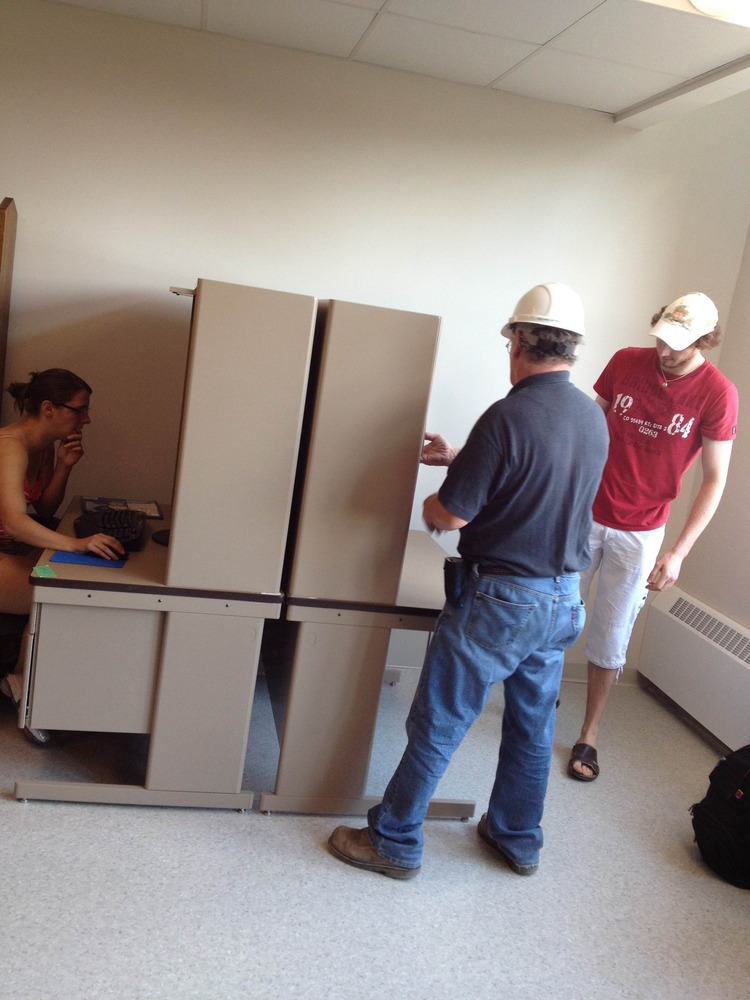
So it is finally time for the grad students to move upstairs!
Our new office looks sunny and nice with a big window 🙂
Great excitement on the faces on Allison and Neven
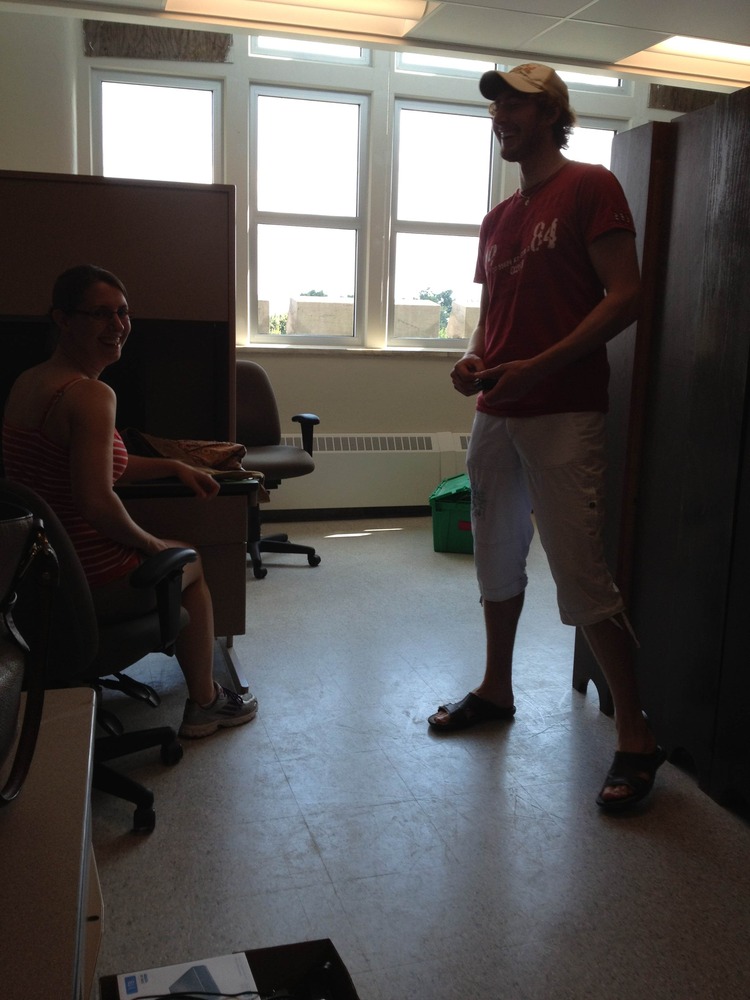
Thanks for everyone who worked hard to make it smooth

Opinions from the community at The Department of Physics and Astronomy of Western University.
So it is finally time for the grad students to move upstairs!
Our new office looks sunny and nice with a big window 🙂
Great excitement on the faces on Allison and Neven
Thanks for everyone who worked hard to make it smooth
Preparing classes would probably be the sensible thing to do right now, but instead, I decided to travel to Asia. I’ll be attending the 28th General Assembly of the International Astronomical Union (IAU) in Beijing, China from tomorrow on (more about that in a later post), but while “in the neighbourhood”, I also took up an earlier invitation for a work visit to the Institute for Astronomy and Astrophysics at the Academia Sinica (ASIAA) — say the equivalent of the National Academies. The institute has a staff of about 170 people under the directorship of Paul Ho, and is operated from a new and modern building on the campus of the National Taiwan University.
A key element in the operational model of the ASIAA are active
collaborations with some of the world’s leading institutes, facilities
and researchers. My visit came after an invitation from my friend and
collaborator Ciska Kemper. I’ve known Ciska since I was a Masters
student at the Leiden Observatory in the Netherlands in 1996, and we
both got our PhD from the University of Amsterdam in 2002. After a
Spitzer fellowship at UCLA and faculty positions at the University of
Virginia in Charlottesville and the University of Manchester, she took
up her current position at the ASIAA, where she is the ALMA project
manager.
After 29 hours of traveling (there is a 12 hour time difference
between London and Taipei, so it’s quite far away…), I arrived in
Taipei on Tuesday evening. It has been a fruitful visit, resulting in
several new collaborative projects about fullerenes, dust formation
and AGB stars. As it generally goes for work visits, I also gave a
colloquium, and had a very nice chat with Paul Ho (the ASIAA
director). In addition, there was ample time for social contacts, and
for exploring parts of Taipei and the surroundings. In Taipei,
appartments tend to be fairly small, and often do not include a proper
kitchen, and thus people go out for dinner pretty much every
evening. There’s a large number of restaurants and food stalls; at
street level, almost all building space is used for restaurants or for
shops. I enjoyed all sorts of different cuisines — Korean, Japanese,
Chinese, Shanghai-ese, … all very very yummy! I also gave a guest
lecture about Belgian beer in a pub that was all stocked up with such
liquid delights.
On Saturday, we took the Maokong gondola up to the Chi Nan temple, and
then on to the teahouses where we enjoyed the views, and fresh tea and
a few bites. Later that day, we visited the Taipei 101 — the second
tallest building in the world. Quite impressive! On Sunday, we decided
to go hiking in Yangmingshan National Park, up to the peak of Mount
Qixing which is the highest point in the park. It was — how shall we
say this — a fairly strenuous hike for a person of my fitness
level. In fact, it was brutal. The trail went up steeply at times —
apparently nobody around here believes in switchbacks and thus trails
go up steeply. And the tropics are great, but not so much when you’re
hiking. The temperature was about 36 degrees with a high humidity;
even higher up, it was still much hotter than is comfortable for a
normal human being….As if that wasn’t hot enough, the area is
volcanic and the trail passes over several very hot fumaroles. Along
the path were lots of pretty lizards, butterflies and a lonely
poisonous snake in a landscape of bamboo and other tropical plants and
flowers. I made it to the top, and probably had about 20 less liters
of body fluids to carry down the hill. But the views of the city and
out to the ocean were worth it! After hiking down and taking a very
wild busride back home, a cold shower and a good Japanese dinner by
the water made us forget most of the painful muscles.
And so the week has gone by quickly! Tomorrow I’m off to Beijing and
the IAU GA, but that’s for another time!
I spent last week attending the International Conference on Rheology in Lisbon, Portugal. This is the biggest conference in the field, and is held every four years. It alternates continents: in 2004 it was in Korea, and in 2008 in California. The next one, in 2016, will be in Kyoto, Japan. There were about 1000 people there, and 11 parallel sessions of contributed talks. It was a very intense conference, with talks starting at 8:30 AM and running until 6:30 PM. They even had poster sessions during the coffee breaks, so there was very little time to sit and catch your breath! However they had a good social program, including a port-tasting evening, a half-day bus tour on Wednesday afternoon, a beach party, and a banquet, so there was a bit of time to see some of the sights, to talk shop and get to know some people.
I enjoyed most of the talks I attended and got several good ideas, which for me is the mark of a good conference. Now all I need is time, and money, and students to turn the ideas into reality …. One thing that impressed me was the breadth of subjects that were covered, and how the flow of complex fluids impacts many diverse areas of research and application. There were lots of talks about blood flow, for example, and blood clotting. Also lots of talks about nanocomposite materials made of polymers mixed with carbon nanotubes or graphene. There were very applied talks about polymer processing and highly theoretical talks on trying to predict bulk properties based on molecular structure, which is one of the holy grails of the field. Most talks were well presented and interesting.
My own talk was scheduled for late Friday morning, the last talk in the last contributed session on the last day of the conference. To make matters worse, one of the talks in my session was cancelled, so everyone drifted off to other rooms for a while. Most of them came back, however, and I had enough of an audience – about 20 people – for my talk to make it worthwhile. Since it was the last talk, there was time for quite a good discussion and question period after.
I enjoyed Lisbon and would go back to see more of the city if I had the opportunity. It reminded me of Rio, perhaps not surprisingly, but was better looked after and not as crowded. Restaurants were relatively inexpensive and the 20 words of Portuguese I picked up in Brazil served me well! The weather was great – low 30s and sunny all the time.
Now it is back to reality, with two courses starting in a couple of weeks and a to-do list a mile long.
Hopefully one of our planetary-science types will soon be strong-armed persuaded to write a blog post telling us about their perspective on the Mars Science Laboratory mission. In the mean time, here is what I learned from the landing event. All of these were things that I really should have known already, but now I’ve really got them.


10. London, Ontario has no shortage of people willing to sit in a stuffy room with strangers in the middle of the night to watch an Internet feed (see Figure 1). And no shortage of fantastic amateur astronomers who will operate telescopes and show people stars and planets while they wait for the middle of the night.
9. The RASC London Centre‘s Bob Duff will valiantly attempt to count all of these people (see Figure 2). He thinks there were about 70 people in addition to the somewhat-expected Western and RASC types (see Figure 3).
8. When you get people together in the middle of the night, they drink quite a bit of coffee. It’s a good idea to bring extra cups.
7. When you forget to bring extra cups, we have great grad students who are willing to go on a mission to find the nearest grocery store open at midnight on a holiday. Thanks Tony!
6. When you bring people together to watch an Internet feed (thanks Neil and Mat for running cables down hallways and through windows), it’s a good idea to find out if your computer has the right software to actually show the live stream.
5. When you forget to do #6, we have great grad students who bring their own laptops and are happy for them to be pressed into service. Thanks Emily!
4. When organizing a public event, it’s possible to spend too much time worrying about which nerdy T-shirt to wear (see Figure 4).
3. Some things are worth staying up past one’s bedtime for. (See Figure 5. As an astronomer I should really have had a better appreciation for this one!)
2. Being on camera forced me to make up my mind about whether I thought the landing would actually be a success. (There may be implications here for teaching and/or politics.) If the interview actually made the Weather Network (!) you’ll see that I did in fact say that it would work.
1. Science WORKS. It’s not just a bunch of tedious, meaningless symbol manipulation, regardless of what students think as they grind through their problem sets. Those folks in the blue shirts, and plenty of their colleagues who were not on camera, made it through those problem sets, and they figured out how to land a nuclear-powered laser car on another planet. Pretty awesome.
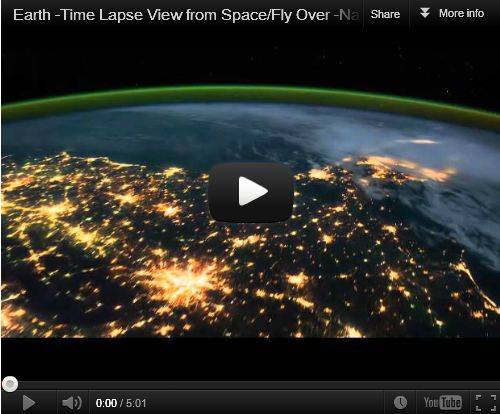 http://www.youtube.com/watch?v=ls9yJTphLxg
By sheer coincidence I had been watching some of great video footage taken of the Earth by the astronauts in the ISS. I had also been listening to good old Stan Rogers for the first time in ages.
In Stan’s “Canol Road” there is a nice set of lyrics:
“It’s God’s own neon green above the mountains here tonight,
Casting brittle coloured shadows on the snow.”
In my fourth year here at Western, I took a fluid dynamics course with John deBruyn. Many of the topics we touched on fascinated me, but nothing quite amazed me like surface tension. During the course, I studied how the basilisk and different insects walk on water. While the basilisk, or Jesus lizard, uses a large force and surface area to keep him running on the water’s surface, insects, such as the water strider, rely on surface tension to keep them afloat.
Over a year later, thousands of kilometres away, surface tension still boggles my mind. I took this picture of menisci on rocks near Resolute Bay on the beach of the Northwest Passage.
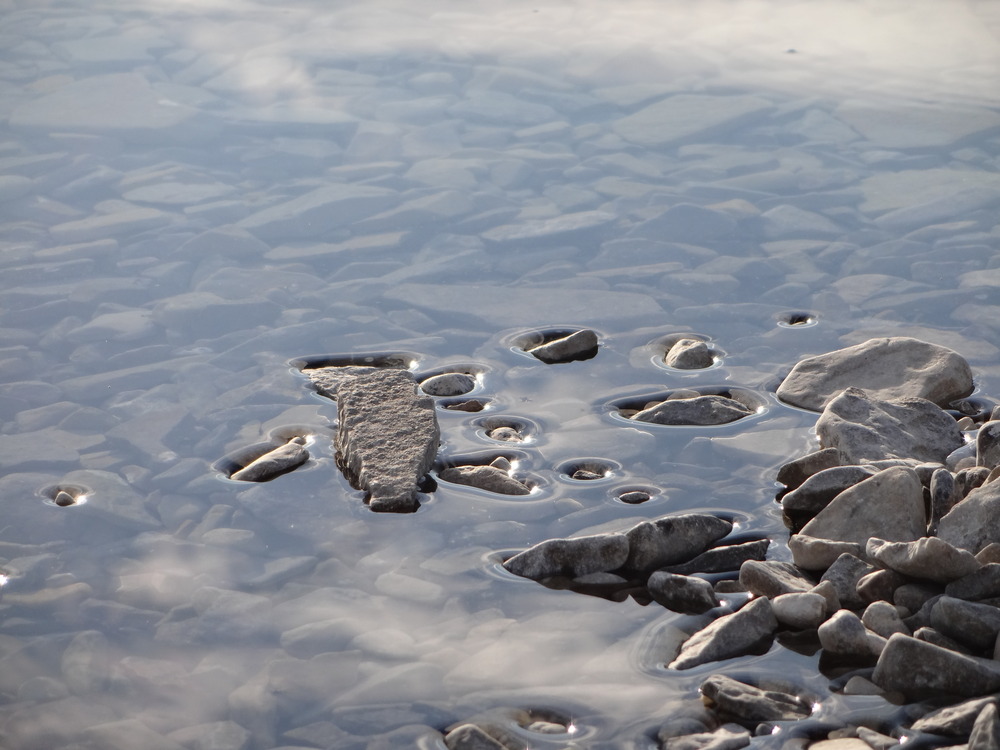
There were also small rocks floating on the surface of the water, drifting in and out with the waves. Since Posterous does not approve of my file format, the video can be seen on YouTube here:
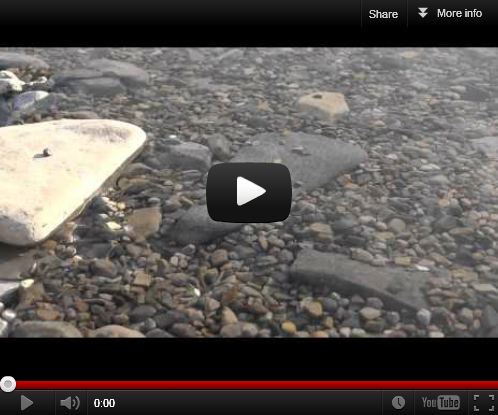 http://www.youtube.com/watch?v=pzvS5nDxb24
We’ve had some discussion recently about the use of bibliometrics and impact factors as a way of evaluating research quality. Very recently, my collaborators chose to submit our joint paper to one journal rather than another because the chosen journal had a higher impact factor.
Today I found this interesting page, which gives the impact factors of physics journals:
http://www.tcm.phy.cam.ac.uk/~tmf20/physics_journals_impact_factor.shtml
You can see some interesting disciplinary differences even from this list: particle physics journals tend to have higher impact factors than condensed matter journals, for example. It is also interesting that overall there are very few physics journals with what one might call high impact factors: Phys. Rev. Lett., Nature Physics, and some review journals. Most of the rest (except for the particle physics journals) tend to have impact factors below 3. In contrast, many of the “normal” biochemistry journals have impact factors around 5.
This list doesn’t include a lot of the fluid mechanics journals I tend to publish in these days but they all have impact factors around 2 to 2.6.
What does this all mean? Your guess is as good as mine. But here is one interpretation (not mine!): Physics doesn’t have much impact.
Of course it is easy to raise the impact factor of the disicpline as a whole. All physicists simply have to cite twice as many papers as we normally would when we write our own papers. Of course it would also help if we all wrote twice as many papers as well, all of which cited lots of other papers. The result would be a huge number of useless papers with meaningless references, but Physics’s impact factor would go up. This should give you some idea of my view of the value of this statistic as a measure of the quality of research.
I’ve been asked this question a lot as our exoplanet faculty search ran its course this winter and spring. God forbid a potential exoplanet find may actually turn out to be a brown dwarf! But why the distinction? There is a case to be made that any object that cannot initiate internal hydrogen fusion is a planet, period. BDs would then just be planets on the more massive end of the spectrum. On the other hand, some prefer to think that BDs should be thought of as more like stars since they have a similar formation mechanism. But do they? Increasingly the evidence is that BDs can form both in a star-like manner as well as through physical processes in a circumstellar disk, where planets are also formed. Should BDs be preserved as a separate third category of object? Perhaps, since they seem able to form both through disk processes and direct collapse of interstellar cloud fragments. Planets may be defined as objects that form only through an initial accumulation of solids in circumstellar disks. Stars form in all the same ways as BDs but can be distinguished from them by having a high enough internal temperature to initiate hydrogen fusion.
I was asked to write an article in Science magazine about some of these matters, and it just appeared in the July 6 issue:
I’ve just read the article that Pauline pointed us to in her comment on my earlier post. Here’s the link again:
http://www.dcscience.net/?p=5388
Read this article. It is really shocking. Faculty at Queen Mary University London (the other London) are being fired if they don’t publish enough papers, including a prescribed number in “high profile” journals. This is absurd. Faculty who complained about this evaluation policy are being investigated for misconduct. I was so angry after reading the article that I fired off an email to the president of QMUL. I urge you to do the same. Details in the above article.
In 2010, NSERC asked the Council of Canadian Academies to look into ways to assess research performance in the various NSERC disciplines. The resulting CCA report has now been released.
Here is a link:
http://www.scienceadvice.ca/en/assessments/completed/science-performance.aspx
This web page gives a brief summary of what’s in the report. You can also download the full report there if you want to. The full report is 162 pages long, and no, I haven’t read it yet.
At first glance, thoiugh, it appears to me that the conclusions of the report are reasonable. Here is a summary, taken from the above web page:
“After examining the available evidence, the Council’s Expert Panel came to a small number of key findings, listed below, and concluded overall that quantitative indicators should inform, rather than replace, expert judgment in science assessment for research funding allocation. The Expert Panel also developed four guiding principles to support research funding agencies undertaking science assessments in support of budget allocation, they are: context matters; do no harm; transparency is critical; and expert judgment remains invaluable. The principles are expanded upon with the Panel’s report.”
The “quantitative indicators” they are referring to are things like bibliometric measures, as discussed in one of my earlier posts.
Here are their “key findings:”
My understanding is that NSERC will give the research community an opportunity to respond to this report, although as yet we don’t know any details. As a member of CAP’s NSERC Liaison Committee, I will be involved in the physics part of this response, so feel free to pass your comments on to me. I also understand that NSERC will then take this report into consideration in deciding on a new Discovery Grant “reallocation process” to move money around among the disciplines. This means that it’s potentially quite important.

