All posts by Blaine Chronik

NSERC budget reallocation in Federal Budget

I said in an earlier post that I’d continue to look for NSERC/CIHR specific elements of the federal budget. So here’s a bit more information.

To start, the annual budgets of both NSERC and CIHR (this is their total budget, which includes the administrative costs of operating the councils, as well as the actual funding programs they run) are being cut by $15M each year for the next two years (see pages 268 and 271 of the budget document). There is language to suggest that the cuts will come from operational expenses and reductions in funding of lower priority areas (page 73).

However, there is an additional $15M per year (ongoing) to NSERC to enhance the industry-academic research collaborations portfolio (see page 74 of the budget document). They call this the “Strategy for Partnerships and Innovation”. I think it amounts to increased funding for programs like the Collaborative Research and Development (CRD) program, and the Engage program (among others no doubt).

So, there appears to be a net reallocation within NSERC towards increased industry-partnered research activities, consistent with recommendations from the Jenkins Report, as well as the general language from government that indicate Canada is generally underperforming when it comes to commercialization of research and the level of industry sponsored R&D (page 56).

There are many other research & innovation elements of the budget. I just wanted to highlight the specific elements that directly affect NSERC for you.

Note: I realize the federal budget document is not a scientific paper, and the comments within the document should always be viewed with a critical eye!

– Blaine Chronik

Jenkins report partially implemented in federal budget

Back in December, I created a post to bring your attention to the Jenkins Report:

http://uwophysastroblog.posterous.com/federal-rd-panel-reports-with-six-major…

When you look at the Federal budget, you can now see the major recommendations of the Jenkins Report implemented (partially of course).

I still haven’t figured out the concrete impact on funding levels within the tri-councils, but as I do I’ll post more for you. As I mentioned yesterday, the immediate impact is on the R&D funding/support mechanisms for industry.

– Blaine

Federal R&D Panel reports with six major recommendations

Whether you are a student or a scientist, you are no doubt familiar with the traditional funding agency for the natural sciences in Canada – NSERC. However,if your research leads you into the realm of applied research, you will inevitably begin to be exposed to a wider, more complicated world of industry-partnered R&D. Support for this kind of work can come from companies themselves (often in the form of direct technical service agreements between the company and your lab), dollar-matching programs at the federal and provincial levels (administered by the traditional agencies of NSERC, CIHR, ORF, et cetera), or more foreign (to those of us in the academy) support programs provided directly to corporations themselves (the “SR&ED” or “shread” credits have been a huge part of this for years). This latter support stream is deep, and it is also going to change in a big way. If you haven’t heard of the “Jenkins report”, you should be aware of it (see below). In the next years, we expect the entire National Research Council structure in Canada to change, as well as the detailed nature of R&D support for industry.
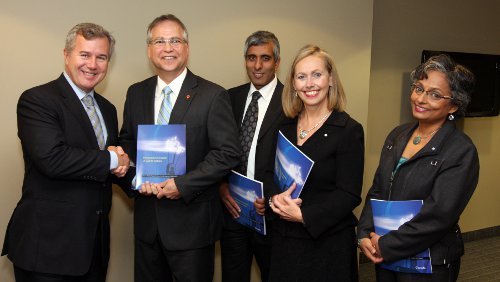
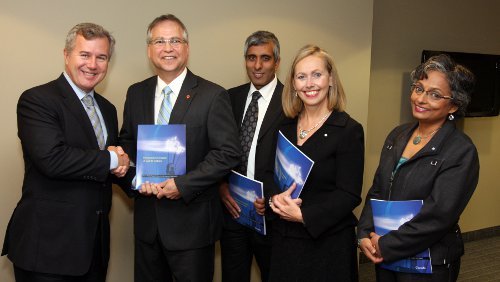
Panel Chair Tom Jenkins, along with Arvind Gupta, Monique F. Leroux and Nobina Robinson, present their reportInnovation Canada: A Call to Action, to the Minister of State (Science and Technology) Gary Goodyear on October 17, 2011. Not shown are panel members David Naylor and Bev Dahlby. (from the Review of Federal Support to Research and Development webpage with link listed below).

http://rd-review.ca/eic/site/033.nsf/eng/home

If this seems all very foreign or irrelevant to university researchers, consider what happened just this past week. The Ontario Research Fund (ORF) provides matching support for Ontario applications to the Canadian Fondation for Innovation (CFI), as well as funds and administers the critical Research Excellence (RE) matching grants competition.

http://www.mri.gov.on.ca/english/programs/ResearchFund.asp

This RE has supported university researchers, with industry partners, with many tens of millions of dollars over the past decade alone. Many, many research staff and students that you see at Western are supported entirely or in part by the ORF RE. This past week (late monday), the current ORF RE application round, as well as the round for next year were cancelled. The money was re-allocated to the South-Western Ontario economic development innitiative announced by Dalton McGuinty on monday (you may have heard about this).

http://www.premier.gov.on.ca/news/event.php?ItemID=19651&Lang=EN).

I’m not going to say whether I think this is good or bad (it is certainly challenging), but these sort of changes (which directly reflect early implementation of the kinds of recommendations made in the federal Jenkins Report) are something we need to react to. There is no immediate benefit to be had by complaining about this, as the changes are already on our doorstep. Criticism may affect change for the coming years, but right now, we need to position ourselves to take advantage of the new climate. This means more industry collaboration, more technical service, and much more strategic planning and effort in monitoring and reacting to the varied opportunities.

The R&D climate has been slowing changing for years now, but I think it’s clear that in the next several years, the changes will be larger and coming faster. It’s an interesting time, so let’s get ready!

(originally posted by Blaine Chronik)

Curling Anyone?

I’m sitting here watching the Canada-One Canada Cup of curling (in case you’ve never heard of this, it’s a major curling competition (we call them bonspiels generally), and the winner automatically gets into the 2014 olympic curling trials for Canada). Makes me wonder: hey, how many people in physics and astronomy curl? Have many/any of us curled regularly? Do we actually have “curlers” in our midst?

Picured above: Kevin Martin, universal god of curling.

Actually, I know at least part of the answer to this: yes, we do have curlers in our midst. I curl regularly in a local men’s league. Tim Scholl curls on my team. One of Western’s Vanier Scholarship winners (Matt Quinn, recent graduate from our undergraduate program and current MD-PhD student at Western over in imaging at Robarts) curls (he spares for my team whenever I need him!). I know Mike Cottam curls every week, as does Pauline Barmby. Brian Dalrymple also curls.

Who else? If you have ever curled, comment to this post. If you would call yourself a “curler”, let us know! And by the way, in case you’ve never curled before, you need to know that Kevin Martin (pictured above) is the best curler that has ever lived. Take it to the bank!

I’ll restrain from putting in a link here to an academic article on the physics of curling (I assure you, there exist)…

(originally posted by Blaine Chronik)

Challenges for North American Universities

Although the article referenced below is talking about American universities, I know for certain that these same debates are going on here in Canada, and within Western. Questions including: “Why do we teach the way we do?”, “How we deliver content?”, and “Are really serving a purpose in ‘today’s world”, are more common and in my mind becoming harder to answer. Why are students sitting in our classrooms instead of watching iTunesU?

I think we have partial answers to some of these questions, but this debate is not going away. I like the quote at the end of the referenced article, where Lawrence Lowell (apparently a past-president of Harvard) is quoted as arguing that “institutions are rarely murdered; they meet their end by suicide… They die because they have outlived their usefulness, or fail to do the work that the world wants done.” Are our universities doomed to this? We’ll be talking about this more, I’m sure.


Schumpeter

University challenge

Slim down, focus and embrace technology: American universities need to be more businesslike

http://www.economist.com/node/21541398


Understanding the “Big screen TV” market?…

In case you’re xmas shopping already (or want to advise those xmas shopping for you!), it’s good to try to stay on top of the flat-screen monitor/TV market. Below is a recent blog entry from the Economist which overviews the current state of the market. We’re physics people – we’re supposed to know this stuff!…

[from the Economist, Dec 3, 2011]

Difference engine

The devil in the details

Consumer electronics: Changes in technology mean that choosing a big-screen television has become more complicated than ever. Should you pay extra for 1080p resolution, LED backlighting or 3D? We crunch the numbers

IF YOU have not gone shopping for a new television set for quite a while, enough has changed to require some serious thought. So before splurging on a new high-definition television (HDTV) set, it is worth considering which features make sense and which do not.


http://www.economist.com/node/21540381

Curling anyone?

I’m sitting here watching the Canada-One Canada Cup of curling (in case you’ve never heard of this, it’s a major curling competition (we call them bonspiels generally), and the winner automatically gets into the 2014 olympic curling trials for Canada). Makes me wonder: hey, how many people in physics and astronomy curl? Have many/any of us curled regularly? Do we actually have “curlers” in our midst?

Picured above: Kevin Martin, universal god of curling.

Actually, I know at least part of the answer to this: yes, we do have curlers in our midst. I curl regularly in a local men’s league. Tim Scholl curls on my team. One of Western’s Vanier Scholarship winners (Matt Quinn, recent graduate from our undergraduate program and current MD-PhD student at Western over in imaging at Robarts) curls (he spares for my team whenever I need him!). I know Mike Cottam curls every week, as does Pauline Barmby. Brian Dalrymple also curls.

Who else? If you have ever curled, comment to this post. If you would call yourself a “curler”, let us know! And by the way, in case you’ve never curled before, you need to know that Kevin Martin (pictured above) is the best curler that has ever lived. Take it to the bank!

I’ll restrain from putting in a link here to an academic article on the physics of curling (I assure you, there exist)…

Federal R&D Panel reports with six major recommendations

Whether you are a student or a scientist, you are no doubt familiar with the traditional funding agency for the natural sciences in Canada – NSERC. However,if your research leads you into the realm of applied research, you will inevitably begin to be exposed to a wider, more complicated world of industry-partnered R&D. Support for this kind of work can come from companies themselves (often in the form of direct technical service agreements between the company and your lab), dollar-matching programs at the federal and provincial levels (administered by the traditional agencies of NSERC, CIHR, ORF, et cetera), or more foreign (to those of us in the academy) support programs provided directly to corporations themselves (the “SR&ED” or “shread” credits have been a huge part of this for years). This latter support stream is deep, and it is also going to change in a big way. If you haven’t heard of the “Jenkins report”, you should be aware of it (see below). In the next years, we expect the entire National Research Council structure in Canada to change, as well as the detailed nature of R&D support for industry.

Panel Chair Tom Jenkins, along with Arvind Gupta, Monique F. Leroux and Nobina Robinson, present their reportInnovation Canada: A Call to Action, to the Minister of State (Science and Technology) Gary Goodyear on October 17, 2011. Not shown are panel members David Naylor and Bev Dahlby. (from the Review of Federal Support to Research and Development webpage with link listed below).

http://rd-review.ca/eic/site/033.nsf/eng/home

If this seems all very foreign or irrelevant to university researchers, consider what happened just this past week. The Ontario Research Fund (ORF) provides matching support for Ontario applications to the Canadian Fondation for Innovation (CFI), as well as funds and administers the critical Research Excellence (RE) matching grants competition.

http://www.mri.gov.on.ca/english/programs/ResearchFund.asp

This RE has supported university researchers, with industry partners, with many tens of millions of dollars over the past decade alone. Many, many research staff and students that you see at Western are supported entirely or in part by the ORF RE. This past week (late monday), the current ORF RE application round, as well as the round for next year were cancelled. The money was re-allocated to the South-Western Ontario economic development innitiative announced by Dalton McGuinty on monday (you may have heard about this).

http://www.premier.gov.on.ca/news/event.php?ItemID=19651&Lang=EN).

I’m not going to say whether I think this is good or bad (it is certainly challenging), but these sort of changes (which directly reflect early implementation of the kinds of recommendations made in the federal Jenkins Report) are something we need to react to. There is no immediate benefit to be had by complaining about this, as the changes are already on our doorstep. Criticism may affect change for the coming years, but right now, we need to position ourselves to take advantage of the new climate. This means more industry collaboration, more technical service, and much more strategic planning and effort in monitoring and reacting to the varied opportunities.

The R&D climate has been slowing changing for years now, but I think it’s clear that in the next several years, the changes will be larger and coming faster. It’s an interesting time, so let’s get ready!


The market for superconductors: still dominated by MRI

Superconductivity was discovered quite a while ago. And interest in “high temperature superconductors” has come and gone several times over the last thirty years or so. I remember when I was in high-school, high-Tc superconductors were one of the more common topics for science fairs throughout the country! As the attached article reminds us, we really haven’t found a market for much other than the “traditional” superconducting material: Niobium-Titanium (in copper matrix) – fully 99% (probably more) of the real superconducting wire in the world is made from this material, and MRI remains by far the dominant driver in this market. But, one needs to be aware of the emerging possibilities – who knows, perhaps in two decades we’ll be talking about some of the applications mentioned!


Resistance is futile

Superconductors: A century after their discovery, superconductors are finally moving beyond scientific and medical uses and into power grids


http://www.economist.com/node/21540385?frsc=dg%7Ca