Category Archives: Physics and Astronomy at Western Blog

Opinions from the community at The Department of Physics and Astronomy of Western University.

The Final Countdown… Month 10

So…  Time has moved on at an alarming pace and the end of Febuary fast approaches.  Thankfully my hunt for something to do after #westernu has been greatly helped by a few websites:

First and foremost the AAS Job Register and the equally helpful EAS Job Register.

(Now I may have just been exceptionally lucky in terms of what has been posted in the past month, but I have already made one application and I am in the process of a second.  So, all I can say is have a look).

Another thing that occurred to me this month is that there are a number of people/groups with whom I would really really like to work or where I know our research interests cross paths.  I realised that not all of these will be actively looking for PostDocs.  So then, I wondered, can I simply write to these people to display my interest to them?

After discussion with a few of the faculty I have been left with this advice:  while it is fine to email regarding interest in working with a group make sure you outline your current research, your research interests, what aspects of their work you are particularly interested in, and most importantly how you will benefit their research.  Let us not forget, if we are considering this option, in some cases it will be advantageous to have applied for funding before approaching the people in question.  In fact #NSERC have funding opportunities available for exactly that, the Postdoctoral Fellowship.

the social side of science

A couple of years ago Paul Corkum, one of Canada’s outstanding physicists, was given an honorary degree by Western. In his address to convocation, he talked about the social aspects of being a scientist. For example, he said that when he was young, he imagined that a scientist would spend his life working alone in a lab, when in reality all of his work is done in collaboration: with students, technicians, colleagues…. He also talked about the fact that he spent a lot of time traveling the world to talk about his research with others. His comments have come back to me this year, as I have been doing a lot of traveling and collaborating myself!

The stereotyped image of the scientist, with lab coat and unruly hairdo, closeted alone in a windowless basement lab, emerging only for injections of caffeine or to catch the last bus home at 2 AM is very far from reality. Wait – let me correct that statement. It was actually fairly close to reality for me when I was a grad student, but it’s certainly not true now.  For a fair chunk of my grad student career I indeed worked in a windowless basement lab, wore a lab coat, and was addicted to caffeine. I often worked until 2 AM, partly because there wasn’t anyone around at that time to distract me with invitations to go for coffee. I even had unruly hair, although not a lot of it by then. However even then my science was far from being a solitary pursuit. There were several other grad students captive in the same lab, and we talked a lot and learned much from each other. I am still close friends with many of them. There were postdocs around (even at 2 AM), and even my supervisor dropped in now and then to chat. I spent a lot of time in the machine shop, where I gossiped with and learned from the technicians and other students. I also went to conferences, in Canada and internationally, where I was thrilled to learn that there were at least a few other people in the world who were interested in my little esoteric corner of physics.

And nowadays? No lab coat, no hair, and my lab has windows. I haven’t been able to drink caffeine for a long time; the result of overindulgence when I was young. I leave the office at 5:30 and although I often work at home in the evenings, it is rare that I stay up past 10 PM. But my work is even more social than ever. I have lots of collaborators, and I probably wouldn’t get any science at all done without them. I love talking to and working with students; they are the part of the job I enjoy the most. I have long-time friends who have become scientific collaborators, and collaborators who have become friends, all over the world. I go to two or three conferences a year, in various exotic (Cyprus, Rio) or not so exotic (Cleveland, Calgary) places, where I see friends and colleagues and talk about my research and theirs. I am continually in e-communication with colleagues, collaborators, current and former students.  I am fortunate to be able to spend part of this year visiting, and working with, colleagues around the world.  I believe that science is truly a social endeavor.

10 tips to complete your physicist’s advantage

What do people think of physics students? What reaction do you get when you tell people you’re a physicist? Usually the reaction I get ranges from a smiling “that’s really interesting!” to the wide-eyed, exaggeratedly scared face “I can’t do math” response. Actually, it doesn’t range…it’s usually just one or the other. I like the first one.
What about people who don’t do physics, but who know about it? Again, two distinct responses come to mind. The slow-nodding, admiring “you’re learning some valuable skills, I wish I could do math”, or the “does your exorbitant, recession-proof funding solve any problems NOW?”
What do physics students think of themselves? This is left as an exercise for the reader…
The only question like this I can answer with any integrity is what I myself think of physics students. I think we’re a group of people in one of the luckiest niches we could ever nestle ourselves into. My argument for this is simple: our main responsibility is to become mentally agile. We’re not responsible for memorizing flocks of data, playing odds, being diplomatic, enforcing the law, risking our careers over political popularity, developing risky business campaigns, doing manual labour (or we can at least delegate it once we’re old enough). The responsibilities of a physicist may not all be glamorous, but my point is that it FORCES us to develop critical thinking skills that we can apply elsewhere in life. We spend hours racking our brains over the proper way to parametrize a surface, and at the end of that day we can enjoy a wealth of mental versatility that some people have to develop on their days off in order to remain sharp.
Mental versatility is a key to freedom. It makes us self-sufficient and independent, and even if it doesn’t guarantee we make good decisions, it guarantees we make clearerdecisions.
But mental versatility isn’t enough to make our lives easy. In fact, it makes some people’s lives difficult once they become aware of, for example, things they don’t like but can’t change.
I believe one of the greatest long-term investments we can make, as physicists or not, is to develop a versatile set of skills, intellectual and non. Even if we don’t need them to fight for our survival, self-sufficience begets self satisfaction.
Not to say that we should all farm our own crops and build our own houses from scratch, but what we may do is acquire new skills that allow us to solve our own problems, in the same way that learning physics fosters a mindset that can solve problems. Here are a few things you could consider doing to complete the physicist’s advantage:
1) Learn to build a fire. Even if you’re not fighting for survival, I guarantee this will hold the attention of everyone in front of it, even if they’re carrying on a conversation with someone right beside them.
http://www.wikihow.com/Build-a-Fire
2) Make homemade bread. It takes only about 20 mins of labour time, and it’s actually cheaper than Wonderbread! I really recommend this recipe.
http://www.epicurious.com/recipes/food/views/Multi-Grain-Bread-with-Sesame-Flax-and-Poppy-Seeds-523
3) Be nice to people who irritate you, and forgive good people. Although this sounds more like a decision than a skill, some of the people who notice and respect this trait are the people whose admiration is most valuable.
4) Do home repairs. If you’ve lived in student housing, you’ll know handymen aren’t always the messiahs you hope for. This is an excellent guide.
http://homerepair.about.com/od/plumbingrepair/Plumbing_Repair_DIY_Tips_and_StepByStep_Guides.htm
5) Become informed about conversation topics that seem to come up a lot.
6) Understand the economic crisis! The Inside Job is a concise and accessible documentary that gives a thorough rundown.
http://vidbox.net/file.php?fd=c86221b7af9ba6738f45f733d916bd41
7) Consider every action an investment in your values. Find something you do regularly that doesn’t fit. Remove it from your routine.
8) Identify your biases, and go learn about them. If your opinion doesn’t change, feel happy. If your opinion does change, feel happy.
9) Don’t think about any phase of your life as a stage of necessary hard work so that you can enjoy life later. Enjoy your hard work.
10) Arrive 15 minutes early, and carry something with you that can occupy 15 minutes of your time.
*11) Here’s a bonus one: http://litreactor.com/columns/20-common-grammar-mistakes-that-almost-everyone-gets-wrong

bean-counting 2.0

You may not be aware of it, but NSERC is currently in the middle of an important exercise which may ultimately lead to a redistribution of their grant funds among disciplines. A group called the Council of Canadian Academies is conducting an assessment of “performance indicators for basic research.” While the wording on the NSERC web page that explains this assessment is not exactly easy to parse, my interpretation of it is that NSERC wants to know what tools they can use to quantitatively assess the bang they are getting for their buck in the different fields that they fund. The implication is that they will use whatever tools they come up as a result of this assessment to carry out a reallocation of funds among the disciplines.

Now, we are all scared of changes at NSERC, but this is not necessarily a bad thing. For one thing, I was intimately involved in NSERC’s last reallocation process, and even though condensed matter physics came out very much ahead of the curve in that exercise, I can assure you that the process was severely flawed. And there is nothing wrong with a government wanting to spend its money in the most cost-effective way. Besides, we all know that our work is so much better and more important than everyone else’s, so it is self-evident that any measure of the value of our work relative to anyone else’s will have to work in our favor, right? Sorry, but “self-evident” won’t cut it. NSERC is looking for “scientific” ways of measuring the relative value of, say, Astronomy vs. Chemical Engineering.

How might this work? First, how do we gauge the impact of one individual’s research? We all know that we shouldn’t just count papers when we looks at someone’s CV, but we all do it anyway. However it is easy for someone to publish a lot of mediocre papers, or a lot of papers on a subject that no-one else is interested in, so while the number of papers alone might be taken as some sort of measure of an individual’s productivity, it is not a useful measure of the quality or the impact of the product. 

The h-index has become a popular measure of an individual’s impact. In case you don’t know, your h-index is X if you have X papers that have been cited at least X times (Hirsch, PNAS 102, 16569 (2005)). For example, my h-index is 21, meaning that 21 of my publications have been cited 21 or more times. My other 60-odd papers have been cited fewer than 21 times, including a disturbing number – some of which I think are actually quite good – that have never been cited at all.  In my field, an h-index of 20-ish is reasonable at my career stage – probably above average, but certainly not at the top of the heap. And, yeah, that sounds about right to me as a measure of my impact in the field. One of the problems with the h-index, though, is that it is very discipline-dependent. In Mathematics, for example, a typical paper might have a bibliography containing four references, whereas mine usually have forty! I found some data in a preprint posted on arXiv (Iglesias and Pecharroman, arxiv.org/ftp/physics/papers/0607/0607224.pdf) indicating that on average, a paper is cited about 7.2 times per year in physics, compared to 4.3 times in materials science, 2.6 times in mathematics, and 24.6 times in molecular biology (sorry, no data for astronomy). One can infer from this that an h-index of 21 would be world-class in math, and laughable in genetics. In fact, the paper by Iglesias and Pecharroman is about a normalized index which takes these disciplinary variations into account.

 On a grander scale, how do we gauge the impact of an entire field of research within a given country? This is really what NSERC wants to know. There are people who spend a lot of time thinking about this, and a number of quantitative indices have been developed. For example, one can take the citations received per year by all the papers published by Canadian physicists, and divide it by the world average citations per year in the same field. If the resulting number is bigger than 1, then Canadian papers are cited more frequently than the world average in this field. There are also measures based on the impact factor (number of citations/number of papers published) of the journals in which the papers are published – so if everyone in a certain country publishes in rinky-dink journals, that country gets a low score, while if everyone publishes in Nature, they get a high score.  You can get some information about this field (called bibliometrics) at www.science-metrix.com, which is the web site of a company that does this stuff in a very serious way.

I understand NSERC’s desire to get some intelligent guidance as to where they should put their money, and I am sure that NSERC plans to rely on more than just a set of numbers to inform any decisions they make about reallocation. I am also all for an informed, scientific approach to just about anything. I confess, however, that I am a bit leery of such a quantification of the research enterprise.  The fact is that numbers tend to dominate the way we think about such things, and any other available information becomes secondary. It is much easier to make a decision based on whether a particular number is above or below some criterion, than it is to carefully weigh a large amount of qualitative and disparate information.  Besides, even if these bibliometric indicators are robust and reliable (which they probably are, since they involve a lot of averaging), reducing the combined efforts of hundreds of smart, creative, hardworking people down to a single number seems to me somewhat insulting. 

How I spent my year’s leave, part 3: getting settled in Hong Kong


Well, here I am in Hong Kong. I am living here for two months, working in the Department of Mathematics at the City University of Hong Kong. My host here is Jonathan Wylie, who, as you no doubt recall, gave a colloquium in our department at Western a couple of years ago. I’ve known Jonathan for several years, and our research areas have intertwined several times, so I am looking forward to working with him for a while. I will have to pretend to be a theorist – perhaps even a mathematician – for a while, but I can probably handle that.  


Hong Kong, like New York, is a city that never sleeps. I now understand why: we are staying in an apartment in the university residences, and the mattresses are about as soft as a slab of concrete. Apparently this is the local standard. I suppose it encourages people to get up and do something constructive rather than spend a little while longer snuggled under the covers.  


The food here is great, of course, and usually cheap. There are lots of neighborhoods full of bustling markets and streets lined with restaurants where not a word of English is spoken (or written on the menus!). Last night we walked into a randomly chosen restaurant where, after some gesticulation, we feasted on fresh-out-of-the-tank seafood. We blew the budget, coming in at about 13 Canadian dollars each, including beer and tip.


I was surprised to learn that there is a lot of Hong Kong that is not crowded and in fact not even urban. Last weekend, Jonathan took us for hike in a nice woodsy park just outside of the city, where we hiked for a couple of hours. About 40% of Hong Kong is national parkland. We intend to explore this aspect of the territory more fully!


I suppose I should insert a bit of physics into this post. On my first day here I ran into Igor Bello, who has oscillated between City U and Surface Science Western a few times. Yesterday he gave me a tour of some of the Physics Department’s research labs. I was quite impressed. At a university that is extremely cramped for space (it’s surrounded by residential neighborhoods and a shopping mall, and has essentially no vacant land left to build on), one physics prof has 6000 square feet of lab space. He uses plasmas to modify the surface properties of materials to reduce corrosion, to make them harder, and so on. He has a lot of industrial contracts, and also does a lot of biomedical research. For example, he and his collaborators have developed a spinal implant to fixes spinal curvature; the plasma treatment makes the metal implant more biocompatible.  Igor himself has quite an empire devoted to surface science and making super-hard materials. (Did you know that diamond could be made with a cubic crystal lattice? hexagonal? It was certainly news to me!) I also saw a lab where they made organic LEDs which they were developing for use as room lighting. All of this was very impressive. In each case, the government had invested millions of dollars (C$ – that’s tens of millions of HK$) in equipment and lab space, as well as in the large number of grad students and postdocs I saw in each of these labs. I was left wondering if labs like this could even exist in a Canadian physics department.

Plagiarism

Here’s an interesting article about plagiarism:

http://www.thestar.com/news/article/1130885–ryerson-professor-s-work-plagiarized-by-iranian-academics

The article talks about the fact that two Iranian professors published a word-for-word duplicate of a paper originally written by a prof from Ryerson. It turns out that these two have done the same thing on other occasions. The Iranians’ version of the paper was withdrawn by the journal and they have been banned from submitting papers there for three years. I have to agree with the sentiments expressed in the paper that this punishment is pretty feeble – there are zillions of other journals they can submit plagiarized papers to! If one of our students submits plagiarized work, they automatically get a zero for that work. If they do it again, they could well face expulsion from the university. If one of my colleagues made a habit of submitting plagiarized work, I hope they would lose their job!

One of my colleagues at Memorial had one of his papers plagiarized once: someone took paragraphs from my colleague’s paper and alternated them with paragraphs of his own. The overall result made no sense at all, and was caught by a diligent referee. However a bit of digging showed that the perpetrator had done the same thing previously, and got it published. That journal was notified and printed a retraction. The perpetrator’s university (in India, if I remember correctly) was notified and did nothing.

Chocolate box

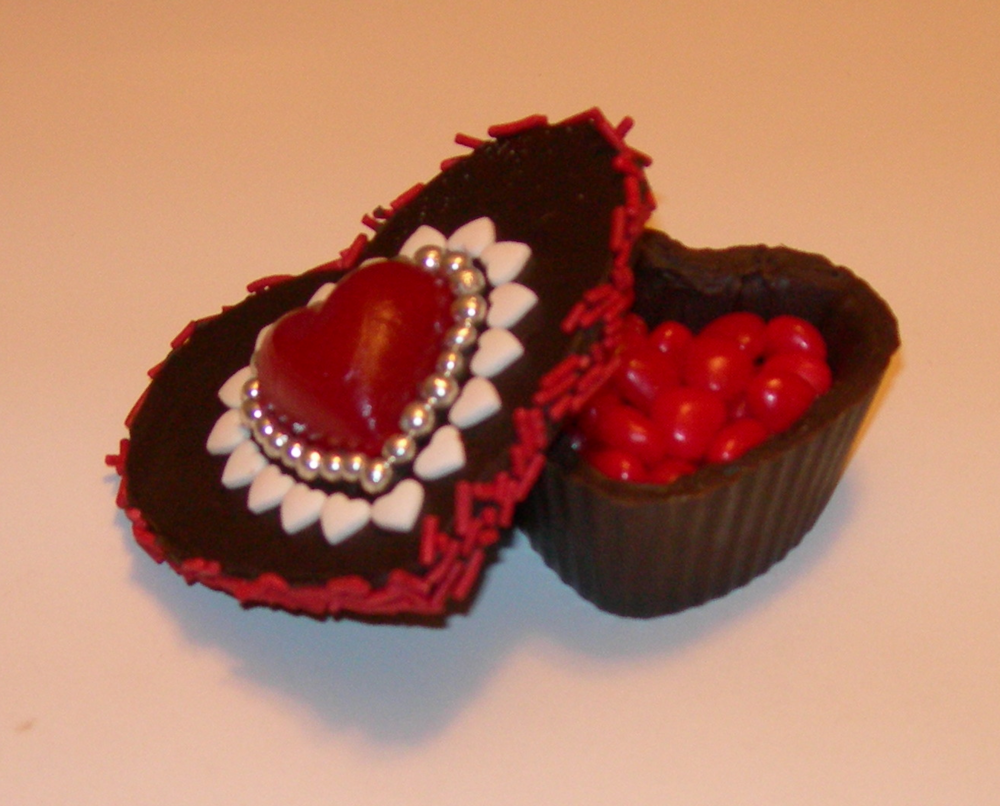
Want to give something special to your Valentine or favourite person around the department?  Need a box for it?  Here’s a perfect box!

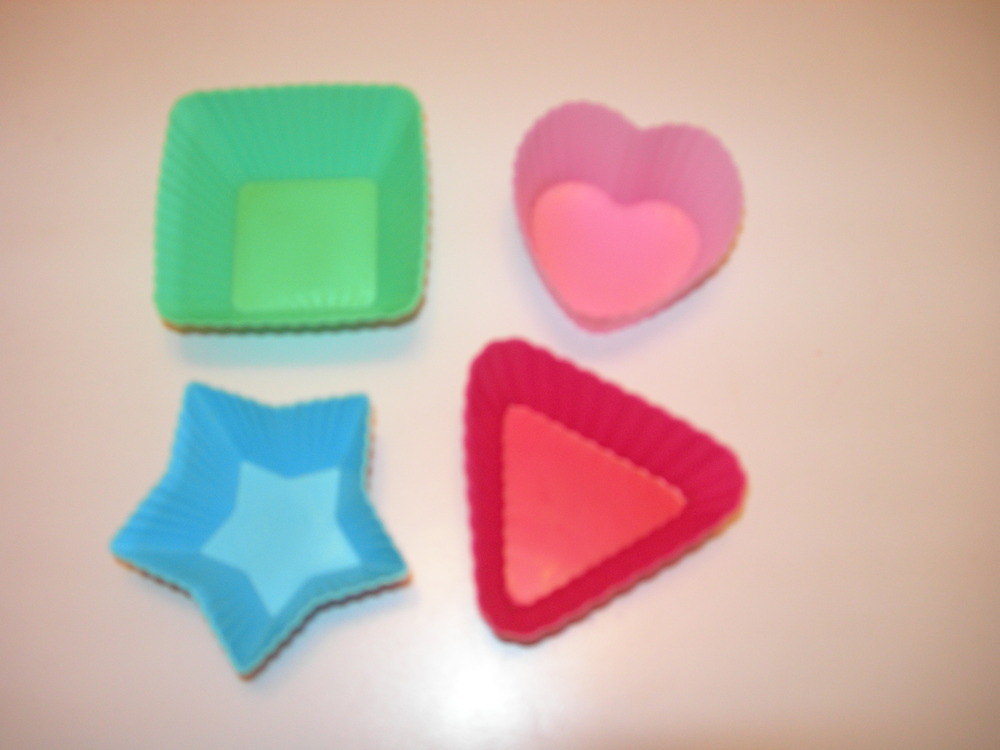
To create this, I have used a cupcake silicon baking cup.  They are great and come in all sorts of shapes (shown below), but they can be expensive.  A cheaper alternative is to use a paper cupcake baking cup inside a muffin tin (so it has support) or line a mug with aluminum foil.

 Ingredients:
– chocolate chips (what I used) or Merckens coloured melting wafers
– candy for decorating the lid

 Other stuff:
– cupcake silicon baking cup or alternative
– paintbrush with plastic bristles
– microwave safe bowl
– spoon
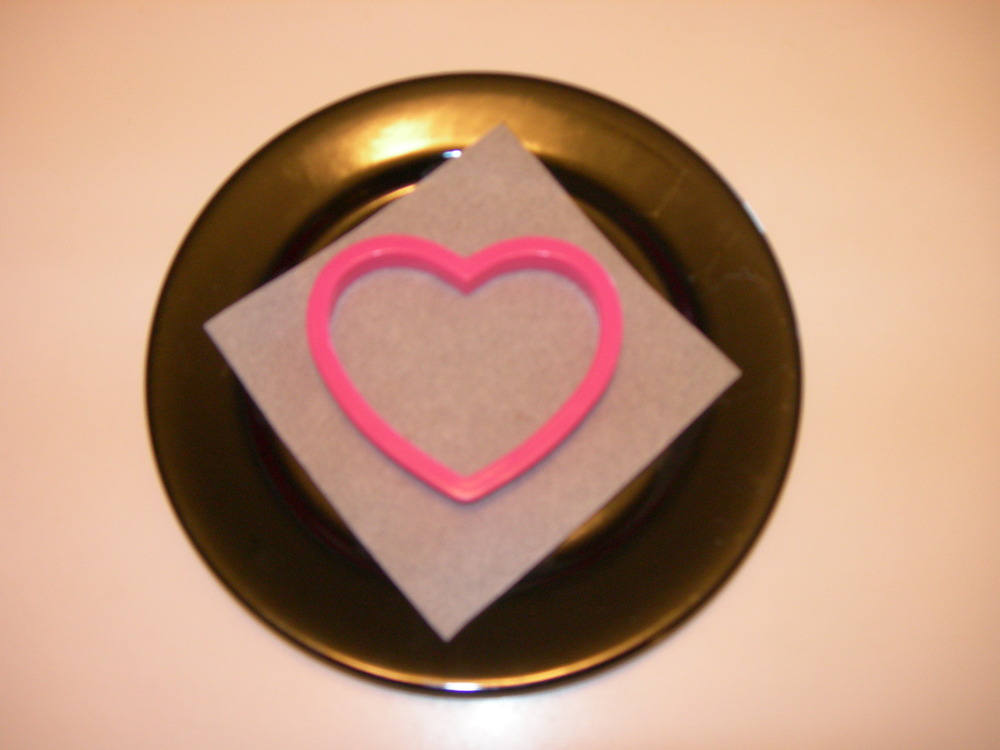
– two cookie cutters—one in the shape that you want for the lid, larger than the opening of the baking cup, one in the same shape as the opening of the baking cup, small enough to fit inside the opening and have at least ¼ inch space between it and the cup all the way around
– wax paper (a piece larger than largest cookie cutter)
– two plates
– sharp knife (optional)

 How to melt chocolate chips:
Place chocolate chips in a microwave safe bowl.  Heat in the microwave 30 seconds at a time, stirring in between until smooth.

 Create the box
1. Melt chocolate chips and paint the inside of the silicone baking cup (or alternative) completely.  Refrigerate until solid (depending on the thickness of the chocolate layer 2-5 minutes).

2. Repeat step 1 until there is a thick, solid layer of chocolate coating the inside of the baking cup (or alternative).

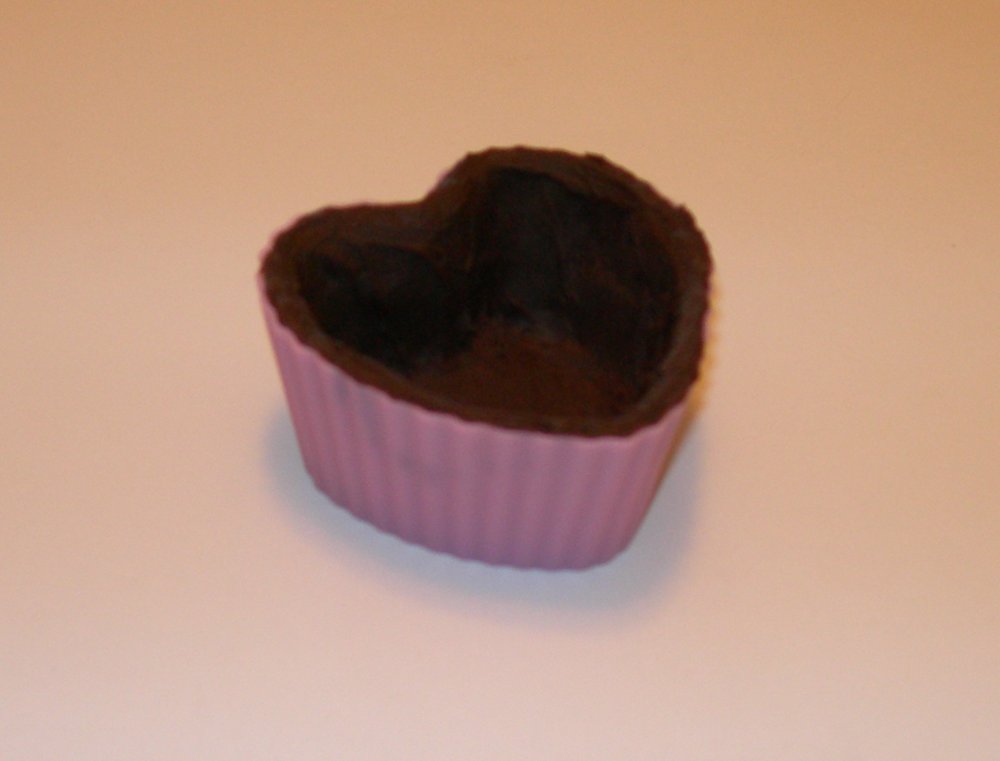
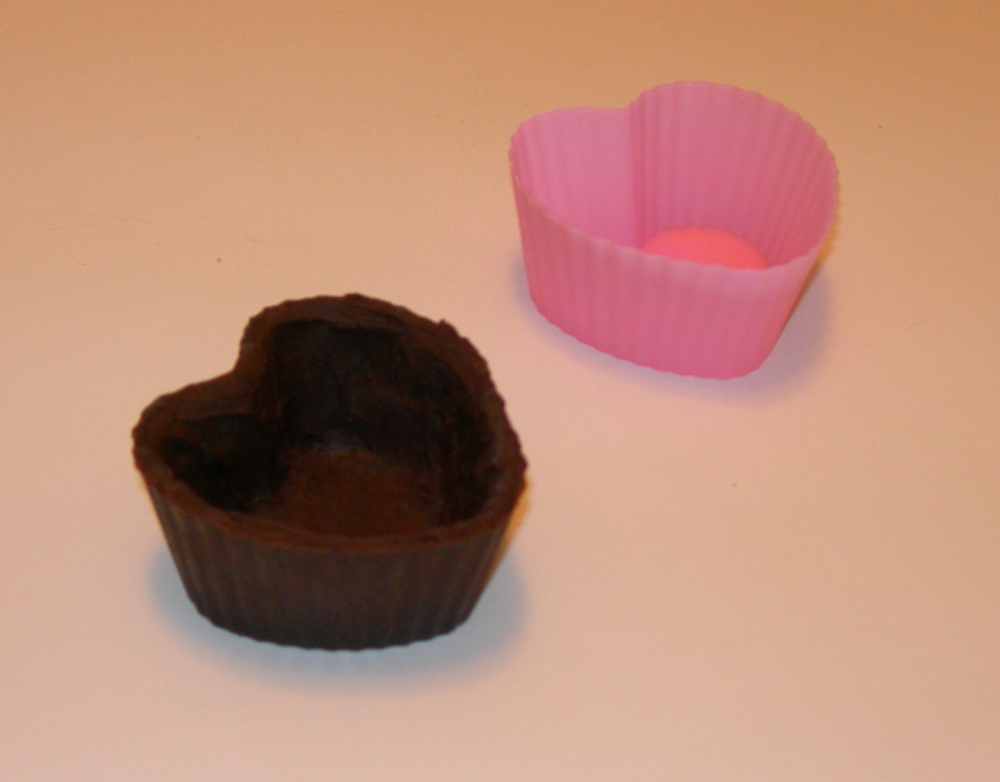
3. Carefully peal the silicone or paper baking cup off of the chocolate.  If you are using an aluminum lined mug, gently remove the aluminum foil and chocolate from the mug, and then peel the aluminum off.

Create the lid
1. Put the wax paper on the plate and the largest cookie cutter on top.

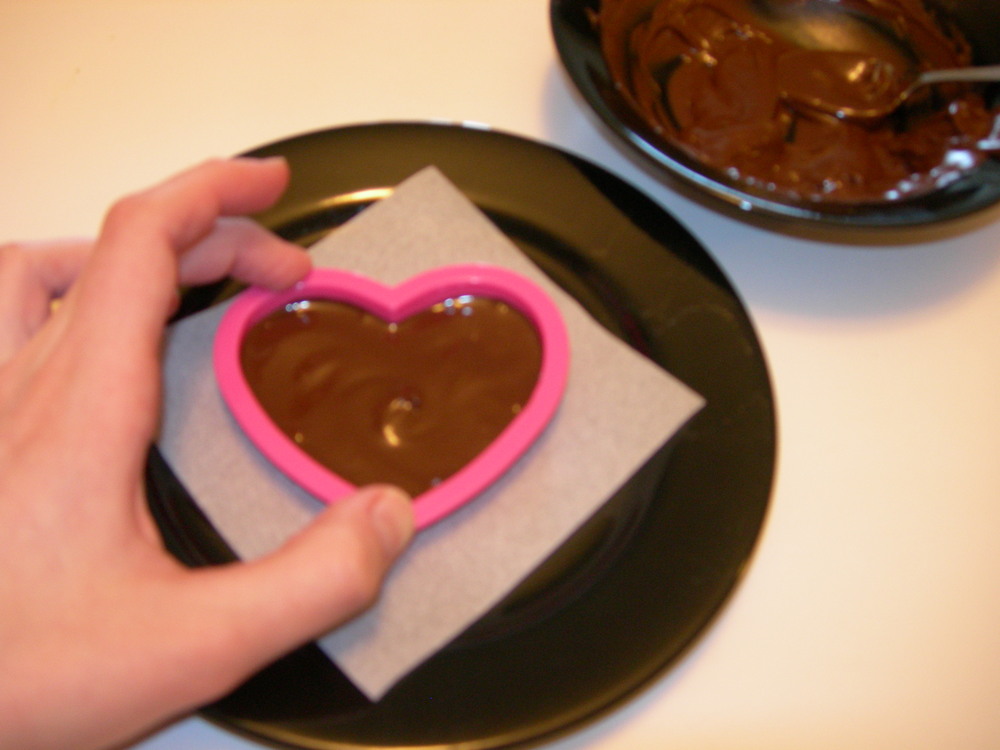
2. As you hold the cookie cutter, fill the cookie cutter with melted chocolate, at least ¼ inch high.  Use a spoon (or your clean fingers) to try to “level out” the chocolate.

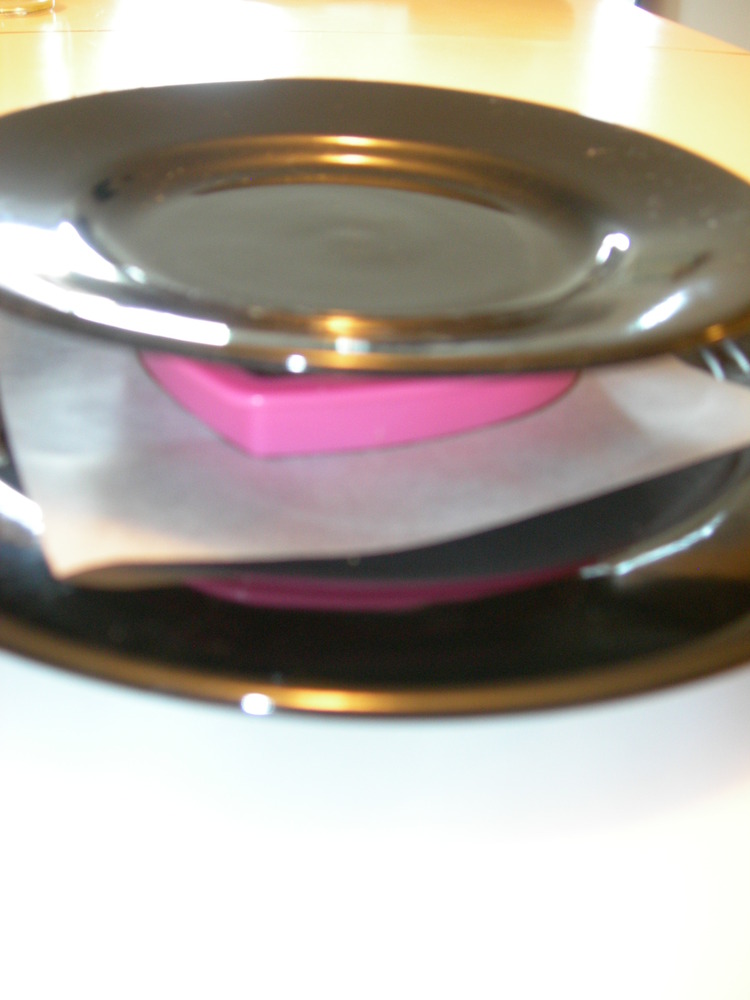
3. Place the second plate on top of the cookie cutter (to weigh it down) and refrigerate until solid.  Since this is a lot of chocolate, it will probably need 5-10 minutes.

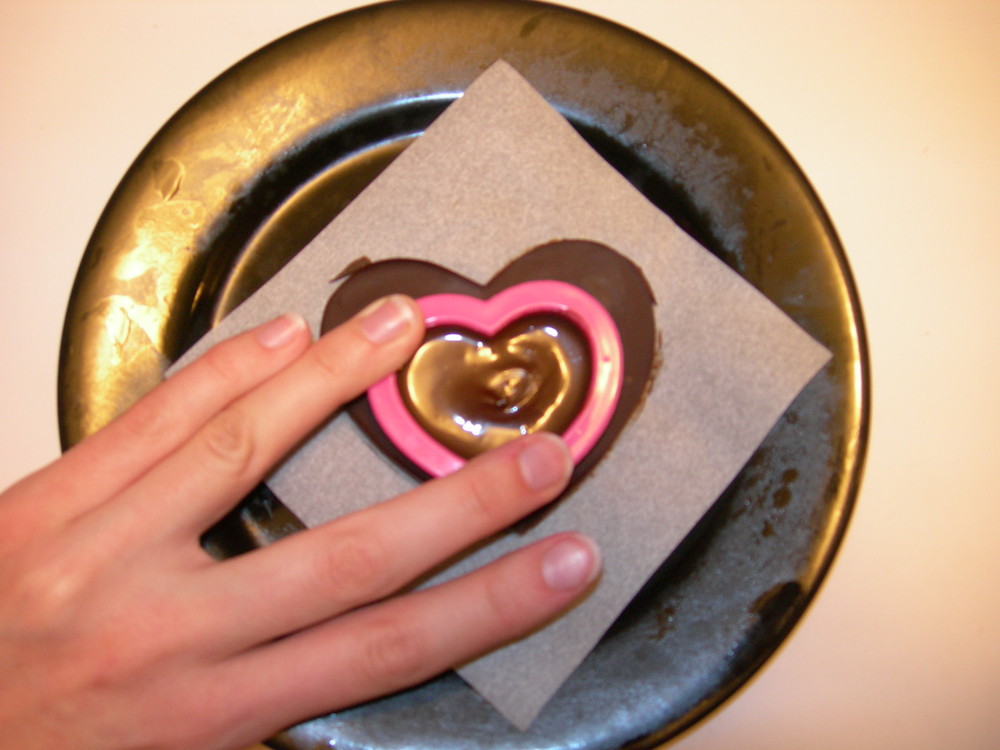
4. Once the chocolate is solid, remove the top plate.  Gently press the chocolate out of the cookie cutter.  Centre the smaller cookie cutter on the chocolate shape and fill with chocolate (about ¼ inch high) as you hold the cookie cutter down.  Level out the chocolate.  Place the second plate on top of the cookie cutter and refrigerate until solid.  This creates a lip on the bottom of the lid so that it won’t slide off the box.

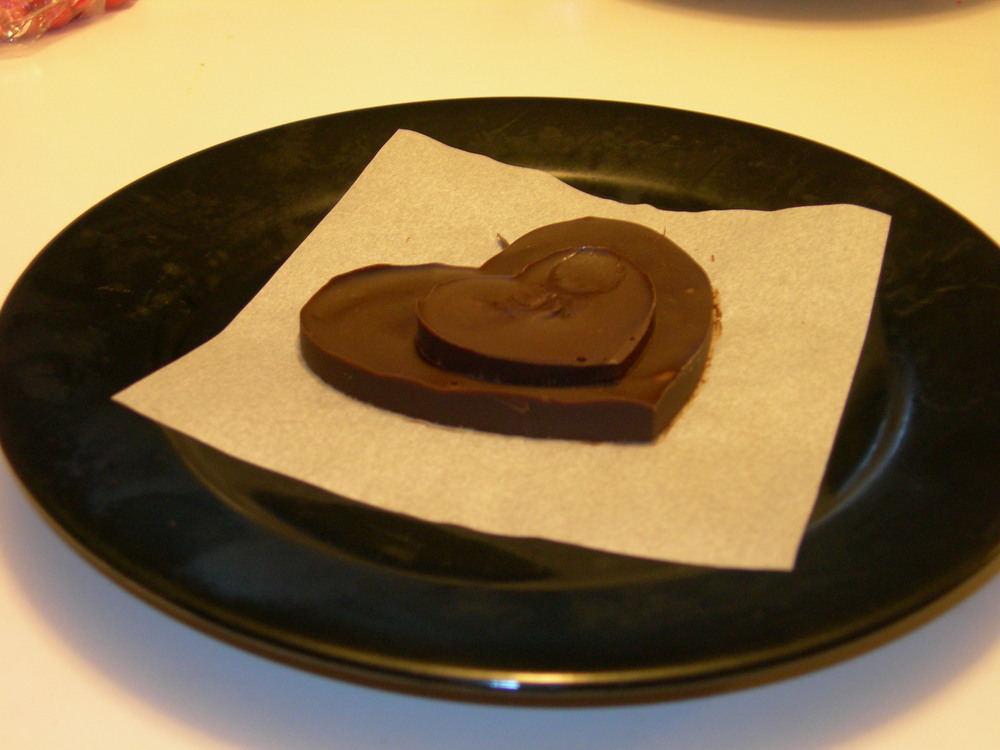
5. Gently press the chocolate out of the cookie cutter.  It should look something like this.  You can round off the sharp edges by “shaving” the chocolate with a sharp knife, if you wish.

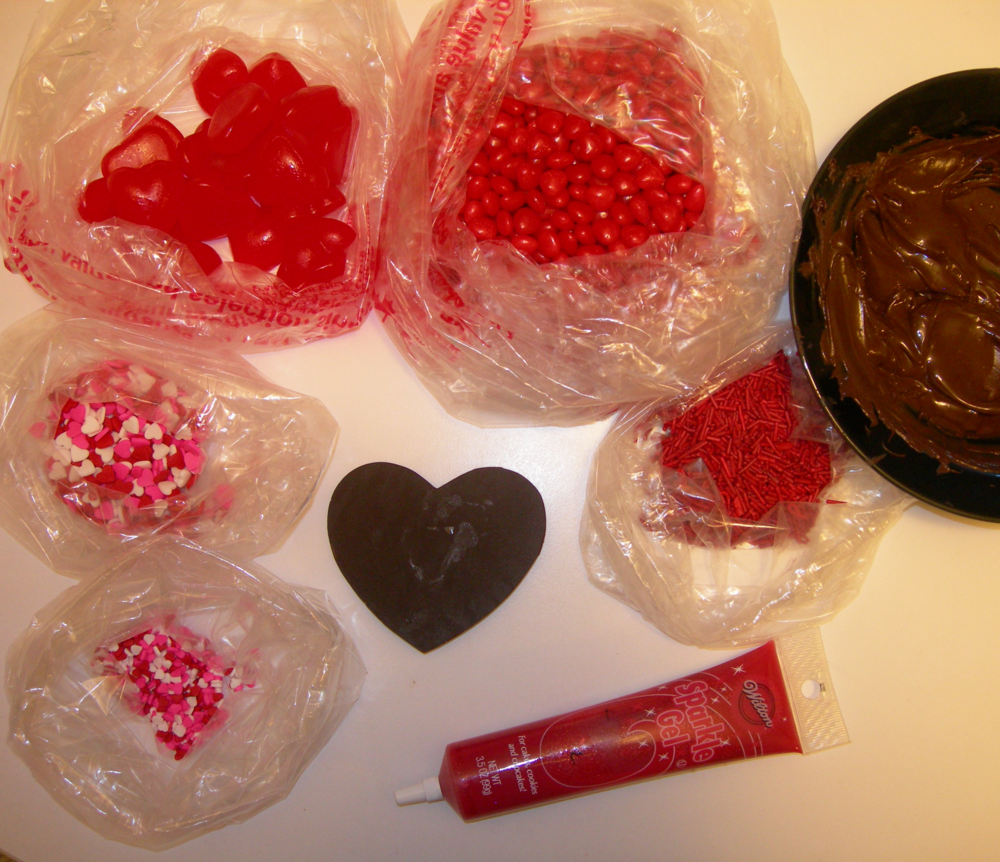
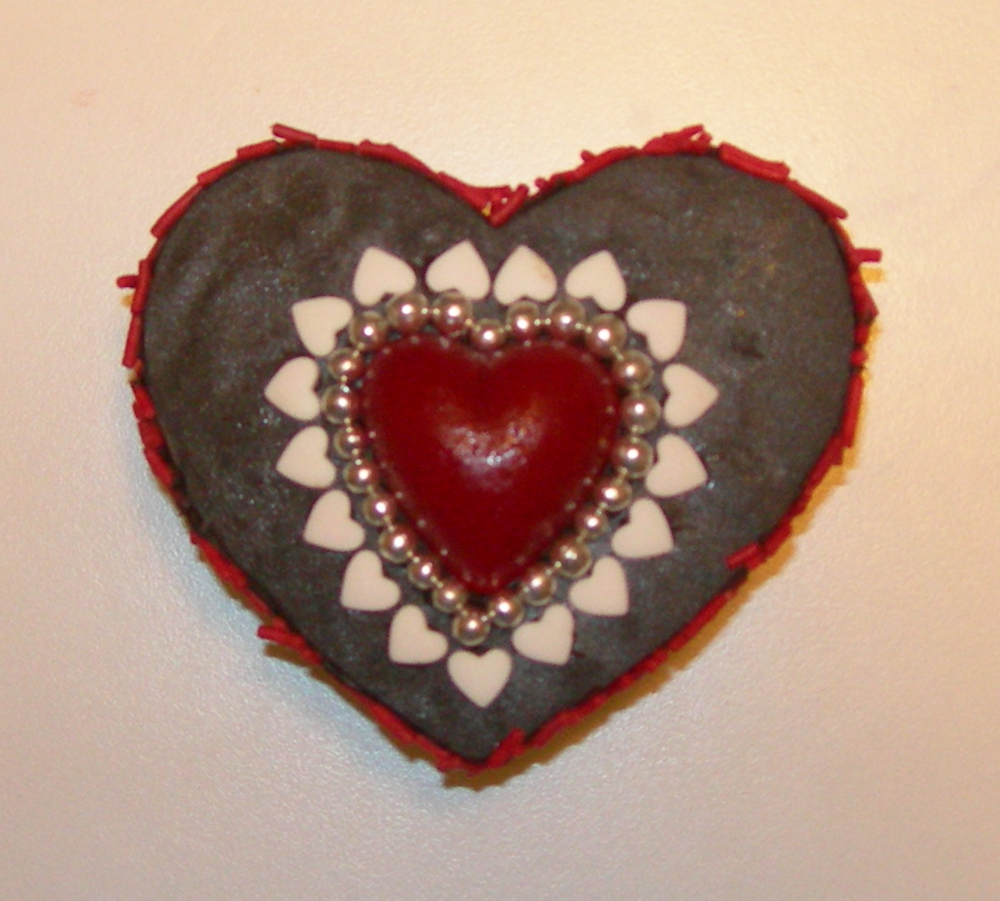
6. Flip the lid over (so the wax paper is on the top) and peel off the wax paper.  Decorate the lid with icing and candies, such as sequins, jujubes, cinnamon hearts, and sprinkles.  Use melted chocolate or royal icing as glue for attaching candies to the lid.


7. Fill the box with candy, a note, or a gift, place the decorated lid on top.  Store in the fridge (or at room temperature, just not near heat sources) until you are ready to give it away/eat it.


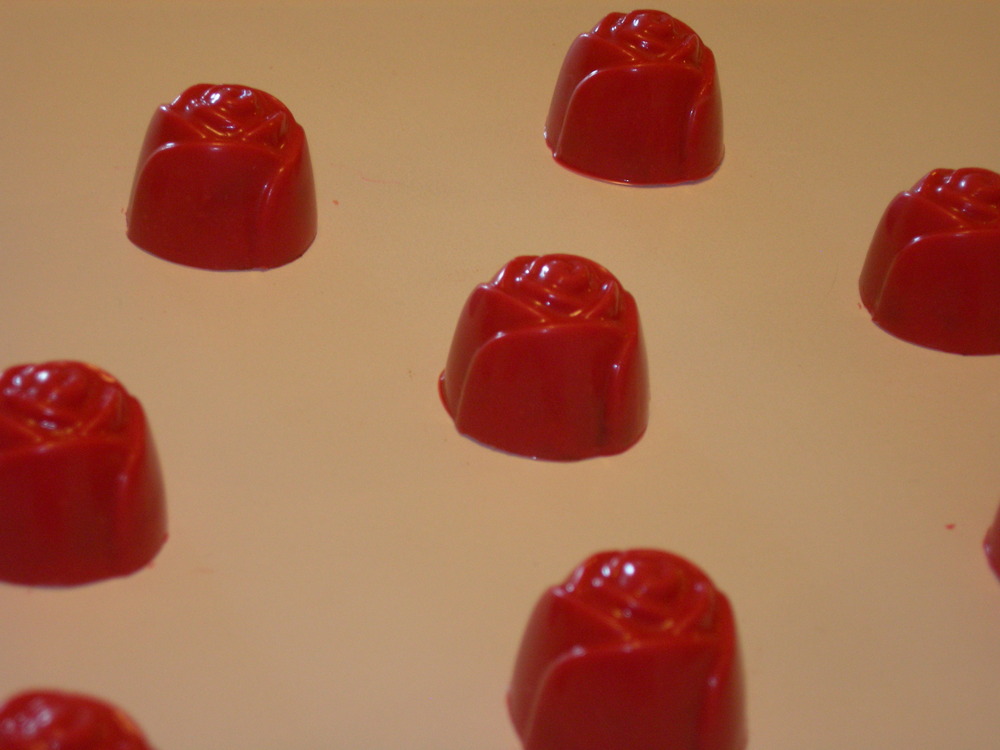
Candy covered truffle roses

These truffles are both tasty and cute and guarenteed to please any chocolate lover.  The candy shell allows them to be stored at room temperature without melting, while the truffle inside melts in your mouth.  The truffle recipe I used is from Jordan Demello, an engineer here at the University of Western Ontario.  Instead of truffles, you could also try caramel, nuts, marshmallow fluff, candied cherries, jam, etc.

These treats use coloured melting wafers (coloured disks that taste like white chocolate, available in a variety of colours from Bulk Barn).  If you cannot find the colour you want, you can mix the wafers, but do not use water based food colouring as the wafers are oil based.  Likewise, make sure that the plastic mold is completely dry before using with the wafers.

I don’t intend to sound like an advertisement for Bulk Barn, but it is probably my favourite store—and students and seniors get 10% off on Wednesdays.

Ingredients:

– Merckens coloured melting wafers (roughly 0.25 kg makes 36 candy shells)
– filling (I used the truffle recipe below)

Other stuff:
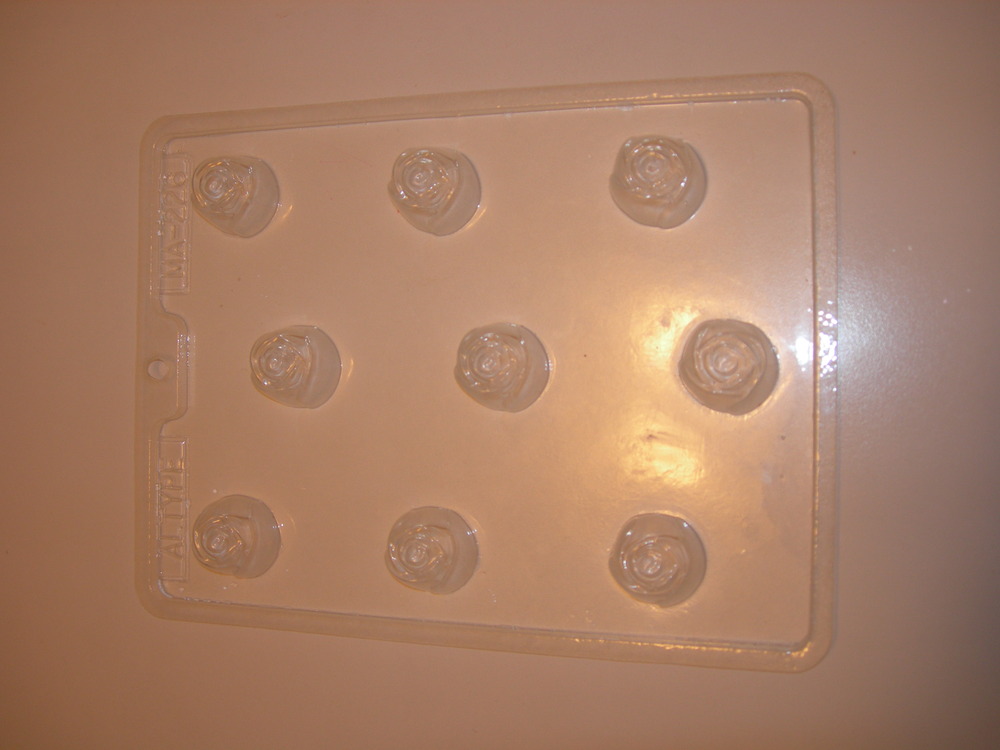
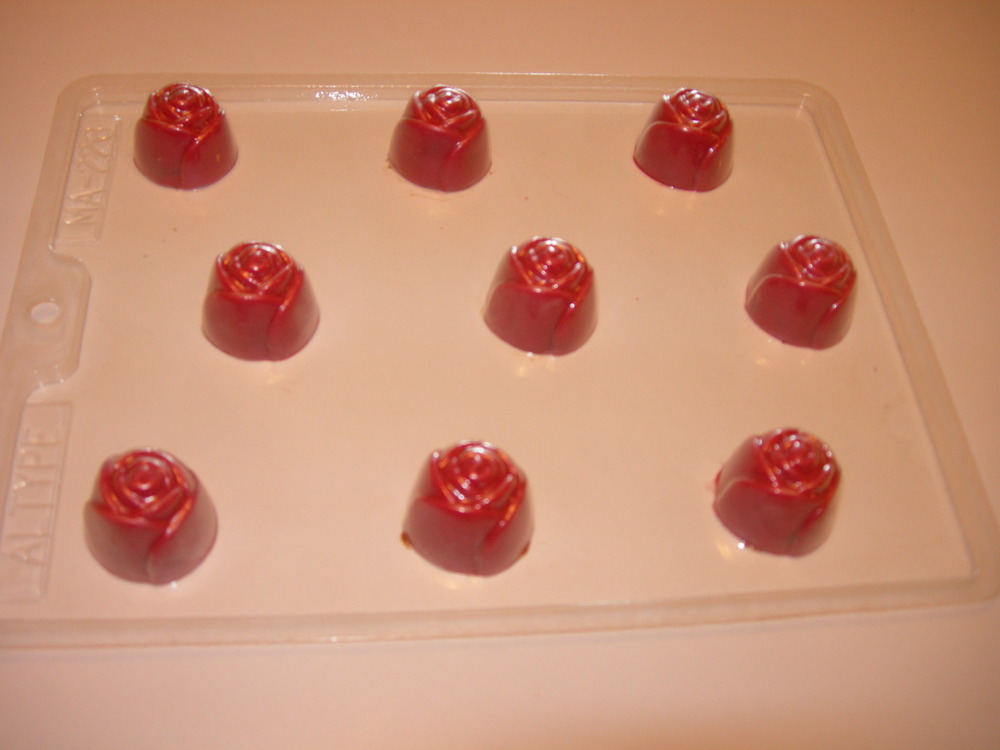
– rose (or whatever shape you want) candy mold (available from Bulk Barn, shown here)

– paintbrush with plastic bristles (available from Bulk Barn, but expensive there.  Probably available at a lower price from Zellers or Walmart.)
– microwave safe bowl
– spoon

1. Put a handful or two of the melting wafers into the microwave safe bowl.  Microwave for 30 seconds.

2. Stir vigorously until smooth.  If there are a lot of wafers in the bowl, you may need to put them in the microwave for another 15-30 seconds.

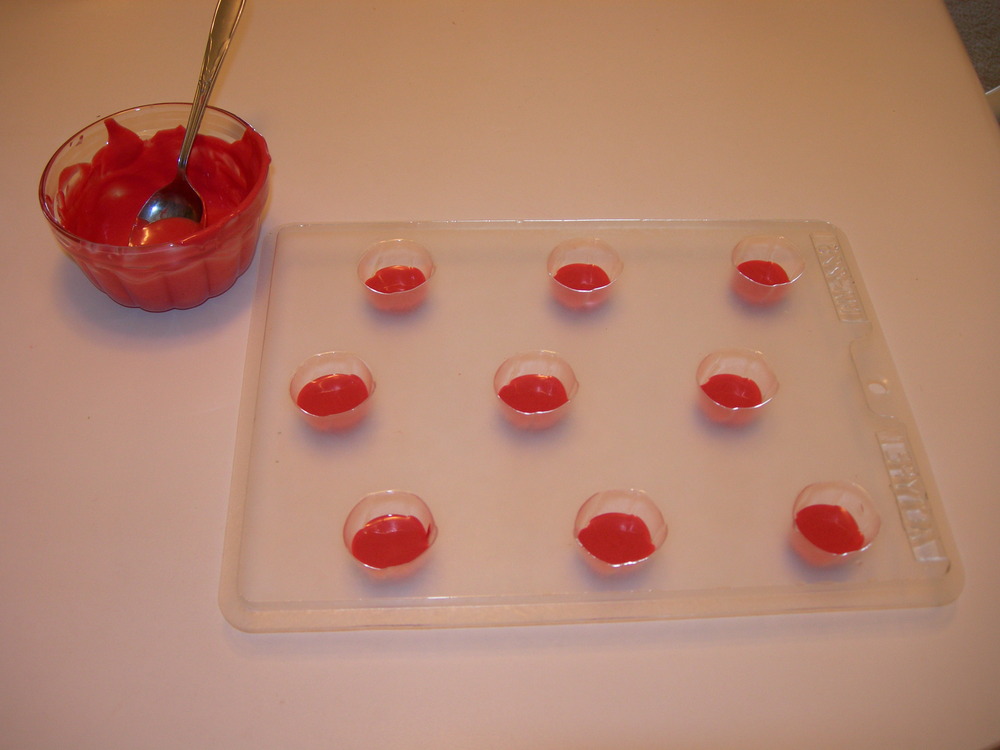
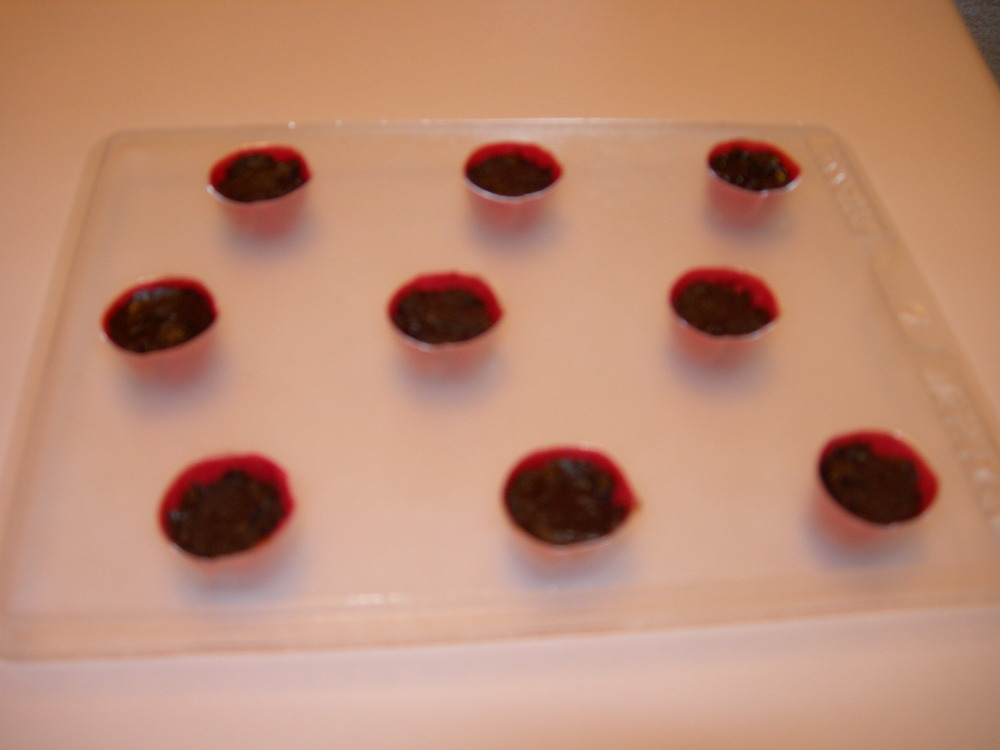
3. Spoon melted wafers into each cavity until the cavity is slightly less than half full (it is better to underfill than overfill).  Tap the mold to release any air bubbles.

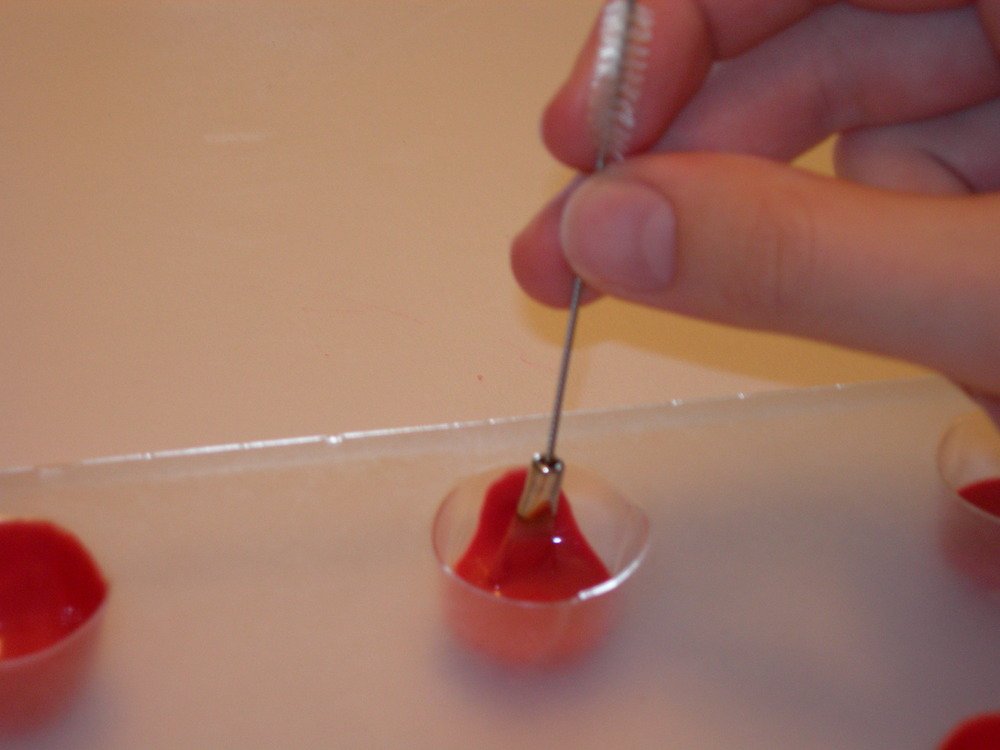
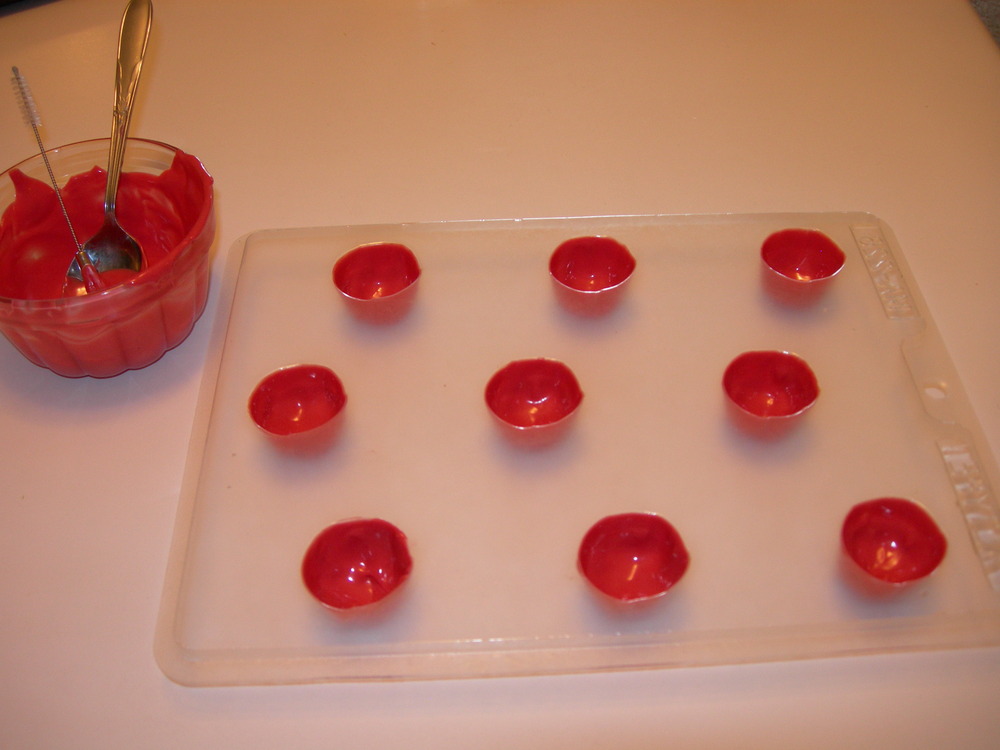
4. With the paintbrush, paint the melted wafers up the side of the cavity.  Make sure all sides and bottom of the cavity are completely covered.  If you need more wafers in the cavity, you can grab some with the paint brush.


5. Refrigerate until set (about a minute or two).  The candy is set when it looks “frosty” if you look through the plastic mold at the candy (if it is not set, it will look wet and rich in colour).

6. Fill each cavity with the filling of choice, leaving the top ¼ inch of the cavity empty.  If you are using a viscous filling, such as the truffles, you may need to gently, but firmly, press the mixture into the cavity (as to not trap air inside).  If using a temperature sensitive filling (such as truffles), it is good to put them in the fridge for a minute or two to allow them to stiffen again.


7. Spoon melted wafers in cavities to fill (may need to add more wafers and/or microwave your wafers again).  Tap the mold to release air bubbles and flatten the bottom of the candies.  Put in the fridge for 2-3 minutes (until set and firm to the touch).

8. Invert the mold onto a clean surface.  Tap the mold to release the candies.


9. Enjoy or store at room temperature or in the fridge/freezer to enjoy later.


Truffles (from Jordan Demello)
 Ingredients:
– 350 grams (roughly 2 cups) semisweet or bittersweet chocolate chips
– 1 cup (250 mL) whipping cream (35% cream)
– 3 tablespoons butter
– 2 tablespoons flavouring –optional (some good ones are vanilla extract, orange extract, mint extract or alcohol (such as Grand Marnier, Kahlua, rum, etc.))
– covering (if making candy covered truffles, then you don’t need this as the candy shells are the covering.  If you are making just truffles, you will need something to roll them in, such as icing sugar, cocoa powder, crystallized sugar, sprinkles, etc.)

 Other stuff:
– a heat resistant bowl (and lid)
– a pot
– a spoon/whisk
– a couple teaspoons

1. Put the chocolate chips in the heat resistant bowl, set aside.

2. Combine the rest of the ingredients in the pot and bring just to a boil over medium low heat, stirring frequently.

3. As soon as the mixture starts to boil, pour the hot liquid over the chocolate chips and cover with the lid.  Leave it for a few minutes to allow the heat to permeate.

4. Whisk/stir thoroughly.  The mixture will jump from a thin “chocolate milk” consistency to a dark, viscous one.

5. Refrigerate up to two hours, or until set (firm enough to work with).

6. Put this into candy shells or roll into small spheres (roughly ¾ inches in diameter) then roll in the “covering”.  Warning: This part is very messy.  Using a couple teaspoons to form the spheres helps cut back on the mess.  You may need to move the truffle mixture in and out of the fridge to keep it at a workable temperature.

7. Enjoy or store in the fridge/freezer to enjoy later.

Do the math first please! #Starbucks versus #TimHortons who’s cheaper? #caffeine

You are constantly bombarded with propaganda convincing you the Tim Horton’s is the warm-hearted little guy coffee maker for the people while rich people with money to burn go to Starbucks. While it is true that my Bob-Bodum-brewed cup of morning Kona is cheaper and much better than either, if you can’t roll your own I argue save money and go to Starbucks.

Huh? No, this has nothing to do about Tim’s changing the cup sizes around. Let’s compare the brews under the following assumption: we are drinking coffee for the caffeine. Taste is subjective, but caffeine is caffeine and if this isn’t a prime reason most of us are coffee drinkers, then I invite you to have a big mug of Joe right before bed. Ok, Mrs. Sica can do that but most of us can’t. And study after study shows that overall coffee has mostly positive health benefits.

So, a 20 oz Timmie’s (which I believe is now called a Large) is about $1.60 and has about 200 mg of caffeine. A Starbuck’s Venti is the same size and will set you back like $2.10, but has about 400 mg of caffeine. There you go, 25% more coin for a Bucky for 2x the buzz. Which coffee is the bargain!

Just found out that in comparing these numbers remember: your mileage may vary. Here’s an interesting story from NPR in the States about the large variations in caffeine content: http://www.npr.org/templates/story/story.php?storyId=6155178. For instance:

The study also found that Starbucks’ caffeinated breakfast blend, purchased at a Florida store, varied greatly in its caffeine content from day to day. One day, a 16-ounce cup had 259 milligrams of caffeine. Another day, the same size coffee contained 564 milligrams.

So given the error my initial reaction was to be safe and bring a thermos, but the article argues that more like 100 mg might be a optimum dose. Since they are still working on my new office here, maybe I can get them to plumb in some lines for a proper espresso maker so I can spread out my daily buzz!

How to thesis: Focus

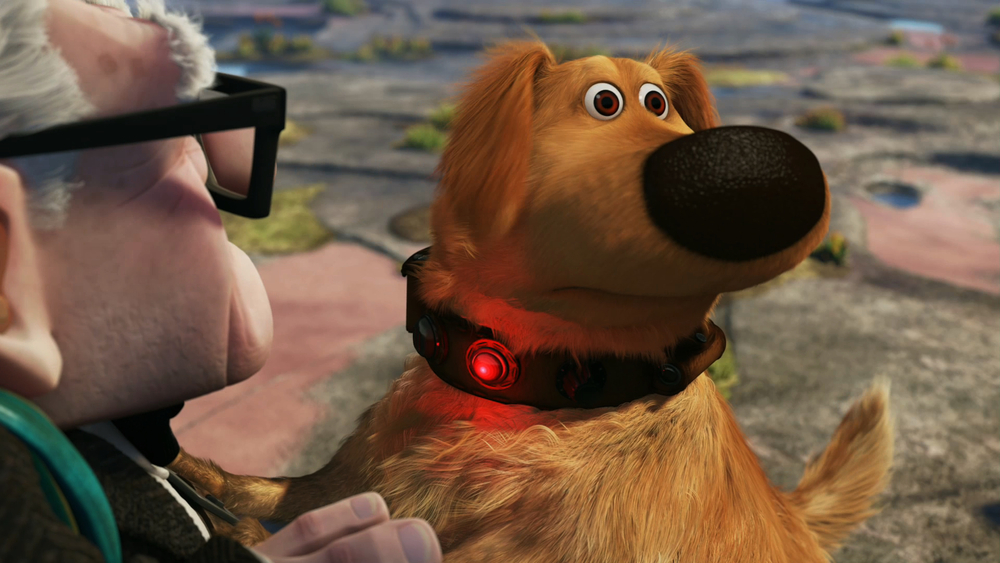
Focusing on one task for a long period of time is somewhat important for writing a thesis (or doing any task that requires sustained concentration in general).  However, it has never been a strong suit of mine.  Sometimes I feel a lot like that dog from the movie Up.

Fortunately, I have picked up some tricks that help me concentrate and perhaps this information can be helpful to others who might still be having problems with this.  Here they are:

Sleep

Now, this may sound obvious, but keeping a regular sleep schedule can be difficult sometimes and a lot of the time, sleep gets set aside in favour of more time to do work.   However, getting a solid x hours of sleep a night (where x is the number of hours you require to feel rested) is really key to working well.

There’s even science to back this up.  People who are sleep deprived experience more difficulty in performing tasks requiring a lot of attention as well as doing things like forming new memories (if you needed another reason to avoid staying up all night cramming for midterms the night before).

Of course, it’s also an entirely different thing to forgo sufficient sleep in the days just before a deadline than it is to make a habit of it.

Exercise

Regular physical activity not only helps with sleep quality and reduces stress, but personally, I find it makes me a lot less restless during the day.  If I’m less restless, I can get more work done.  It also has a lot of health benefits, so it’s a good thing to do aside from helping you pay attention.

Caffeine

If you’re the sort of person who has a lot of negative effects from caffeine, this won’t help.  But there are studies indicating that caffeine does help improve focus and attention span.  This may seem a bit counterintuitive (e.g. shouldn’t it make you more restless?), but it does make sense when you consider that a well-rested person can focus better than one that is sleep deprived/tired and that caffeine is a stimulant, which will temporarily make you feel less tired.

Scheduling

I think I’ll write more on this point in another post, but in short: Make a schedule and try to stick to it.  If you make a series of small goals throughout the day (or mini-deadlines, if you prefer to think of it that way) and make a sincere effort to accomplish the tasks you set by the time in which you set out to do them, it can be easier to focus on that one task that you want to finish by a certain time.  Don’t beat yourself up if you fail to meet your schedule, just do your best (you can never anticipate the difficulties that might crop up during a particular task if you haven’t done it).

Take Breaks

By this, I don’t mean that you should randomly take some time out of your day to browse youtube.  I mean you should schedule some breaks throughout the day (say 10 minutes every hour) in which you do something that takes you away from the task you were performing.  So if you were working on your computer, go for a walk, have a snack somewhere that isn’t your desk, make some coffee/tea, do some dishes, whatever.

Working in small chunks makes it easier to focus (you don’t have to do it for nearly as long) and doing something different from your previous task really gives you a break from it.  If you go from sitting at the computer working to sitting at the computer checking your email, this isn’t quite the same effect (your body isn’t getting a break from its previous task).  You may also find that taking a walk can give you time to mull over any issues you were having with your work and perhaps you can think of a few solutions by the time you get back to your desk.

Music

This definitely doesn’t work for everyone.  It does work for me (and I know I’m not alone in this), but listening to music or having some background noise (nothing too loud, just enough that it’s not absolute silence) helps me pay attention to my work a lot.  It might come from growing up in a fairly noisy house and doing most of my homework in front of the television when I was in high school, but I really just can’t focus when it’s quiet (nor can I focus with construction noises).

I hope that my tricks to stay focused are helpful.  If you have any tricks that you employ, feel free to leave comments because perhaps what works for you will work for other people too.

Until next time…

SQUIRREL!


Sarah is in the final year of her PhD.  “How to thesis” is a series in which she imparts various (hopefully) useful things she has learned during her graduate career.