Category Archives: Physics and Astronomy at Western Blog

Opinions from the community at The Department of Physics and Astronomy of Western University.

Those lazy profs

Back in the fall of 2010, when it looked like members of UWOFA might be going on strike, there was occasionally some muttering about “those lazy profs who only work 3 hours a week”. It’s true that our actual classroom time is small compared to elementary or high school teachers, so what does a prof do with the other hours in the week?

Most professors at Western have their workloads divided between teaching, research and service. The balance varies, but the standard is 40% of time to research, 40% to teaching and 20% to service. So that tells you where some of the non-classroom time is going — to things completely other than teaching.

But how about the other non-classroom-but-teaching hours? From my perspective, some of those hours are spent doing the same things other teachers do:  preparing class activities (including lectures), preparing and marking assignments and tests, and dealing with a gradebook. I write letters of recommendation for students and meet with them in my office to talk about coursework or (espeically in the case of graduate students) their research. I go to conferences and workshops which are supposed to help me be a better teacher.

There are some things that elementary and high school teachers do which are not part of my job. I don’t have yard duty at recess, and, except in rare cases, I don’t talk to the parents of my students. However, I also do some things that elementary or high school teachers don’t do. (Let me be clear that I don’t think their jobs are easier than mine, just different!)

Some of these tasks are related to the size of our classes: for instance, this term I have one class with 100 students and one with 200; I’m course coordinator of two courses which means that I have some organizational responsibility for about 900 students total. With large classes, we have teaching assistants to help with things like tutorials and marking, and organizing those TAs is a non-trivial task. With that many students, administrating them — for example, arranging make-up exams for students who missed a midterm — also takes time. I have to make up many-page course outlines which spell out the details of my courses, such as what happens if a student misses a midterm. And a sad fact of life is that I have to spend time on anti-cheating measures, for example making multiple versions of exams.

The other category of teaching tasks that I think is different for profs is related to our greater freedom to decide what and how we want to teach. For elementary and high school students in Ontario, the province sets the curriculum. We have the Western course Calendar which doesn’t exactly go into the same level of detail. So I spend a fair bit of time thinking about what I want my students to learn, and why. For, say, first-year physics, this course content is driven to a large extent by the upper-level courses which these students will go on to take. But for a graduate course, or an astronomy-for-non-scientists course,  there’s not such a clear set of requirements.

This means that I spend time looking around for examples of similar courses, looking at textbooks to see which ones might be most suitable, and talking to other profs about what they want students to learn from this course. Then once I figure out where I want students to go, I have to figure out how I can help them to get there. Again, I spend some time looking around, trying to figure out what educational methods are best suited for the type of course and students that I have. If I give complicated assignments, I try to do them myself to make sure they’re feasible. If I’m going to use some new technology, I have to make sure that I can make it work.

My prof colleagues who are reading this now know exactly how lazy I am (or not). For students who read this all the way down, I hope it gives you a bit of a behind-the-scenes look at what I am doing when we’re not in the classroom together. In a future post I’ll discuss some of what the other 60% of my time involves.
The Final Countdown… Month 11

I trust we all had a great Christmas and New Year and are back in to the swing of a new winter term.  I have, as promised, been doing some reading into the preparation of an academic CV, and no real surprise it is pretty straight forward and with some common sense not really to difficult.  That being said like all things in research experience is key and thus, looking at websites and reading over example documents is the best way to prepare the initial one; which can then be improved upon.  For this purpose I include two links:

  1. Western’s Career Centre – a sample CV may be found at the bottom of this page.
  2. Vitae – a British resource which has a number of samples depending on level of application and field of study/research.  May be found here.

As a graduate student near the end of my student career I am both nervous and excited about what the next few years have in store and plan to do my utmost to prepare myself for the reality of the current academic and nonacademic job markets.  For me, this means information is key, thus I cannot recommend strongly enough events like the Graduate Career Day for arming ones self with the information to make the decision that is right for you.

I also, highly recommend that we spend a long time deciding which path to take.  Make the academis versus industry decision for yourself.  It wasn’t something I really thought about seriously until my PhD. was well underway, and I spent a lot of time weighing up the pros and cons for me and my family.  For me personally the final decision came when I was looking over the projects that I have had to lay a side, the bits that I am not going to have time to finish in my PhD. research.  As I was sorting the folders with all the titbits of background information and personal data I began to wonder about the possibilities housed in these notes.  It was that juvenile excitement that made me realise that it is not only the science of Stellar Astronomy that is important to me but also the freedom of personal research.  That being said, if I had to choose between research and hands on observing, the telescope would win hands down (but that is for another dicussion, later when I start looking at my options).

Anyway, since I seem to have rambled a little there, I will conclude.  Make the decision for you, not for your supervisor or simply because it is easier to not think about it.

Jobs for physicists

A while back Shantanu posted a link to an article on the question of whether our universities are producing too many PhDs. I don’t have a yes or no answer to that question, but I have some rambling thoughts on the subject. Bear with me, the punch line is way down at the end.


I was a undergrad in the late 70s and a grad student for most of the 80s. (I’m not that one guy who skews all the statistics on graduate degree completion times, but I took a while. That’s another story, though.) I wanted to be a university professor, and for most of that time, university jobs for physicists were very tight. Most universities expanded a lot in the early 70s, then didn’t hire anyone for a long time. Industry jobs got harder to find, too. When I was an undergrad, my profs told me, “Don’t worry, when you finish your PhD in five years the job market will really open up.” When I was an MSc student, they said, “Don’t worry, in five years the job market will really open up.” When I was a PhD student, they said “Don’t worry, in five years the job market will really open up.” What I learned from this is that Physics profs don’t know very much about job markets, or about economics in general. Nonetheless I was fortunate to get a faculty position in 1989, after a short postdoc in the States. There were six faculty positions in physics advertised in Canada that year. If I remember correctly, two of them were 3-year positions and the other four were tenure-track. I know three of the other people who got hired that year, and I have to say that I am in good company.


In the early 90s, students figured out that jobs for physicists were hard to find. Enrollment in university physics programs all across the continent started to drop, and kept dropping for all of the 90s. I don’t have the figures for Canada, but in 1999 the number of BSc and PhD degrees in physics hit a minimum. I think around this time UWO’s honors physics class had all of two students. In the meanwhile, though,  something really did change in the job market. In the early 90s things started to pick up. Not just in the universities – industry started to hire more physicists, too. Opto-electronics, semiconductors, and “high-tech” in general exploded. Investment banks discovered that the problem solving, math, and computer skills that physicists knew were useful in the world of finance, and hired a significant number of physicists at salaries on the order of $300,000 per year. As the world’s economy became more and more computer-based, information based, knowledge-based, whatever you want to call it, people like physicists who were good at dealing with computers, and information, and knowledge became more in demand.


So, eventually students figured out that there actually were jobs for physicists out there. Through the 00s, physics enrollments steadily went back up. In 2010, the number of BSc and PhD degrees awarded in the States was the highest it’s ever been! Again the numbers for Canada are harder to find, but the trends here have been the same, and Western’s honors class has been in the high teens to low 20s for the last few years.


The point is this: If there are physics jobs available, students will take physics. If there are not, they won’t. There tends to be a bit of a time lag between employment conditions and enrollments, so the system is not perfect (actually this kind of feedback system can be mathematically unstable, but again that’s another story) but it is more-or-less self-regulating.


In recent years, both the federal and provincial governments have decided that Canada needs more “highly qualified personnel” to support the “new knowledge-based economy” … blah blah blah. To help meet this need, the governments have dangled money in front of the universities, rewarding them for increasing their graduate enrollments. Of course the universities love this, because they get more money, and more students, and more research papers, and more degrees, and more alumni who when they are rich will give more money to the universities…. But do programs like this really help the economy? What is the effect of these programs on the more-or-less self-regulation of enrollments that I mentioned above? Most importantly, will all of the “extra” grad students were are training find jobs when they graduate?


I said that physics profs aren’t very good at economics, and that applies to me, too. I can’t answer my own questions. I assume that somebody, somewhere, thought about these questions before the governments decided that we needed more scientifically-trained people, but I’ve never heard the answers.


I will end on an optimistic note. According to the American Institute of Physics, the unemployment rate among newly-minted PhD physicists has never been more than about 6% for as long as they have been keeping statistics. It’s typically around 2%. Their graph is quite interesting; you can see it here: http://www.aip.org/statistics/trends/highlite/emp3/figure1a.htm

You can track the strength of the economy by following the curves for “Potentially Permanent Position” and “Postdoc.” Their graph shows a small hump in unemployment in the 90s that peaks at 6% in 1993, but since then unemployment has been lower. Here the message is simply that essentially all PhD physicists have been able to get jobs when they graduate, even when there were supposedly no jobs for physicists out there! I don’t understand economics, but I do understand this: the bottom line is that the skills that physicists have are useful, so people hire them. I am hopeful that this will continue even as the supply of physicists increases.

How I spent my year’s leave, part 2

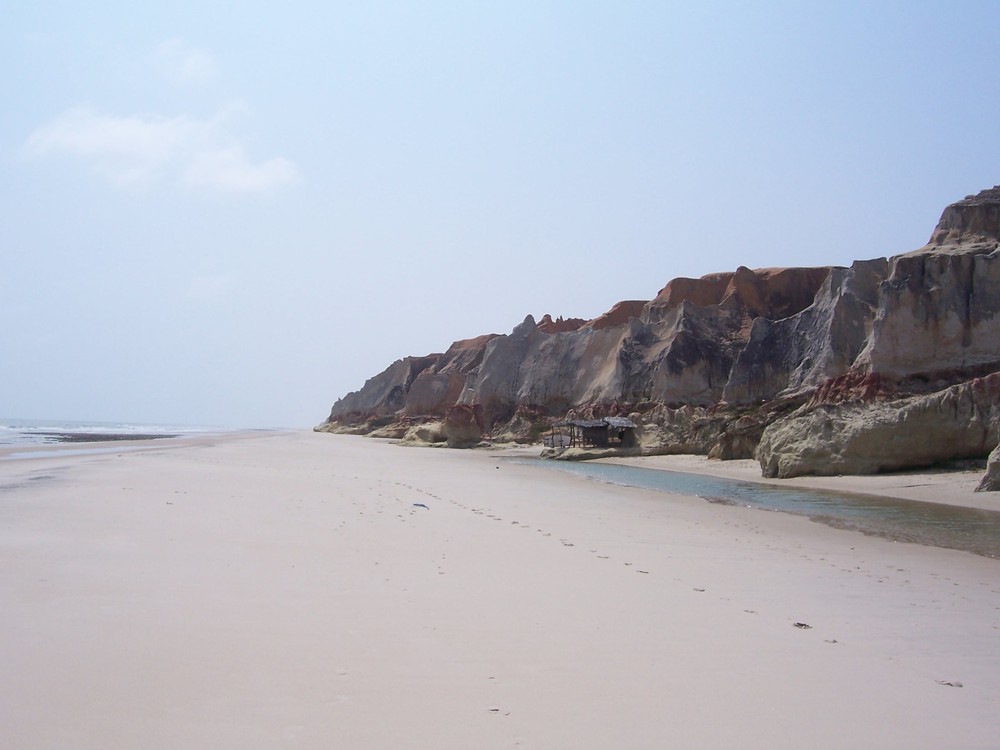
While I was in Brazil this fall, I visited Raimundo Costa Filho at the University of Ceara in Fortaleza. Raimundo was a prof at Western for a couple of years. Fortaleza is only three degrees south of the equator, and the weather there is the same all year round: sunny, temperature in the low to mid 30s, with a nice breeze blowing off the ocean to keep things from getting too hot. Lovely! And the beaches around Fortaleza are absolutely spectacular.


While he was at Western, Raimundo and I talked about some work I was doing with my PhD student Simon de Vet on the formation of impact craters in granular materials. Since then, Raimundo and one of his former students have been working on numerical simulations of the impact process. I’m looking forward to seeing their paper.


I gave a talk about our crater work in Fortaleza. The experiments Simon did are quite simple – he dropped a ball into a bucket of tiny glass beads, and looked at the crater that results.  Our granular craters look just like craters on the moon: Small ones are smooth bowls with a raised rim, and bigger ones have a peak in the middle. Simon and I were interested in the extent to which the process we were studying really mimicked the formation of craters by a meteor impact. The energy scale in our case was some 20 orders of magnitude smaller, and many of the details were dramatically different, but nonetheless the end product was very similar. There were also some theoretical reasons to think that our experiments really did have something to say about “real” impact craters.  Simon’s work focused on the granular flows that took place after the impact. We think that the fluid dynamics is essentially the same as it is in a meteor impact, and that’s why the shape and morphology of the craters is the same. On the other hand, Simon found that the (appropriately scaled) energetics of the crater-formation process were quite different in the two cases. In big lunar craters, essentially all of the kinetic energy of the projectile is used to excavate the crater, while in our granular impacts it’s about 0.1%. Where does all the energy go in the granular case? Friction, and inelastic collisions between the grains. I spent part of my time in Brazil writing a paper about some of Simon’s work.


I won’t write about Brazil any more, becasue next month we are going to Hong Kong.

Thinking – incorrectly – about waves

Last year I supervised Erin Kennedy’s honors thesis research. Erin plans to be a teacher, so she was interested in doing a thesis on physics education. Her project involved studying how well students understood some basic ideas about mechanical waves. Her guinea pigs were last year’s Physics 2110 and Physics 1502 classes, which I taught. She gave the second years a diagnostic test (developed by Wittmann as part of his 1998 PhD thesis at the University of Maryland) early in the course, and again at the end. She analyzed the results of the pre-test to see where students held misconceptions about wave physics, then designed and delivered lessons intended to help correct these misconceptions. The post-test was intended to show how well the students’ understanding improved as a result of the inspired teaching they received.


Wittmann had earlier used his diagnostic test on first-year students in the U.S. He (and earlier researchers) found that the students held a number of interesting misconceptions. For example, many students thought that if you flicked an stretched string harder, then the wave you produced would travel faster. (It won’t, by the way. The speed of the wave is a property of the string – it depends only on the mass density of the string and the tension, and doesn’t depend on the way the wave is produced. But you knew that.) Wittmann figured out that many students were taking ideas from their understanding of the motion of objects and incorrectly applying them to wave motion. In other words, students were trying to treat waves the same way they would treat a baseball: If you throw a ball harder, it moves faster. Therefore, if you hit the string harder, the wave will move faster. When I read Wittmann’s work, I was astounded by this. I had taught first-year physics, and waves in particular, many times, and I had never knowingly run across this way of thinking. Clearly students in the US must be a lot dumber than students in Canada!


Well, guess what Erin found? Our students are just as dumb as the US students. To be a bit more polite, our students held exactly the same misconceptions as those found in the previous studies. She did find that student understanding improved from first year to the end of the second year course, which is reassuring. In many cases, however, these misconceptions persisted even after the students had studied waves in first year, and then had a full course on oscillations and waves in second year! I confess I was surprised by this.


What I find really interesting, however, is that the same common misconceptions have been found in studies on students from the US, Canada, France, Australia, and Thailand. It seems that the misconceptions cannot be blamed on cultural factors or on a particular educational system. They are universal. I suspect the same is true of the common misconceptions that have been identified in other areas of mechanics. Why? Why would a kid from Thailand independently come up with the same wrong ideas about wave propagation as a kid from France? It must have something to do with the way our brains work, the way our minds try to make sense out of the world. It’s too bad that our brains evidently come up with something that’s not physics, but, to be fair, it took people as smart as Galileo and Newton to figure this stuff out in the first place!

Rant to our #Padawans on New Year’s morn #westernu

It’s the New Year and thus given Day 1 in the blog rotation I sense a need to offer some life advice for the our padawans. Let them know there is a purpose to what they are doing beyond the next assignment. I take this responsibility with great fear and loathing, but if your wakeup bell hasn’t been rung yet allow me. And if I offend any sensibilities along the way so be it.

You might be worried about a job. You’ve already got one. You’re a citizen of Earth and here to make this a better place then when you arrived. So how are you going to do that?

By pursuing some esoteric path of N-dimensional fantasy theory of everything? Trying to find an Earth clone 100,000 light years away we can’t learn from? Higgs Boson? A better cherry-flavor cola substitute?

I got life advice once. I was your age working the summer at Fermilab, thinking I would do real (e.g. particle) physics when if I grew up. The lab manager took me aside one day and said, “you seem like a smart kid, get out of this field it’s a dead end.” He was right. The grad students were in their late 20s, the PDFs in their 40s and, truth be known, the science was really not relevant to things that matter like hunger or disease. I was soon gone to Alaska to become an atmospheric scientist.

Dave Kendall from the Canadian Space Agency was down here last month talking to the students and challenged them to take risks. That’s an excellent way to put it. Staying in school and studying something with no goal to make this Planet a better place to live is safe and easy and Wrong. If you have a passion or an idea run with it. Believe in yourself. Visionaries like Frank Zappa, Larry Page, Steve Schneider, Ken Kesey, Steve Jobs, etc. did not sit on their fannies and wait for someone to tell them what they wanted to do was “OK”.

Don’t turn your back on Gaia now. There is a war on out there with battles being fought on the fronts of climate, health, social justice, to name a few. You can name more. Pick one that burns in your belly and fight it.

Don’t

  • go to grad school just to go.
  • make the purpose of your education education. Empower yourself for a fight and jump into it. Kill cancer. Fix the mess on Reserves. Clean the air.
  • buy into the BS that knowledge for knowledge’s sake is important and will pay off down the line. We are in deep stuff right now and need your talents now. Focus.

Do

  • Fight the “good fight”
  • remember, if you compromise now you’ll live you life on your knees.
  • Your permanent record won’t follow you for the rest of your life. Be free.

I’m not trying to be an irrational doomsayer here but if we look farther than our FirstWorldProblems to the big picture there is much work to be done to make our home a better place. I am not a gear in an Economic Engine and don’t encourage you to be either.

One person can make a difference, and it starts today with you. We at P&A will do our best to prepare you to succeed at whatever challenges you dare.

Happy New Year.


The Kinetic Sculptures of Theo Jansen

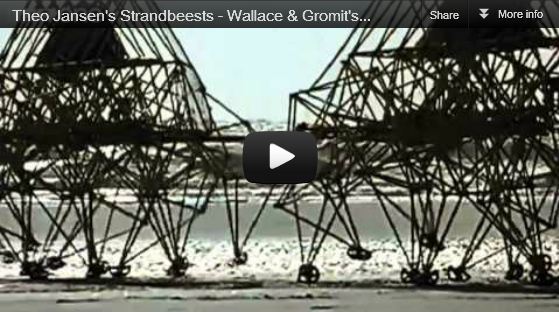
I am not sure why I like Theo Jansen’s kinetic sculptures so much.

[youtube http://www.youtube.com/watch?v=HSKyHmjyrkA]

It could be the almost miraculous way in which they come to life in a strong wind.

There is also something about Theo Jansen himself.  Is he a mathematician, engineer, artist, or mix of each?

But it is the seeming simplicity of the design of his famous ‘mechanism’ that also enchants me. It strikes the same chords (pun intended) as listening to Glen Gould or Andres Segovia play Bach.

There is also something about longevity and stick-to-it-ive-ness of the artist and musician that I admire in people like Theo Jansen. He has publicly given away the details of his movement mechanism, and one could easily understand if this alone, in terms of fame, would have satisfied Mr. Jansen.  But he has continued working on his kinetic creatures for 20 years, making it a life long passion – not unlike Gould, Segovia, or Bach.

Alex D. has already made an interesting posting in our blog about ‘the golden ratio’ and the Fibonacci sequence in nature, and I would be curious to know if any of the lever arms in Mr. Jansen’s design have similar ratios. In fact if one looks at the Jansen mechanism, it has a curvature that is not dissimilar to portion of a nautilus shell.

Then again, such a simple work of geomety perhaps also harkens back to the days when engineers and physicists creatively designed all kinds of machines containing ingenious cams, gears, governors, and other mechanisms,


Physics and astronomy knittery

This past summer, the stitching group Stitch London (located in the other London) held an event called Stitched Science at the Science Museum.  This event featured a knitted/felted model solar system (including Martians for Mars) as well as a knitted nebula and a crocheted Marie Curie and Galileo among many other sciencey stitched pieces.

However, these examples don’t include all instances of physics or astronomy acting as inspiration for knitted or crocheted projects by a long shot.  There are crocheted space shuttles.  There are knitted solar system sweaters, Galileo mittens, atomic orbital plushes.  There’s even a knitted a Higgs boson and a scarf featuring the CMBR power spectrum.

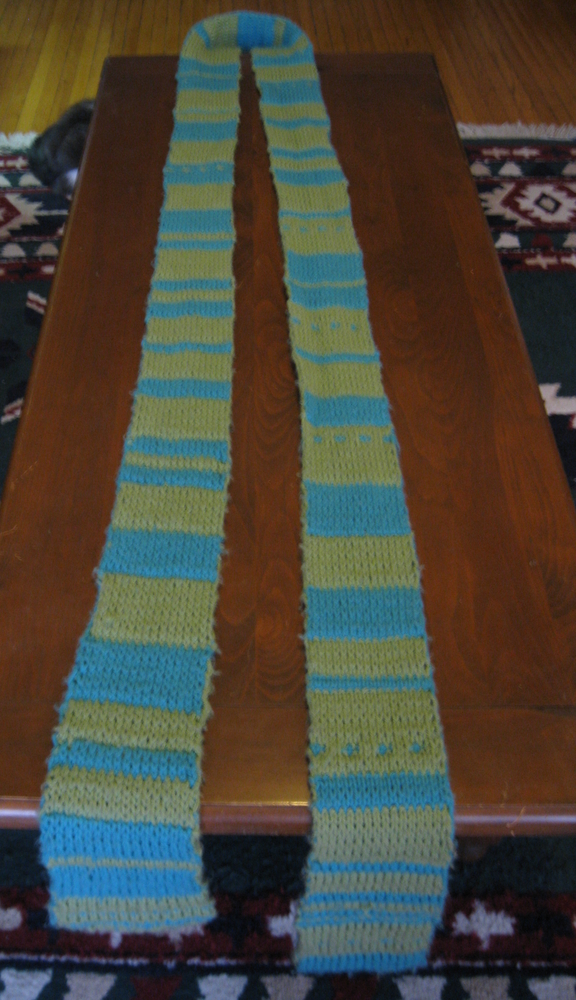
If we look at more mathematically inspired projects, there are mobius scarves, irrational constant mittens, Lorenz manifold mobiles and pi scarves, such as this one I made last year:

The stripes each represent one digit. There are 101 digits of pi represented in this scarf.

So next time someone tries to tell you that physicists aren’t the creative types, you can point to the abundance of physics-inspired knitting and prove them wrong.

The Final Countdown… Month 12

In the next 12 months I hope to bring you monthly updates on my final year (or so I hope) of my PhD.  In this time, I intend to give a little insight into not only the crazy world of thesis writing and submission but also, and more interestingly, into the process of the post Grad-school work applications.

I will post not only detail of the positions for which I apply but also positions that I think are interesting outside of Astrophysics and academia.  Although I do intend to do a PostDoc, I think it is nice to see what else is out there and this, I think, is worth sharing.

A little personal homework for myself over Christmas and a perfect place to start: preparing an academic and non-academic CV for Physics and Astronomy graduates.  Next month I will include hints and tips and probably a link or two.  But for this month I will leave you with some food for thought; what skills does one acquire while studying Physics?

  • Communications – from giving seminar talks to your peers, to running a lab or tutorial, to writing a research proposal, to writing a scholarship application we communicate on many levels with many different audiences.  Being able to communicate complex ideas easily and concisely is a skill that is useful far beyond academia or science.
  • Time Management – those of us who have had courses to take, while TAing various courses, while carrying out intensive or time consuming research perform a precarious juggling act.  It is never easy, but in the long run we gain from such experience.  Eventually we become more efficient and not just in our research or our courses or our teaching.  Again these are lessons that are more far reaching.
  • Independence – a good academic supervisor guides us in our research they do not lead.  They allow us to make our own decisions under their guidance, and eventually without it.  As far as our research is concerned we might have some one guiding the reigns and checking our progress but we also learn to be our own bosses.  If we do not pull our weight in the end we fail only ourselves.  This should leave us with a great ability to work under our own iniciative.
  • Computer Literate – for the most part this speaks for itself but in addition to what most of the world consider to be computer literate we have probably all picked-up at least two programming languages along the way and with that the basics of a few others.  Similarly given the technological nature of modern research I also imagine that many of us are pretty tech savvy to boot.
  • Technical Experience – what you are good at here, obviously depends on your area of choice, but we each have something.  Depending on what you have been doing for the past few years, you’ll know what it is you are learned in here.  But consider the extra bits and pieces that go into that experience.
  • Problem Solving – I mean thinking on your feet, not algebra.  Many of our activities involve doing this: your results do something terribly unexpected, your computer freezes up in the middle of you doing the most important piece of work you have done that week, the target doesn’t appear in the guiding camera.
  • Technical Writing – journal articles, need I say more.
  • Teaching – not just communicating but actually conveying information.  Personally I see this as one of the best skills a grad student will acquire.  Obviously useful in a future academc career, but also in many other things.  Paying attention to how students learn arms you with the information on how anybody/everybody learns.  This is useful in training of any variety both within and without the work place.  The insights you gain from student-TA interactions  can be useful in many other places.

Happy Holidays!!

An Amazon (Physics) Adventure

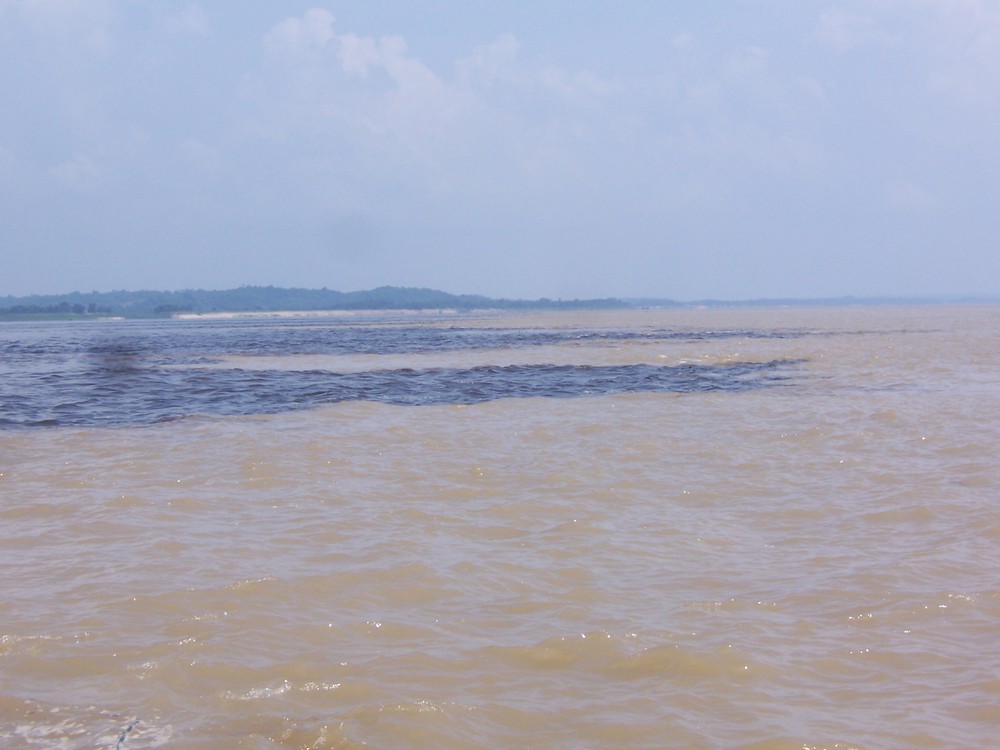
One of the highlights of my trip to Brazil was a visit to Manaus, on the Amazon River. My wife and I took a one-day tour on the river and in the rainforest, during which we saw, among other things, sloths, monkeys, an anaconda, caimans, piraracu (the worlds largest freshwater fish) and went fishing for piranha. The physics highlight is shown in the picture. This is the “meeting of the waters,” where the Rio Negro and the Rio Solimoes join to form the Amazon. The water in the Negro is almost black (hence the name), warm (about 26 degrees) and has a current of about 2 km/hr. The Solimoes is brown from the large amount of sediment it carries, cooler (22 degrees) and faster (6 km/hr). When the rivers meet, the boundary between them is very distinct, and when we stuck our hands in the water while the boat drove across the boundary, the temperature difference was very sudden and easy to feel.


If you look at this location in a satellite photo (e.g., on Google Maps) you’ll see that the  boundary between the two colors of water stays distinct for something on the order of 20 kilometers downstream. Why do they mix so slowly? Actually this is the wrong question to ask! If we assume that the two rivers mix by diffusion alone, then the boundary should broaden to a width d of, say, 10 m in a time t = d^2/D, where D = 2e(-9) m^2/s is the diffusion constant of water. This calculation gives a mixing time on the order of 10^11 seconds, which is thousands of years! Diffusion is a very slow process; far too slow to explain what is happening here! The right question to ask is clearly “Why do they mix so quickly?” or, in other words, what process other than diffusion is at play here?


You can see a hint of the answer in my photo, but it’s a lot more clear if you zoom in on the satellite photo on Google Maps. The line separating the black and brown water is not straight – it’s wavy, and it becomes more so as you move downstream. The initially flat interface between the two streams is unstable. Swirls and waves develop and grow at the interface as it flows downstream. This makes mixing much faster for a couple of reasons. First, swirls make the surface area of the interface bigger, so there is more diffusion across it. More importantly, the water gets stirred by the swirls, and this mixes the streams just like stirring your coffee mixes in the cream.


This is a great example of what’s called the Kelvin-Helmholtz instability, and it can be analyzed in detail mathematically. Exactly the same instability gives rise to the parallel rows of clouds you often see in the sky!


Want to know more? Take fluid dynamics next year!