
Monthly Archives: March 2012
The physics of irate feathered creatures in a microgravity environment.
This must be the first launch of a video game from space, but it’s a physics puzzle game,and NASA approves it, so it must be good for our education! I love Angry Birds enough to make homework assignments about the physics of Angry Birds, so I can’t wait for this new release…
[youtube http://www.youtube.com/watch?v=lxI1L1RiSJQ?wmode=transparent]
VLT rediscovers life on Earth.
This could have been an article from the Onion, but in fact, it’s legitimate science!
http://www.eso.org/public/news/eso1210/?utm_source=feedburner&utm_medium=…
Plugging citizens into science, and putting the fun in funding!
One thing that keeps on surprising me is how often interested lay persons ask about possibilities to assist a scientist in his/her research. Non-scientists are often curious, interested and motivated, and so there is a huge potential for help, support and resources from all those interested folks! In the last two decades, there has been an exciting transformation in how citizens can become part of (and even guide!) scientific research. This is a great evolution, sicne it allows much more science to be done, and could even lead to a completely new funding model for scientific research as illustrated below.
In the mid-nineties, several researchers started developing programs to tap into this huge resource by designing programs for distributed computing — where a large number of home users contribute their computer spare CPU time by running a low-priority calculation, and so form a large and powerful computer network. There is indeed great power in numbers, and coincidentally, one of the first (if not the first) such projects was the Great Internet Mersenne Prime Search (GIMPS) project that is (still) searching for so-called Mersenne prime numbers. For many years, I ran a Linux version of the mprime program on all computers that I had access to. One of the stimuli may have been the fact that there was a $100,000 award from the Electronic Frontier Foundation for the first prime number that has more than 10 million digits. The 45th Mersenne prime number was found in August 2008, and after rigorous verification, confirmed as the prize winner in November 2009. If you’re interested, the number is 243,112,609 – 1 and totals nearly 13 million digits. Interestingly, the 46th Mersenne prime number was found and was named as one of the best inventions of 2008 by Time magazine. Not a bad score for a number!
Since 1999, the University of California at Berkeley has been running another immensely popular distributed computing program called SETI@Home.A cleverly designed screensaver program uses your unused CPU cycles to analyze radio waves and search for possible extraterrestrial signals. This project has attracted well over 5 million users! More and more such projects have surfaced, and it is one way for scientists to access computing resources that are otherwise unaffordable. A great example is the world community grid which aims to be the world’s largest computer grid (more than half a million users to date), and which is funded and operated by IBM to support humanitarian research. If you’re looking for some honorable projects to donate your computer time to, go have a look! You could help find a cure for cancer!
More recently, social networks and mobile technology have played a big role in the success of a whole new series of citizen science projects. 2006 saw the launch of the Stardust@Home project, once more by UC Berkeley. This time, scientists weren’t looking for your spare CPU cycles, but asked you to scan microscope images to find interstellar dust particles in an aerogel. Why? Because the human brain is much much better at this than a computer is. Inspired by this approach, the Galaxy Zoo project took off in 2007 where now your help was asked to classify galaxies. The project was such a success that a whole series of similar projects is now hosted under the name Zooniverse — from galaxy classification to searching for interstellar gas bubbles to hunting for planets or finding targets for the New Horizons spacecraft once it’s done with Pluto. The Zooniverse project has now even expanded to include climate research, whale research and studies about the lives of ancient Greeks! More than 600,000 volunteers participate — and anyone can, since no science education is needed. There is in the meantime a long list of papers in the literature describing new discoveries done by these sorts of projects. In Astronomy 1021, we offer some of these as projects, and many students absolutely love the idea of taking part!
Very recently, I found out about another type of citizen involvement in research, this time through actively contributing research funding: petridish.org. It goes like this: scientists propose projects and include rewards for whoever backs their proposal up financially at a certain level. Citizens can pledge whatever amount they see fit for whatever project they like. Again, large numbers that contribute small amounts make enough for funding your research! Who knows, maybe soon we’ll all be posting our research proposals on facbook!
Prof. Giovanni Fanchini named associate editor of “Dataset Papers in Optics”.
Prof. Giovanni Fanchini named associate editor of “Dataset Papers in Optics“.
Relay for Life
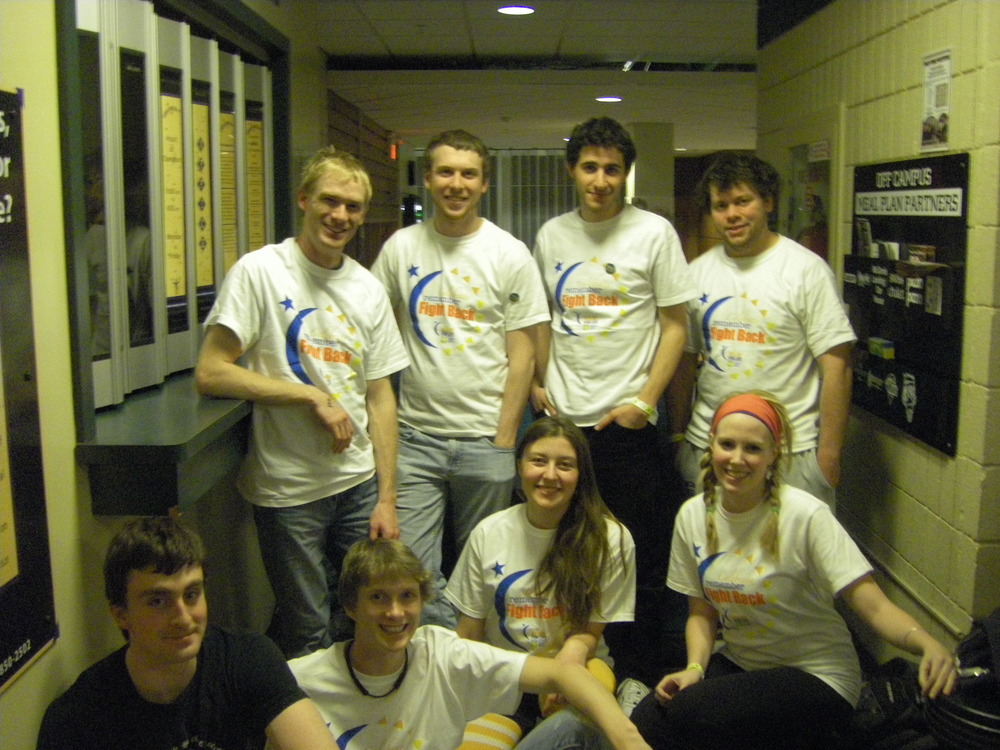
Last year’s Physics and Astronomy Department’s Relay for life team (from left to right, top to bottom): Jason Kirkness, Allan Rutt, Dan Martire, Mat Abado, Ben Revington, Gabe Keenleyside, Mel Wright, and Ashley Rutt
Relay for Life is an event that takes place across Canada annually to raise awareness and funds for the Canadian Cancer Society. The money raised through this event goes towards funding Canadian research projects on all types of cancer, providing information services and supporting programs in the community, advocating for public policies that prevent cancer, and helping those living with it. More information on the society can be found at http://www.cancer.ca. Cancer is a disease that has affected a lot of lives, including mine and quite a few others in our department.
Most Relay for Life teams consist of 10-15 people. Participants walk/run/jog along a track for the duration of the event (12 hours). At least one member per team must be on the track at all times. Don’t let that daunt you though! There are plenty of other events throughout the night. Such events in the past have included futsol, movies, yoga, Rock Band, and free Marble Slab ice cream.
This year, as in the past, we have a Physics and Astronomy Department (and friends) team. The details for this year’s campus event are:
Our team name: Run ’til it Hz
Where: UCC Atrium
When: Saturday, March 24th 7:00 PM to March 25th 7:00 AM
This would be a perfect time to get to know some people in the department, have fun, and (if necessary) catch up on readings, marking, or course work.
Join our team by registering online at https://secure2.convio.net/cco/site/TRR/RelayForLife/RFL_ON_even_/897751001?pg=ptype&fr_id=10708. (There is a $10 registration fee.)
Donate on behalf of our team either in person to Nelia (main office) or Mel (room 130) or online at http://convio.cancer.ca/site/TR/RelayForLife/RFL_ON_even_?pg=team&fr_id=10708&team_id=265639.
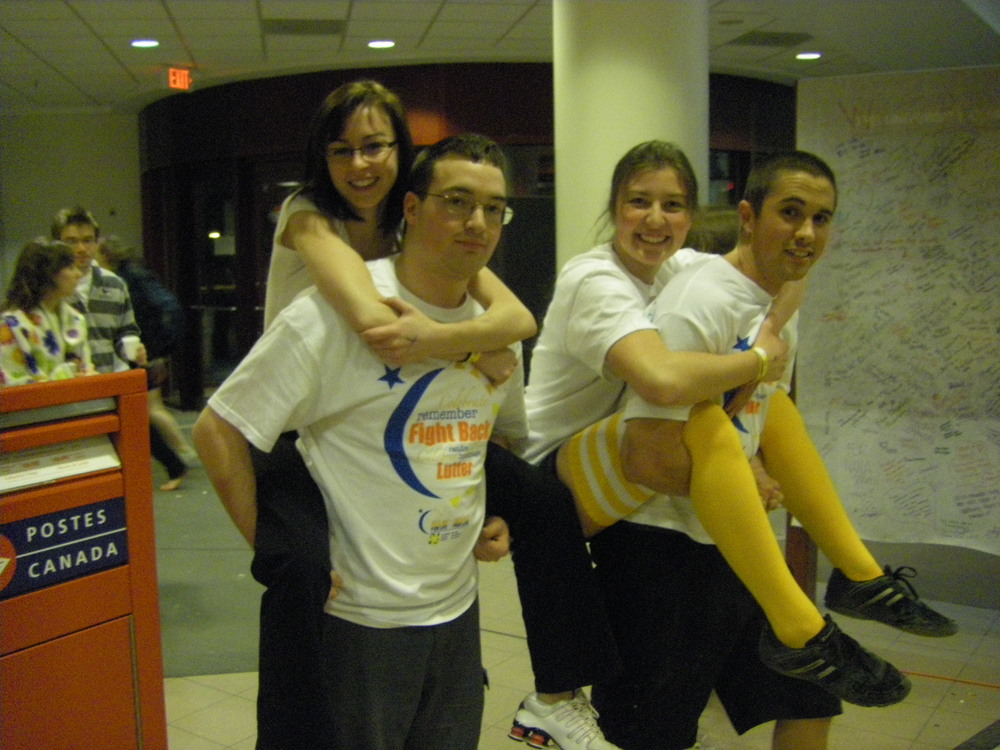 Some of 2010’s department team: Elaine Hegarty, Patrick Cookson, Mel Wright, and Chris Witters
Most people decorate their shirts for relay. Here is how our team decorated theirs in 2010:
Dilini Subasinghe:
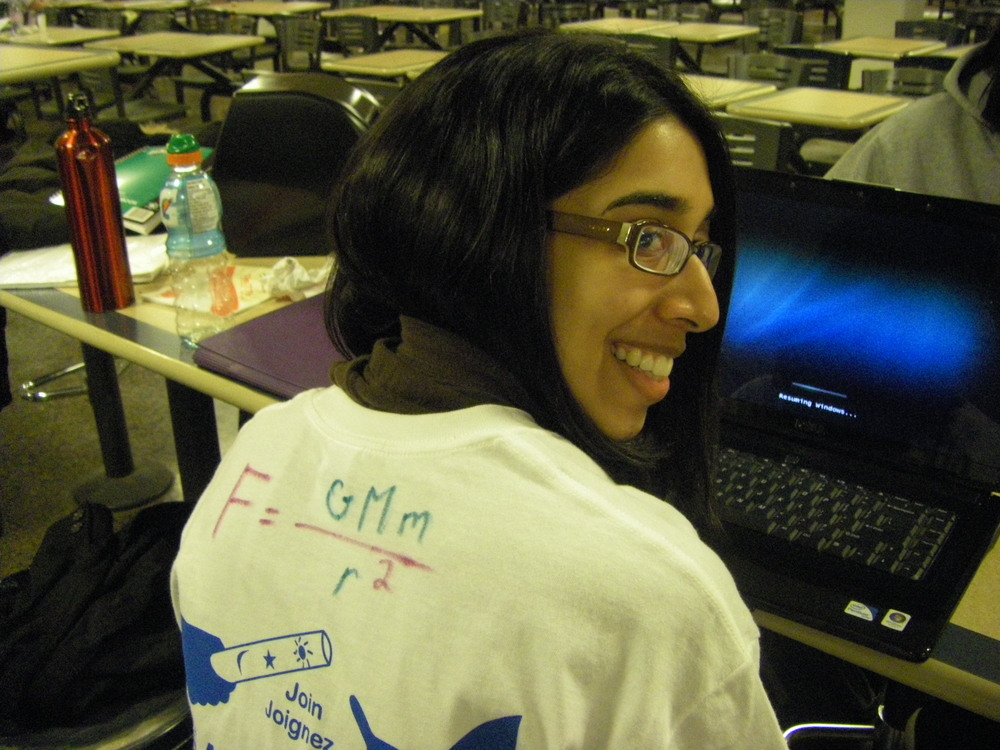
Mat Abado:
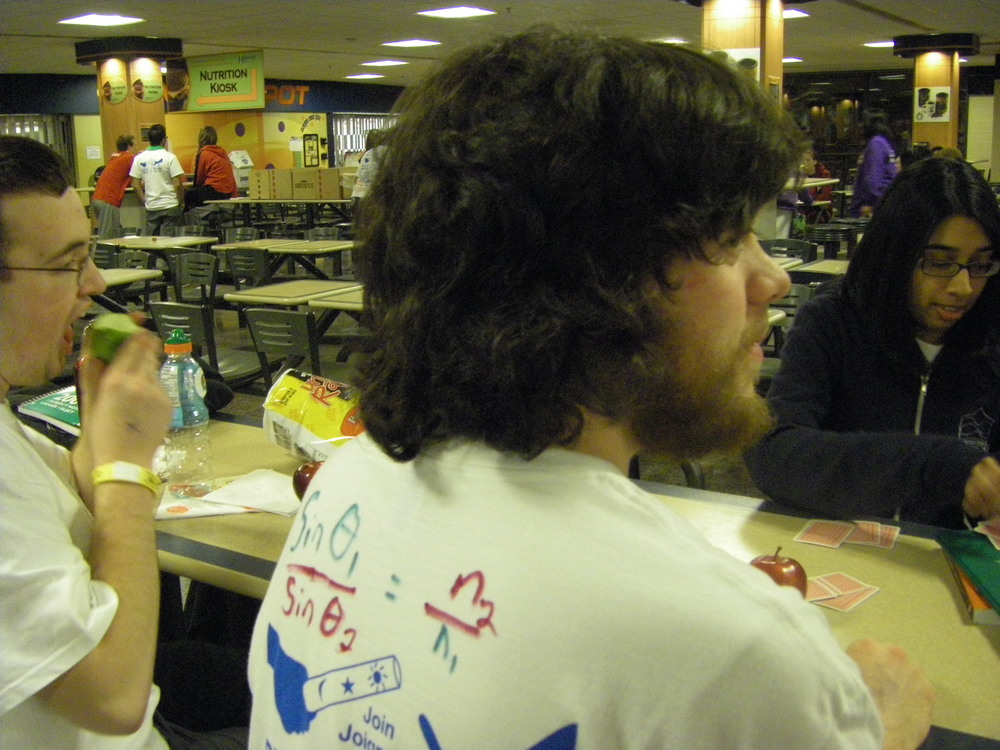
Pat Cookson:
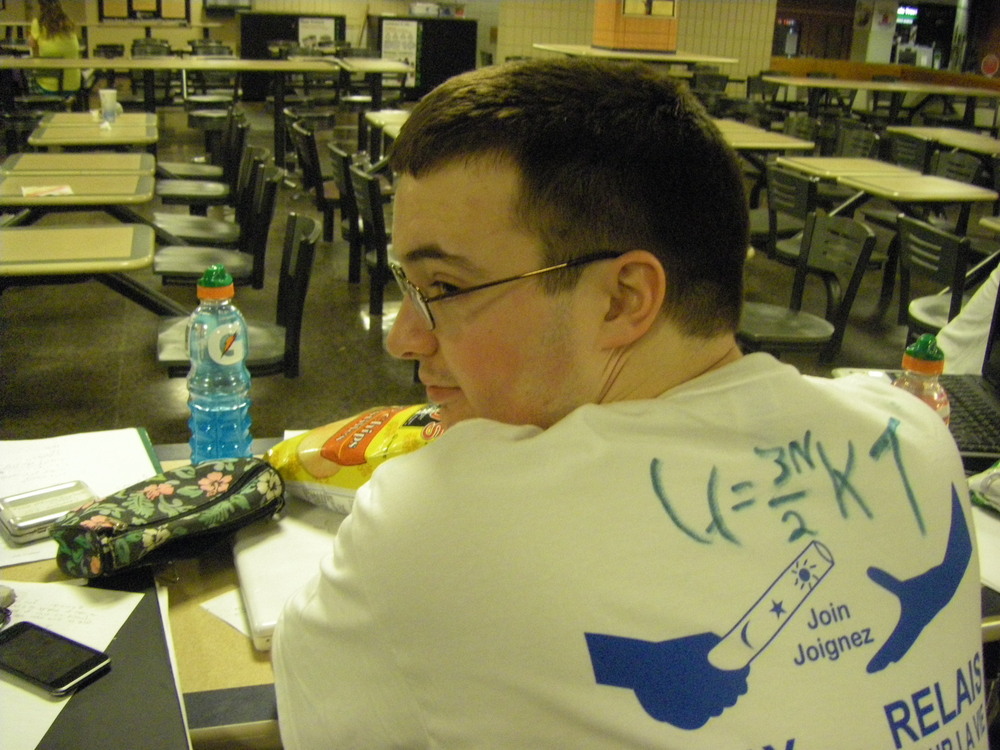
Chris Witters:
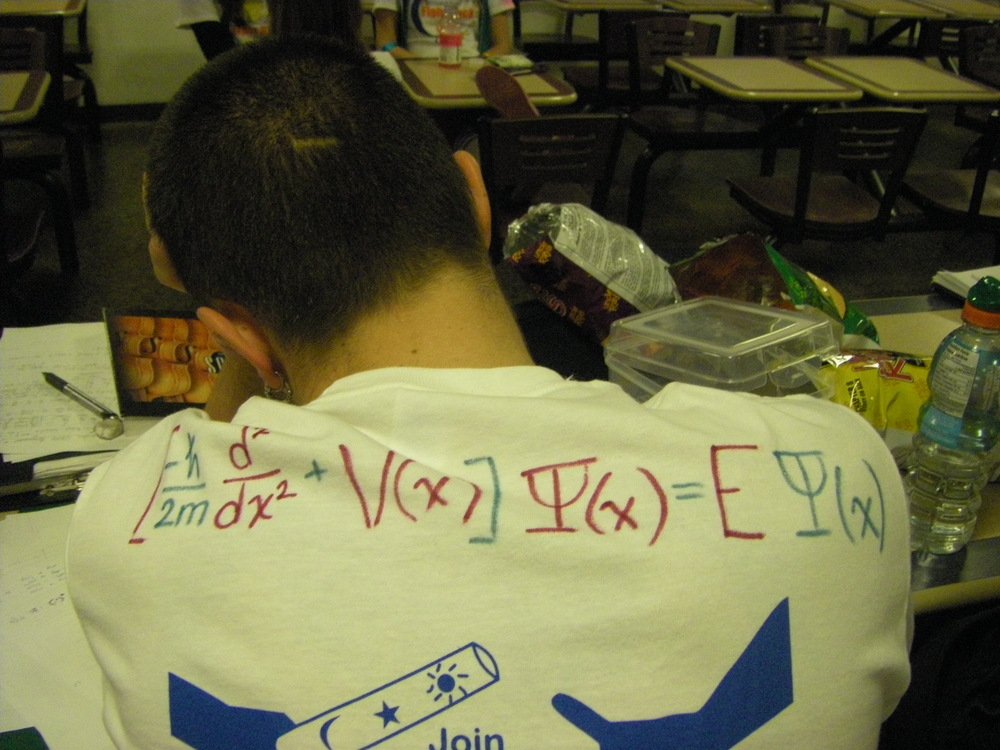
doing the rounds locally
Normal 0 false false false MicrosoftInternetExplorer4
Hong Kong has six universities. I was surprised to learn that all of them are English-language universities, since while most educated people here speak at least some English, the lingua franca is certainly Cantonese. I am working at City University, which is in Kowloon, a few kilometers north of the main commercial/tourist area (although, to be honest, all of urban Hong Kong is commercial). Last week I visited Chinese University (CUHK), which is located about four subway stops north-westish of City U. The physics department there has the reputation of being the best among those at the six local universities, and in fact it has two Nobel Prizewinners associated with it – 1957 Laureate C. N. Yang, of Yang-Mills theory, is a “Distinguished Professor-at-Large,” and Charles Kao, who won in 2009 for the development of fiber optics, was a professor at CUHK for a while, and later the president of the university. Leo Lau, who spent some time at Western, was Chair of the physics department there, and later Dean of Science.
I didn’t know anyone there, however, so I resorted to perusing their web pages. I was pleased to find a prof there named Lei Xu, whose research interests were very similar to mine. I emailed him and politely invited myself for a visit. I spent a morning talking to him, looking around his lab(s), learning about his research and telling him about mine. I learned some useful things, which I’ll get a grad student to think about when I get home! I then went for lunch with several members of the department and a rather overwhelmed-looking young fellow who, it turned out, was there for a job interview.
There are other people in the department that I should also talk too, but they were busy with the job candidate the day I visited. It’s easy for me to go there again before I come home, though.
As an aside, I was interested to see a large statue of the “Goddess of Democracy,” who was made famous at Tienanmin Square twenty-three years ago, standing outside the University subway station. A sign next to it documented the problems experienced by this poor statue. Apparently she was a bit too controversial, and no-one, including the current University president, wanted to upset the Beijing government by hosting the statue. Eventually – with large support from the CUHK students and faculty, if not the senior administration – she was placed at the train station, where she is an impressive sight.
Writing about writing
As a physics professor I write a lot, and I also spend a lot of time editing other people’s writing. In fact, I would say that writing is probably the most important part of my job. Of course I have to be good at physics, and I have to have good ideas, and I have to keep beating on my students – pardon me, I mean constructively encouraging my students – to get things done, but none of this would get me anywhere if I couldn’t write about it. I think it’s also true that writing is an extremely important part of many other jobs that our students could find themselves in after leaving school – almost everyone has to write a report to their boss at some point.
On the way to getting this job, I had to write a couple of theses, which are essentially full-length books about the research I did as a student. I need money to pay my students and to run my research operation, and to get money I need to write grant proposals. While the ideas and so on are very important, if I can’t express those ideas clearly in the written proposal, I shouldn’t expect to get funded. Once the research is done, I have to tell the world about it, and I do this by writing papers. It is a lot easier to get a paper published if it is well-written, and, more importantly, it is a lot easier for other scientists to read and understand a paper that is well-written. Since my ultimate success as a physics researcher depends on how other people regard my research, I am not going to be successful if I am unable to get people to read about my work.
My students have to write, too, and since I want my students to succeed, I try very hard to ensure that what they write is of high quality. This is sometimes very hard. I have had students who write very well, but I have also had students whose writing was awful. Sometimes language is an issue – it is obviously very difficult for someone to write a 300-page PhD thesis in their second language – but often there are problems that go beyond language. I have had students who were native speakers but had essentially no idea how to string sentences together to tell a coherent story. I had a student from China whose English writing was grammatically and structurally fine, but completely disorganized. That student told me that she was a poor writer even in her own language.
There are several aspects to writing. The first has nothing to do with the actual words: it is the ability to get the content right. On a large scale, this involves deciding what you want to say, what ideas you want to convey, essentially what the story is that you want to tell. On a smaller scale, you need to figure out what level of detail is appropriate, and you have to organize what you want to say: you need to decide in what order to present things so as to produce a clear and logical storyline. These are hard things to do, especially for one who has not done a lot of serious technical writing. One you know what you want to say, you need to write it down. Here you have to worry about the mechanics of writing – sentences and paragraphs, spelling and punctuation. This seems to be hard for some people, too, despite that fact that in this case there are usually rules that can be learned and, one hopes, followed. A third aspect involves getting the right style – a physics journal paper would be written in a very different style from a letter to your mom. In my view, the first aspect is by far the most important. It is relatively easy to edit a well-organized draft for grammar, punctuation, and even style, but it’s a lot harder to deal with a piece of writing that is poorly organized, is missing important information, or wanders through the subject matter like the random walks I talked about in my last post.
I think it’s essential that our students learn how to write properly. I’m less certain how to achieve this. Certainly practice is essential, and for that reason I always assign essays or written projects in my third- and fourth-year courses and grad courses. But students need to get feedback on their writing if they are going to become good at it, and they don’t really get that until they start working on their honors thesis. Western has courses on technical writing, but there really isn’t any space in our modules for them. I’ve thought about teaching students to write in our seminar course, but it’s hard to make students do much work in a zero-credit course.
I’ll have more to say about this subject in future posts.
Trip to India Feb 2012
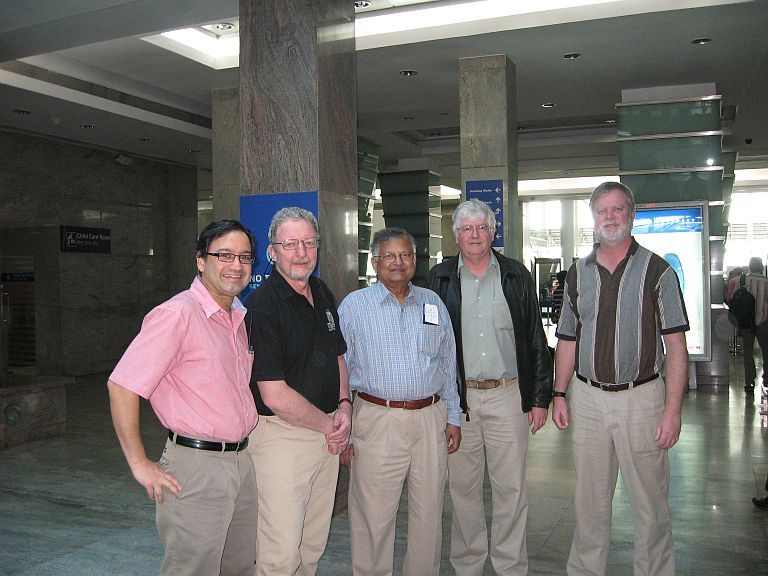
My first major stop was Pune, in Maharashtra state, and about 150 km southeast of Mumbai. Here, I visited the Inter-University Center for Astronomy and Astrophysics (IUCAA). This is India’s top research institution for astrophysics, and runs a very active visitors program for faculty snd students, as well as frequent workshops and conferences. IUCAA is involved in many major international astronomy projects, and is on track to garnering the next Advanced LIGO gravitational wave detector for India. Faculty and graduate students are welcome for extended stays, ideally centered around a workshop related to their work. Guest accommodations and meals are available at IUCAA itself – Dr. Ajit Kembhavi, Director, is happy to host you, so you just have to pay your way to get to Pune! The beautiful courtyard at IUCAA, pictured here, and containing statues of Galileo, Newton, Einstein, and the ancient Indian astronomer Aryabhatta, really lends itself to thought and reflection.
What about undergraduate students? Any undergraduate student that is considering an exchange visit to India should seriously consider Pune University. (IUCAA is also located on the Pune University campus.) This university has a beautiful sprawling campus that is set apart from the city traffic, and has Departments in most major subjects, including Physics. It is also home to the Indian office of the Ontario-Maharashtra-Goa exchange program. Vaishali Potnis, OMG India Coordinator, is happy to help any students settle into Pune. There are already about 10 Ontario undergraduate students on exchange at Pune University in any given year. The OMG program website (http://www.omgprogram.org/)describes how to apply for travel grants.
Later in my trip, in New Delhi, I visited the Indira Gandhi National Open University (IGNOU; http://www.ignou.ac.in). This is the largest distance studies university in the world, with 3.5 million students! IGNOU also operates in 40 other countries besides India. I met with Dr. Ravi Singh, who holds a PhD in Physics from Western, supervised by Prof. Mahi Singh. Ravi is Director of the Regional Services Division at IGNOU, and shared his vision of expanded offerings in distance education. Considering that India currently has 12% rate of postsecondary education, and wants to get to about 30% like the USA and other developed countries, the only feasible way to approach such numbers in the next decade or two is by relying on distance education. Here, distance education does not mean fully online education, as there are test-taking centers across the country and also access to regional laboratory facilities. Ravi felt that Western and other foreign universities could join in this effort by offering summer courses on site (e.g., at Western) and also creating new online courses not covered in IGNOU’s current curriculum.
I also visited the Sharda University (http://www.sharda.ac.in/), a new private university in Greater Noida, Uttar Pradesh, some 40 km east of New Delhi. Private universities are a new phenomenon in India, operating on a for-profit basis and offering an entryway to university education for those who cannot get into top government schools but have the money to pay for an education. In a country with very limited spaces in the top public univerisites, there is a big market for private providers. Sharda University opened only in 2009, but boasts impressive new facilities and already operates with many domestic and international students. I was hosted by Prof. Sunil Kumar Mishra, who organized a very lavish reception, and gave me a chance to talk about Western and also some of my group’s work on star and planet formation. Dr. Mishra is Director of the Research and Technology Development Center, and the science effort here is very much in the applied sciences. Due to its nice atmosphere, facilities, and existing group of international students, this university also seemed an interesting destination for Canadian undergraduates seeking an exchange term in India.

Overall, a very informative trip to a rapidly changing country. I found New Delhi to be completely transformed from my last visit in 2004, with a bright gleaming new airport, new highways, monuments, glass-paneled office towers, and public transport options. Western stands to benefit by staying engaged with India and indeed all the emerging economies of the world.