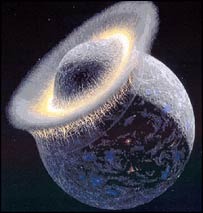
Check out the incredible video about how Moon evolved, all thanks to the Lunar Reconnaissance Orbiter (LRO)!
Credit: Space.com

Check out the incredible video about how Moon evolved, all thanks to the Lunar Reconnaissance Orbiter (LRO)!
Credit: Space.com
Poster: http://www.physics.uwo.ca/colloquia/Colloquia%20Notices/2011_2012/CURIEL%20Colloquium.pdf
Western University
DEPARTMENT OF PHYSICS AND ASTRONOMY
PHYSICS & ASTRONOMY COLLOQUIUM
Date: Thursday, 29th March 2012
Time: 1:30 p.m.
Location: Physics & Astronomy Seminar Room 22
Dr. Erik Curiel
Rotman Institute of Philosophy
Department of Philosophy
Western University
“Are Black Holes Hot or Cold?”
ABSTRACT
In the early 1970s it was realized that there is a striking formal analogy between the so-called laws of black-hole mechanics and the laws of classical thermodynamics. Before the discovery of Hawking radiation, however, it was generally thought that the analogy was only formal, and did not reflect a deep connection between gravitational and thermodynamical phenomena. In particular, it is still commonly held that the surface gravity of a stationary black hole can be construed as a true physical temperature only when quantum effects are taken into account; in the context of classical general relativity alone, one cannot cogently construe it so. Does the use of quantum field theory in curved spacetime offer the only hope for taking the analogy seriously? I think the answer is ‘no.’ To attempt to justify that answer, I shall begin by arguing that the standard argument to the contrary begs the question. Looking at the various ways that the idea of “temperature” enters classical thermodynamics then will suggest arguments that, I claim, show the analogy between classical black-hole mechanics and classical thermodynamics should be taken more seriously, at least so far as temperature goes, without the need to rely on or invoke quantum mechanics. If this is correct, then there may be a deep connection between classical general relativity and classical thermodynamics on their own, independent of quantum mechanics.
Coffee & cookies will be available, courtesy of PASA.
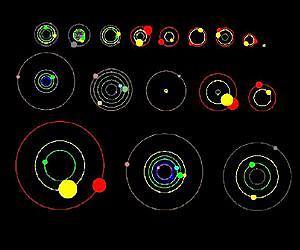
Hopes were high when Kepler was launched to find Earth-like planets, but Kepler’s Statistical Analysis shows Earth-like planets are rare!
Report is presented on Space Daily last week: Check it out here!
While in Hong Kong, I have been working with Jonathan Wylie on the theory of diffusion with “traps”. This is related to some of my experiments, and what we are aiming for is a way to extract some new physical information from our experimental measurements. The experiments involve measuring the diffusion of little tracer particles suspended in a complex fluids. For simple Brownian motion, the mean squared displacement increases linearly with time. In many complex fluids, we see something rather different: At very short times, the mean squared displacement increases linearly. Then over some intermediate time range, the mean squared displacement flattens out into a plateau. At longer times, it grows linearly again, but with a lower diffusion constant than at short times. The plateau occurs because the tracers get trapped by the microstructure of the complex fluid. However over longer times, the microstructure evolves and the particles can escape from the traps and diffuse freely again. The calculations we are doing – actually it’s mostly Jonathan so far – involve using the formal theory of random walks to figure out the distribution of distances traveled by the tracers in the presence of traps. The particles diffuse freely until they hit a trap, then they are held in the trap for a time drawn from a particular distribution, then they diffuse again. Parts of the calculation are straightforward, if you know about random walk theory. But parts are what you might call interesting. I have had to refresh my memory about Green functions, which caused me nightmares when I was a student and played a significant role in my decision to become an experimentalist. We have also run across one of those pathological cases that mathematicians warn us about, but which never happen in real life – we get an expression involving an integral over an infinite sum, and it turns out that you cannot interchange the order of the sum and the integral. All good stuff. The idea is that this will model our experimental data, and the ratio of the diffusion constants we find at short and long times will depend on the time the particles spend in the traps.
I was thinking about the physics of beer, so off to google I went – and found this. Our own beer, how cool is that?
http://www.brewdog.com/the_physics

Dr. Jan Cami has been honored by being named a Faculty Scholar.
The objective of the Faculty Scholar award is, “To honor and celebrate outstanding scholarly achievements at a critical point in the career of a Faculty Member at Western”. “This award recognizes outstanding contributions in research, teaching or service reflecting sustained excellence in all scholarly activities.”
Not only is Jan acknowledged as a enthusiastic, inspirational lecturer, he has in addition been involved in some outstanding international research collaborations over the past several years. He may be best known for his discovery of Fullerene molecules (Bucky Balls) in space in 2010, but just recently he was on an international team which made the discovery of carbon monoxide molecules in supernova remnant Cassiopeia A.
Remember the ‘Powers of Ten’ from wayyy back? Well this is updated and interactive with eerie music.
Scroll bar goes from Planck Length to Universe Scale-along with captions.
Back in the day, when Quantum Mechanics was just getting started, Einstein suggested a thought experiment that would disprove the Heisenberg Uncertainty Principal, and with that show Quantum Mechanics was inconsistent. Which it could have done if Bohr hadn’t responded in turn with his own thought experiment to win thought experiment round 1 and to keep quantum mechanics alive. Today’s physicists have taken a second look at Einstein’s argument, and say he could have been correct after all. Check this all out here.
Have the possibility of an asteroid threat coupled with all the 2012 doomsday talk gotten you worried? Check out this article about our possible solutions to those asteroid (Hint: It involves nuclear weapons)