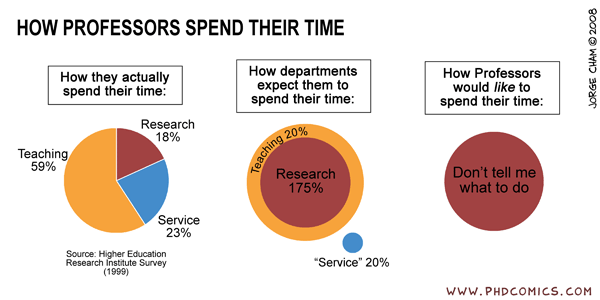
As usual, PhD Comics has it about right. In my January and February posts, I tried to describe a little about what the teaching and research parts of the job entail. But service is even more nebulous — what does it mean? [Generally no tennis or badminton is involved.]
Part of service is doing things for the benefit of the Department or University. So this might mean being a member of committee that selects scholarship recipients, in which case one reads a lot of application forms, tries to rank the applicants, and then goes to a meeting in which the committee comes to a consensus. Or it might mean being on a committee which is deciding on changes to the curriculum — again, doing some background reading and then going to a meeting where things get discussed. Service also includes things like being a member of the University Senate (I suspect meetings are also involved here) or a department chair or Dean (again, meetings, probably also paperwork).
Another kind of service would be service to one’s scientific community. This would include things like peer review of papers, grant applications, or (for astronomers) telescope time applications. There are two kinds of review here: in one type, the reviewer sees only one paper/application and does a detailed check for sensibility and worthiness. In the other kind, more like the scholarship application, the reviewer sees a whole bunch of applications and has to rank them relative to each other. These are somewhat different and it can take time to switch one’s mindset from one to the other. Other things that qualify as service to one’s profession might include organizing conferences, helping to run a professional society like the Canadian Astronomical Society, or being an outside reviewer of another university’s department or program.
Finally, there is service to the wider community: being a judge at a science fair, giving a public talk, visiting a school to talk about your field, answering questions from the public on a website. Different fields vary in how important this is considered to be: in astronomy, because we use taxpayers’ money to do something which (some would say) doesn’t have immediate economic value, most of us consider outreach to be extremely important. Plus we think we get to do fantastic stuff and we love to tell people about it! Admittedly it helps that many people are interested in our field, moreso than in others, like (say) actuarial science.
So that’s academic service from my point of view. As I have to keep explaining to my Mom, we don’t get paid extra for this; it’s part of the job. How big a part? I refer you to the eloquent statement by Jorge Cham — it’s supposed to be 20% of one’s time, and if you can accomplish it by not actually spending any time on it (see middle chart), so much the better.