Little AstroNerds solve the mystery of Great Red Spot!!
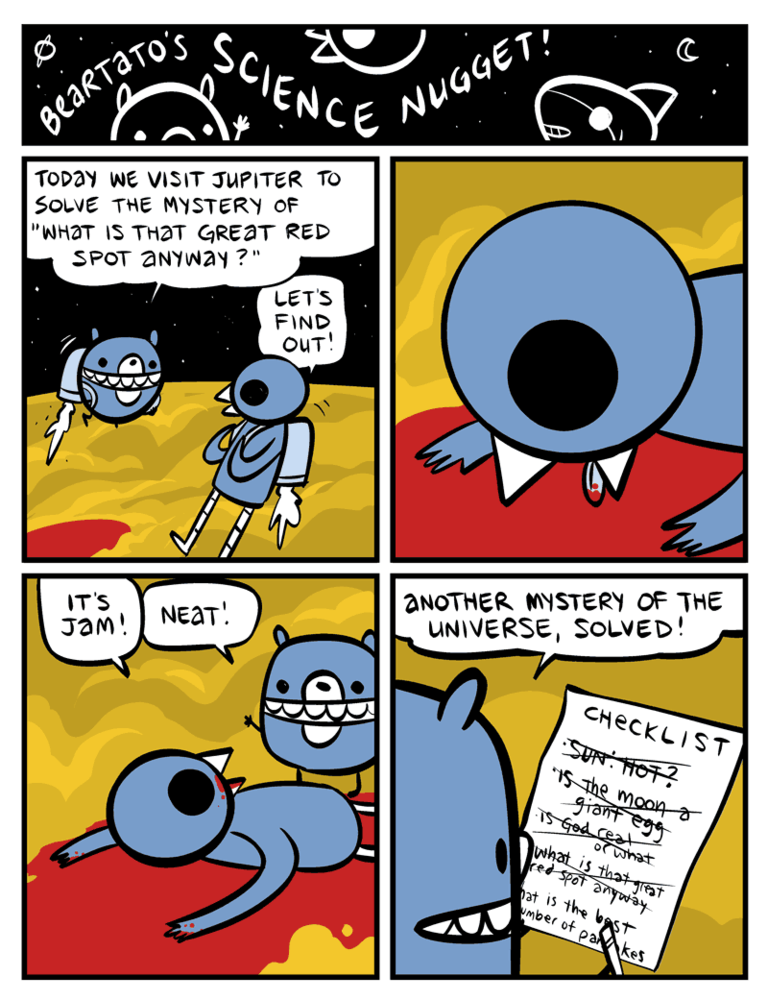
Courtesy: Nedroid.com

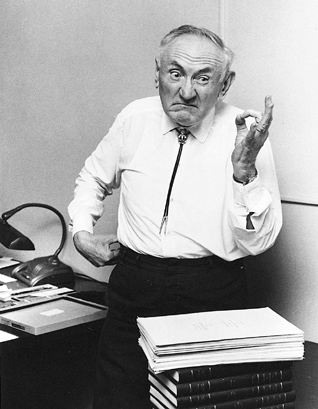
For those of you not in the mood for Valentine’s Day, here’s to two originals born on February 14th — the inventor Margaret Knight (1838-1914) and the astronomer Fritz Zwicky (1898-1974).

Physicists in the UK have found an equation to describe the swelling of a swatch of hair as a function of curliness and length. It can be described using the (newly defined) Rapunzel number. Link to Physics Review Letters synopsis.

Image credit: Johnny Gruelle.

The rocket deployed 9 small satellites into orbit, including three built by university students in Poland, Romania, and Hungary.
More details on the launch. Video of yesterday’s launch.

Image credit: ESA – S. Corvaja
Here’s an interesting article about plagiarism:
The article talks about the fact that two Iranian professors published a word-for-word duplicate of a paper originally written by a prof from Ryerson. It turns out that these two have done the same thing on other occasions. The Iranians’ version of the paper was withdrawn by the journal and they have been banned from submitting papers there for three years. I have to agree with the sentiments expressed in the paper that this punishment is pretty feeble – there are zillions of other journals they can submit plagiarized papers to! If one of our students submits plagiarized work, they automatically get a zero for that work. If they do it again, they could well face expulsion from the university. If one of my colleagues made a habit of submitting plagiarized work, I hope they would lose their job!
One of my colleagues at Memorial had one of his papers plagiarized once: someone took paragraphs from my colleague’s paper and alternated them with paragraphs of his own. The overall result made no sense at all, and was caught by a diligent referee. However a bit of digging showed that the perpetrator had done the same thing previously, and got it published. That journal was notified and printed a retraction. The perpetrator’s university (in India, if I remember correctly) was notified and did nothing.
Question: If you strapped a slice of buttered bread to the back of a cat, which way down would it land?
Answer: I’m glad you asked this question.
When you drop a buttered piece of bread, it drops butter side down and a cat always lands on its feet. What would happen if you took a piece of buttered bread, strapped it on the back on a cat (butter side up) and dropped it off Centerpoint Tower?
Even if you are too lazy to do the experiment yourself you should be able to deduce the obvious result. The laws of butterology demand that the butter must hit the ground, and the equally strict laws of feline aerodynamics demand that the cat can not smash it’s furry back.
If the combined construct were to land, nature would have no way to resolve this paradox. Therefore it simply does not fall.
That’s right you clever mortal (well, as clever as a mortal can get), you have discovered the secret of antigravity! A buttered cat will, when released, quickly move to a height where the forces of cat-twisting and butter repulsion are in equilibrium. This equilibrium point can be modified by scraping off some of the butter, providing lift, or removing some of the cat’s limbs, allowing descent.
Most of the civilized species of the Universe already use this principle to drive their ships while within a planetary system. The loud humming heard by most sighters of UFOs is, in fact, the purring of several hundred tabbies.
The one obvious danger is, of course, if the cats manage to eat the bread off their backs they will instantly plummet. Of course the cats will land on their feet, but this usually doesn’t do them much good, since right after they make their graceful landing several tons of red-hot starship and pissed off aliens crash on top of them.