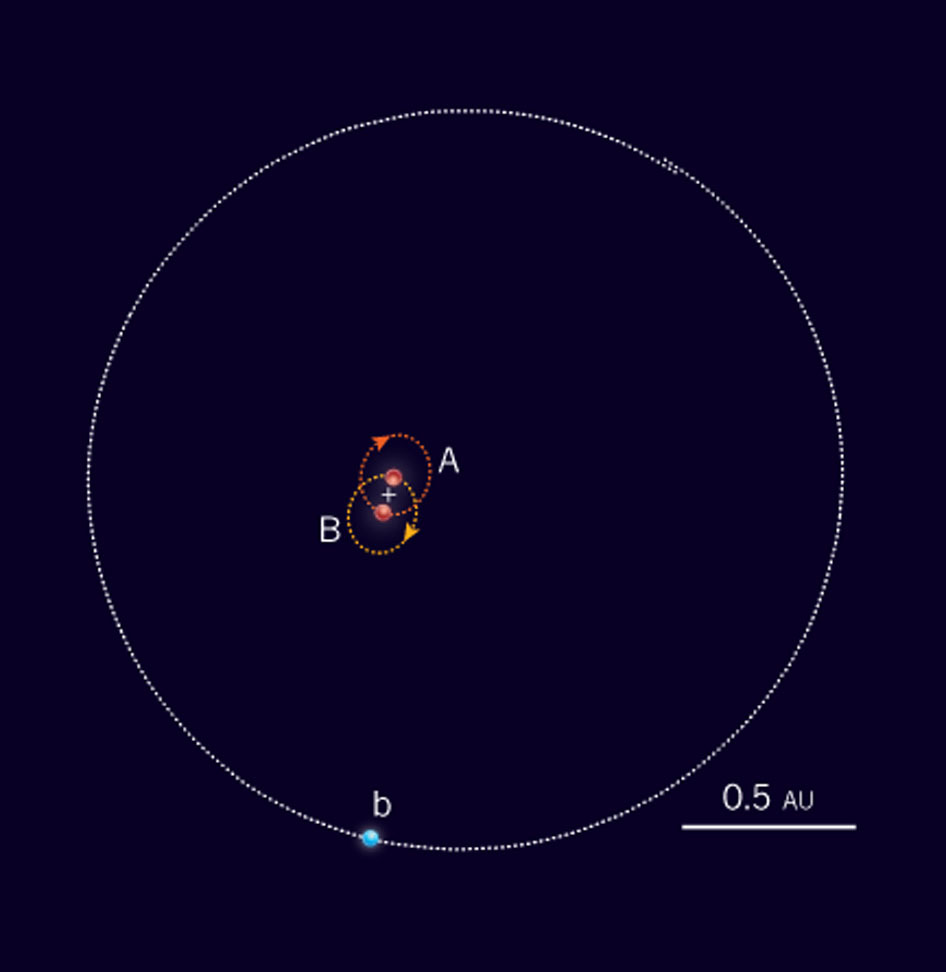
A Nature paper describes a new class of planets. The new class of planets are called circumbinary planets; they orbits a pair of stars (it rings a bell right? yup just like the planet Tatooine in Star Wars). Kepler-34b (i think it should be named Tatooine-1) was discovered by Kepler Spacecraft which uses transit method to discover extra-solar planets in constellations of Cygnus and Lyra.
An interesting paper perfect to read with a cup of coffee 🙂
Image courtesy: Nature!
Image Description: Orbital configurations of Kepler-34 system.
Now that we are hunting for Alien Worlds, the first thing that comes to mind for life to survive on such planets is Water.
Here is an interesting study of how Alien Planets might lose their water. Tidal forces!!! Tidal forces are well known to Earthlings; caused by gravitational pull of the Moon and Sun.
Have a look at the interesting findings!
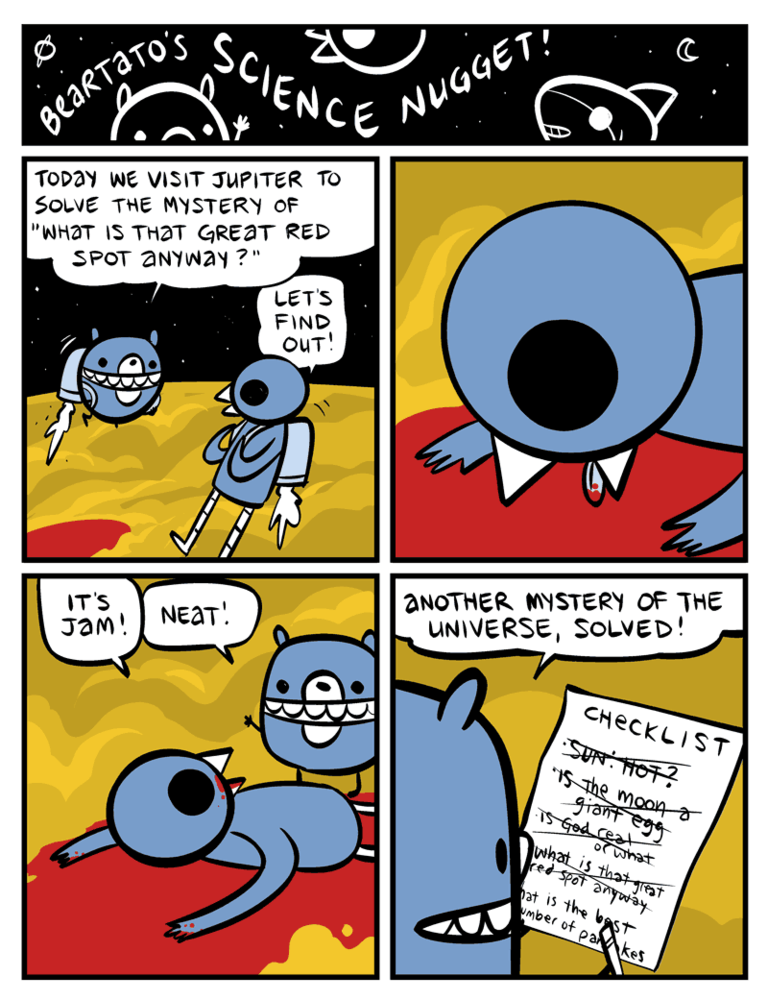
Little AstroNerds solve the mystery of Great Red Spot!!
Courtesy: Nedroid.com
Scientists detected a chemical produced from reaction between ozone and alkenes that could help in ending Global Warming. Criegee Biradicals are chemical compounds that are mostly released by plants. Biradicals could oxidize sulfur dioxide, which eventually turns into sulphuric acid. Sulphuric acid acts as a cooling effect in the atmosphere.Since plants help in making Biradicals, the ecosystem can act as negative effect on global warming. For more information on this newly detected particle, check out!
- Worth a 1000 words so you owe me.
- Maybe @cpsxnews ‘s MB wants to try this but not me!
- Other cool planetary stuff:
!Prof Wiegert!: what do you think about this?
- Western P&A Honor Roll: Phin
Top tweet of the month (true dat):
Asteroid Vesta is one of the handful of asteroids visited by a spacecraft. Asteroids are believed to be debris left over from the formation of our Solar System. Understanding these small bodies will help us understand the formation of the Solar System and the existence of greater terrestrial bodies. A spacecraft hovering near an asteroid yields a lot of information about the body like its mass and density. Some of the most useful information provided by the spacecraft are the spectacular photographs of the body which help us understand its history.
NASA’s Dawn Spacecraft was launched in 2007 to study the two largest bodies of the Asteroid Belt, Vesta and Ceres (the dwarf planet). The mission has provided us with a lot of information about Vesta and will fly by Ceres in 2015.
Impressive new information about Vesta was just released by NASA. The principal investigator Chris Russell in a recent interview said that Vesta resembles a terrestrial dwarf planet more than an asteroid. He suggests this is due to the fact that not only is the body differentiated (all terrestrial planets are differentiated), but it also contains an iron core and has surface features like that of the terrestrial planets.
Here is the link to the article from Space Daily for more information: http://www.spacedaily.com/reports/Is_Vesta_the_Smallest_Terrestrial_Planet_999.html
News, Events, and Opinions from our community