The coolest images from alien worlds are those that we can relate to…..
http://www.jpl.nasa.gov/news/news.cfm?release=2012-021&cid=release_2012-021

The coolest images from alien worlds are those that we can relate to…..
http://www.jpl.nasa.gov/news/news.cfm?release=2012-021&cid=release_2012-021
A couple of years ago Paul Corkum, one of Canada’s outstanding physicists, was given an honorary degree by Western. In his address to convocation, he talked about the social aspects of being a scientist. For example, he said that when he was young, he imagined that a scientist would spend his life working alone in a lab, when in reality all of his work is done in collaboration: with students, technicians, colleagues…. He also talked about the fact that he spent a lot of time traveling the world to talk about his research with others. His comments have come back to me this year, as I have been doing a lot of traveling and collaborating myself!
The stereotyped image of the scientist, with lab coat and unruly hairdo, closeted alone in a windowless basement lab, emerging only for injections of caffeine or to catch the last bus home at 2 AM is very far from reality. Wait – let me correct that statement. It was actually fairly close to reality for me when I was a grad student, but it’s certainly not true now. For a fair chunk of my grad student career I indeed worked in a windowless basement lab, wore a lab coat, and was addicted to caffeine. I often worked until 2 AM, partly because there wasn’t anyone around at that time to distract me with invitations to go for coffee. I even had unruly hair, although not a lot of it by then. However even then my science was far from being a solitary pursuit. There were several other grad students captive in the same lab, and we talked a lot and learned much from each other. I am still close friends with many of them. There were postdocs around (even at 2 AM), and even my supervisor dropped in now and then to chat. I spent a lot of time in the machine shop, where I gossiped with and learned from the technicians and other students. I also went to conferences, in Canada and internationally, where I was thrilled to learn that there were at least a few other people in the world who were interested in my little esoteric corner of physics.
And nowadays? No lab coat, no hair, and my lab has windows. I haven’t been able to drink caffeine for a long time; the result of overindulgence when I was young. I leave the office at 5:30 and although I often work at home in the evenings, it is rare that I stay up past 10 PM. But my work is even more social than ever. I have lots of collaborators, and I probably wouldn’t get any science at all done without them. I love talking to and working with students; they are the part of the job I enjoy the most. I have long-time friends who have become scientific collaborators, and collaborators who have become friends, all over the world. I go to two or three conferences a year, in various exotic (Cyprus, Rio) or not so exotic (Cleveland, Calgary) places, where I see friends and colleagues and talk about my research and theirs. I am continually in e-communication with colleagues, collaborators, current and former students. I am fortunate to be able to spend part of this year visiting, and working with, colleagues around the world. I believe that science is truly a social endeavor.
What do people think of physics students? What reaction do you get when you tell people you’re a physicist? Usually the reaction I get ranges from a smiling “that’s really interesting!” to the wide-eyed, exaggeratedly scared face “I can’t do math” response. Actually, it doesn’t range…it’s usually just one or the other. I like the first one.
What about people who don’t do physics, but who know about it? Again, two distinct responses come to mind. The slow-nodding, admiring “you’re learning some valuable skills, I wish I could do math”, or the “does your exorbitant, recession-proof funding solve any problems NOW?”
What do physics students think of themselves? This is left as an exercise for the reader…
The only question like this I can answer with any integrity is what I myself think of physics students. I think we’re a group of people in one of the luckiest niches we could ever nestle ourselves into. My argument for this is simple: our main responsibility is to become mentally agile. We’re not responsible for memorizing flocks of data, playing odds, being diplomatic, enforcing the law, risking our careers over political popularity, developing risky business campaigns, doing manual labour (or we can at least delegate it once we’re old enough). The responsibilities of a physicist may not all be glamorous, but my point is that it FORCES us to develop critical thinking skills that we can apply elsewhere in life. We spend hours racking our brains over the proper way to parametrize a surface, and at the end of that day we can enjoy a wealth of mental versatility that some people have to develop on their days off in order to remain sharp.
Mental versatility is a key to freedom. It makes us self-sufficient and independent, and even if it doesn’t guarantee we make good decisions, it guarantees we make clearerdecisions.
But mental versatility isn’t enough to make our lives easy. In fact, it makes some people’s lives difficult once they become aware of, for example, things they don’t like but can’t change.
I believe one of the greatest long-term investments we can make, as physicists or not, is to develop a versatile set of skills, intellectual and non. Even if we don’t need them to fight for our survival, self-sufficience begets self satisfaction.
Not to say that we should all farm our own crops and build our own houses from scratch, but what we may do is acquire new skills that allow us to solve our own problems, in the same way that learning physics fosters a mindset that can solve problems. Here are a few things you could consider doing to complete the physicist’s advantage:
1) Learn to build a fire. Even if you’re not fighting for survival, I guarantee this will hold the attention of everyone in front of it, even if they’re carrying on a conversation with someone right beside them.
http://www.wikihow.com/Build-a-Fire
2) Make homemade bread. It takes only about 20 mins of labour time, and it’s actually cheaper than Wonderbread! I really recommend this recipe.
http://www.epicurious.com/recipes/food/views/Multi-Grain-Bread-with-Sesame-Flax-and-Poppy-Seeds-523
3) Be nice to people who irritate you, and forgive good people. Although this sounds more like a decision than a skill, some of the people who notice and respect this trait are the people whose admiration is most valuable.
4) Do home repairs. If you’ve lived in student housing, you’ll know handymen aren’t always the messiahs you hope for. This is an excellent guide.
http://homerepair.about.com/od/plumbingrepair/Plumbing_Repair_DIY_Tips_and_StepByStep_Guides.htm
5) Become informed about conversation topics that seem to come up a lot.
6) Understand the economic crisis! The Inside Job is a concise and accessible documentary that gives a thorough rundown.
http://vidbox.net/file.php?fd=c86221b7af9ba6738f45f733d916bd41
7) Consider every action an investment in your values. Find something you do regularly that doesn’t fit. Remove it from your routine.
8) Identify your biases, and go learn about them. If your opinion doesn’t change, feel happy. If your opinion does change, feel happy.
9) Don’t think about any phase of your life as a stage of necessary hard work so that you can enjoy life later. Enjoy your hard work.
10) Arrive 15 minutes early, and carry something with you that can occupy 15 minutes of your time.
*11) Here’s a bonus one: http://litreactor.com/columns/20-common-grammar-mistakes-that-almost-everyone-gets-wrong
You may not be aware of it, but NSERC is currently in the middle of an important exercise which may ultimately lead to a redistribution of their grant funds among disciplines. A group called the Council of Canadian Academies is conducting an assessment of “performance indicators for basic research.” While the wording on the NSERC web page that explains this assessment is not exactly easy to parse, my interpretation of it is that NSERC wants to know what tools they can use to quantitatively assess the bang they are getting for their buck in the different fields that they fund. The implication is that they will use whatever tools they come up as a result of this assessment to carry out a reallocation of funds among the disciplines.
Now, we are all scared of changes at NSERC, but this is not necessarily a bad thing. For one thing, I was intimately involved in NSERC’s last reallocation process, and even though condensed matter physics came out very much ahead of the curve in that exercise, I can assure you that the process was severely flawed. And there is nothing wrong with a government wanting to spend its money in the most cost-effective way. Besides, we all know that our work is so much better and more important than everyone else’s, so it is self-evident that any measure of the value of our work relative to anyone else’s will have to work in our favor, right? Sorry, but “self-evident” won’t cut it. NSERC is looking for “scientific” ways of measuring the relative value of, say, Astronomy vs. Chemical Engineering.
How might this work? First, how do we gauge the impact of one individual’s research? We all know that we shouldn’t just count papers when we looks at someone’s CV, but we all do it anyway. However it is easy for someone to publish a lot of mediocre papers, or a lot of papers on a subject that no-one else is interested in, so while the number of papers alone might be taken as some sort of measure of an individual’s productivity, it is not a useful measure of the quality or the impact of the product.
The h-index has become a popular measure of an individual’s impact. In case you don’t know, your h-index is X if you have X papers that have been cited at least X times (Hirsch, PNAS 102, 16569 (2005)). For example, my h-index is 21, meaning that 21 of my publications have been cited 21 or more times. My other 60-odd papers have been cited fewer than 21 times, including a disturbing number – some of which I think are actually quite good – that have never been cited at all. In my field, an h-index of 20-ish is reasonable at my career stage – probably above average, but certainly not at the top of the heap. And, yeah, that sounds about right to me as a measure of my impact in the field. One of the problems with the h-index, though, is that it is very discipline-dependent. In Mathematics, for example, a typical paper might have a bibliography containing four references, whereas mine usually have forty! I found some data in a preprint posted on arXiv (Iglesias and Pecharroman, arxiv.org/ftp/physics/papers/0607/0607224.pdf) indicating that on average, a paper is cited about 7.2 times per year in physics, compared to 4.3 times in materials science, 2.6 times in mathematics, and 24.6 times in molecular biology (sorry, no data for astronomy). One can infer from this that an h-index of 21 would be world-class in math, and laughable in genetics. In fact, the paper by Iglesias and Pecharroman is about a normalized index which takes these disciplinary variations into account.
On a grander scale, how do we gauge the impact of an entire field of research within a given country? This is really what NSERC wants to know. There are people who spend a lot of time thinking about this, and a number of quantitative indices have been developed. For example, one can take the citations received per year by all the papers published by Canadian physicists, and divide it by the world average citations per year in the same field. If the resulting number is bigger than 1, then Canadian papers are cited more frequently than the world average in this field. There are also measures based on the impact factor (number of citations/number of papers published) of the journals in which the papers are published – so if everyone in a certain country publishes in rinky-dink journals, that country gets a low score, while if everyone publishes in Nature, they get a high score. You can get some information about this field (called bibliometrics) at www.science-metrix.com, which is the web site of a company that does this stuff in a very serious way.
I understand NSERC’s desire to get some intelligent guidance as to where they should put their money, and I am sure that NSERC plans to rely on more than just a set of numbers to inform any decisions they make about reallocation. I am also all for an informed, scientific approach to just about anything. I confess, however, that I am a bit leery of such a quantification of the research enterprise. The fact is that numbers tend to dominate the way we think about such things, and any other available information becomes secondary. It is much easier to make a decision based on whether a particular number is above or below some criterion, than it is to carefully weigh a large amount of qualitative and disparate information. Besides, even if these bibliometric indicators are robust and reliable (which they probably are, since they involve a lot of averaging), reducing the combined efforts of hundreds of smart, creative, hardworking people down to a single number seems to me somewhat insulting.
Poster: http://www.physics.uwo.ca/colloquia/Colloquia%20Notices/2011_2012/GONCHAROVA%20Colloquium.pdf
Western University
DEPARTMENT OF PHYSICS AND ASTRONOMY
PHYSICS & ASTRONOMY COLLOQUIUM
Date: Thursday, 1st March 2012
Time: 1:30 p.m.
Location: Physics & Astronomy Seminar Room 22
Dr. Lyudmila Goncharova
Department of Physics & Astronomy
Western University
“Ion beam analysis in modern materials science”
ABSTRACT
Modern synthetic approaches and nanofabrication are providing us the means of creating material structures controlled at the atomic scale. Familiar examples include the formation of hetero-structures grown with atomic precision, nanoparticles with designed electronic properties, and new carbon-based devices. The forefront of such materials research includes creation of novel materials for energy and electronics applications. One of the challenges here is that electron transport properties of these diverse materials are closely linked to the basic interactions at the interface.
Ion scattering has been very successfully applied in our group to study interfaces of devices based on silicon and higher-mobility semiconductors, as well as to prepare arrays of nanocrystals for photonic applications. Among quantum emitters semiconductor quantum dots (QD) have the highest emission rates and can be easily integrated with semiconductor technology. QD emission properties often degrade because of various imperfections at the QD-dielectric interface. I will review the electronic states and optical properties of Si and Ge quantum dots with variable size prepared by ion implantation in a dielectric matrix studied by ion beam analysis and complementary techniques. Our results for QDs will be compared with other studies for Si-QDs prepared by alternative methods, and discrepancies in the interfacial compositions will be analyzed.
Finally, ion beam analysis, and its role in interfacial characterization will be described in the context of a number of projects underway in our group. These include: 1) interfacial analysis of complex oxide thin film stacks, 2) diffusion and oxidation processes with sub-nm resolution, 3) origin of ferromagnetic contribution to the magnetization of commercial single crystal substrates and thin films. Their understanding requires detailed analysis by high-resolution methods including ion beam analysis..
Coffee & cookies will be available, courtesy of PASA
by Prof. Harald Pfeiffer of the Canadian Institute for Theoretical Astrophysics, 1:30 pm PAB 22.
Gravitational waves are expected to be detected later this decade by the Advanced LIGO experiment. Today’s talk should give us a look ahead. Harald tells me there are already searches on to detect signatures of a population of low mass (less than the mass of the Sun) black holes in the halo of the Milky Way. How such things could possibly have formed is another issue! There is also apparently an uncertainty of a factor of 50(!) in the expected rate of GW signals measurable by Advanced LIGO.
You’ve heard of radial velocity techniques and the transit method, but here is an article about an exoplanet detection method of the future. Those wanting to ride the cusp of the next wave, or the just curious, should read this article and the previous one that is linked in the first line.
http://www.astroengine.com/2011/04/screaming-exoplanets-detecting-alien-magne…
Well, here I am in Hong Kong. I am living here for two months, working in the Department of Mathematics at the City University of Hong Kong. My host here is Jonathan Wylie, who, as you no doubt recall, gave a colloquium in our department at Western a couple of years ago. I’ve known Jonathan for several years, and our research areas have intertwined several times, so I am looking forward to working with him for a while. I will have to pretend to be a theorist – perhaps even a mathematician – for a while, but I can probably handle that.
Hong Kong, like New York, is a city that never sleeps. I now understand why: we are staying in an apartment in the university residences, and the mattresses are about as soft as a slab of concrete. Apparently this is the local standard. I suppose it encourages people to get up and do something constructive rather than spend a little while longer snuggled under the covers.
The food here is great, of course, and usually cheap. There are lots of neighborhoods full of bustling markets and streets lined with restaurants where not a word of English is spoken (or written on the menus!). Last night we walked into a randomly chosen restaurant where, after some gesticulation, we feasted on fresh-out-of-the-tank seafood. We blew the budget, coming in at about 13 Canadian dollars each, including beer and tip.
I was surprised to learn that there is a lot of Hong Kong that is not crowded and in fact not even urban. Last weekend, Jonathan took us for hike in a nice woodsy park just outside of the city, where we hiked for a couple of hours. About 40% of Hong Kong is national parkland. We intend to explore this aspect of the territory more fully!
I suppose I should insert a bit of physics into this post. On my first day here I ran into Igor Bello, who has oscillated between City U and Surface Science Western a few times. Yesterday he gave me a tour of some of the Physics Department’s research labs. I was quite impressed. At a university that is extremely cramped for space (it’s surrounded by residential neighborhoods and a shopping mall, and has essentially no vacant land left to build on), one physics prof has 6000 square feet of lab space. He uses plasmas to modify the surface properties of materials to reduce corrosion, to make them harder, and so on. He has a lot of industrial contracts, and also does a lot of biomedical research. For example, he and his collaborators have developed a spinal implant to fixes spinal curvature; the plasma treatment makes the metal implant more biocompatible. Igor himself has quite an empire devoted to surface science and making super-hard materials. (Did you know that diamond could be made with a cubic crystal lattice? hexagonal? It was certainly news to me!) I also saw a lab where they made organic LEDs which they were developing for use as room lighting. All of this was very impressive. In each case, the government had invested millions of dollars (C$ – that’s tens of millions of HK$) in equipment and lab space, as well as in the large number of grad students and postdocs I saw in each of these labs. I was left wondering if labs like this could even exist in a Canadian physics department.
A Nature paper describes a new class of planets. The new class of planets are called circumbinary planets; they orbits a pair of stars (it rings a bell right? yup just like the planet Tatooine in Star Wars). Kepler-34b (i think it should be named Tatooine-1) was discovered by Kepler Spacecraft which uses transit method to discover extra-solar planets in constellations of Cygnus and Lyra.
An interesting paper perfect to read with a cup of coffee 🙂
Image courtesy: Nature!
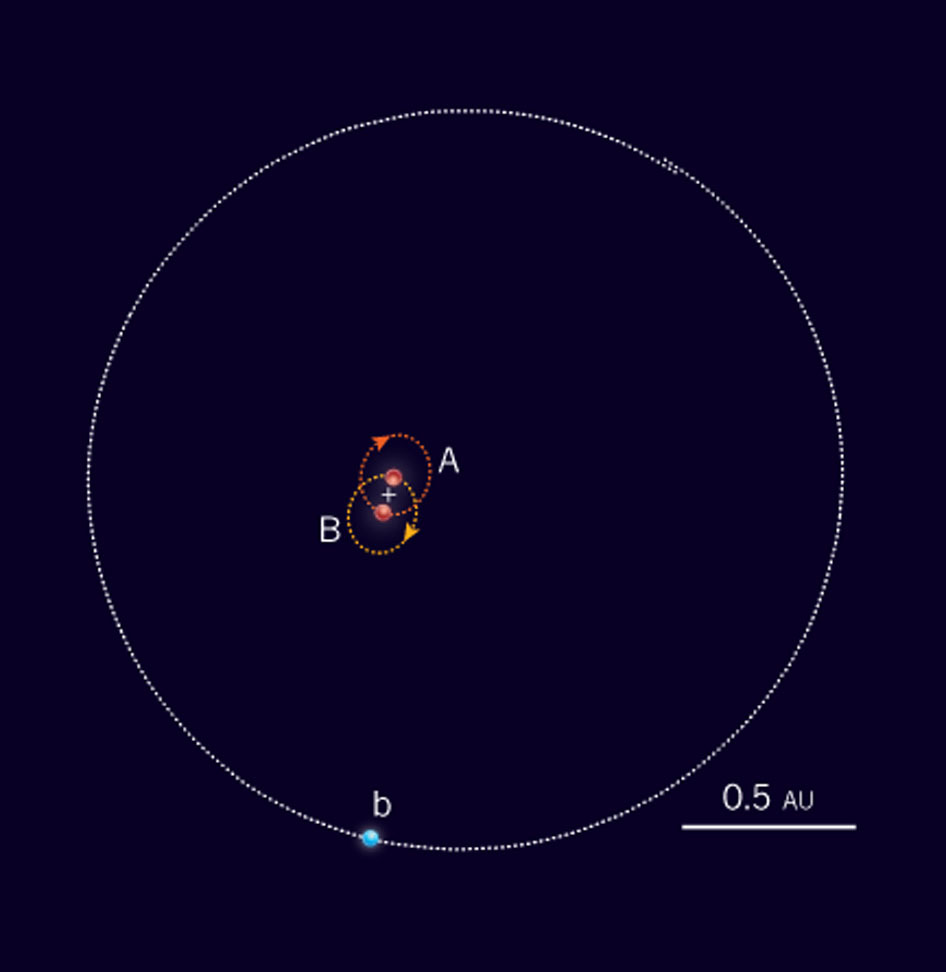
Image Description: Orbital configurations of Kepler-34 system.
Now that we are hunting for Alien Worlds, the first thing that comes to mind for life to survive on such planets is Water.
Here is an interesting study of how Alien Planets might lose their water. Tidal forces!!! Tidal forces are well known to Earthlings; caused by gravitational pull of the Moon and Sun.