Another first for Canadian astronaut Chris Hadfield

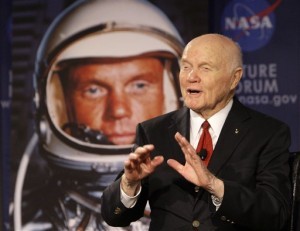
These are changing times for human spaceflight but we shouldn’t forget that Canada has two relatively new astronauts and one heading to the International Space Station (ISS) later this year.

Canadian astronaut Chris Hadfield has racked up several first in Space, including the first Canadian space walk, but in December 2012, he will take up his biggest role yet: Commander of the ISS.

More information is here: http://www.asc-csa.gc.ca/eng/missions/expedition34-35/default.asp and there is a nice interview from a couple of day ago here: http://www.bbc.co.uk/news/science-environment-17092546

Canadian government is ‘muzzling its scientists’

It has often been said that science and politics should not mix; however, unfortunately for us scientists, politics does play a huge role in defining funding for science, what science gets done, and even what science gets reported. The latter is particularly troubling here in Canada where, as reported in this BBC news article, the Canadian government is “muzzling its scientists”:

http://www.bbc.co.uk/news/science-environment-16861468

Having worked at the Canadian Space Agency before coming to Western 4 years ago, I can say that this is not some media hype but is actually happening and is what all government scientists are facing. It’s interesting that this BBC news article was on their front page for a time, but received very little attention here in Canada!

There is a CBC news article here: http://www.cbc.ca/news/technology/story/2012/02/17/science-federal-muzzling-s…

We should all be aware of this and voice our concerns whenever we can.


The Final Countdown… Month 10

So…  Time has moved on at an alarming pace and the end of Febuary fast approaches.  Thankfully my hunt for something to do after #westernu has been greatly helped by a few websites:

First and foremost the AAS Job Register and the equally helpful EAS Job Register.

(Now I may have just been exceptionally lucky in terms of what has been posted in the past month, but I have already made one application and I am in the process of a second.  So, all I can say is have a look).

Another thing that occurred to me this month is that there are a number of people/groups with whom I would really really like to work or where I know our research interests cross paths.  I realised that not all of these will be actively looking for PostDocs.  So then, I wondered, can I simply write to these people to display my interest to them?

After discussion with a few of the faculty I have been left with this advice:  while it is fine to email regarding interest in working with a group make sure you outline your current research, your research interests, what aspects of their work you are particularly interested in, and most importantly how you will benefit their research.  Let us not forget, if we are considering this option, in some cases it will be advantageous to have applied for funding before approaching the people in question.  In fact #NSERC have funding opportunities available for exactly that, the Postdoctoral Fellowship.

An overdose of planets in the night sky

If you’ve looked up shortly after sunset on a clear evening in the last few days, you may have noticed two very bright stars in the West. Those are not stars — they’re the planets Venus and Jupiter. The two are putting up a show in the next days/weeks as they get closer for a conjunction in March. By the end of Feb, they will be joined by the crescent Moon. This year though the three will not conspire to form a Smiley Face, but it’s still a pretty neat thing to see! Many people that see the bright objects mistake them for a UFO, but you know better now!

This NASA story gives more details about the conjunction, but it does not mention that there are more planets visible the next few weeks: Mars rises in the east around sunset, and Saturn a few hours later. You may want to look at Saturn before sunrise, and then take the opportunity to try and find Mercury in the twilight, and then you have seen all planets that are visible to the naked eye in 1 night!

A good source of information for all your skygazing needs in the site Heavens Above, which also lists passes of the International Space Station and other satellites. Or why not use the free planetarium software package Stellarium to search for what wonders of the sky you can see for yourself? Of course, we are here to point it out for you — on our Cronyn observatory public nights (one coming up next weekend, on Feb 25!)


Massive stars in a cluster are not the same age!

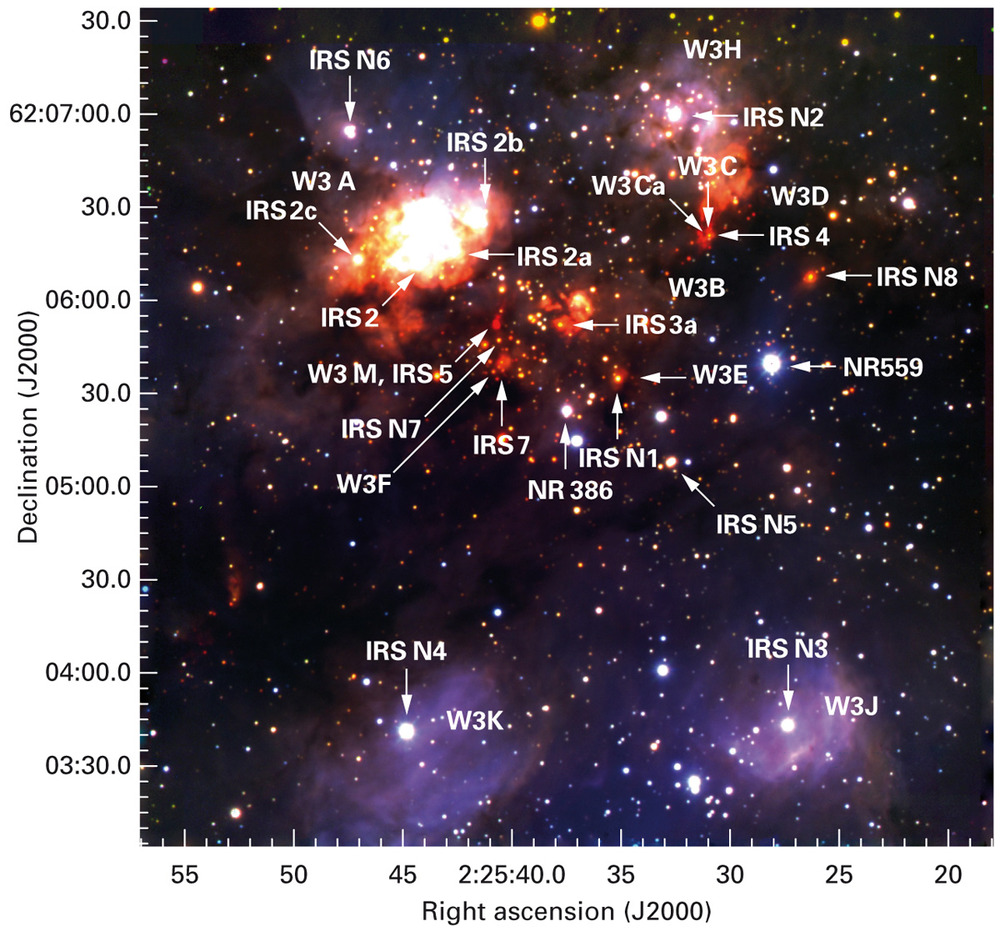
Stars form from the gravitational collapse of interstellar clouds of gas and dust, and it has long been assumed that this implies that stars in a cluster have about the same age. A recent paper presents new observations of the well-known massive star cluster W3, and concludes that the ages of the stars in the cluster are quite different — from newly born stars to some that are 2 million years old.

This very nice piece of work was carried out by Arjan Bik and coworkers.I have very fond memories of Arjan who was my office mate in Amsterdam where we were both grad students; we had a good time!

You can read more about this in the Press Release; and here’s the ApJ paper. 


Riding a comet…..

One of Europe’s exciting cornerstone missions is Rosetta. Rosetta has been traveling through the Solar System since 2004, and is slated to meet up with comet 67P/Churyumov–Gerasimenko in 2014. From orbit and with a lander (named Philae), the comet will be studied as it becomes more active and swings around the Sun. Here’s a short description & a NASA sciencecast about the mission.

http://science.nasa.gov/science-news/science-at-nasa/2012/02feb_rosetta/

[youtube http://www.youtube.com/watch?v=FoePrO4-fGQ?wmode=transparent]