End of an Era

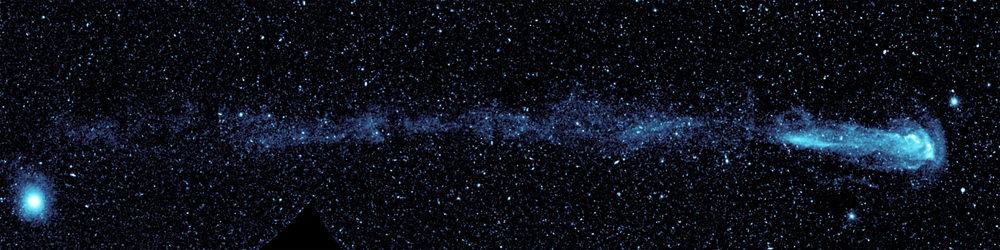
The Galaxy Evolution Explorer (GALEX), an orbital ultaviolet telescope, was recently placed in standby mode as teams prepare to end the 9 year old mission. Its mission was originally to determine distances to galaxies in the nearby and distant Universe and measure how quickly they are forming stars. However, among the mission’s many scientific discoveries are things like the image below, an ultraviolet tail and a bow shock between the stellar wind of the star Mira and the surrounding interstellar medium as it plows through our own home galaxy The Milky Way.

More information about GALEX, its discoveries, and the latest news can be found on their website.

Photo: GALEX view of Mira (NASA/JPL-Caltech/C. Martin (Caltech)/M. Seibert(OCIW))

Those lazy profs, part 2

Last month I tried to explain how I spend my teaching time both inside and outside the classroom. So what about the other 60% of my time: 40% for research and 20% for service. What do those mean? Let’s tackle the research part this month.

I’m an observational astrophysicist, which means that my research consists of using observational data to figure out how the universe works. But this doesn’t mean that I spend my nights at a telescope glued to the eyepiece. I use data from telescopes on the ground (CFHT, Gemini,  JCMT, and others) and in space (Hubble, Spitzer, Chandra) to try and answer specific questions about how stars in nearby galaxies are born, live and die. So, broadly, my research might go something like this.

  1. Think of an interesting question and find out if it’s already answered. This usualy involves a lot of reading, mostly through the Astrophysics Data Service.
  2. If not answered, figure out what data might be needed to answer it. If already answered, go back to step 1.
  3. Figure out whether the data already exist. This can involve a lot of web-searching at online archives of telescope data. Someday there will be one-stop-shopping for such (the “Virtual Observatory”) but not yet.
  4. If the data already exist, great: download them and get to work. If not: figure out what telescope could generate the necessary data, write a compelling proposal for telescope time, and design (& perhaps perform) the observations. [The previous sentence summarizes what can be months of work and will perhaps be the subject of a future post.] Sometimes it turns out that it’s not feasible to get the necessary data, in which case go back to step 1.
  5. Once data are in hand, “reduce” them. The idea is to go from numbers in some kind of digital image to physical measurements, for example luminosity of an object in Watts. This step is what grad students spend a lot of their time on.
  6. Finally, figure out the meaning of the physical measurements. Often this is done by comparing to simulations or other theoretical models — do the models and data agree? If not, is there a plausible reason why?
  7. Share the results of the research: write a journal paper, give a conference talk or seminar, present a poster. More often than not, I do all three for a given piece of research (sometimes at different stages in the work).
  8. Hopefully the research has suggested new questions to explore: return to step 1.

Many of these steps are done in collaboration with other people (see recent post by John de Bruyn) — one person doesn’t usually have the required technical expertise to do everything. (And see also this paper on the decline of the single-author paper in astronomy.) Almost all of these steps are done while sitting in front of a computer, but that computer can be nearly anywhere in the world. I know people who reduce the data from observing runs on their airplane flights home. Or write their papers in telescope control rooms. I’m usually too tired to do either.

You’ll also notice that there’s a lot of “back to step 1” in the list above. That’s the nature of research: 2 steps forward, 3 steps back, a couple of sideways steps. Eventually we get somewhere, but it’s not always where we expected. But that’s why it’s fun.

Now, if you will excuse me, I have an observing proposal to write.

Carl Wieman’s insights into teaching science

If you have not heard of Carl Wieman, his bio is on http://cwsei.ubc.ca/.  In 2009, he has given various talks on scientific approach in science education.  Many of you who are in tuned with science education would no doubt know of his work.

I found that he had transcribed his talk into five written parts here: http://www.science20.com/carl_wieman/why_not_try_scientific_approach_science_education

While you may not agree with his proposed solutions, I would like to quote two points here that I find particularly good that may pique your interests:


  1. “puzzle of my graduate students—why their first 17 years of education seemed so ineffective, while a few years of doing research turned graduate students into expert physicists”
  2. “… novices see the content of physics instruction as isolated pieces of information— handed down by an authority and disconnected from the world around them — that they can only learn by memorization.  To the novice, scientific problem-solving is just matching the pattern of the problem to certain memorized recipes.
    Experts—i.e., physicists—see physics as a coherent structure of concepts that describe nature and that have been established by experiment. Expert problem-solving involves employing systematic, concept-based, and widely applicable strategies.”

I would love to hear what your thoughts are on Wieman’s insights or if you have ideas of how best to turn novices into experts.


Physics & astronomy podcasts

Last month I listed some of my favorite, mostly general science, podcasts. Here are some more which focus specifically on physics and/or astronomy. This list doesn’t include “course lecture recording”-type podcasts, of which there are many: next month I’ll try to recommend some of these.

Physics Central Podcasts and Vodcasts

Physics World Science Podcast

Learning About Teaching Physics Podcast

Perimeter Institute Podcasts

365 Days of Astronomy

AstronomyCast

Naked Astronomy (my son says this name is “just plain creepy”)

Silicon Valley Astronomy Lectures

Physics apps for your favorite device

The Institute of Physics in the UK gives us their guide to cool physics apps:

 

With 15 million to choose from, smartphone users are spoilt for choice. Here’s our pick of the best physics apps, from the practical to the weird and wonderful.

If we’ve left out your favourite physics app, why not tell us?


LHSee

Here’s one for all you armchair particle physicists. Find out all about the ATLAS detector, have a go at spotting the Higgs, and best of all, download particle collisions live from CERN. You can then explore particle tracks inside ATLAS  in full 3D glory – even if (like us) you don’t really know what’s going on, you have to admit it looks pretty cool.

Available on Android. Free.


Launchball

The Science Museum’s infuriatingly addictive game has gone mobile. A variation on the classic ‘get the ball into the goal’ puzzle, Launchball requires you to play with fire, electricity and magnetism as you progress through its levels. You can even build your own fiendishly difficult levels or try out other players’ creations.

Available on iPhone. Cost: around £0.70.


Google Sky Map

Stargazing is great, but it’s even better when you know what you’re looking at. Google Sky Map tells you just that – simply point your phone at the heavens and a map of the sky based on your location springs up, complete with stars, constellations planets and satellites. You could even point it at your feet to take a peek at what astronomers on the other side of the world can see.

Available on Android. Free.

(A similar app for iPhone and iPad users is Star Walk)


Solar System for iPad

Ever wanted to zoom in on Jupiter’s Great Red Spot or soar along a Martian canyon? This app provides a visually stunning tour of our solar system’s planets, moons and other celestial bodies. Packed with great stories, facts, beautiful imagery and plenty of other treats.

Available on iPad. Cost: around £9.99.
Solar System has also been released as a book, available on Amazon.


Wolfram alpha

This app is an intelligent reference guide to just about everything. Use it to find facts and formulae, perform calculations, plot graphs, get info about space probes and much more. There’s a good pinch of humour in there too – just try asking for the meaning of life or why the chicken crossed the road.

Available on Android, iPhone and iPad. Cost: around £1.50.
Also available free as a website.


Navigate to…


<< Back      Home >>

Let us know what you think of these pages – take our quick and easy survey.


Share:

The folowing links are external



neutrinos not so fast after all

http://news.sciencemag.org/scienceinsider/2012/02/breaking-news-error-undoes-faster.html


BREAKING NEWS: Error Undoes Faster-Than-Light Neutrino Results


It appears that the faster-than-light neutrino results, announced last September by the OPERA collaboration in Italy, was due to a mistake after all. A bad connection between a GPS unit and a computer may be to blame.


Physicists had detected neutrinos travelling from the CERN laboratory in Geneva to the Gran Sasso laboratory near L’Aquila that appeared to make the trip in about 60 nanoseconds less than light speed. Many other physicists suspected that the result was due to some kind of error, given that it seems at odds with Einstein’s special theory of relativity, which says nothing can travel faster than the speed of light. That theory has been vindicated by many experiments over the decades.


According to sources familiar with the experiment, the 60 nanoseconds discrepancy appears to come from a bad connection between a fiber optic cable that connects to the GPS receiver used to correct the timing of the neutrinos’ flight and an electronic card in a computer. After tightening the connection and then measuring the time it takes data to travel the length of the fiber, researchers found that the data arrive 60 nanoseconds earlier than assumed. Since this time is subtracted from the overall time of flight, it appears to explain the early arrival of the neutrinos. New data, however, will be needed to confirm this hypothesis.

Physics & Astronomy Colloquium – THURS. 8th March – DR. TRAVIS BARMAN, Lowell Observatory

Poster: http://www.physics.uwo.ca/colloquia/Colloquia%20Notices/2011_2012/BARMAN%20Colloquium.pdf


The University of Western Ontario
DEPARTMENT OF PHYSICS AND ASTRONOMY


PHYSICS & ASTRONOMY COLLOQUIUM


Date:          Thursday, 8th March 2012
Time:          1:30 p.m.
Location:    Physics & Astronomy Seminar Room 22


Dr. Travis Barman
Lowell Observatory
Flagstaff, Arizona


“Direct Imaging and Spectroscopy of Young Giant Planets”


ABSTRACT


Several young gas giants in wide orbits (> 10 AU) have now been directly imaged. These exciting discoveries provide new insights into the formation and early atmospheric properties of giant planets. This talk will focus on recent attempts to measure the near-infrared spectra of two planets orbiting the star HR8799. These data have aided in the characterization of the planets’ cloud and chemical properties, but also highlight the many difficulties we face when modeling planet atmospheres.

The few planets imaged so far are just the beginning. New instruments, tailor made for high-contrast imaging, are coming online this year and will reveal dozens of young planets. These instruments will also provide low resolution near-IR spectra of each new planet, revealing a wealth of information across a wide range of planet masses and ages. Given the lessons we are learning from systems like HR8799, interpreting these data will not be easy and significant observational and planet modeling obstacles must be overcome.


Coffee & Cookies will be available.