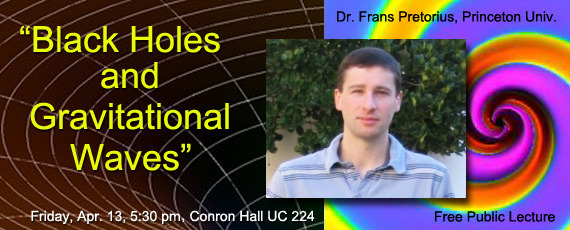
There will be a free public lecture in Conron Hall (University College 224) at 5:30 pm. on Friday, April 13, 2012.
The guest speaker is Dr. Frans Pretorius of Princeton University. The talk is titled “Black Holes and Gravitational Waves“.

There will be a free public lecture in Conron Hall (University College 224) at 5:30 pm. on Friday, April 13, 2012.
The guest speaker is Dr. Frans Pretorius of Princeton University. The talk is titled “Black Holes and Gravitational Waves“.
Have you ever wondered what age you would be if you happened to have been born on another planet? You can easily find out by heading to this webpage and entering your birth date. Check it out its pretty interesting.
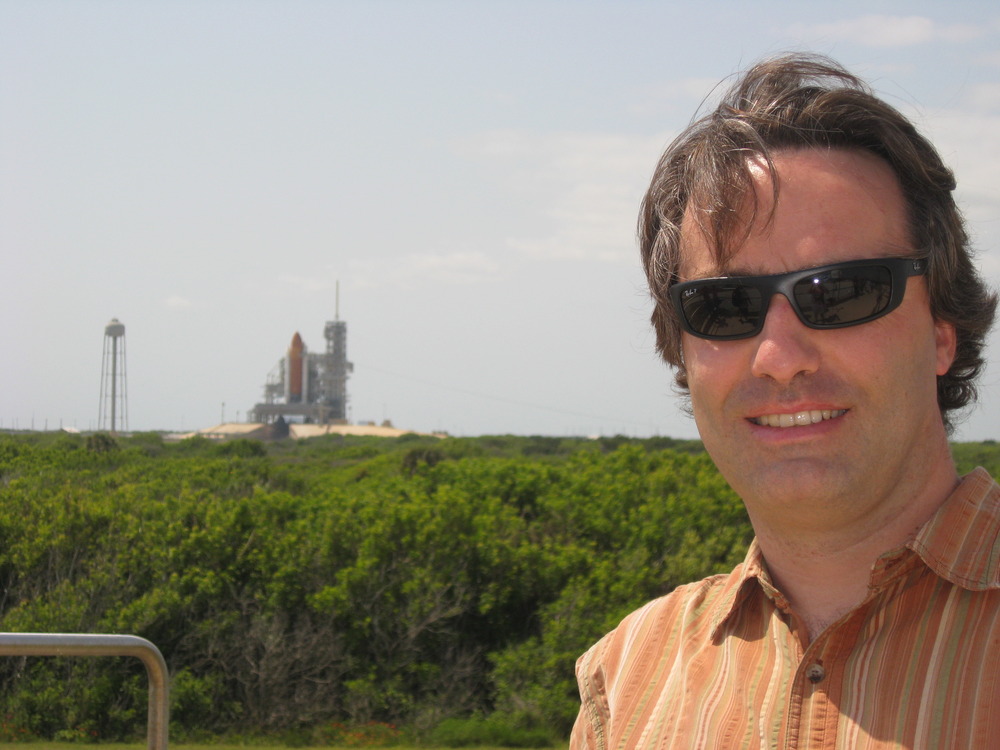
In April last year, a launch was scheduled after teaching duties were over and before travel season started: the last launch of the space shuttle Endeavour, slated for April 29th. When prospects looked good, we booked a last minute flight & hotel to Orlando, and soon found ourselves at the Space View Park in Titusville. It’s still quite a distance from the launch pad, but it offers a direct, unobstructed view of the launch pad. After a long wait, the launch was scrubbed and we extended our stay with a few days hoping to have a new attempt in the following days. That didn’t happen, and so we had a few days to explore everything Kennedy’s Space Center (KSC) has to offer (awesome^2!). As soon as the shuttle’s external fuel tank was drained, it was safe to offer the Discover KSC tours again, which offer the closest views of the launch pad (1.8 miles I believe) that tourist money can buy. A fortunate consequence of the scrubbed launch was that we not only got to see the launch pad — Endeavour was still on it!
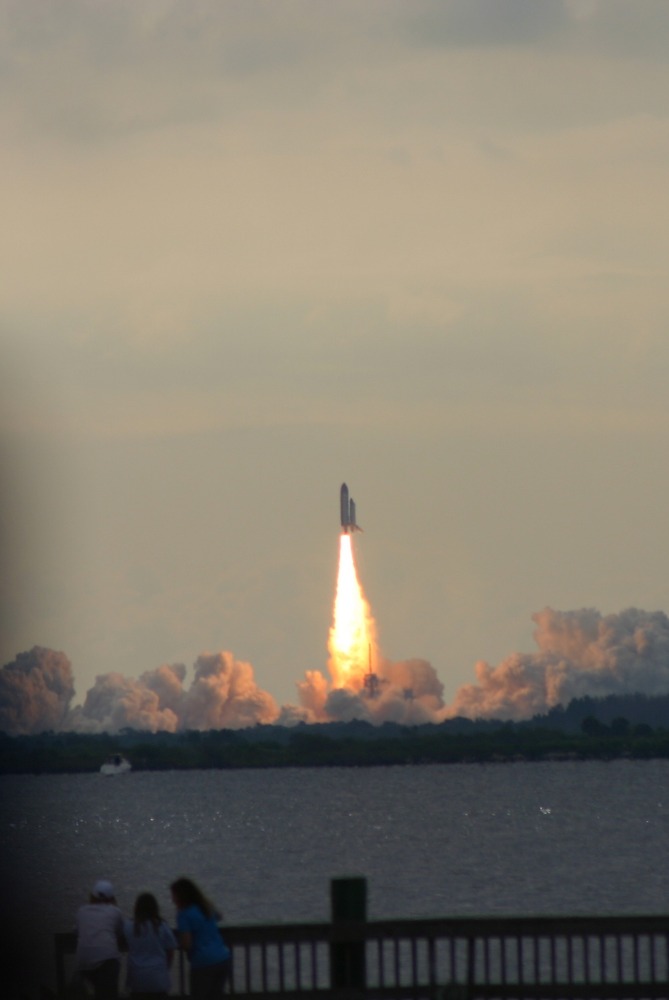
Two weeks later, things looked good again, and another last minute booking brought me back to Titusville on May 16 2011. That day, not only Endeavour commander Mark Kelly was having a beautiful day, The 8 year old in me was having a blast, watching the final launch of Endeavour with awe and joy. Even at that distance,it’s a most impressive sight — the shuttle outline being very clear, and the rocket going up much faster than I seemed to remember from televised launches. You really get a sense of the tremendous power involved in bringing such a massive machine to high speeds! Unfortunately, Endeavour disappeared into the cloud deck after about 15 seconds, and from then on, people in airplanes had a better look than we did. Her last goodbye that day was the shadow of the exhaust plume that the early morning Sun cast on the low cloud deck. But we would meet again soon. Two weeks later, in the early morning hours of May 31st (while tweaking my talk), I saw her again from my hotel room in Toledo, Spain, silently crossing the sky only a few degrees apart from the ISS, less than a day after undocking.
On launch day, I rewarded the 8 year old’s patience with a 60cm cast model of the shuttle Endeavour (ok, you’re right, so I also got a smaller model as well and posters and calendars and whatnot, what’s the big deal?). It’s in my home office, and you would not believe how much joy a grown up (?) can still have from just watching a model of a pretty spacecraft at the start of each working day.
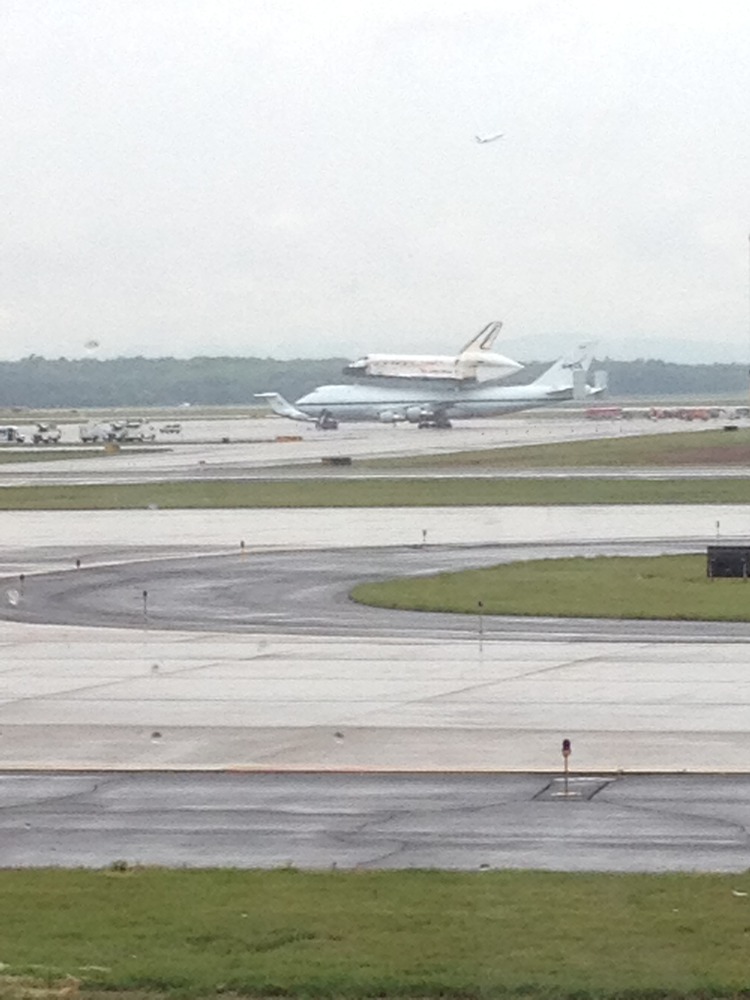
When the shuttle fleet retired, I thought that that would be the end of our story, but this week, there was a nice and surprising little epilogue. The space shuttle Discovery will be replacing the Enterprise in the Udvar-Hazy Center of the Smithsonian Air and Space Museum. As you may have heard in the news, Discovery was flown from KSC to Washington D.C. on Tuesday, and today (Thursday), Discovery was welcomed into the museum with a big ceremony. By some cosmic coincidence, I happened to fly into Washington Dulles on Wednesday. I was wondering whether I’d be able to catch a glimpse of Discovery. Sure enough, there she was, stacked on top of the shuttle carrier just a few hundred meters to my left as we reached the gate. And although I was in the right terminal for my connecting flight, I quickly decided to take the airport shuttle to a different terminal and back, since the airport shuttle’s route brought it much closer to Discovery’s temporary parking spot. And in case there was any doubt, the 8 year old in me is still alive and kicking (and excited, satisfied and happy). After more than 30 years, I’m still as much in love with space and the shuttle as I was back then.
.
I moved to the NASA Ames Research Center in California in July 2002 (and of course, they have a shuttle scale model on display). Fairly soon, on Feb 1st 2003, an interesting opportunity came up: the space shuttle Columbia was returning from space, and the re-entry track brought her over Northern California, promising a very bright overpass (the shuttle’s altitude being only 70 km or so). I was up at 5:30am, but alas, the dreaded marine layer (low clouds) prevented me from seeing anything, and it was only many hours later that I found out that Columbia had disintegrated. Ironically, the same orbiter that as a kid inspired me to go and work for NASA was the one that disintegrated pretty much above my head while I was working at NASA….
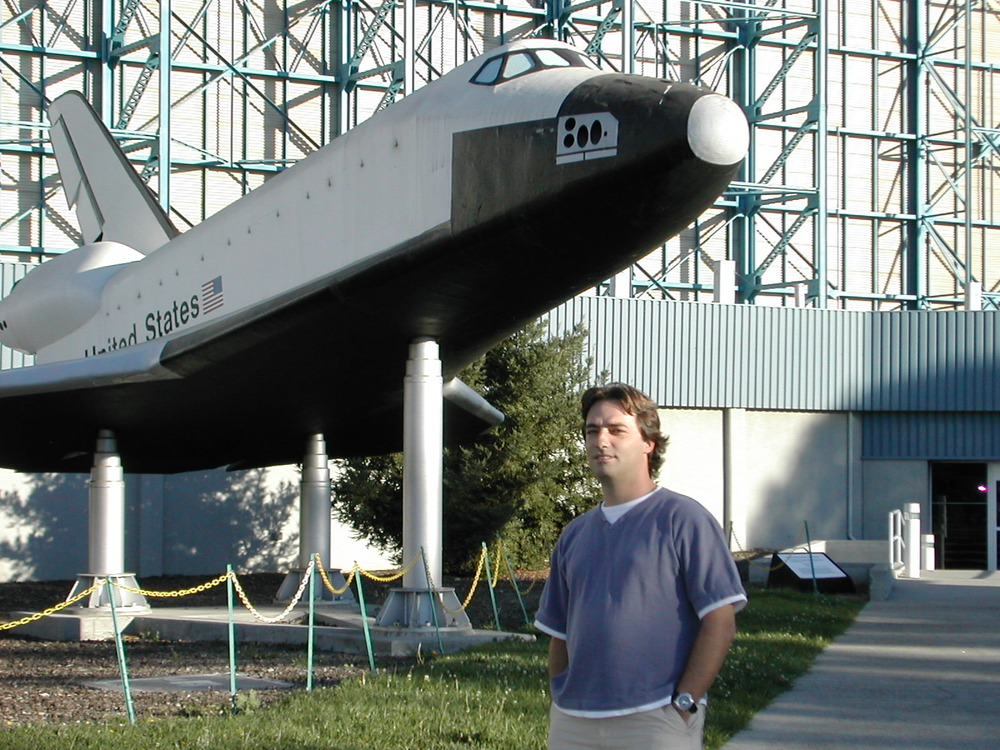
After the Columbia disaster, there were no more shuttle launches for a while, but there were still cool space and plane experiences, with a shuttle component. NASA Ames is located right next to Moffett Federal Airfield, and on Memorial Day 2004, the Air Show Network organized what seems to have been the last of the Moffett Airshows — but how cool is that really, an air show at work! In addition to P-51 Mustangs, F-15 Eagles, The Air Force Thunderbirds (flying F-16s), F/A-18 Hornets, and a flyby of the F-117 Nighthawk stealth fighter, the shuttle carrier was on display, to be explored on the inside and the outside.
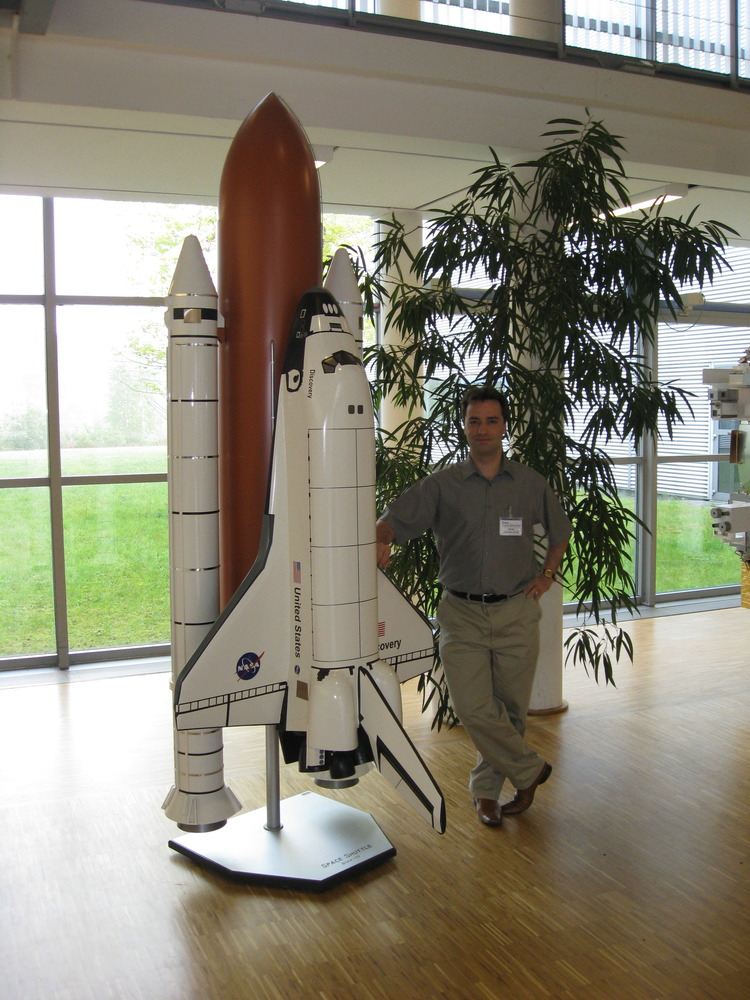
In 2008, the European Space Agency issued a call for astronauts, and of course the 8 year old in me made sure that I was one of approximately 10,000 candidates — over 8,000 of those were furthremore also qualified (i.e. had a graduate degree and work experience). The whole process in itself was quite interesting and unique, but unfortunately, I didn’t make the final cut. To my own amazement though, I made it to the last remaining group of 192 candidates after two rounds of tests in Germany; the last round being organized in the European Astronaut Centre in Cologne, Germany. There, the first thing that caught my eye was a large model of the shuttle, right under an equally impressive 1/20 or so scale model of the fully assembled ISS.
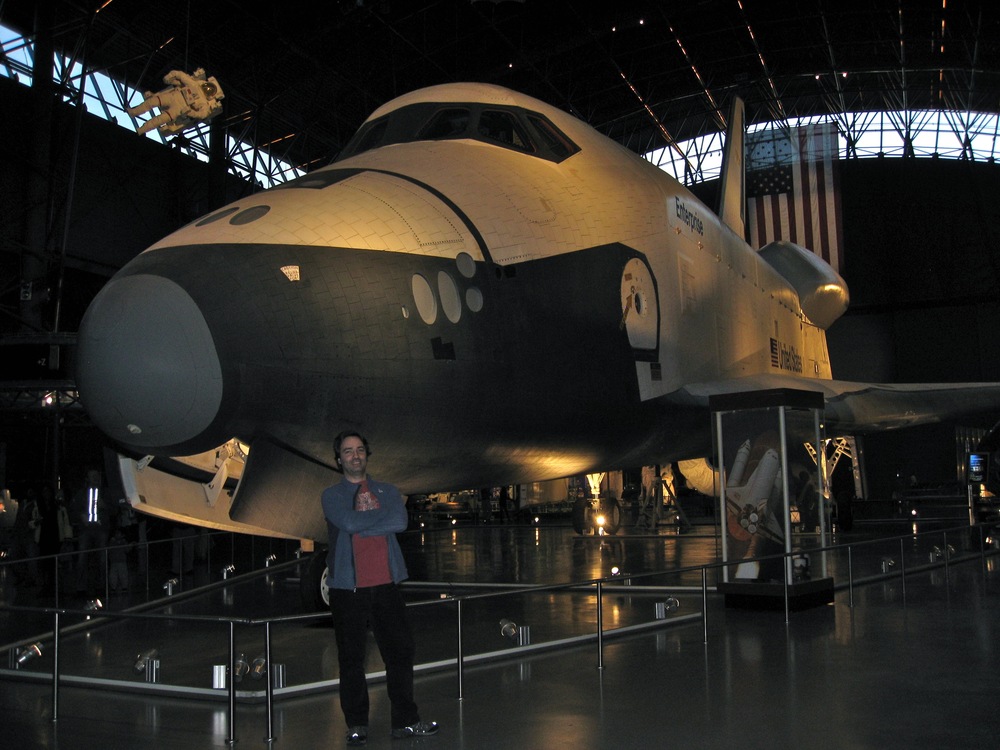
By the time the shuttle program had fully resumed late 2006, a busy teaching and travel schedule turned out to be 100% incompatible with the shuttle launch shedule. In November 2010 though, I finally got to see a shuttle up close and personal when after a work visit to NASA’s Goddard Space Flight Center, I visited the Smithsonian National Air and Space Musem (Steven F. Udvar-Hazy Center)right next to Washington Dulles international airport with my friend, colleague astrochemist and fellow space enthusiast Stefanie Milam. One of the centerpieces of that exhibit was the space shuttle Enterprise. Although the Enterprise has never been in space, it has been used by astronauts for test flights. It’s the real machine. If you’re into planes btw, and your travels bring you through Washington Dulles airport, try to get a layover of a few hours, take the shuttle to the museum, and enjoy the shuttle (Discovery) in addition to the Concorde, the SR-71 Blackbird, the Enola Gay, and many many many many more…
I’ve always had a special connection with the Space Shuttle. She’s been a source of inspiration and motivation in my life since my childhood, and by chance, our paths crossed again just yesterday. Here’s our story.
As is the case for many kids, I found space stuff pretty cool when I was about five years old. But I was born in the seventies, and not much was happening for the first few years of my life; I heard about the Moonwalkers, but I had essentially missed out on the mighty Apollo era. Space was not my only interest though — I also loved planes. There was a small airfield close to our house where I would spend happy days watching small planes and gliders take off and land. Maybe not surprisingly then, I was very much looking forward to the era of the Space Shuttle — after all, it would be pretty much like a space plane!
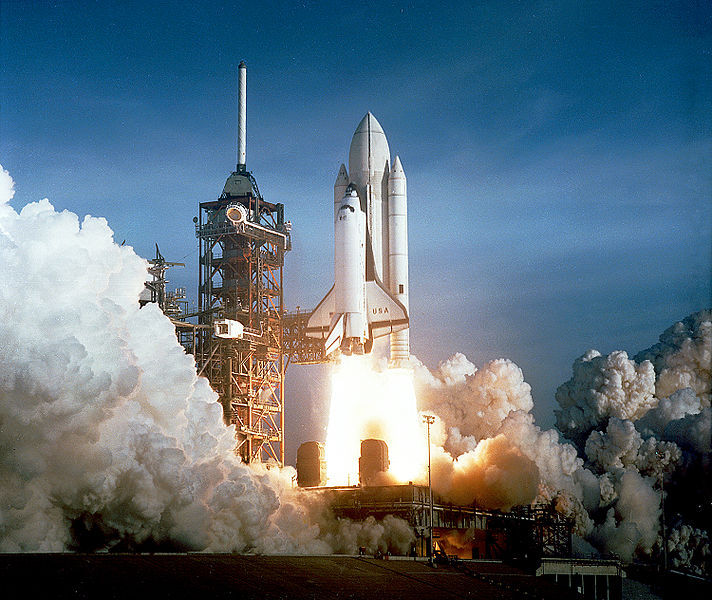
On April 12, 1981, launch day was finally there. We were having our Easter school break, and I was glued to the TV for the entire time of the mission. The first launch of the Columbia was awesome, and even the first landing of this aerodynamic brick at Edwards Air Force base was spectacular to me. It was certainly the most beautiful spacecraft ever built. I told myself (and anybody willing to listen) that one day, I would be there, at NASA’s Kennedy Space Center, for the launch. Hopefully at the controls.
There’s plenty of examples of how big an influence the shuttle was in my life. Drawing classes for instance were a nightmare to me. I couldn’t put anything on paper that even remotely looked like what I had in mind, and moreover I had a tendency to knock paint or ink over my finished work at the last minute. One of the very few times though that I got a very good mark was when I had made a drawing of the shuttle launch. I guess that somehow I spent more time at it, and wanted the drawing to be the pretty sight that I thought the space shuttle is.
Also my first ever computer program was shuttle related. At age ten or so, I joined the local amateur astronomy club called Sirius and found a small home computer (yes, these were the eighties!) in the corner. My first program: a drawing of the shuttle. It were really the older guys that wrote the program, and I guess in a Sheldon type of way quite fascinating: they were just talking to me in coordinates. As an amateur astronomer, I’ve of course also seen many shuttle flybys, including a few double flybys shuttle/Mir and shuttle/ISS. But as a kid living in Europe, the chances of seeing a shuttle up close and personal seemed very remote.
Included in the pile of mail waiting for me when I returned to my office last week was the February issue of the APS News, which had an article on the top 11 physics headlines of 2011. Here they are, with my unsolicited comments thrown in. Many I think are interesting, a few not so much. But 2011 seems to have been a pretty good year for physics overall.
1. Closing in on habitable planets: We heard something about this in our colloquium this week. It is certainly an exciting area! We (by which I mean they) have now detected close to a thousand extra-solar planets, with thousands more candidates in the works. As a devoted Star Trek fan, I am certain that there must me lots of earth-like planets out there, and I can’t wait to visit them.
2. The Japanese tsunami and Fukushima: Surely everyone has asked the same question I asked: why in the world would anyone build a nuclear power plant so close to the coast in a country where earthquakes happen all the time? The Fukushima tragedy will have long-ranging effects on the nuclear industry, some of which are discussed in the Oct-Dec 2011 issue of Physics in Canada, but I can’t help but think that all of this could have been avoided if people had taken the risks seriously when they built the thing. Of course, one is also forced to wonder what risks were ignored in building other nuclear plants. Nuclear power should have been the way of the future, but I think the industry may have shot itself in the foot. By they way, the fluid dynamics of the tsunami is interesting: apparently the wave was the superposition of two separate tsunamis that merged into one mega-big one.
3. Quantum computing: This particular headline is about group that built a chip that can actually do 4-qubit calculations. This does sound like a significant step towards actually doing something useful, but I am afraid I can’t get excited about quantum computing. As an intellectual endeavour, sure, I can see why people find it interesting. But as a practical way to actually compute something, I think we have a long, long way to go.
4. Higgs boson: Has it been seen? Or not? Apparently there have been a few possible sightings that have turned out to be statistical bumps that went away when more data was analyzed. The December report of something at 125 GeV sounded a bit more robust, but we still don’t know for sure.
5. Heaviest antimatter: Some folks at Brookhaven made a few anti-helium nuclei. This was hard to do, and is quite an accomplishment. The article doesn’t say what they actually did with the nuclei, though.
6. Living laser: This one sounds a bit like the work of the kind of mad scientists you see in bad sci-fi movies. Some folks modified a human kidney cell so that it produces a fluorescent protein (one that occurs naturally in jellyfish), then put it between two mirrors and shone some blue light on it. The protein acted as an optical gain medium, and the cell emitted green laser light. Cool.
7. Seeing a wave function: This one was interesting. Some researchers at NRC in Ottawa have devised a way to probe the state of photons with out actually causing their wave function to collapse. This allows a direct measurement of the wave function, without perturbing the system a la Heisenberg. This demonstrates two things: first, some people are very clever, and second, there are many things about quantum mechanics that I don’t understand.
8. Faster than light neutrinos: I’ve posted about this before. It appears that the measurements that produced this headline were wrong due to a problem with the system used for measuring time. Lesson: when you get a result that violates all known physics, check it carefully before you tell anyone about it. This applies as much to students writing up third-year lab reports as it does to professional scientists at CERN.
9. Tevatron shutdown: The Tevatron at Fermilab used to be the highest energy particle accelerator, but that honor now belongs to the LHC. The Tevatron was shutdown last year after 28 years of operation. Even the most useful of tools eventually reaches the end of its useful life. Fermilab will now focus on higher-intensity accelerators rather than higher-energy.
10. Nobel prizes: We’ve heard a lot about these: the physics prize was for the discovery of the acceleration of the expansion of the universe, which is pretty interesting, and the chemistry prize was for the discovery of quasicrystals, crystals with five-fold symmetry that broke all the established rules of solid state physics.
11. Biggest black hole: We’ve about this, too: a black hole with a mass of 21 billion solar masses in a galaxy far, far away. When I was a student, there were debates about whether black holes existed at all, now they are everywhere.
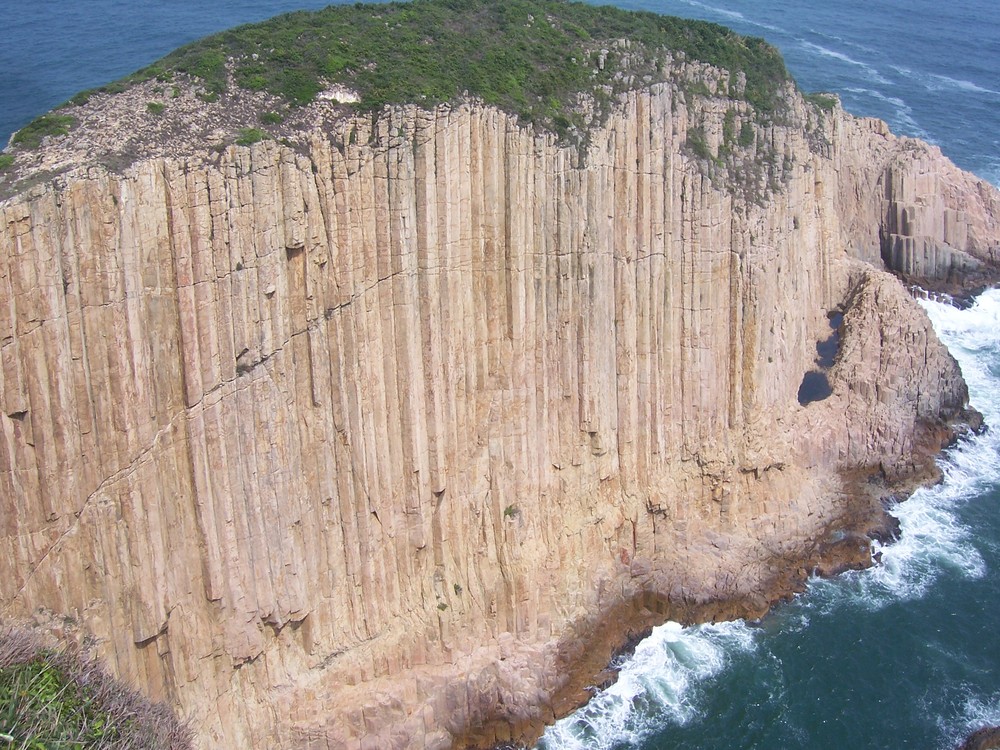
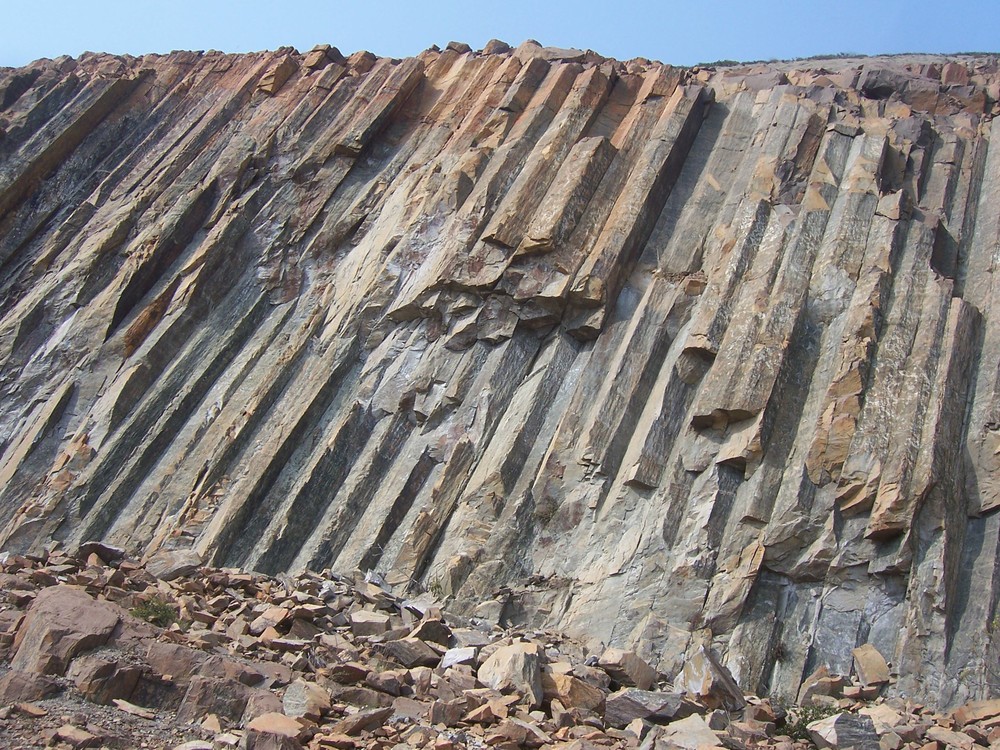
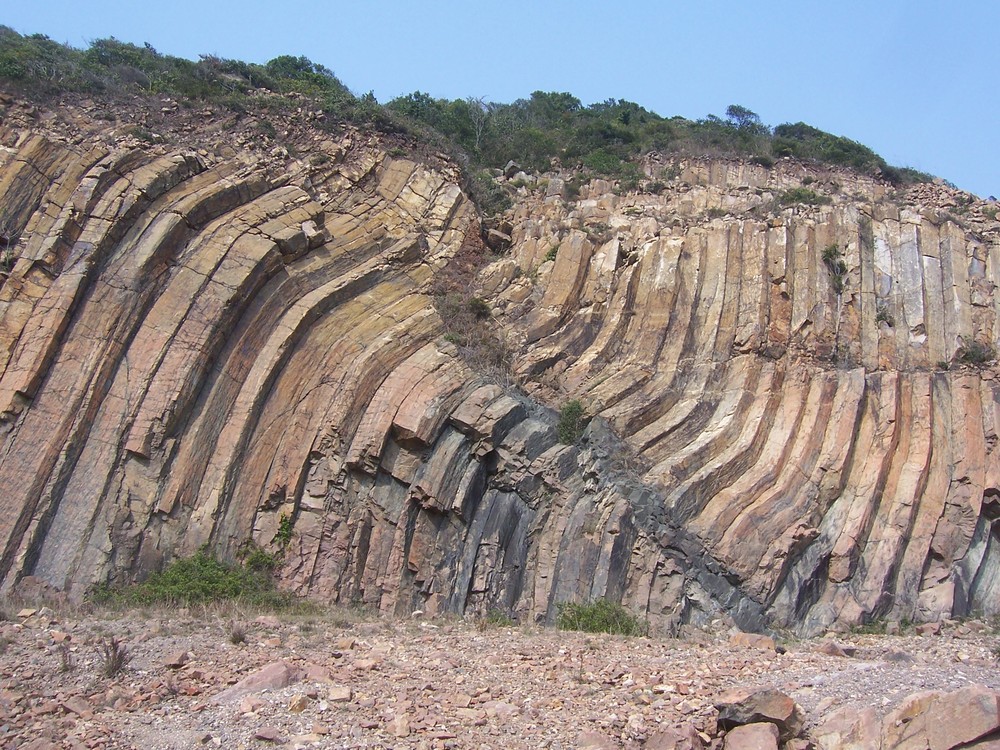
The physics of columnar jointing is interesting, too, and I published a paper on related phenomena a few years back. Let’s first consider a thin layer of lava that has solidified, but is still very hot. As the rock cools, it shrinks. This results in stress building up in the rock, and when the stress at some point gets bigger than the strength of the rock, it cracks. These cracks initially form randomly. Once you get a few cracks, however, these pre-existing cracks influence the location of the next cracks that form: The normal component of the stress is zero at the crack and biggest half-way between cracks, so new cracks tend to form half-way between old cracks. New cracks also tend to meet old crack at right angles, since they propagate in the direction of the stress gradient. The result of this is that as the pattern of crack develops, the spacing between them tends to become more uniform. Now extend this to three dimensions, i.e., think about a deep layer of cooling lava. The cracks will initially form at the top surface, where the cooling is fastest, but they will propagate downwards into the rock as the subsurface rock cools and contracts. The interactions between the cracks makes them organize very quickly into a hexagonal pattern, resulting in the columnar joints you see in the pictures. My friend Stephen Morris from U. of T. has done some beautiful experiments which mimic this process using drying mixtures of water and corn starch – the diffusion of water replaces the diffusion of heat, but otherwise the physics is very much the same.
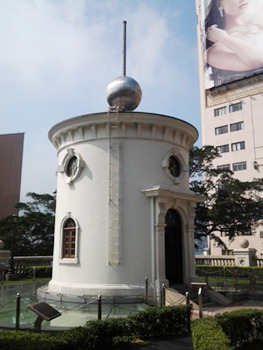
One of the lesser-known sights in Hong Kong is shown in this picture, which I lifted from http://www.1oclockgun.org.uk/hongkong.html because the photos I took are at home.
This is a time ball.Back in the days before GPS, it was vital for ships to have an accurate clock on board if they were to know where they were. This time ball was used in the late 19th-early 20th century by the ships in the harbour to set their chronometers. Normally, the ball was raised up to the top of the pole on the roof of the building. Every day, the Hong Kong observatory would do observations of the sun to determine the local time exactly. They would send a signal to the operator of the time ball, and at precisely 1:00 p.m., the ball would drop from the top to the bottom of the pole. The ships would set their clocks accordingly.
I’m back in London for a little while. We returned from Hong Kong last week after a very productive and enjoyable two months. I was a bit shocked by the falling snow that greeted us when we stepped off the Robert Q bus – perhaps we should have stayed away a bit longer? – but at least it didn’t stick around.
In a previous post I talked about my visit to Chinese University. Since then I visited two more of Hong Kong’s universities: Hong Kong Baptist University and Hong Kong University of Science and Technology. I gave talks to the physics department at both places.
The physics department at HKBU is fairly small – I think they have about eight full time faculty. There are several people there who do nano-materials type research and study optical properties of materials, and a fellow who does theoretical nonlinear dynamics applied to neuroscience. I saw some interesting labs and, as always happens when I talk to people about their research, I got some good (maybe) ideas for things to think about. My host there told me a little bit about a new program in “Energy Science” they were developing. What he didn’t tell me, and what I learned later from a friend at another university, was that their undergrad physics program had been killed! Introducing this new program in Energy Science was apparently part of their survival strategy in the wake of this. Apparently they were not getting many physics majors and their program was ranked lowest among physics programs in Hong Kong, so it was eliminated. Scary!
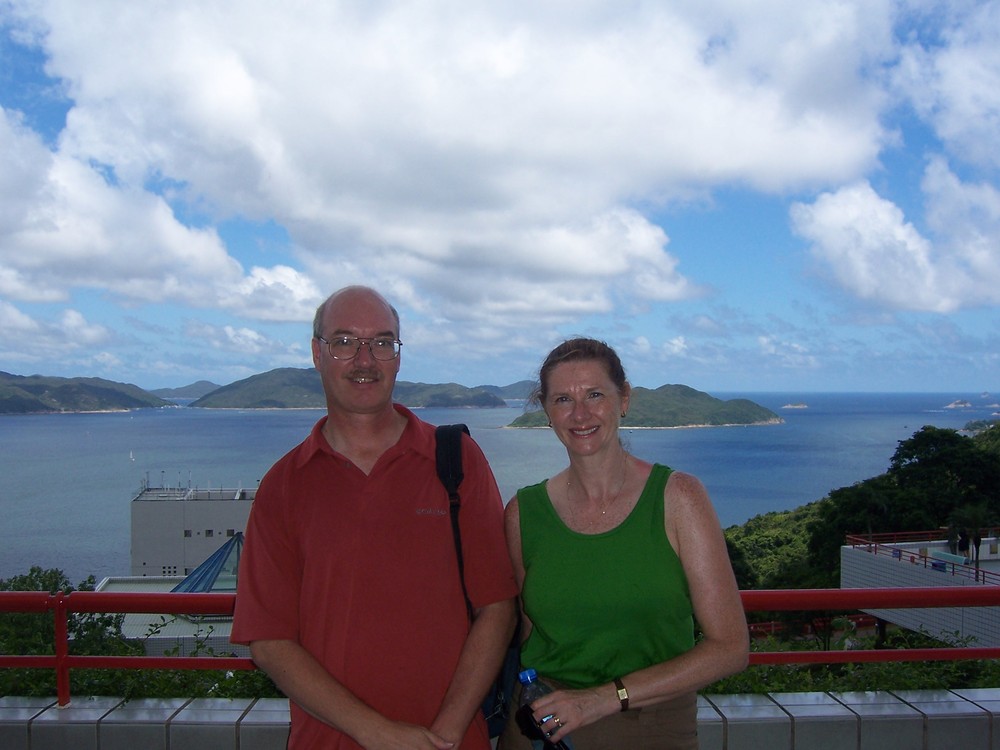
HKUST is a very different place. It is a relatively new university – they just celebrated their 20th anniversary – but it is already ranked in the top 10 in Asia. That’s pretty good! The university was started by the Brits shortly before their lease in HK ended. What I was told is that they had some money in the bank, and, rather than giving it to the Chinese, they used it to build a new university and a new airport. Both are great! The physics department at HKUST is fairly large – about 30 faculty, plus several visitors and soft-money researchers. It’s a very vibrant place. The people I talked to were doing really exciting research in soft matter and nonlinear dynamics; they also have people in many other areas of physics. HKUST also has one of the most beautiful settings of any university in the universe. The picture shows the view from their main building, with a couple of tourists in the foreground. My friend there has an office with an even more spectacular view.
On the same day I was visiting HKUST, a delegation from MIT was there to discuss co-operative international ventures. Western is far from being the only university trying to build ties with Asian universities – in fact, everyone is doing it! I found the article in the Western News about Western’s trip to China, and about how we are trying to “set ourselves apart from the crowd” to be a bit amusing – there really is a crowd, and as far as I can see we are no different from everyone else in this regard.
I also visited Chengdu, in Sichuan, China. Leo Lau, formerly Director of Surface Science Western runs a Green Energy Institute there. Unfortunately my visit there coincided exactly with a major Chinese holiday: Qingming, known as Tomb Sweeping Day. This is like Thanksgiving in that everyone goes home for the holidays. Of course I had no idea of this. One consequence was that Leo’s lab was closed on the days I visited, which meant that, apart from some technical discussions over dinner, I was a tourist for three days. Leo and his wife Margaret were excellent hosts. We went for a great hike in the nearby mountains, saw some of the sights of the city, and had some wonderful food.
What’s next? Once I get through the 30-odd things on my list of things I have to do while I am in my office here, we are off to Vancouver in early May. I will be working at UBC for a month. More on that later!
*Next one doesn’t really rhyme unless you read it in an English accent, sorry!*
When Friedrich Hund saw the first cases
Of miner’s from Chile’s worst cases,
When looking for answers
Said “What are the chances
That they’d tunnel there in the first place??”