
The Origin of Brown Dwarfs in the Universe

First draft for release:

Brown dwarfs are astronomical objects that have too little mass
to be called stars and too much mass to be called planets.
They were only a theoretical concept until discovered in the
mid-1990s and several hundred have now been identified through
infrared telescopes and surveys.


The origin of brown dwarfs is a major open issue of investigation
in modern astrophysics. One theory posits that they are formed like
stars through the direct collapse of interstellar gas cloud fragments.
However the required low mass of such fragments poses a challenge
to that theory. Another theory is that brown dwarfs are formed as
part of multiple systems resulting from the collapse of massive cloud
fragments, and then ejected as a result of many-body
interactions. This theory can also explain why some brown dwarfs
are isolated objects that are not orbiting a parent star. However, the
high ejection speeds in models of this process pose a problem in
comparison with observations, and there should be no proto-brown-dwarf
fragments within interstellar clouds in this scenario.


In a new paper appearing in The Astrophysical Journal, Shantanu Basu
of the Department of Physics and Astronomy at Western University and
Eduard Vorobyov of the Institute of Astrophysics at The University
of Vienna present a new model of brown dwarf formation that unites the
best features of existing theories and has far-reaching implications for
our understanding of the population of low mass objects in the universe.
Employing numerical simulations, carried out in part using the SHARCNET
consortium facilities at Western, they show that the evolution of the
swirling nebular disk of gas around a newly formed protostar is key to
brown dwarf formation. Such a disk of gas has long been postulated to
exist around the early Sun, and the planets in the Solar System are
thought to have condensed out of such a disk. In this work,
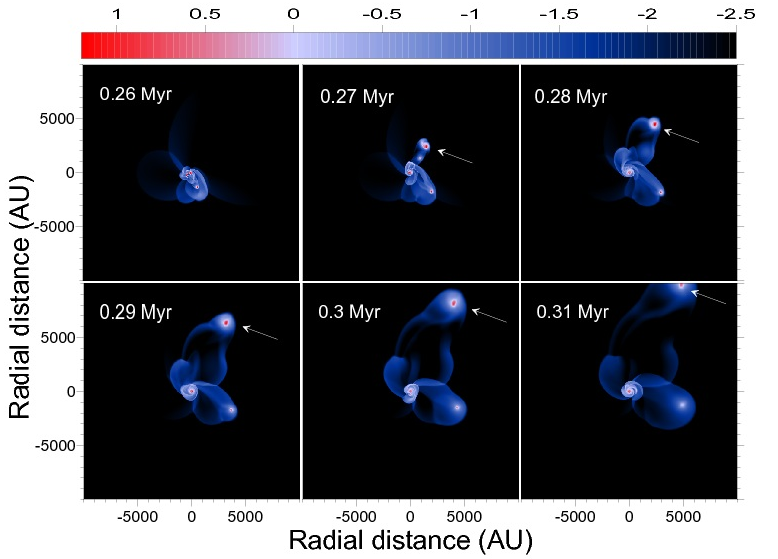
Basu and Vorobyov show that the early life of a disk is
characterized by the formation of multiple fragments that orbit
the central protostar, and that the interaction of fragments leads to
the ejection of some proto-brown-dwarf fragments. The ejection speeds
in this mechanism are much lower than in a model where ejections occur
only for finished brown dwarfs, and provides a more favorable comparison
with observations that show that brown dwarfs are present in close
proximity to young stars.
If proto-brown-dwarf fragments are routinely ejected from nebular disks
around protostars, they are potentially much more numerous in the universe
than current estimates. Although current observations establish that
brown dwarfs are less numerous than proper stars, their faintness has
made a complete census difficult. New ongoing infrared surveys may
find many more brown dwarfs, and this theoretical result has the implication
that they could be more numerous than previously thought.


In that case, there could be significant mass in the universe that is
locked up in brown dwarfs, and contribute at least part of the budget for
the missing “dark matter”. Furthermore, the common idea that the first stars
in the early universe were only of very high mass may need revision.


The paper appears in the 1 May 2012 issue of The Astrophysical Journal,
Vol. 750, p. 30, and can be accessed directly at
<a href=”http://stacks.iop.org/0004-637X/750/30.
http://stacks.iop.org/0004-637X/750/30.<br/>
 

Physics & Astronomy Colloquium – THURS. 26th April – DR. SHELLEY WRIGHT, Dunlap Inst., UofT

Poster: http://www.physics.uwo.ca/colloquia/Colloquia%20Notices/2011_2012/WRIGHT%20Colloquium.pdf


Western University
DEPARTMENT OF PHYSICS AND ASTRONOMY


PHYSICS & ASTRONOMY COLLOQUIUM


Date:          Thursday, 26th April 2012
Time:          1:30 p.m.
Location:    Physics & Astronomy Seminar Room 22


Dr. Shelley Wright
Department of Astronomy & Astrophysics
and Dunlap Institute of Astronomy & Astrophysics
University of Toronto


“Studying Galaxies in the Early Universe with Innovative Astronomical Instrumentation”


ABSTRACT


Studies of galaxies in the early universe (z > 1) have greatly benefited from recent advances in diffraction-limited techniques on 8-10m telescopes using adaptive optics (AO) and integral field spectroscopy. These innovative spectrographs have led to significant scientific achievements and are stimulating the design of future instrumentation. My talk will focus on development and use of the latest near-infrared instruments behind Keck Observatory’s AO system. I will present OSIRIS and Keck AO observations of spatially resolved optical emission lines (e.g., Halpha, and [N II]) from high-redshift (1 < z < 3) star forming galaxies. These results are part of an ongoing survey to study the dynamics, chemical abundances, and active galactic nuclei (AGN) in early galaxies. The high spatial resolution and 2D capability of an integral field spectrograph has allowed the discovery of some of the lowest luminosity AGN known at this epoch, and I will discuss their potential impact on high-redshift metallicity studies and galaxy formation. Lastly, I will discuss future instrumentation upgrades for OSIRIS and development of new instrumentation on extremely large telescopes (30m), which will offer extraordinary potential to probe the dynamics, assembly, and abundances of galaxies in the early universe.


Coffee & cookies will be available, courtesy of PASA.

P&A Special Undergrad Level Talk – NEXT TUESDAY – DR. NICOLAS COWAN, Northwestern University

The University of Western Ontario
DEPARTMENT OF PHYSICS AND ASTRONOMY


Special Undergraduate LevelTalk


Date:          Tuesday, 17th April 2012
Time:          10:30 a.m.
Location:    Physics & Astronomy Seminar Room 22


Dr. Nicolas Cowan
Center for Interdisciplinary Exploration and Research in Astrophysics (CIERA)

Northwestern University, Illinois


“Tortured Climes: Infrared Observations of Hot Jupiters”


ABSTRACT


The discovery of gas giant planets in few-day orbits around their host stars posed serious challenges to theories of planet formation. In the last half-decade, our ability to probe the atmospheres of these hot Jupiters has likewise challenged our notions of climate. Many of these worlds have extremely eccentric orbits, leading to seasons that make Earth’s obliquity-driven seasons seem like a joke. For most Solar System planets, the dominant driver of heat transport is the equator-to-pole temperature gradient. On hot Jupiters, it is the huge day-night temperature contrast (from hundreds to thousands of degrees) that drives atmospheric circulation, potentially leading to transonic winds. Their atmospheres are slightly ionized, making magnetohydrodynamics relevant. Some of the shortest period gas giants have severely warped shapes due to tidal effects. In short, these planets are unlike anything climate scientists have thought much about.

I will present observational studies that can help constrain the mysterious workings of these planets. I will show how we can use time-resolved infrared photometry to learn about hot Jupiters.

Physics & Astronomy Colloquium – MONDAY, 23rd April – DR. STANIMIR METCHEV, Stony Brook University

Poster: http://www.physics.uwo.ca/colloquia/Colloquia%20Notices/2011_2012/METCHEV%20Research%20Talk.pdf


The University of Western Ontario
DEPARTMENT OF PHYSICS AND ASTRONOMY


PHYSICS & ASTRONOMY COLLOQUIUM


Date:          Monday, 23rd April 2012
Time:          1:30 p.m.
Location:    Physics & Astronomy Seminar Room 22


Dr. Stanimir Metchev
Department of Physics and Astronomy

Stony Brook University, New York


“Exoplanetary Worlds: Atmospheres, Architectures, and Evolution”

ABSTRACT


The detection of global weather phenomena in irradiated extrasolar hot Jupiter planets has provided tremendous insights into their atmospheric structure. Non-irradiated substellar atmospheres probe weather in an entirely different regime, where global atmospheric flows result primarily from a combination of rapid rotation and internal convection—e.g., as in the atmosphere of Jupiter—rather than from external forcing. Isolated brown dwarfs are ideal targets for such investigations because they possess planet-like atmospheric dynamics, yet have greater intrinsic brightnesses and lack nearby bright stars to contaminate observations. I will overview recent results on non-irradiated brown dwarf and planetary atmospheres, and will present the prospects for the direct characterization of extrasolar planets with the coming generation of extreme-contrast imaging telescopes.

Physics & Astronomy Colloquium – NEXT MONDAY, 16th April – DR. NICOLAS COWAN, Northwestern University

Poster: http://www.physics.uwo.ca/colloquia/Colloquia%20Notices/2011_2012/COWAN%20Research%20Talk.pdf


The University of Western Ontario
DEPARTMENT OF PHYSICS AND ASTRONOMY

PHYSICS & ASTRONOMY COLLOQUIUM

Date:           MONDAY, 16th April 2012
Time:          1:30 p.m.
Location:    Physics & Astronomy Seminar Room 22

Dr. Nicolas Cowan
Center for Interdisciplinary Exploration and Research in Astrophysics (CIERA)

Northwestern University, Illinois

“Divining the Climate of a Pale Blue Dot”

ABSTRACT


Temperate rocky planets are being discovered around nearby stars but we know precious little about them aside from mass, incident stellar flux, and sometimes bulk density. To understand what these worlds are like we will need to know their climate. This will most likely require one or more expensive space missions, and it is worth studying which measurement suites best constrain simple climate models. I will describe how the changing colour and brightness of an exoplanet—at both optical and thermal wavelengths—can be used to constrain its surface conditions and climate.

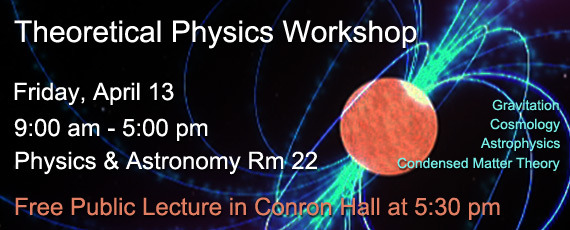
Theoretical Physics Workshop – Friday, April 13, 9am-5pm

A Theoretical Physics Workshop is being held all day Friday, April 13, 2012 in the Physics and Astronomy building.

Registration is at 9:00am in PAB 22. Talks begin at 9:30am.

Interested students who are not on the participants list are welcome to attend and listen to the talks.

[Workshop web site]

Note that immediately after the workshop there will be a free public lecture in Conron Hall (University College 224) at 5:30 pm.

The guest speaker is Dr. Frans Pretorius of Princeton University. The talk is titled “Black Holes and Gravitational Waves“.

Yoctogram Detected! #westernu

The world’s most sensitive scale has detected a yoctogram [10^-24 grams]. These aren’t ordinary scales, but actually nanotubes that vibrate at specific frequencies dependent on the mass of the particle/molecule.


Applications include diagnosing health conditions and distinguishing elements in chemical samples.


LINK: http://www.newscientist.com/article/dn21651-worlds-most-sensitive-scales-dete…