A bartender asked Rene Descartes if he would like another beer. He responded "I think not" Q: What did one quantum physicist say when he wanted to fight another quantum physicist? A: Let me atom. What was the name of the first satellite to orbit the Earth? The moon. Why did the chicken cross the road? Whether the chicken crossed the road or the road crossed the chicken depends on your frame of reference. Q: Why did the chicken cross the Mobius strip? A: To get to the same side.
Monthly Archives: April 2012
REMINDER: JOINT Phys&Astr / CPSX Seminar – TODAY (5th April) – DR. NIKKU MADHUSUDHAN, Yale
TODAY @ 1:30
JOINT SEMINAR—the Department of Physics and Astronomy and the Centre for Planetary Science and Exploration (CPSX)
Date: Thursday, 5th April 2012
Time: 1:30 p.m.
Location: Physics & Astronomy Seminar Room 22
Dr. Nikku Madhusudhan
Yale Center for Astronomy and Astrophysics
Yale University
“Chemical Characterization of Exoplanetary Atmospheres”
ABSTRACT
Recent advances in exoplanetary science are leading to unprecedented constraints on chemical compositions of exoplanetary atmospheres. Molecular and elemental abundances derived from exoplanetary spectra provide critical clues on the chemical and dynamical processes in exoplanetary atmospheres, on the compositions of their interiors and formation environments, and on the potential habitability of rocky exoplanets. In this talk, I will present emerging constraints on chemical abundances for an ensemble of exoplanetary atmospheres, and their implications for atmospheric processes, interiors, and formation conditions of exoplanets. Strong constraints are emerging on mixing ratios of carbon and oxygen based molecules and on the elemental C/H, O/H, and C/O ratios in giant exoplanetary atmospheres. In particular, the C/O ratio critically influences the H2O abundance, with major repercussions on atmospheric chemistry and thermal inversions, and on the compositions of ices and rocks in planetary interiors and protoplanetary formation zones. Some of the first constraints span C/O ratios of unity or higher, opening the exotic possibility of carbon-rich planets (CRPs). The properties and formation scenarios of CRPs will be discussed in this talk. Such compositional estimates of extrasolar planets open new research avenues at the intersections of geosciences, planetary science, and astronomy. I will discuss some frontier areas in this direction, along with an overview of observational campaigns, from ground and space, and theoretical and experimental efforts.
Coffee & cookies will be available, courtesy of PASA.
REMINDER: MSc Public Lecture – TODAY (4 April) @ 2p.m. – MISHA CHAVARHA
TODAY @ 2:00 p.m.
Department of Physics and Astronomy
MSc Public Lecture
Mykhaylo (Misha) Chavarha
Supervisor: Dr. Lyudmila Goncharova
“Defects and magnetism in SrTiO3 single crystals and ultra-thin films on Si”
DATE: WEDNESDAY, 4th April 2012
TIME: 1:30 p.m.2:00 p.m.
PLACE: Physics & Astronomy Room 22
All are welcome to attend.
Dirac fermions in Molecular graphene
You can read the paper on http://www.nature.com/nature/journal/v483/n7389/fig_tab/nature10941_F1.html
MENLO PARK, US: Researchers from Stanford University and the US Department of Energy’s SLAC National Accelerator Laboratory have created the first-ever system of ‘designer electrons’- exotic variants of ordinary electrons with tunable properties that may ultimately lead to new types of materials and devices.
“The behaviour of electrons in materials is at the heart of essentially all of today’s technologies. We’re now able to tune the fundamental properties of electrons so they behave in ways rarely seen in ordinary materials,” said Hari Manoharan, Associate Professor, Stanford University.
Their first examples, reported in Nature, were hand-crafted, honeycomb-shaped structures inspired by graphene, a pure form of carbon that has been widely heralded for its potential in future electronics. Initially, the electrons in this structure had graphene-like properties; for example, unlike ordinary electrons, they had no mass and traveled as if they were moving at the speed of light in a vacuum. But researchers were then able to tune these electrons in ways that are difficult to do in real graphene.
To make the structure, which Manoharan calls molecular graphene, the scientists use a scanning tunneling microscope to place individual carbon monoxide molecules on a perfectly smooth copper surface. The carbon monoxide repels the free-flowing electrons on the copper surface and forces them into a honeycomb pattern, where they behave like graphene electrons.
To tune the electrons’ properties, the researchers repositioned the carbon monoxide molecules on the surface; this changed the symmetry of the electron flow. In some configurations, electrons acted as if they had been exposed to a magnetic or electric field. In others, researchers were able to finely tune the density of electrons on the surface by introducing defects or impurities. By writing complex patterns that mimicked changes in carbon-carbon bond lengths and strengths in graphene, the researchers were able to restore the electrons’ mass in small, selected areas.
“One of the wildest things we did was to make the electrons think they are in a huge magnetic field when, in fact, no real field had been applied,” said Manoharan. The Stanford team calculated the positions where carbon atoms in graphene should be to make its electrons believe they were being exposed to magnetic fields ranging from zero to 60 Tesla, more than 30 per cent higher than the strongest continuous magnetic field ever achieved on Earth. The researchers then moved carbon monoxide molecules to steer the electrons into precisely those positions, and the electrons responded by behaving exactly as predicted, as if they had been exposed to a real field.
“Our new approach is a powerful new test bed for physics. Molecular graphene is just the first in a series of possible designer structures. We expect that our research will ultimately identify new nanoscale materials with useful electronic properties,” said Manoharan.
Stories on carbon-based nanomaterials – Researchers create piezoelectric graphene
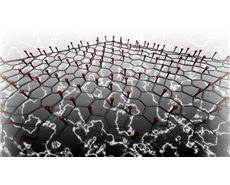
…The drill was using Li-doped Graphene or doping both sides of a Graphene layer with different atoms
http://www.worldofchemicals.com/media/academy/researchers-create-piezoelectri…
CALIFORNIA, US: Graphene, the most studied substance of the last decade, is one-hundred-times-better conductor of electricity than silicon. It is stronger than diamond. And, at just one atom thick, it is so thin as to be essentially a two-dimensional material. Yet, graphene is not piezoelectric. Piezoelectricity is the property of some materials to produce electric charge when bent, squeezed or twisted. Perhaps more importantly, piezoelectricity is reversible. When an electric field is applied, piezoelectric materials change shape, yielding a remarkable level of engineering control.
Piezoelectrics have found application in countless devices from watches, radios and ultrasound to the push-button starters on propane grills, but these uses all require relatively large, three-dimensional quantities of piezoelectric materials. In a paper published in the journal ACS Nano, two materials engineers at Stanford have described how they have engineered piezoelectrics into graphene, extending for the first time such fine physical control to the nanoscale.
“The physical deformations we can create are directly proportional to the electrical field applied. This represents a fundamentally new way to control electronics at the nanoscale. This phenomenon brings new dimension to the concept of ‘straintronics,’ because of the way the electrical field strains, the lattice of carbon, causing it to change shape in predictable ways,” said Evan Reed, Head of the Materials Computation and Theory Group, Stanford University.
“Piezoelectric graphene could provide an unparalleled degree of electrical, optical or mechanical control for applications ranging from touchscreens to nanoscale transistors,” said Mitchell Ong, Post-doctoral Scholar, Stanford University. Using a sophisticated modeling application running on high-performance supercomputers, the engineers simulated the deposition of atoms on one side of a graphene lattice, a process known as doping, and measured the piezoelectric effect.
They modeled graphene doped with lithium, hydrogen, potassium and fluorine, as well as combinations of hydrogen and fluorine and lithium and fluorine on either side of the lattice. Doping just one side of the graphene, or doping both sides with different atoms, is key to the process as it breaks graphene’s perfect physical symmetry, which otherwise cancels the piezoelectric effect.
“We thought the piezoelectric effect would be present, but relatively small. Yet, we were able to achieve piezoelectric levels comparable to traditional three-dimensional materials. It was pretty significant,” said Reed. The researchers were further able to fine tune the effect by pattern doping the graphene, selectively placing atoms in specific sections and not others. “We call it designer piezoelectricity because it allows us to strategically control where, when and how much the graphene is deformed by an applied electrical field with promising implications for engineering,” said Ong.
While the results in creating piezoelectric graphene are encouraging, the researchers believe that their technique might further be used to engineer piezoelectricity in nanotubes and other nanomaterials with applications ranging from electronics, photonics, and energy harvesting to chemical sensing and high-frequency acoustics. “We’re already looking at new piezoelectric devices based on other 2D and low-dimensional materials, hoping they might open new and dramatic possibilities in nanotechnology,” said Reed.
Reno Phase V no joke !
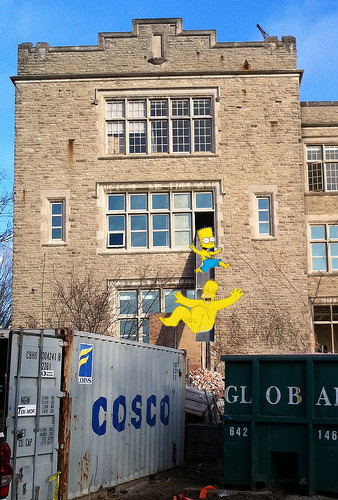
I thought that the posting I read this morning regarding the quick decision to proceed directly to Phase V of building renovations to be a joke.
That was until I saw the mass evictions taking place with my own eyes.
Shame on them!
Harper Government to Close Only High Arctic Ozone Monitoring Site @saveEC #AprilFool ?
The Harper Government is proceeding with its plan to close Canada’s only high Arctic research station for atmospheric measurements including ozone. In last week’s budget they (re) announced that one of these days they would be building a new facility. Unfortunately they have insisted on building it so far south it would have likely be unable to monitor events like last winter’s Arctic Ozone Hole. No plans for filling in the data record for the years until the new facility is available were given, nor what expertise would remain of the current generation of young Canadian atmospheric scientists to operate it.
OK, I’ve been April Fooling you all morning. But it’s afternoon now and THIS IS REAL! For further information or to help out please go to the CANDAC website or Save Environment Canada websites.
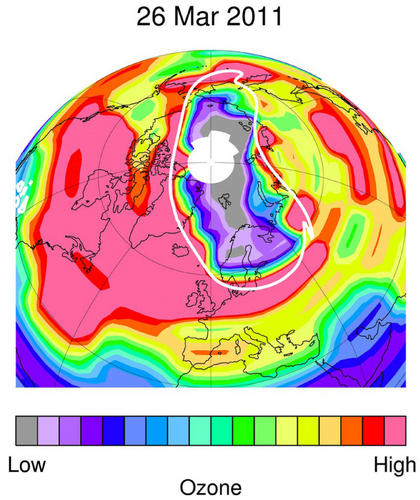
Image from the article Record Ozone Loss Over the Arctic in the Toronto Star.
2012 Budget Requires Canadian Scientists to Use Government Approved List of Physical Constants. #NRC #cdnpoli
There were almost no big surprises in the new federal budget. For science, (as discussed on this blog by Prof. Chronik) most of the changes were given earlier in the Jenkins report and concerned changes in research/industrial partnerships between NRC and the private sector. But no one reading the tea leaves was prepared for what was apparently a last minute addition by scientific policy advisors to Chapter 3, Supporting Jobs and Growth.
The Government requires all scientists, engineers and astrologers receiving federal funding to immediately use the following constants.
- the value of pi shall now be 22/7
- the following constants shall be increased by a surtax of 5%: the speed of light, the universal gas constant, Avogadro’s Number and the Love Number
- conversions from the metric to English system will now be tied to the Canadian dollar
- the Froude number may not be publicly displayed in any Federal building
- the value of the Hubble constant shall be revised to reflect the correct age of the Universe, 6000 years.
- the federal government is responsible for funding research which uses constants for the determination of irradiance, the provinces are responsible for funding research which includes determination of radiance.
- the provinces are responsible for funding any research involving the following constants: Loschmidt Number, Stefan-Boltzmann radiation constant, Rydberg constant and acceleration due to gravity.
- introduction of Stockwell’s number (number of unreported crimes occurring per minute in Canada).

Imagine from the University of Bergen’s Department of Mathematics website.
@cern to relocate #LHC to atrium of Physics & Astronomy Bldg @westernu
It started with some ideas for a few hands-on exhibits, grew to a small Foucault pendulum and then the Chair of the Department of Physics, Astronomy and Enology at Occidental Université (formally the Easterly University of Northerly Ontario), Prof. S. Basu said enough is enough. “If we keep thinking small we will stay small” he told a group of reporters anxious for the 411 on this latest coup for Occidental.
Prof. Basu called CERN director general Rolf-Dieter Heuer and laid it on the line: give us the Large Hadron Collider. “I told him we have a world-class building with the latest renovations and due to the topology of the landscape we are built on neutrinos should be moving at least at 2c as they whiz through our building. He said deal and we’re in the process of making a few tweaks in the atrium design to accommodate the main storage ring.”
The Large Hadron Collider (LHC) currently sits in a circular tunnel 27 km in circumference. The tunnel is buried around 50 to 175 m underground and straddles the border between Switzerland and France. How will the atrium accommodate it, Basu was asked. “The Euros goofed when they designed LHC and they knew it. Special relativity tells that though we see the ring having a circumference of 27 km the particles in the ring, moving near the speed of light, see the tunnel as having a circumference about the diameter of our atrium. So there is no need for such a huge tunnel, it was a political move so the French would pony up big bucks.”
Basu went on to discuss how the Department would produce twin particles, of which one particle would stay in the centre of the ring and the other could be accelerated by a student around the ring a few times and come back 100 years older than its twin and with a long grey beard. The installation is expected to come online when the building renovations are finished in 2525 (“if Man is still alive”).
Below: Director General of Cern Rolf-Dieter Heuer with Prof. Basu at the announcement.
UWO Prof Uses His Meteorology Skills to Solve Campus Fainting Mystery #westernu
Easterly University of Northerly Ontario (formally Westward University of Southward Ontario) Professor of Lidarology R. J. Sica was called in by the Provost who had a most unusual problem. “We don’t understand it, but this winter students have been dropping like flies on campus during the day, particularly during the 10 min periods between class changes. Since your Department has all the brains in this place we thought you could solve the mystery.”
Prof. Sica replied he would get to the bottom of it, because frankly he really had nothing else to do in his cushy position except for occasionally diving out of the wall of falling valances. Here is part of the Executive Summary of his final report, which you can view in its entirety here.
Students were observed moving between classes. I notice a large fraction of one of the genders had Canada Goose South Pole Expedition parkas on. Having lived in interior Alaska for several long, cold, dark winters, I knew that these coats were typically uncomfortably warm in Fairbanks during January, when the average temperature was –25C. This winter the temperature seldom got down to +5C. However, as I watched the weak collapse in the herd of students leaving Nat Sci 145 I observed that not all the students in the parkas dropped. I had to be missing something. Then it came to me. The parkas were generating an additional 1000 W of body heat, but when worn with heels the excess heat could dump to the ground through the feet. The students who dropped were all wearing Uggs with the coats. The combination of the Canada Goose Expedition Parkas, Uggs and balmy temperatures were the perfect negative storm, producing temperatures equivalent to solar chromosphere near the body of the wearer.
These results were verified by Crow Emily, shown here standing barefoot in the Eureka, NWT as part of a 30 min experiment to determine if she would get cold or not. Funny, I haven’t heard anything back from her yet?