The photographer Laurent Laveder is literally playing with the moon in these fantastic Moon Games photos.


The photographer Laurent Laveder is literally playing with the moon in these fantastic Moon Games photos.
Planning to go stargazing? Get this meteor app on your iPhone and help research!
http://science.nasa.gov/science-news/science-at-nasa/2011/13dec_meteorcounter/
Just a REMINDER that the last day for theWestern Cares Food Drive isTOMORROW.
If you’re able to bring in any non-perishable items, they would be very gratefully accepted. We have a collection box in the Physics & Astronomy Main Office.
Thank you very much!
Jodi
A good video for anyone (Like me) who needs a little refresher on what the Higg’s Boson is. Especially useful in light of the recent info coming from CERN. This video is presented by Fermilab scientist Don Lincoln.
[youtube http://www.youtube.com/watch?v=RIg1Vh7uPyw?wmode=transparent]
(PhysOrg.com) — Researchers have set a new world record for data transfer, helping to usher in the next generation of high-speed network technology. At the SuperComputing 2011 (SC11) conference in Seattle during mid-November, the international team transferred data in opposite directions at a combined rate of 186 gigabits per second (Gbps) in a wide-area network circuit. The rate is equivalent to moving two million gigabytes per day, fast enough to transfer nearly 100,000 full Blu-ray disks—each with a complete movie and all the extras—in a day.
The team of high-energy physicists, computer scientists, and network engineers was led by the California Institute of Technology (Caltech), the University of Victoria, the University of Michigan, the European Center for Nuclear Research (CERN), Florida International University, and other partners.
According to the researchers, the achievement will help establish new ways to transport the increasingly large quantities of data that traverse continents and oceans via global networks of optical fibers. These new methods are needed for the next generation of network technology—which allows transfer rates of 40 and 100 Gbps—that will be built in the next couple of years.
“Our group and its partners are showing how massive amounts of data will be handled and transported in the future,” says Harvey Newman, professor of physics and head of the high-energy physics (HEP) team. “Having these tools in our hands allows us to engage in realizable visions others do not have. We can see a clear path to a future others cannot yet imagine with any confidence.”
Using a 100-Gbps circuit set up by Canada’s Advanced Research and Innovation Network (CANARIE) and BCNET, a non-profit, shared IT services organization, the team was able to reach transfer rates of 98 Gbps between the University of Victoria Computing Centre located in Victoria, British Columbia, and the Washington State Convention Centre in Seattle. With a simultaneous data rate of 88 Gbps in the opposite direction, the team reached a sustained two-way data rate of 186 Gbps between two data centers, breaking the team’s previous peak-rate record of 119 Gbps set in 2009.
In addition, partners from the University of Florida, the University of California at San Diego, Vanderbilt University, Brazil (Rio de Janeiro State University and the São Paulo State University), and Korea (Kyungpook National University and the Korean Institute for Science and Technology Information) helped with a larger demonstration, transferring massive amounts of data between the Caltech booth at the SC11 conference and other locations within the United States, as well as in Brazil and Korea.
The fast transfer rate is also crucial for dealing with the tremendous amounts of data coming from the Large Hadron Collider (LHC) at CERN, the particle accelerator that physicists hope will help them discover new particles and better understand the nature of matter, and space and time, solving some of the biggest mysteries of the universe. More than 100 petabytes (more than four million Blu-ray disks) of data have been processed, distributed, and analyzed using a global grid of 300 computing and storage facilities located at laboratories and universities around the world, and the data volume is expected to rise a thousand-fold as physicists crank up the collision rates and energies at the LHC.
“Enabling scientists anywhere in the world to work on the LHC data is a key objective, bringing the best minds together to work on the mysteries of the universe,” says David Foster, the deputy IT department head at CERN.
“The 100-Gbps demonstration at SC11 is pushing the limits of network technology by showing that it is possible to transfer petascale particle physics data in a matter of hours to anywhere around the world,” adds Randall Sobie, a research scientist at the Institute of Particle Physics in Canada and team member.
The key to discovery, the researchers say, is in picking out the rare signals that may indicate new physics discoveries from a sea of potentially overwhelming background noise caused by already understood particle interactions. To do this, individual physicists and small groups located around the world must repeatedly access—and sometimes extract and transport—multiterabyte data sets on demand from petabyte data stores. That’s equivalent to grabbing hundreds of Blu-ray movies all at once from a pool of hundreds of thousands. The HEP team hopes that the demonstrations at SC11 will pave the way towards more effective distribution and use for discoveries of the masses of LHC data.
“By sharing our methods and tools with scientists in many fields, we hope that the research community will be well positioned to further enable their discoveries, taking full advantage of 100 Gbps networks as they become available,” Newman says. “In particular, we hope that these developments will afford physicists and young students the opportunity to participate directly in the LHC’s next round of discoveries as they emerge.”
http://www.guardian.co.uk/science/2011/dec/13/higgs-boson-seminar-god-particle
For anyone hoping to follow the information, this site is updated with the latest releases, and information regarding the Higgs Boson. Thought it might be worth checking out!
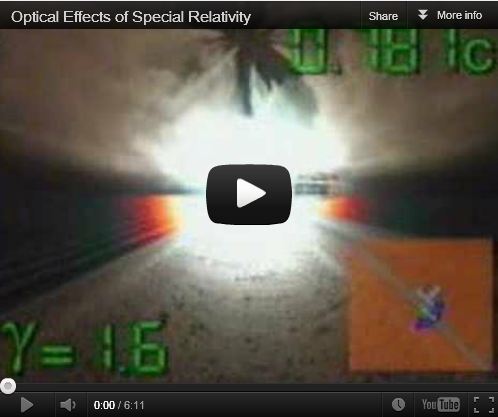
This truly awesome video has the answers to that question. It imagines a trip down a desert highway at speeds approaching light, and then shows all the weird and wonderful optical effects the theory of special relativity says we’d experience.
This video is the work of Antony Searle and Craig Savage, physicists at the Australian National University, as part of their Seeing Relativity project. They used to supercomputers to simulate what the world would look like if the speed of light was slowed down to just a meter per second, at which point we’d see relativistic effects as part of our everyday life.
All the major relativistic effects are covered in the video. First, objects will become distorted, as things appear to move further and further away even as we approach them, and objects to the side become twisted out of their normal shape. Then the Doppler effect kicks in, morphing the colors around us so that nearby objects are blue and faraway ones are red. And that’s still only the beginning of the full relativistic weirdness on display here.
Here’s a follow-up to Mel’s recent post about the Higgs boson. This morning the folks at CERN announced “hints” of the Higgs in their data at a mass of about 124 GeV/c^2. There are two different experiments looking for the Higgs, and they both see something at the same energy, which is very suggestive. Neither signal is above the 2-sigma level, however (i.e., 2 standard deviations above the background). I interpret this to mean they are 95% sure it’s there, which is pretty sure! The conventions of particle physics require a 5-sigma signal to make it a solid claim, though. 5-sigma would correspond to 99.99994% certainty, which as far as I am concerned is as sure as you are going to get about anything. Another year’s data collection should get them to that level.
Is this an exciting result? I have a bit of a prejudice here (and a lot of ignorance), so I’ll be provocative and say no, not really. The “Standard Model” predicted the existence of the Higgs. That model works pretty well, and it would have been much more of a surprise if the Higgs wasn’t there. In a sense all this result does is demonstrate that the model that everyone believed in is still right. On the other hand, a confirmation that the Standard Model still works tells us (them, actually; I have nothing to do with this field) that it is the right place to start from in exploring even higher energies, so it’s certainly helpful.
Ideally, you should go through your class notes every night and spend at least another two hours (per hour of class) solving problems. Realistically, you have a life; it’s not likely that you can devote that kind of time commitment to each course.
Keep good, organized notes
Write your notes out neatly, perhaps in a bound book (available at the book store for roughly $4) or type them up on your computer. Don’t just copy what the professor says; turn it into your own words so that next time you read over them you will understand concepts and steps quicker and better. Neat, good, organized notes are easier to understand than loose papers, especially if you only have half of those papers… Plus, you never know when they are going to come in handy!
Review your notes
Spend about 10 minutes per class hour each night reviewing what you covered in class earlier that day. This enables you to see the material again and become more familiar with it. If you didn’t understand a concept in class, go through it slower on your own and see if you can “decode” what your professor did in class. Don’t have time? Read them on the bus to/from school or while waiting for the bus. You would be amazed at how much time you waste on the bus and waiting for it–that’s how I read all 11 novels for my first year English class!
Ask questions
Don’t understand something? Ask questions!!! Ask your professor questions, your TA, other students in your class. Don’t be worried about “appearing stupid”; everyone has questions (except for perhaps Gauss). You’re in science. The whole point of science is to ask (and try to answer, through observation) questions about stuff we don’t know.
All of the above is great advice, but they are things you need to do throughout the school year, not suddenly at exam time. My advice for those exams that you really have to cram for:
Determine the exam content
You could always try the brute force method of simply asking your professor what is on the exam, but don’t be surprised if it doesn’t work. Think back to lectures and assignments. What did you spend a lot of time on? What did the professor emphasize? Chances are that will be tested.
Determine what kind of examiner your professor is
Think back to midterms and tests. Does your professor prefer to test your knowledge through derivations, problems, or conceptual questions? Will the test be long answer, multiple choice, or a combination?
Determine your weak points
Determine what you don’t know or understand too well. Determine what you need to know in order to understand the tougher/more advanced material. Focus on the more basic stuff first.
Acknowledge your strengths
So you understand a concept really well. Yes, it feels nice to finally be able to get the same answer as the back of the book or practice test solutions or to see how that derivation is “trivial”, but you understand that material; do a couple questions and move on. If later on during your study session you start to get discouraged, do another one of these problems to boost your confidence!
Make a “cheat sheet”
Even if you aren’t allowed to use it on the exam, make a “cheat sheet”. It is a good way to summarize concepts and equations that you need to know.
Reward yourself
Sit yourself down in an area with few to no distractions. Set a time that you are going to work until or a section that you are going to get through. If it is a time, set a timer and don’t look at your watch while studying. If it is a section/chapter, put a post-it note in your book at that spot. Before you begin studying, also set what you will get as your reward, such as two Mario Kart races, a walk around the block, preparing a snack while listening to your favourite song, whatever. I find the best breaks are relatively short (5-10 minutes) and do not involve brain power. When your break is done, acknowledge that it is done; sit yourself back down, set a new study goal, and another reward, then work for it.
Eat healthy–maybe even healthier than normal
Pick up carrots, celery, cucumber, apples, pineapple, watermelon, berries, broccoli, cauliflower, etc. to snack on, rather than junk food. I find I feel a lot better with veggies and fruit in my system. You also won’t run into a sugar crash.
Maintain your work-out schedule
Even though you are swamped with work, yes, you still have time to go to the gym for your daily swim. It is a good study break and healthy for you. If you don’t feel like you have time to head to the gym, then take a walk around your neighbourhood instead.
Avoid coffee and energy drinks
Okay, so the caffeine in coffee and energy drinks helps you stay awake so you can cram more information into your brain, but is it actually helping? Are you retaining that information? A good night’s rest followed by serious studying is more beneficial than spending the night hyped up on caffeine, watching three youtube videos for every two minutes of work, and being completely and utterly drained the next day.
Get a good night’s rest
While you are studying and especially the night before an exam, get a good night’s sleep. You will feel refreshed and your head will likely be clear and willing to accept more information.
Different things work for different people
My advice isn’t the only advice out there–I bet your parents, professors, TAs, and friends all have advice. I know Raffi has a Study Guide on PASA’s website at http://pasa-uwo.com/studytips.php. Try out different methods of studying and see what works best for you.
Good luck!!!
The Student Development Centre (SDC) at Western offers many useful learning skills services. One service that I found particularly helpful during my undergraduate carreer here was their free series of workshops including writing workshops, learning skills workshops, and psychological services workshops. The content covered in these workshops covers everything from strategies to write exams (particularly multiple choice exams), referencing your paper, writing in the sciences, and writing a thesis statement to managing and regulating your emotions and managing anxiety and stress (something I think all of us need a little help with during exam time).
There are also GradWRITE interactive workshops, where participants are encouraged to bring their own work in progress to get help with writing a literature review, creating an abstract, writing effective proposals, and polishing their writing.
The certificate part? Well, not only do these workshops help you in your studies, but if you attend four of them (between September and April of the same school year), the SDC will issue you a Certificate of Academic Engagement; a regonition to students who “make the effort to be their academic best”.
Find out more information about the Certificate of Academic Engagement, the workshops offered by the SDC, and other services offered by the SDC at: http://www.sdc.uwo.ca/learning/.