
Here’s a nice – and for once – well written article on meteorites, what there are, where they come from, and why we study them. The article begins by mentioning our very own Peter Brown’s most recent fireball discovery. Check out the article here: http://www.cbc.ca/news/technology/story/2011/12/14/f-faq-meteor.html#
Ultimate Death Wish: Comet Lovejoy will dive into the Sun today!
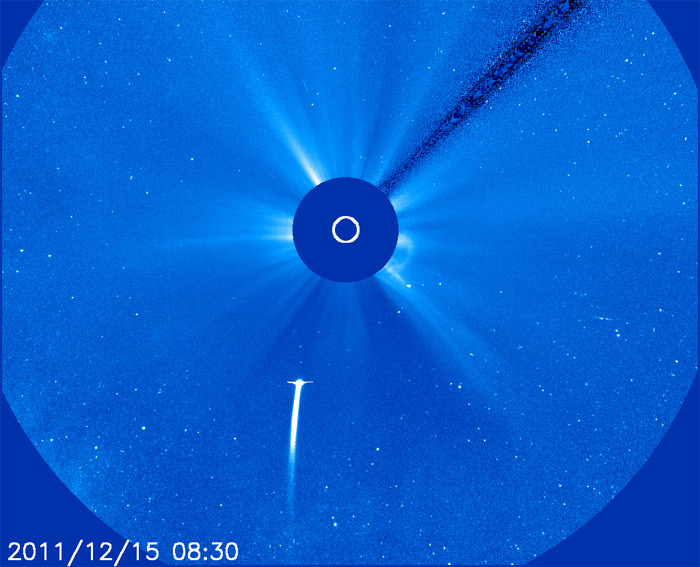
Comet Lovejoy is a Sun-razer, which was discovered by an Australian amateur astronomer Terry Lovejoy on 27th November 2011. Comet Lovejoy will make the closest approach to the Sun today at 7p.m. EST. It will narrowly miss the Sun by passing just ~140,000 kilometers from the Solar Photosphere. It will likely vaporize before narrowly missing the Sun.
Here is an article’s on Discovery!!!
Beauty of Lunar Eclipse captured!
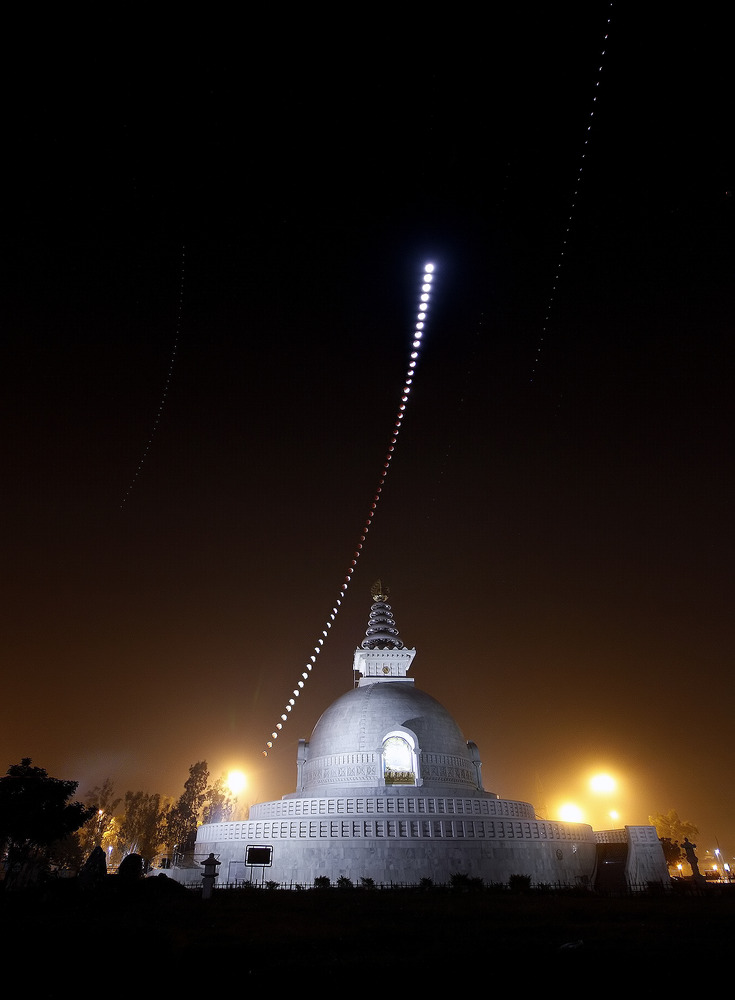
The Total Lunar Eclipse of 10th December 2011 is beautifully captured here in a superimposed image. This sequence of images was recorded by Chander Devgun at the Shanti Stupa Peace Pagota in New Delhi, India.
A beautiful view for those who missed it!
Here is it on the NASA’s Astronomy Picture of the Day website!
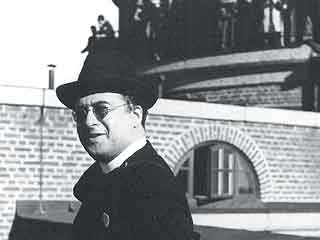
Georges Lemaître, (The Lesser Known) Father of the Big Bang!
When anyone talks about The Big Bang Cosmology or The Expanding Universe, the first name that comes to one’s mind is Edwin Hubble. He is called the Father of the Big Bang.
But the lesser known fact is that the idea of the expanding universe was first proposed by Georges Lemaitre in 1927.
Here is complete information about Georges Lemaitre and the idea of the Expanding Universe on the American Museum of Natural History website.
.
Is Asteroid Vesta the Smallest known Terrestrial Planet???
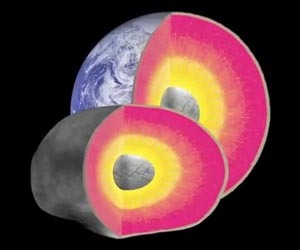
Asteroid Vesta is one of the handful of asteroids visited by a spacecraft. Asteroids are believed to be debris left over from the formation of our Solar System. Understanding these small bodies will help us understand the formation of the Solar System and the existence of greater terrestrial bodies. A spacecraft hovering near an asteroid yields a lot of information about the body like its mass and density. Some of the most useful information provided by the spacecraft are the spectacular photographs of the body which help us understand its history.
NASA’s Dawn Spacecraft was launched in 2007 to study the two largest bodies of the Asteroid Belt, Vesta and Ceres (the dwarf planet). The mission has provided us with a lot of information about Vesta and will fly by Ceres in 2015.
Impressive new information about Vesta was just released by NASA. The principal investigator Chris Russell in a recent interview said that Vesta resembles a terrestrial dwarf planet more than an asteroid. He suggests this is due to the fact that not only is the body differentiated (all terrestrial planets are differentiated), but it also contains an iron core and has surface features like that of the terrestrial planets.
Here is the link to the article from Space Daily for more information: http://www.spacedaily.com/reports/Is_Vesta_the_Smallest_Terrestrial_Planet_999.html
Undergrads/Grads: opportunities to work in the Arctic at #westernu #CANDAC @CREATEArcticSci
Opportunities are now available for undergraduate summer research experiences and graduate studies via the NSERC CREATE Training Program in Arctic Atmospheric Science (http://www.candac.ca/create). If you want to hear more about this you can contact Bob Sica (sicaATuwoDOTca) locally or check out the website.

Why you should learn Unix
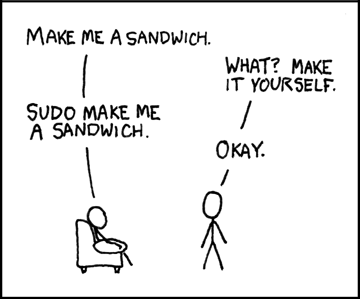
One of the first things that any undergraduate student starting astronomy research has to do is become familiar with the Unix environment. Most of the software used to analyze data is only available in Unix operating systems (this includes Linux and Mac OSX), and programming is much more efficient from the command line. But the real reason you should learn Unix is that this comic becomes really funny:
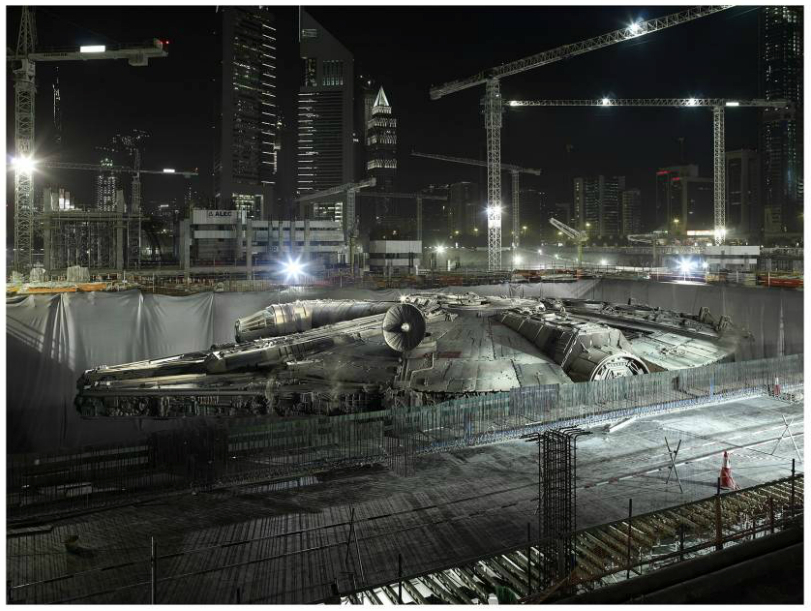
Who knew the Millenium Falcon was hidden in Dubai?
When PASA asked the Physics & Astronomy faculty as part of a series of questions: “Star Trek or Star Wars?”, I had to answer “Battlestar Galactica”. But “Star Wars” was one of the first movies I ever saw in a movie theatre, and so I will always think of it fondly (despite the terrible things George Lucas did to the franchise in later years). Here are some new tweaks on the Star Wars universe from the photographer Cédric Delsaux’s Dark Lensseries.
Selwyn, Ontario fireball official press release
FOR IMMEDIATE RELEASE
THE UNIVERSITY OF WESTERN ONTARIO
DECEMBER 14, 2011
Western astronomers capture rare meteor footage in the sky east of Toronto
Astronomers from The University of Western Ontario have released footage of a meteor, which was captured by its highly advanced video surveillance system, traveling through the evening sky east of Toronto on Monday evening (December 12, 2011).
Although this bright fireball occurred near the peak of the annual Geminid meteor shower, it is unrelated to the shower.
At 6:04 p.m., six cameras of Western’s Southern Ontario Meteor Network recorded a slow-moving fireball, estimated no bigger than a basketball, which first entered the atmosphere at a shallow angle of 25 degrees from the horizontal moving at 14 km per second. It first became visible over Lake Erie then moved toward the north-northeast ending at an altitude of 31 km just south of the town of Selwyn, Ontario. It is likely to have dropped small meteorites in a region to the East of Selwyn near the eastern end of Upper Stony Lake.
The video data suggest an end mass that may total as much as a few kilograms, likely in the form of many fragments in one gram to hundreds of a gram size range.
“Finding a meteorite from a fireball captured by video is equivalent to a planetary sample return mission,” says Peter Brown, the Director of Western’s Centre for Planetary & Space Exploration. “We know where the object comes from in our solar system and can study it in the lab. Only about a dozen previous meteorite falls have had their orbits measured by cameras so each new event adds significantly to our understanding of the small bodies in the solar system. In essence, each new recovered meteorite is adding to our understanding of the formation and evolution of our own solar system.”
Researchers at Western and the Royal Ontario Museum are interested in hearing from anyone who may have witnessed or recorded this evening event, or who may have found fragments of the freshly fallen meteorite.
For assistance with possible meteorites, please contact Kimberly Tait at 416-586-5820 or ktait@rom.on.ca
To arrange interviews with Peter Brown, please contact Jeff Renaud at 519-661-2111, ext 85165 or jrenaud9@uwo.ca
For videos, please visit http://meteor.uwo.ca/research/fireball/events/selwyn/videos.html
For an overview, images and a map, please visit http://meteor.uwo.ca/research/fireball/events/selwyn/overview.html
Biggest black holes yet
It appears that every massive galaxy hosts a supermassive black hole in its centre. A recent article in the journal Nature described the discovery of black holes as massive as 10 billion Suns. Even by supermassive black hole standards, that’s pretty big. For some perspective, the black hole in the centre of our Galaxy is about 4 million times the mass of the Sun (or about a 2500 times smaller). Is there some upper limit to the mass of black holes? Probably, because they only seem to grow to be a fixed fraction (about 0.3%) of the mass of the galaxies they live in. We’re still working on figuring out how black holes and their host galaxies can grow in tandem.
Here is the orginal Nature article, and a discussion of the result in the New York Times.
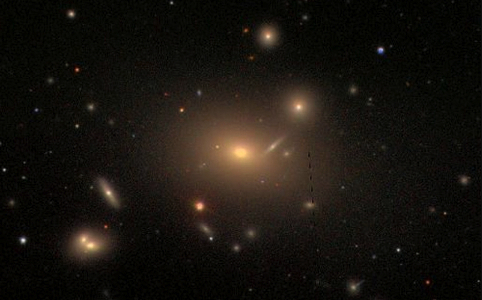
This is an optical image of NGC 4889, an elliptical galaxy that hosts one of the big black holes profiled in the article.