All posts by John de Bruyn

doing the rounds locally

Normal 0 false false false MicrosoftInternetExplorer4

Hong Kong has six universities. I was surprised to learn that all of them are English-language universities, since while most educated people here speak at least some English, the lingua franca is certainly Cantonese. I am working at City University, which is in Kowloon, a few kilometers north of the main commercial/tourist area (although, to be honest, all of urban Hong Kong is commercial). Last week I visited Chinese University (CUHK), which is located about four subway stops north-westish of City U. The physics department there has the reputation of being the best among those at the six local universities, and in fact it has two Nobel Prizewinners associated with it – 1957 Laureate C. N. Yang, of Yang-Mills theory, is a “Distinguished Professor-at-Large,” and Charles Kao, who won in 2009 for the development of fiber optics, was a professor at CUHK for a while, and later the president of the university. Leo Lau, who spent some time at Western, was Chair of the physics department there, and later Dean of Science.

I didn’t know anyone there, however, so I resorted to perusing their web pages. I was pleased to find a prof there named Lei Xu, whose research interests were very similar to mine. I emailed him and politely invited myself for a visit. I spent a morning talking to him, looking around his lab(s), learning about his research and telling him about mine. I learned some useful things, which I’ll get a grad student to think about when I get home! I then went for lunch with several members of the department and a rather overwhelmed-looking young fellow who, it turned out, was there for a job interview.

There are other people in the department that I should also talk too, but they were busy with the job candidate the day I visited. It’s easy for me to go there again before I come home, though.

As an aside, I was interested to see a large statue of the “Goddess of Democracy,” who was made famous at Tienanmin Square twenty-three years ago, standing outside the University subway station. A sign next to it documented the problems experienced by this poor statue. Apparently she was a bit too controversial, and no-one, including the current University president, wanted to upset the Beijing government by hosting the statue. Eventually – with large support from the CUHK students and faculty, if not the senior administration – she was placed at the train station, where she is an impressive sight. 

Writing about writing

As a physics professor I write a lot, and I also spend a lot of time editing other people’s writing. In fact, I would say that writing is probably the most important part of my job. Of course I have to be good at physics, and I have to have good ideas, and I have to keep beating on my students – pardon me, I mean constructively encouraging my students – to get things done, but none of this would get me anywhere if I couldn’t write about it. I think it’s also true that writing is an extremely important part of many other jobs that our students could find themselves in after leaving school – almost everyone has to write a report to their boss at some point. 

On the way to getting this job, I had to write a couple of theses, which are essentially full-length books about the research I did as a student. I need money to pay my students and to run my research operation, and to get money I need to write grant proposals. While the ideas and so on are very important, if I can’t express those ideas clearly in the written proposal, I shouldn’t expect to get funded. Once the research is done, I have to tell the world about it, and I do this by writing papers. It is a lot easier to get a paper published if it is well-written, and, more importantly, it is a lot easier for other scientists to read and understand a paper that is well-written. Since my ultimate success as a physics researcher depends on how other people regard my research, I am not going to be successful if I am unable to get people to read about my work.

My students have to write, too, and since I want my students to succeed, I try very hard to ensure that what they write is of high quality. This is sometimes very hard. I have had students who write very well, but I have also had students whose writing was awful. Sometimes language is an issue – it is obviously very difficult for someone to write a 300-page PhD thesis in their second language – but often there are problems that go beyond language. I have had students who were native speakers but had essentially no idea how to string sentences together to tell a coherent story. I had a student from China whose English writing was grammatically and structurally fine, but completely disorganized. That student told me that she was a poor writer even in her own language.

There are several aspects to writing. The first has nothing to do with the actual words: it is the ability to get the content right. On a large scale, this involves deciding what you want to say, what ideas you want to convey, essentially what the story is that you want to tell. On a smaller scale, you need to figure out what level of detail is appropriate, and you have to organize what you want to say: you need to decide in what order to present things so as to produce a clear and logical storyline. These are hard things to do, especially for one who has not done a lot of serious technical writing. One you know what you want to say, you need to write it down. Here you have to worry about the mechanics of writing – sentences and paragraphs, spelling and punctuation. This seems to be hard for some people, too, despite that fact that in this case there are usually rules that can be learned and, one hopes, followed. A third aspect involves getting the right style – a physics journal paper would be written in a very different style from a letter to your mom. In my view, the first aspect is by far the most important. It is relatively easy to edit a well-organized draft for grammar, punctuation, and even style, but it’s a lot harder to deal with a piece of writing that is poorly organized, is missing important information, or wanders through the subject matter like the random walks I talked about in my last post. 

I think it’s essential that our students learn how to write properly. I’m less certain how to achieve this. Certainly practice is essential, and for that reason I always assign essays or written projects in my third- and fourth-year courses and grad courses. But students need to get feedback on their writing if they are going to become good at it, and they don’t really get that until they start working on their honors thesis. Western has courses on technical writing, but there really isn’t any space in our modules for them. I’ve thought about teaching students to write in our seminar course, but it’s hard to make students do much work in a zero-credit course.

I’ll have more to say about this subject in future posts.

How I spent my year’s leave, part 4: random walks in Hong Kong

While in Hong Kong, I have been working with Jonathan Wylie on the theory of diffusion with “traps”. This is related to some of my experiments, and what we are aiming for is a way to extract some new physical information from our experimental measurements. The experiments involve measuring the diffusion of little tracer particles suspended in a complex fluids. For simple Brownian motion, the mean squared displacement increases linearly with time. In many complex fluids, we see something rather different: At very short times, the mean squared displacement increases linearly. Then over some intermediate time range, the mean squared displacement flattens out into a plateau. At longer times, it grows linearly again, but with a lower diffusion constant than at short times. The plateau occurs because the tracers get trapped by the microstructure of the complex fluid. However over longer times, the microstructure evolves and the particles can escape from the traps and diffuse freely again. The calculations we are doing – actually it’s mostly Jonathan so far – involve using the formal theory of random walks to figure out the distribution of distances traveled by the tracers in the presence of traps. The particles diffuse freely until they hit a trap, then they are held in the trap for a time drawn from a particular distribution, then they diffuse again. Parts of the calculation are straightforward, if you know about random walk theory. But parts are what you might call interesting. I have had to refresh my memory about Green functions, which caused me nightmares when I was a student and played a significant role in my decision to become an experimentalist. We have also run across one of those pathological cases that mathematicians warn us about, but which never happen in real life – we get an expression involving an integral over an infinite sum, and it turns out that you cannot interchange the order of the sum and the integral. All good stuff. The idea is that this will model our experimental data, and the ratio of the diffusion constants we find at short and long times will depend on the time the particles spend in the traps.

educational milk

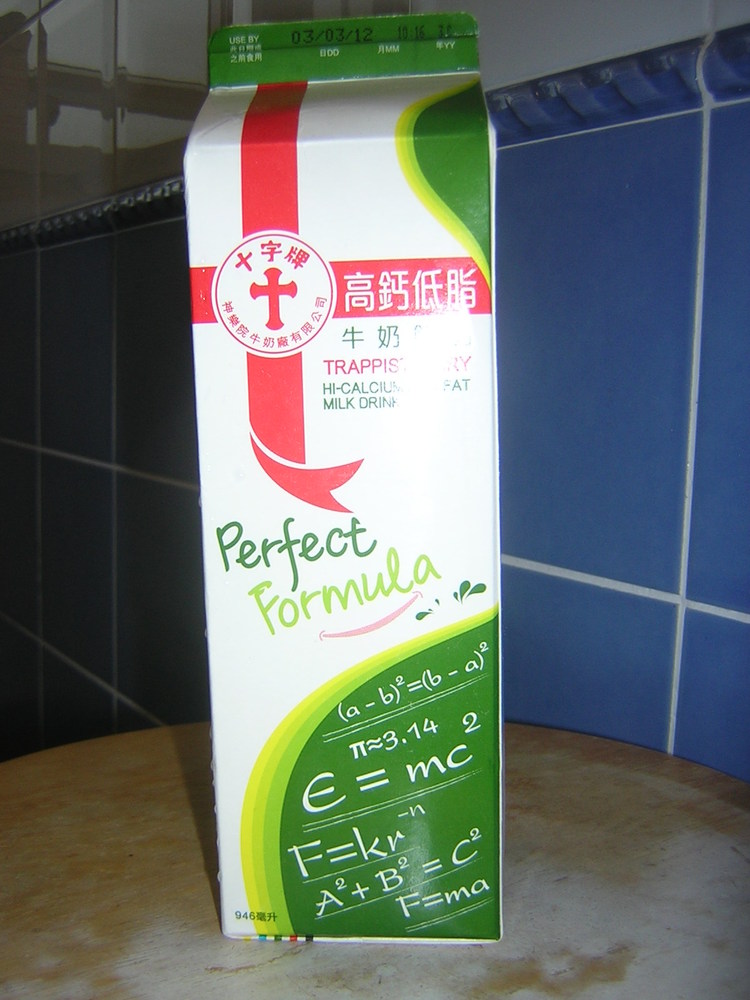
Here is a photo of a carton of “Perfect Formula” milk, which is produced by some physics-friendly cows in Hong Kong.

My favorite is the inverse-power force law. The other formulae are fairly “standard”, but seeing the inverse power law on this carton suggests to me that the designer might actually have taken a physics course at some time. And the milk is good, too!

something to be aware of at NSERC

from the nserc newsletter:

Evaluation planned for Discovery Grants Program

Planning for the formal evaluation of the Discovery Grants Program is currently under way. NSERC will conduct the evaluation in 2013, drawing on multiple sources of information. Those will include surveys of applicants, scientific societies and institutions, with the goal of assessing the continuing performance and delivery of the program. Details about the research community’s participation in the evaluation process will be provided as they become available.

neutrinos not so fast after all

http://news.sciencemag.org/scienceinsider/2012/02/breaking-news-error-undoes-faster.html


BREAKING NEWS: Error Undoes Faster-Than-Light Neutrino Results


It appears that the faster-than-light neutrino results, announced last September by the OPERA collaboration in Italy, was due to a mistake after all. A bad connection between a GPS unit and a computer may be to blame.


Physicists had detected neutrinos travelling from the CERN laboratory in Geneva to the Gran Sasso laboratory near L’Aquila that appeared to make the trip in about 60 nanoseconds less than light speed. Many other physicists suspected that the result was due to some kind of error, given that it seems at odds with Einstein’s special theory of relativity, which says nothing can travel faster than the speed of light. That theory has been vindicated by many experiments over the decades.


According to sources familiar with the experiment, the 60 nanoseconds discrepancy appears to come from a bad connection between a fiber optic cable that connects to the GPS receiver used to correct the timing of the neutrinos’ flight and an electronic card in a computer. After tightening the connection and then measuring the time it takes data to travel the length of the fiber, researchers found that the data arrive 60 nanoseconds earlier than assumed. Since this time is subtracted from the overall time of flight, it appears to explain the early arrival of the neutrinos. New data, however, will be needed to confirm this hypothesis.

the social side of science

A couple of years ago Paul Corkum, one of Canada’s outstanding physicists, was given an honorary degree by Western. In his address to convocation, he talked about the social aspects of being a scientist. For example, he said that when he was young, he imagined that a scientist would spend his life working alone in a lab, when in reality all of his work is done in collaboration: with students, technicians, colleagues…. He also talked about the fact that he spent a lot of time traveling the world to talk about his research with others. His comments have come back to me this year, as I have been doing a lot of traveling and collaborating myself!

The stereotyped image of the scientist, with lab coat and unruly hairdo, closeted alone in a windowless basement lab, emerging only for injections of caffeine or to catch the last bus home at 2 AM is very far from reality. Wait – let me correct that statement. It was actually fairly close to reality for me when I was a grad student, but it’s certainly not true now.  For a fair chunk of my grad student career I indeed worked in a windowless basement lab, wore a lab coat, and was addicted to caffeine. I often worked until 2 AM, partly because there wasn’t anyone around at that time to distract me with invitations to go for coffee. I even had unruly hair, although not a lot of it by then. However even then my science was far from being a solitary pursuit. There were several other grad students captive in the same lab, and we talked a lot and learned much from each other. I am still close friends with many of them. There were postdocs around (even at 2 AM), and even my supervisor dropped in now and then to chat. I spent a lot of time in the machine shop, where I gossiped with and learned from the technicians and other students. I also went to conferences, in Canada and internationally, where I was thrilled to learn that there were at least a few other people in the world who were interested in my little esoteric corner of physics.

And nowadays? No lab coat, no hair, and my lab has windows. I haven’t been able to drink caffeine for a long time; the result of overindulgence when I was young. I leave the office at 5:30 and although I often work at home in the evenings, it is rare that I stay up past 10 PM. But my work is even more social than ever. I have lots of collaborators, and I probably wouldn’t get any science at all done without them. I love talking to and working with students; they are the part of the job I enjoy the most. I have long-time friends who have become scientific collaborators, and collaborators who have become friends, all over the world. I go to two or three conferences a year, in various exotic (Cyprus, Rio) or not so exotic (Cleveland, Calgary) places, where I see friends and colleagues and talk about my research and theirs. I am continually in e-communication with colleagues, collaborators, current and former students.  I am fortunate to be able to spend part of this year visiting, and working with, colleagues around the world.  I believe that science is truly a social endeavor.

bean-counting 2.0

You may not be aware of it, but NSERC is currently in the middle of an important exercise which may ultimately lead to a redistribution of their grant funds among disciplines. A group called the Council of Canadian Academies is conducting an assessment of “performance indicators for basic research.” While the wording on the NSERC web page that explains this assessment is not exactly easy to parse, my interpretation of it is that NSERC wants to know what tools they can use to quantitatively assess the bang they are getting for their buck in the different fields that they fund. The implication is that they will use whatever tools they come up as a result of this assessment to carry out a reallocation of funds among the disciplines.

Now, we are all scared of changes at NSERC, but this is not necessarily a bad thing. For one thing, I was intimately involved in NSERC’s last reallocation process, and even though condensed matter physics came out very much ahead of the curve in that exercise, I can assure you that the process was severely flawed. And there is nothing wrong with a government wanting to spend its money in the most cost-effective way. Besides, we all know that our work is so much better and more important than everyone else’s, so it is self-evident that any measure of the value of our work relative to anyone else’s will have to work in our favor, right? Sorry, but “self-evident” won’t cut it. NSERC is looking for “scientific” ways of measuring the relative value of, say, Astronomy vs. Chemical Engineering.

How might this work? First, how do we gauge the impact of one individual’s research? We all know that we shouldn’t just count papers when we looks at someone’s CV, but we all do it anyway. However it is easy for someone to publish a lot of mediocre papers, or a lot of papers on a subject that no-one else is interested in, so while the number of papers alone might be taken as some sort of measure of an individual’s productivity, it is not a useful measure of the quality or the impact of the product. 

The h-index has become a popular measure of an individual’s impact. In case you don’t know, your h-index is X if you have X papers that have been cited at least X times (Hirsch, PNAS 102, 16569 (2005)). For example, my h-index is 21, meaning that 21 of my publications have been cited 21 or more times. My other 60-odd papers have been cited fewer than 21 times, including a disturbing number – some of which I think are actually quite good – that have never been cited at all.  In my field, an h-index of 20-ish is reasonable at my career stage – probably above average, but certainly not at the top of the heap. And, yeah, that sounds about right to me as a measure of my impact in the field. One of the problems with the h-index, though, is that it is very discipline-dependent. In Mathematics, for example, a typical paper might have a bibliography containing four references, whereas mine usually have forty! I found some data in a preprint posted on arXiv (Iglesias and Pecharroman, arxiv.org/ftp/physics/papers/0607/0607224.pdf) indicating that on average, a paper is cited about 7.2 times per year in physics, compared to 4.3 times in materials science, 2.6 times in mathematics, and 24.6 times in molecular biology (sorry, no data for astronomy). One can infer from this that an h-index of 21 would be world-class in math, and laughable in genetics. In fact, the paper by Iglesias and Pecharroman is about a normalized index which takes these disciplinary variations into account.

 On a grander scale, how do we gauge the impact of an entire field of research within a given country? This is really what NSERC wants to know. There are people who spend a lot of time thinking about this, and a number of quantitative indices have been developed. For example, one can take the citations received per year by all the papers published by Canadian physicists, and divide it by the world average citations per year in the same field. If the resulting number is bigger than 1, then Canadian papers are cited more frequently than the world average in this field. There are also measures based on the impact factor (number of citations/number of papers published) of the journals in which the papers are published – so if everyone in a certain country publishes in rinky-dink journals, that country gets a low score, while if everyone publishes in Nature, they get a high score.  You can get some information about this field (called bibliometrics) at www.science-metrix.com, which is the web site of a company that does this stuff in a very serious way.

I understand NSERC’s desire to get some intelligent guidance as to where they should put their money, and I am sure that NSERC plans to rely on more than just a set of numbers to inform any decisions they make about reallocation. I am also all for an informed, scientific approach to just about anything. I confess, however, that I am a bit leery of such a quantification of the research enterprise.  The fact is that numbers tend to dominate the way we think about such things, and any other available information becomes secondary. It is much easier to make a decision based on whether a particular number is above or below some criterion, than it is to carefully weigh a large amount of qualitative and disparate information.  Besides, even if these bibliometric indicators are robust and reliable (which they probably are, since they involve a lot of averaging), reducing the combined efforts of hundreds of smart, creative, hardworking people down to a single number seems to me somewhat insulting. 

How I spent my year’s leave, part 3: getting settled in Hong Kong


Well, here I am in Hong Kong. I am living here for two months, working in the Department of Mathematics at the City University of Hong Kong. My host here is Jonathan Wylie, who, as you no doubt recall, gave a colloquium in our department at Western a couple of years ago. I’ve known Jonathan for several years, and our research areas have intertwined several times, so I am looking forward to working with him for a while. I will have to pretend to be a theorist – perhaps even a mathematician – for a while, but I can probably handle that.  


Hong Kong, like New York, is a city that never sleeps. I now understand why: we are staying in an apartment in the university residences, and the mattresses are about as soft as a slab of concrete. Apparently this is the local standard. I suppose it encourages people to get up and do something constructive rather than spend a little while longer snuggled under the covers.  


The food here is great, of course, and usually cheap. There are lots of neighborhoods full of bustling markets and streets lined with restaurants where not a word of English is spoken (or written on the menus!). Last night we walked into a randomly chosen restaurant where, after some gesticulation, we feasted on fresh-out-of-the-tank seafood. We blew the budget, coming in at about 13 Canadian dollars each, including beer and tip.


I was surprised to learn that there is a lot of Hong Kong that is not crowded and in fact not even urban. Last weekend, Jonathan took us for hike in a nice woodsy park just outside of the city, where we hiked for a couple of hours. About 40% of Hong Kong is national parkland. We intend to explore this aspect of the territory more fully!


I suppose I should insert a bit of physics into this post. On my first day here I ran into Igor Bello, who has oscillated between City U and Surface Science Western a few times. Yesterday he gave me a tour of some of the Physics Department’s research labs. I was quite impressed. At a university that is extremely cramped for space (it’s surrounded by residential neighborhoods and a shopping mall, and has essentially no vacant land left to build on), one physics prof has 6000 square feet of lab space. He uses plasmas to modify the surface properties of materials to reduce corrosion, to make them harder, and so on. He has a lot of industrial contracts, and also does a lot of biomedical research. For example, he and his collaborators have developed a spinal implant to fixes spinal curvature; the plasma treatment makes the metal implant more biocompatible.  Igor himself has quite an empire devoted to surface science and making super-hard materials. (Did you know that diamond could be made with a cubic crystal lattice? hexagonal? It was certainly news to me!) I also saw a lab where they made organic LEDs which they were developing for use as room lighting. All of this was very impressive. In each case, the government had invested millions of dollars (C$ – that’s tens of millions of HK$) in equipment and lab space, as well as in the large number of grad students and postdocs I saw in each of these labs. I was left wondering if labs like this could even exist in a Canadian physics department.