I’m not a mathemagician, and I have no idea how the Banach-Tarski paradox works, but this is nonetheless a very amusing video:
http://boingboing.net/2012/01/04/banach-tarski-fun-with-some.html

I’m not a mathemagician, and I have no idea how the Banach-Tarski paradox works, but this is nonetheless a very amusing video:
http://boingboing.net/2012/01/04/banach-tarski-fun-with-some.html
One of the highlights of my trip to Brazil was a visit to Manaus, on the Amazon River. My wife and I took a one-day tour on the river and in the rainforest, during which we saw, among other things, sloths, monkeys, an anaconda, caimans, piraracu (the worlds largest freshwater fish) and went fishing for piranha. The physics highlight is shown in the picture. This is the “meeting of the waters,” where the Rio Negro and the Rio Solimoes join to form the Amazon. The water in the Negro is almost black (hence the name), warm (about 26 degrees) and has a current of about 2 km/hr. The Solimoes is brown from the large amount of sediment it carries, cooler (22 degrees) and faster (6 km/hr). When the rivers meet, the boundary between them is very distinct, and when we stuck our hands in the water while the boat drove across the boundary, the temperature difference was very sudden and easy to feel.
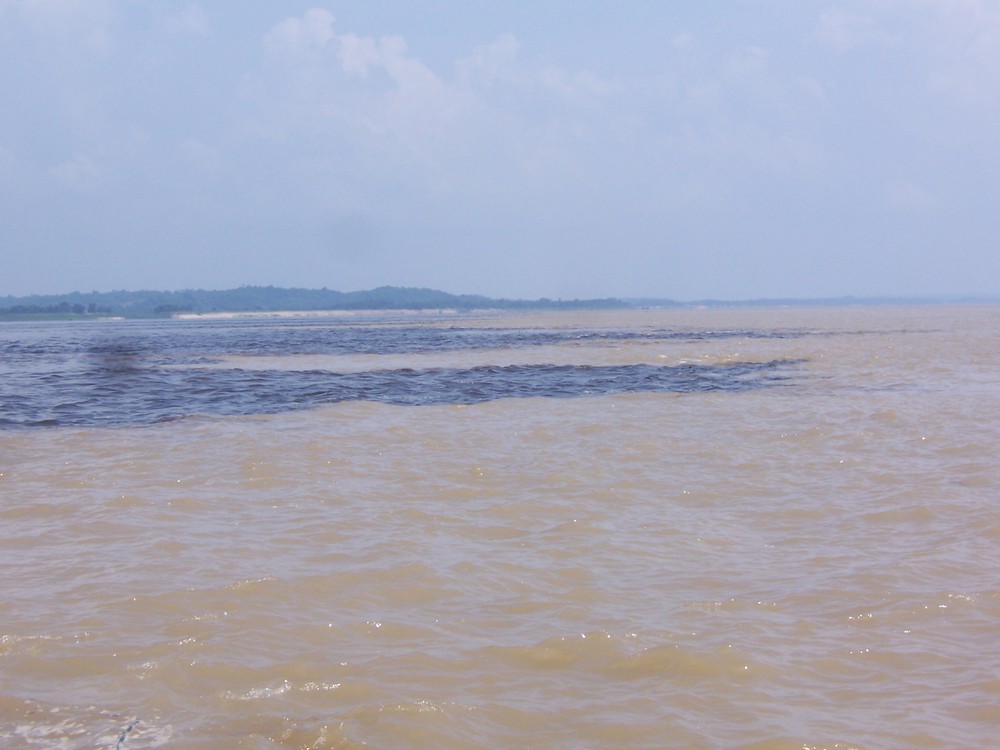
If you look at this location in a satellite photo (e.g., on Google Maps) you’ll see that the boundary between the two colors of water stays distinct for something on the order of 20 kilometers downstream. Why do they mix so slowly? Actually this is the wrong question to ask! If we assume that the two rivers mix by diffusion alone, then the boundary should broaden to a width d of, say, 10 m in a time t = d^2/D, where D = 2e(-9) m^2/s is the diffusion constant of water. This calculation gives a mixing time on the order of 10^11 seconds, which is thousands of years! Diffusion is a very slow process; far too slow to explain what is happening here! The right question to ask is clearly “Why do they mix so quickly?” or, in other words, what process other than diffusion is at play here?
You can see a hint of the answer in my photo, but it’s a lot more clear if you zoom in on the satellite photo on Google Maps. The line separating the black and brown water is not straight – it’s wavy, and it becomes more so as you move downstream. The initially flat interface between the two streams is unstable. Swirls and waves develop and grow at the interface as it flows downstream. This makes mixing much faster for a couple of reasons. First, swirls make the surface area of the interface bigger, so there is more diffusion across it. More importantly, the water gets stirred by the swirls, and this mixes the streams just like stirring your coffee mixes in the cream.
This is a great example of what’s called the Kelvin-Helmholtz instability, and it can be analyzed in detail mathematically. Exactly the same instability gives rise to the parallel rows of clouds you often see in the sky!
Want to know more? Take fluid dynamics next year!
One of the more interesting physics stories in the news recently concerns an experiment that purports to have measured neutrinos moving faster than the speed of light. A team of researchers sent a beam of neutrinos 700 km through the mountains from CERN in Switzerland, where the neutrinos were created, to a neutrino detector in Italy. The time of flight was 2.4 milliseconds, and the neutrinos arrived at the detector 60 nanoseconds earlier than they would have if they’d traveled at the speed of light. That’s a difference of a few parts in 10^5. People are pretty good at measuring small time intervals. This group used GPS satellites and atomic clocks to do the timing, and the accuracy in their time measurement was 1 nanosecond.
This result raises lots of questions! Like: is it right? I don’t know, but they’ve done it twice – in two slightly differently ways – and got the same result both times. Nonetheless, experiments like this are hard – neutrinos are pesky little things, and anyone who’s taken Physics 1052 knows that measuring time at two different places can be tricky when things are moving close to the speed of light. These folks have probably got the relativity right, but the possibility of some sort of systematic error in their measurements remains. Other experiments will have to be done to confirm – or refute – this result.
There’s one important data point that suggests that neutrinos are in fact well-behaved and do not travel faster than c. The neutrinos emitted by Supernova 1987A (which was discovered by a Canadian astronomy grad student) arrived at earth about three hours before the visible light from the supernova. In this case, the time difference is understood: It’s due to the fact that the refractive index of interstellar space is marginally greater than 1. If the speed of the neutrinos was as high as implied by the new CERN results, then the neutrinos from SN 1987A would have arrived here in 1983, four years before the light was detected in 1987.
If the new experiments are right, though, then perhaps “everything you know is wrong.” Or almost everything, anyway. That would be pretty exciting (lots of jobs for physicists, maybe), but distressing at the same time! Relativity has proven to be a pretty good theory so far, though, and I would be slow to abandon it.
I like to walk a lot, so naturally (naturally for a physicist, anyway) I have occasionally thought about the physics of walking. Here’s a simple calculation you can do. Imagine that a leg is a pendulum that swings at its natural frequency. First year physics tell you what its period of oscillation is. The length of the stride must be proportional to the length of your leg – if this isn’t obvious, draw a picture. So now it’s easy to figure out how walking speed depends on the length of the leg.
If you do the calculation, you’ll find that walking speed also depends on the acceleration due to gravity.
This is amusing, but do your results make sense? In other words, does this little calculation have anything to do with real walking? What about running? What about walking on the moon?
Post your thoughts as comments here. The best comment wins a very good (albeit slightly used) book of SF short stories (and yes, I’ll mail it to you if you live somewhere else!).
I am on administrative leave this year. This is NOT a year-long holiday. It just means I have no classroom teaching duties – all of my time is for research. Nonetheless I am taking advantage of the opportunity to do some work-related traveling. I have just returned from two months in Rio de Janeiro, where I was working in the Department of Mechanical Engineering at the Pontifical Catholic University of Rio (referred to as “Pooky” by those in the know). My host/friend/colleague/collaborator there was Paulo de Souza Mendes. We have a lot of research interests in common. In particular, we both like to do fluid dynamics experiments using a material called Carbopol, which is the main ingredient in hair gel. Much of Paulo’s research is funded by Petrobras, the Brazilian oil company. Petrobras is required by law to use some fraction of their (extremely large) revenues to fund research and other cultural endeavors, and as a result they have a large presence in the research labs of the country. Paulo does experiments that model situations important in the oil extraction business. For example, I was involved in an experiment with Paulo and his graduate student Alexandra Alicke that was concerned with bubbles rising up through Carbopol. Why is this interesting? First of all, Carbopol is a yield-stress fluid, meaning that it behaves like a solid if you don’t push it very hard, but it flows if you push it hard enough. Like hair gel, or margarine, or toothpaste … or freshly poured cement. After an oil well is drilled, a pipe is cemented into the wellbore to isolate the well from the surrounding rock. Bubbles of gas or air can get into the cement before it hardens, rise up a bit due to buoyancy, and then get stuck as the cement hardens. This results in voids in the cement. Sometimes the rising bubble can even leave a long trail behind it as it rises through the not-quite-hard cement. This can weaken the cement and, in the worst case, lead to a catastrophic failure of the well. Paulo and Alexandra use Carbopol to model the properties of the cement. By studying the behavior of the bubbles in their experiment, they can learn more about how bubbles will behave in cement a kilometer under the surface of the ocean, and maybe learn how to prevent expensive and potentially dangerous problems.
Paulo also likes hiking. Here’s a picture of us in a park a bit south of Rio.

Here’s a follow-up to Mel’s recent post about the Higgs boson. This morning the folks at CERN announced “hints” of the Higgs in their data at a mass of about 124 GeV/c^2. There are two different experiments looking for the Higgs, and they both see something at the same energy, which is very suggestive. Neither signal is above the 2-sigma level, however (i.e., 2 standard deviations above the background). I interpret this to mean they are 95% sure it’s there, which is pretty sure! The conventions of particle physics require a 5-sigma signal to make it a solid claim, though. 5-sigma would correspond to 99.99994% certainty, which as far as I am concerned is as sure as you are going to get about anything. Another year’s data collection should get them to that level.
Is this an exciting result? I have a bit of a prejudice here (and a lot of ignorance), so I’ll be provocative and say no, not really. The “Standard Model” predicted the existence of the Higgs. That model works pretty well, and it would have been much more of a surprise if the Higgs wasn’t there. In a sense all this result does is demonstrate that the model that everyone believed in is still right. On the other hand, a confirmation that the Standard Model still works tells us (them, actually; I have nothing to do with this field) that it is the right place to start from in exploring even higher energies, so it’s certainly helpful.