All posts by John de Bruyn

Plagiarism

Here’s an interesting article about plagiarism:

http://www.thestar.com/news/article/1130885–ryerson-professor-s-work-plagiarized-by-iranian-academics

The article talks about the fact that two Iranian professors published a word-for-word duplicate of a paper originally written by a prof from Ryerson. It turns out that these two have done the same thing on other occasions. The Iranians’ version of the paper was withdrawn by the journal and they have been banned from submitting papers there for three years. I have to agree with the sentiments expressed in the paper that this punishment is pretty feeble – there are zillions of other journals they can submit plagiarized papers to! If one of our students submits plagiarized work, they automatically get a zero for that work. If they do it again, they could well face expulsion from the university. If one of my colleagues made a habit of submitting plagiarized work, I hope they would lose their job!

One of my colleagues at Memorial had one of his papers plagiarized once: someone took paragraphs from my colleague’s paper and alternated them with paragraphs of his own. The overall result made no sense at all, and was caught by a diligent referee. However a bit of digging showed that the perpetrator had done the same thing previously, and got it published. That journal was notified and printed a retraction. The perpetrator’s university (in India, if I remember correctly) was notified and did nothing.

email campaign re federal funding for research

Below is the text of an email I got from the Canadian Association of Physicists, asking folks to send an email to MPs regarding the level of funding for research in the upcoming budget. The process is quick and easy and can have a real influence.

Here is a link where you can send an email with a few clicks:

http://e-activist.com/ea-action/action?ea.client.id=1727&ea.campaign.id=12842
Here is the whole message:
As you may know, The Canadian Association of Physicists is a member of the Canadian Consortium for Research (CCR), the umbrella body that advocates for research and post-secondary education at the federal level and a CAP past president, Paul Vincett, is Chair of the CCR. 

CCR has recently raised concerns that there is again a substantial possibility that the upcoming federal Budget will be a bad one for research.  For example, cuts to the Granting Councils are a very real possibility.  Substantial cuts to in-house government science have already started, notably at Environment Canada.  The context is the federal Strategic and Operating Review which required all departments to propose a departmental budget based on an overall cut of (a) 5% and (b) 10%.  Final decisions will be made by senior ministers.  Presumably, cuts to the Granting Councils, and/or more cuts to government science, may well be proposed under this exercise.  
While this process is well underway, Minister Flaherty has talked of 'flexibility' in the government's plans.  Moreover, the fluid international economic outlook probably means that the government's plans will also be fluid.  

This situation is at best unclear and at worst threatening for research funding.  Yet, given the economic uncertainties, the government may be open to persuasion, based on the critical importance of research to Canada's future.  

IT IS THEREFORE VERY IMPORTANT THAT THE VOICE OF THE RESEARCH COMMUNITY BE HEARD!  

As part of its actions to address this matter, the CCR is coordinating an e-mail campaign to ensure the concerns of the research community are brought to the attention of the federal government.  PARTICIPATION IS VERY EASY THIS YEAR, thanks to an online facility kindly being provided by the Canadian Psychological Association, a CCR member. 

The CAP Executive supports this initiative, and we are therefore asking you to participate in this campaign.  By accessing a new online system, you can very easily send an e-mail to your MP, with copies to Ministers Flaherty, Paradis and Goodyear.  The links at the end of this message will take you to the system, where you can review an (editable) template letter.  The system will automatically identify your local MP based on your postal code, and will send copies of your submission to Ministers Flaherty, Paradis, and Goodyear when you submit/e-mail your message. 

If a large number of researchers makes their views known, it is not too late to have an impact! The success of the 2010 e-mail campaign initiated by the CAP regarding the Ontario Engineering Act suggests to us that a large number of e-mails could well be effective. After a similar effort regarding the budget last year (which produced over 500 e-mails), the budget turned out to be much better for research than had been feared.
We therefore urge you to click on one of the links below as soon as possible (preferably within the next week) and to follow the simple instructions.   We encourage you to incorporate some modifications to the template to personalize the message; however, simply submitting the template message will have a significant impact.  With minor editing of the template message, you should be able to complete the process within 3-5 minutes.

Thank you.

Jobs for physicists

A while back Shantanu posted a link to an article on the question of whether our universities are producing too many PhDs. I don’t have a yes or no answer to that question, but I have some rambling thoughts on the subject. Bear with me, the punch line is way down at the end.


I was a undergrad in the late 70s and a grad student for most of the 80s. (I’m not that one guy who skews all the statistics on graduate degree completion times, but I took a while. That’s another story, though.) I wanted to be a university professor, and for most of that time, university jobs for physicists were very tight. Most universities expanded a lot in the early 70s, then didn’t hire anyone for a long time. Industry jobs got harder to find, too. When I was an undergrad, my profs told me, “Don’t worry, when you finish your PhD in five years the job market will really open up.” When I was an MSc student, they said, “Don’t worry, in five years the job market will really open up.” When I was a PhD student, they said “Don’t worry, in five years the job market will really open up.” What I learned from this is that Physics profs don’t know very much about job markets, or about economics in general. Nonetheless I was fortunate to get a faculty position in 1989, after a short postdoc in the States. There were six faculty positions in physics advertised in Canada that year. If I remember correctly, two of them were 3-year positions and the other four were tenure-track. I know three of the other people who got hired that year, and I have to say that I am in good company.


In the early 90s, students figured out that jobs for physicists were hard to find. Enrollment in university physics programs all across the continent started to drop, and kept dropping for all of the 90s. I don’t have the figures for Canada, but in 1999 the number of BSc and PhD degrees in physics hit a minimum. I think around this time UWO’s honors physics class had all of two students. In the meanwhile, though,  something really did change in the job market. In the early 90s things started to pick up. Not just in the universities – industry started to hire more physicists, too. Opto-electronics, semiconductors, and “high-tech” in general exploded. Investment banks discovered that the problem solving, math, and computer skills that physicists knew were useful in the world of finance, and hired a significant number of physicists at salaries on the order of $300,000 per year. As the world’s economy became more and more computer-based, information based, knowledge-based, whatever you want to call it, people like physicists who were good at dealing with computers, and information, and knowledge became more in demand.


So, eventually students figured out that there actually were jobs for physicists out there. Through the 00s, physics enrollments steadily went back up. In 2010, the number of BSc and PhD degrees awarded in the States was the highest it’s ever been! Again the numbers for Canada are harder to find, but the trends here have been the same, and Western’s honors class has been in the high teens to low 20s for the last few years.


The point is this: If there are physics jobs available, students will take physics. If there are not, they won’t. There tends to be a bit of a time lag between employment conditions and enrollments, so the system is not perfect (actually this kind of feedback system can be mathematically unstable, but again that’s another story) but it is more-or-less self-regulating.


In recent years, both the federal and provincial governments have decided that Canada needs more “highly qualified personnel” to support the “new knowledge-based economy” … blah blah blah. To help meet this need, the governments have dangled money in front of the universities, rewarding them for increasing their graduate enrollments. Of course the universities love this, because they get more money, and more students, and more research papers, and more degrees, and more alumni who when they are rich will give more money to the universities…. But do programs like this really help the economy? What is the effect of these programs on the more-or-less self-regulation of enrollments that I mentioned above? Most importantly, will all of the “extra” grad students were are training find jobs when they graduate?


I said that physics profs aren’t very good at economics, and that applies to me, too. I can’t answer my own questions. I assume that somebody, somewhere, thought about these questions before the governments decided that we needed more scientifically-trained people, but I’ve never heard the answers.


I will end on an optimistic note. According to the American Institute of Physics, the unemployment rate among newly-minted PhD physicists has never been more than about 6% for as long as they have been keeping statistics. It’s typically around 2%. Their graph is quite interesting; you can see it here: http://www.aip.org/statistics/trends/highlite/emp3/figure1a.htm

You can track the strength of the economy by following the curves for “Potentially Permanent Position” and “Postdoc.” Their graph shows a small hump in unemployment in the 90s that peaks at 6% in 1993, but since then unemployment has been lower. Here the message is simply that essentially all PhD physicists have been able to get jobs when they graduate, even when there were supposedly no jobs for physicists out there! I don’t understand economics, but I do understand this: the bottom line is that the skills that physicists have are useful, so people hire them. I am hopeful that this will continue even as the supply of physicists increases.

Supernova in a jar

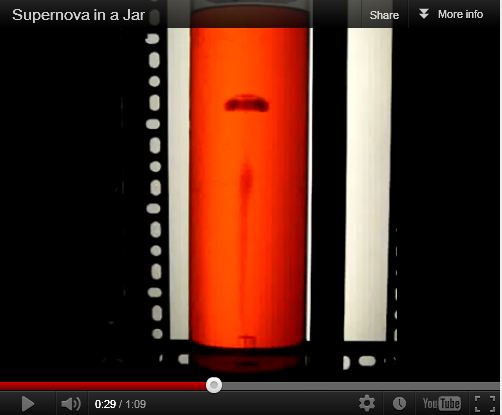
My brother-in-law (and collaborator) Stephen Morris is a prof in the Physics Department at U of T. He and his student Mike Rogers studied a particular auto-catalytic chemical reaction that produces buoyant plumes. The interplay between the chemistry and the fluid flow leads to interesting dynamics, which you can read about here:

http://focus.aps.org/story/v26/st23

But there is an interesting side story. When Stephen was writing this paper a year ago, he discovered that one of his earlier papers on the subject had been cited in a paper about supernovae. It turns out that you get buoyant plumes at the beginning of Type IA supernovae, too, except that the reactions involved are nuclear, not chemical, and the whole thing is over in microseconds rather than hours. So, Stephen put a line in his paper to the effect that their chemical plumes might serve as a laboratory analog for the plumes involved in the detonation of Type IA supernovae. Apparently science writers troll through the arXive preprint site looking for cool stuff to write about. Some of them came across Stephen’s paper and went wild. He is now famous for having created a “supernova in a jar.” Here’s a video:

[youtube http://www.youtube.com/watch?v=7tedVybfxSI?wmode=transparent]

How I spent my year’s leave, part 2

While I was in Brazil this fall, I visited Raimundo Costa Filho at the University of Ceara in Fortaleza. Raimundo was a prof at Western for a couple of years. Fortaleza is only three degrees south of the equator, and the weather there is the same all year round: sunny, temperature in the low to mid 30s, with a nice breeze blowing off the ocean to keep things from getting too hot. Lovely! And the beaches around Fortaleza are absolutely spectacular.


While he was at Western, Raimundo and I talked about some work I was doing with my PhD student Simon de Vet on the formation of impact craters in granular materials. Since then, Raimundo and one of his former students have been working on numerical simulations of the impact process. I’m looking forward to seeing their paper.


I gave a talk about our crater work in Fortaleza. The experiments Simon did are quite simple – he dropped a ball into a bucket of tiny glass beads, and looked at the crater that results.  Our granular craters look just like craters on the moon: Small ones are smooth bowls with a raised rim, and bigger ones have a peak in the middle. Simon and I were interested in the extent to which the process we were studying really mimicked the formation of craters by a meteor impact. The energy scale in our case was some 20 orders of magnitude smaller, and many of the details were dramatically different, but nonetheless the end product was very similar. There were also some theoretical reasons to think that our experiments really did have something to say about “real” impact craters.  Simon’s work focused on the granular flows that took place after the impact. We think that the fluid dynamics is essentially the same as it is in a meteor impact, and that’s why the shape and morphology of the craters is the same. On the other hand, Simon found that the (appropriately scaled) energetics of the crater-formation process were quite different in the two cases. In big lunar craters, essentially all of the kinetic energy of the projectile is used to excavate the crater, while in our granular impacts it’s about 0.1%. Where does all the energy go in the granular case? Friction, and inelastic collisions between the grains. I spent part of my time in Brazil writing a paper about some of Simon’s work.


I won’t write about Brazil any more, becasue next month we are going to Hong Kong.

Thinking – incorrectly – about waves

Last year I supervised Erin Kennedy’s honors thesis research. Erin plans to be a teacher, so she was interested in doing a thesis on physics education. Her project involved studying how well students understood some basic ideas about mechanical waves. Her guinea pigs were last year’s Physics 2110 and Physics 1502 classes, which I taught. She gave the second years a diagnostic test (developed by Wittmann as part of his 1998 PhD thesis at the University of Maryland) early in the course, and again at the end. She analyzed the results of the pre-test to see where students held misconceptions about wave physics, then designed and delivered lessons intended to help correct these misconceptions. The post-test was intended to show how well the students’ understanding improved as a result of the inspired teaching they received.


Wittmann had earlier used his diagnostic test on first-year students in the U.S. He (and earlier researchers) found that the students held a number of interesting misconceptions. For example, many students thought that if you flicked an stretched string harder, then the wave you produced would travel faster. (It won’t, by the way. The speed of the wave is a property of the string – it depends only on the mass density of the string and the tension, and doesn’t depend on the way the wave is produced. But you knew that.) Wittmann figured out that many students were taking ideas from their understanding of the motion of objects and incorrectly applying them to wave motion. In other words, students were trying to treat waves the same way they would treat a baseball: If you throw a ball harder, it moves faster. Therefore, if you hit the string harder, the wave will move faster. When I read Wittmann’s work, I was astounded by this. I had taught first-year physics, and waves in particular, many times, and I had never knowingly run across this way of thinking. Clearly students in the US must be a lot dumber than students in Canada!


Well, guess what Erin found? Our students are just as dumb as the US students. To be a bit more polite, our students held exactly the same misconceptions as those found in the previous studies. She did find that student understanding improved from first year to the end of the second year course, which is reassuring. In many cases, however, these misconceptions persisted even after the students had studied waves in first year, and then had a full course on oscillations and waves in second year! I confess I was surprised by this.


What I find really interesting, however, is that the same common misconceptions have been found in studies on students from the US, Canada, France, Australia, and Thailand. It seems that the misconceptions cannot be blamed on cultural factors or on a particular educational system. They are universal. I suspect the same is true of the common misconceptions that have been identified in other areas of mechanics. Why? Why would a kid from Thailand independently come up with the same wrong ideas about wave propagation as a kid from France? It must have something to do with the way our brains work, the way our minds try to make sense out of the world. It’s too bad that our brains evidently come up with something that’s not physics, but, to be fair, it took people as smart as Galileo and Newton to figure this stuff out in the first place!