All posts by John de Bruyn

Report from the CAP congress in Calgary

The annual congress of the Canadian Association of Physicists was held last week in Calgary. This is Canada’s biggest and most important national physics conference. The Canadian physics community is small and quite diverse, so it’s not the most important conference of the year from a scientific perspective, but I find it extremely useful politically and socially, and I always learn something there. In fact, because of the diversity of talks at the meeting, it’s an opportunity to attend some good talks on subjects outside of my own field.

This year’s meeting was attended by 619 people. That’s not as much as in Toronto two years ago, but it’s pretty good overall. Our department was represented by faculty members Giovanni Fanchini and me, grad students Tahani Aldahri, Arash Akbari-Sharbaf, Eric Barbagiovanni, and Sergey Dedyulin, and undergrad but soon-to-be grad student Masha Goiko. (If I missed you, I apologize! Please let me know and I’ll edit this post to include you!) There were, I think, a lot of students there. I attended the final session of the conference where the prizes for the student talks were decided, and heard 8 excellent presentations on subjects ranging from the tracking of ionized blobs in the ionosphere to the characterization of the plexiglass used in a planned dark-matter detector.

There were excellent plenary talks on the Alpha experiment to trap anti-hydrogen atoms at CERN and on using nanotechnology for biophysical experiments – in both cases, both the physics and the technical skill involved in doing the experiments were amazing. The winners of the various CAP medals all gave talks. Included among these were two of the best talks about quantum field theory and string theory that I have ever heard. It appears that superstring theory is now making predictions of new, measureable phenomena. If these predictions are borne out, I might start to believe that superstrings are more than just fancy math and actually have something to do with explaining reality.  There was a public talk in the Red and White room at McMahon Stadium (where the Calgary Stampeders  play) about quantum computing. In my opinion (and my wife’s), this talk was less accessible to the public than it should have been, and I remain unconvinced about the prospects of quantum computers to change the world. I also attended sessions on physics education, magnetism, soft matter and surfaces, graphene, Monte Carlo techniques, and others that have already faded from my memory.  The poster session on Tuesday evening was extremely well attended and I had good conversations with many people about my poster (co-authored with Alyssa Gilbert) about Canadian publications (or rather, the relative absence of Canadian publications) in the field of physics education. My voice was hoarse and my feet were sore by the end of the evening.

On the science policy front, we had extensive and constructive discussions with Samir Boughaba, the NSERC staffer in charge of physics and astronomy. One topic discussed in detail was the RTI program.  I learned that the decision to cancel RTI and MRS was more complex than I had thought, with part of the cause being a federal decision to disallow the re-targeting of unspent year-end money. Since RTI has always been funded by exactly these funds, NSERC was more or less stuck. I can tell you, however, that NSERC has heard loud and clear that the community views RTI as extremely important, and they are trying to find a way to keep some form of the RTI program operating for the next few years, albeit with a smaller budget, until they can find a way to fund it properly. That is very positive news. CAP decided to commission a bibliometric study of Canadian physics (see my post a few months ago about bibliometrics) in preparation for the upcoming NSERC reallocation process.  Ted Hsu, MP for Kingston and the Islands, who has a PhD in physics and is the Liberal science critic, spoke to us by Skype after the conference banquet Thursday evening about his life as a politician.  CAP remains active in lobbying Parliament Hill on matters relating to science and research, and I think that their message is getting through – the facts that NSERC’s budget was cut by only 1.7% while other government departments were cut by an average of 7%, and that “basic research” was mentioned explicitly in the budget speech have to be taken as strong indicators that there is some recognition by the government of the importance of research to the country.

I am now on the CAP executive as Director for Full Members, as well as being the CAP Councilor for Southwestern Ontario. If you have any gripes, or want more information about anything to do with CAP, feel free to let me know. Meanwhile:

–          If you are a CAP member and have not yet filled out their survey about NSERC funding, please do so as soon as possible. The survey will remain open until the end of June.

If you are not a member of CAP, please join. Given the CAP’s role in promoting our discipline to government decision makers, I can’t see that you have any excuse not to be a member. Undergrads can join for free, and grad students get a year’s membership at no cost. And for my astronomy colleagues, bear in mind that you can get a joint membership in CAP and CASCA at a special discounted rate. 
Pursuit of Light

One of my colleagues at the SETI Institute, Franck Marchis, pointed me to this video from NASA Goddard titled “Pursuit of Light”. This video showcases quite a few recent achievements in the top goals from NASA’s Science Mission Directorate — exploration of the solar system as well as detailed observations of the Earth and Solar activity. If you look at some of the images and animations in this video, it’s clear that we’re living in a great era — we have high-resolution and high-quality observations available covering long timescales and often from different perspecives (we continuously observe the sun from all sides for instance with the STEREO satellites), not only revealing phenomena in great detail, but also how they evolve over time. As scientists, we are part of this amazing endeavour (and often on the front row to see new discoveries), which makes us lucky, lucky people! Let’s try to make sure that this effort to understand our home and our place in the Universe is not cut short!

[youtube http://www.youtube.com/watch?v=AkHc_3Zrv8s]

Reading for writing

A while ago I wrote about writing. In this post I want to say a bit more on the subject. In particular, I’ll discuss one thing that can prepare you to become a better writer – reading.

If you want to write, you have to read. A lot. You have to do more than just scan the words, though, you have to read critically. Certainly if you want to write a scientific paper, you need to understand how scientific papers should be structured and what makes a good or a bad scientific paper. So … read a lot of scientific papers. Naturally, this is something you should be doing anyway to gain the scientific background you need for your research. As you read the papers, though, you should also make note of the way the authors tell their story. Look at how much background material is given in the introductory section. How much detail is provided in the experimental section? Take note of how figures are used, and how the discussion in the text relates to the figures. Follow the trains of thought that the authors take in interpreting their results and developing their conclusions. Not all papers do all of these things the same, of course. Sometimes the differences are a function of the journal the paper is published in. Physical Review Letters restricts papers to only four pages in length, for example, so they have to be very concise, with no extraneous detail. In contrast, papers in Physical Review E have no length restrictions and so can go into more depth. But other differences can be due to the writing style of the authors. As you read, think about whether the point of the paper is easy to understand. Can you follow the authors’ arguments? Do they explain things clearly and logically?

Don’t restrict your reading to scientific journals, however. Read novels. Read newspapers. Read blogs. Read non-fiction. Read everything – and develop a sense of what works and what doesn’t in all of these different types of writing.

Reading other people’s writing can help you to develop an understanding of what constitutes good writing. The next step is to apply that understanding to your own work. I’ll have some ideas on how to do that next time.

How I spent my year’s leave, part 5

Ah, Vancouver in the spring. I grew up here, and there are some things about Vancouver that just seem to me to be perfect: the skyline of the mountains on the North Shore, for example, or the dark, damp green of the coastal forests. When these things register on my senses, my brain just pushes a button that says “home.” I moved away for good (so far, at least) after I got my Ph.D. in 1987. I’ve been back several times since then, but since none of my family lives here anymore, I’ve not stayed long. This time we are here for a month, which will give me a chance to get to know the place again. As with any friend you haven’t seen for 25 years, there have been some changes. One is obvious as soon as you arrive – it used to be a real pain to get from the airport to downtown by public transit, but now there is a quick and easy rapid transit link.

We are living on the 29th floor of an apartment building in a trendy part of downtown called Yaletown. We have a nice view of lots of other tall apartment buildings, and if we lean the right way we can see Mt. Seymour. Yaletown didn’t exist when I was a kid, as far as I know. What is now Yaletown used to be a wasteland of light industry and warehouses; it was a part of town one never had any reason to visit. In the mid-80s is became the site of Expo 86, the World’s Fair. After the fair, they sold the area to a developer who tore down everything and built lots and lots of hi-rise apartments. It is now the most densely populated area of the city. I wasn’t sure what to expect, but in fact it is very pleasant. We are a couple of blocks from the waterfront, where there is a great sea-wall walk and bike path. There are dozens of restaurants within a 10 minute walk of our apartment, most of which are quite reasonably priced. Transit is close and convenient. There are parks. It would have been nice if our apartment had been dusted before we arrived, but otherwise we have no complaints.

I’m working at UBC while I’m here. That’s another place where there have been many changes. I haven’t counted, but I am sure that more than half the buildings on campus have been built since I left, and most of the others have had bits added to them. There is ongoing construction at half a dozen sites, and I gather this has been the norm for the last 20 years. I guess I am technically visiting the Math Department. My office is in what used to be the Computer Science Building; it has a new name and new occupants, including the Institute for Applied Mathematics, which is where I am sitting as I type this. Downstairs is the Complex Fluids Laboratory, where I have been spending a fair bit of my time. My hosts are Neil Balmforth, who is Director of the aforesaid Institute, and Ian Frigaard, who divides his time between Math and Mechanical Engineering. Both do research on yield-stress fluids. Neil is interested in geophysical flows, like landslides and lava flows and such, while a lot of Ian’s research has applications in the oil industry.  I will be spending part of my time working on an experiment that is supposed to model what happens when water flows beneath a glacier. Not only does the water lubricate the flow of the glacier, in some cases it can also cause the ice sheet to lift up significantly. Neil and his postdoc Ian Hewitt have been working on a mathematical model of this process, including the forces on the water due to the elastic deformation of the ice. The experiments will involve syrup flowing under a rubber sheet; the rubber sheet will exert forces on the fluid that mimic those due to the ice. At present we are at the “looking for stuff” stage of the experiments, but hopefully we’ll get everything set up this week. Meanwhile, I am enjoying the west-coast spring weather!


Geocaching as a threat to global security

Some of you know that one of my hobbies is geocaching. For the blissfully ignorant, geocaching works this way: People put some trinkets in a container and hide it somewhere. They post the coordinates (latitude and longitude, accurate to a couple of meters) on a website. Others then use a gps to find the hidden stuff. There are some details, but they are unimportant. There’s also some good physics involved, but we don’t need to go into it now. It’s a fun activity, and a good excuse (if one is needed) for a walk in the woods. I enjoy geocaching when I travel to a new city, as I typically get led to interesting places that I otherwise would never see. There are about a million and a half geocaches hidden around the world, including several hundred around London.  One of the small pleasures of the game is that it’s a little bit subversive – you have to sneak around to find the caches, and you’re not supposed to let the un-initiated know what or where they are. Cachers occasionally get asked what they are up to by various authority figures. It’s all part of the fun.

While we were visiting my in-laws in Victoria this weekend, my sister-in-law pointed out this news article to me: http://www.timescolonist.com/news/Bomb+squad+called+after+suspicious+object+found+tree/6612573/story.html

The gist of it is that someone had found a suspicious object hidden in a tree. The bomb squad had been called out, and after several hours of doing I don’t know what, they determined that the object in question was not in fact a pipe bomb, but a geocache. I thought this was pretty funny. I wondered if this sort of thing had happened before, and in fact it had: in Toronto, just a few days earlier. Here’s the story on that one:

http://www.cbc.ca/news/offbeat/story/2012/05/10/pipe-bomb-scare-geocaching.html

In this case, authorities confined local residents to their houses for three hours while the bomb squad blew up the suspicious container. This cache had been sitting in plain view, attached to a lamp post with cable ties, for more than a month, but apparently it didn’t become a potential bomb until last week. There have been other incidents as well – I found information about one in North Carolina, and another in Colorado Springs.

I suppose such incidents end up costing taxpayers lots of money. I find it hard to get mad at geocachers about this, though. Instead, I take it as a sad commentary on our collective mindset that otherwise rational people would conclude that a piece of plastic pipe hidden in plain view in a public space must be a bomb, rather than something totally innocent. I also find it odd that bomb experts would reach the same conclusion, even after looking carefully at said pipe. Surely there are ways to determine whether that pipe contains trinkets rather than explosives without spending hours at it, without detonating it, and without terrifying all the neighbours. What about using those swabs they always wipe over my laptop at the airport, for example? Or bringing in one of those bomb-sniffing dogs? Or, for that matter, what about going to the geocahcing web site and checking to see if there is a cache listed at the location in question? Perhaps bomb squaddies should put a geocaching app on their mobile phones, so they can easily do this!

Certainly one lesson from this is that geocachers should be careful to hide their caches where people prone to panic are unlikely to find them. Another is that a lot of people need to chill out a bit. Don’t forget, there are another 1.5 million of them still out there!

2011 physics headlines

Included in the pile of mail waiting for me when I returned to my office last week was the February issue of the APS News, which had an article on the top 11 physics headlines of 2011. Here they are, with my unsolicited comments thrown in. Many I think are interesting, a few not so much. But 2011 seems to have been a pretty good year for physics overall.


1. Closing in on habitable planets: We heard something about this in our colloquium this week. It is certainly an exciting area! We (by which I mean they) have now detected close to a thousand extra-solar planets, with thousands more candidates in the works. As a devoted Star Trek fan, I am certain that there must me lots of earth-like planets out there, and I can’t wait to visit them.


2. The Japanese tsunami and Fukushima: Surely everyone has asked the same question I asked: why in the world would anyone build a nuclear power plant so close to the coast in a country where earthquakes happen all the time? The Fukushima tragedy will have long-ranging effects on the nuclear industry, some of which are discussed in the Oct-Dec 2011 issue of Physics in Canada, but I can’t help but think that all of this could have been avoided if people had taken the risks seriously when they built the thing. Of course, one is also forced to wonder what risks were ignored in building other nuclear plants. Nuclear power should have been the way of the future, but I think the industry may have shot itself in the foot. By they way, the fluid dynamics of the tsunami is interesting: apparently the wave was the superposition of two separate tsunamis that merged into one mega-big one.


3. Quantum computing:  This particular headline is about group that built a chip that can actually do 4-qubit calculations. This does sound like a significant step towards actually doing something useful, but I am afraid I can’t get excited about quantum computing. As an intellectual endeavour, sure, I can see why people find it interesting. But as a practical way to actually compute something, I think we have a long, long way to go.


4. Higgs boson: Has it been seen? Or not? Apparently there have been a few possible sightings that have turned out to be statistical bumps that went away when more data was analyzed. The December report of something at 125 GeV sounded a bit more robust, but we still don’t know for sure.


5. Heaviest antimatter: Some folks at Brookhaven made a few anti-helium nuclei. This was hard to do, and is quite an accomplishment. The article doesn’t say what they actually did with the nuclei, though.


6. Living laser: This one sounds a bit like the work of the kind of mad scientists you see in bad sci-fi movies. Some folks modified a human kidney cell so that it produces a fluorescent protein (one that occurs naturally in jellyfish), then put it between two mirrors and shone some blue light on it. The protein acted as an optical gain medium, and the cell emitted green laser light. Cool.    


7. Seeing a wave function: This one was interesting. Some researchers at NRC in Ottawa have devised a way to probe the state of photons with out actually causing their wave function to collapse. This allows a direct measurement of the wave function, without perturbing the system a la Heisenberg. This demonstrates two things: first, some people are very clever, and second, there are many things about quantum mechanics that I don’t understand.


8. Faster than light neutrinos: I’ve posted about this before. It appears that the measurements that produced this headline were wrong due to a problem with the system used for measuring time. Lesson: when you get a result that violates all known physics, check it carefully before you tell anyone about it. This applies as much to students writing up third-year lab reports as it does to professional scientists at CERN.


9. Tevatron shutdown: The Tevatron at Fermilab used to be the highest energy particle accelerator, but that honor now belongs to the LHC. The Tevatron was shutdown last year after 28 years of operation. Even the most useful of tools eventually reaches the end of its useful life. Fermilab will now focus on higher-intensity accelerators rather than higher-energy.


10. Nobel prizes: We’ve heard a lot about these: the physics prize was for the discovery of the acceleration of the expansion of the universe, which is pretty interesting, and the chemistry prize was for the discovery of quasicrystals, crystals with five-fold symmetry that broke all the established rules of solid state physics.


11. Biggest black hole: We’ve about this, too: a black hole with a mass of 21 billion solar masses in a galaxy far, far away. When I was a student, there were debates about whether black holes existed at all, now they are everywhere.

Columnar joints


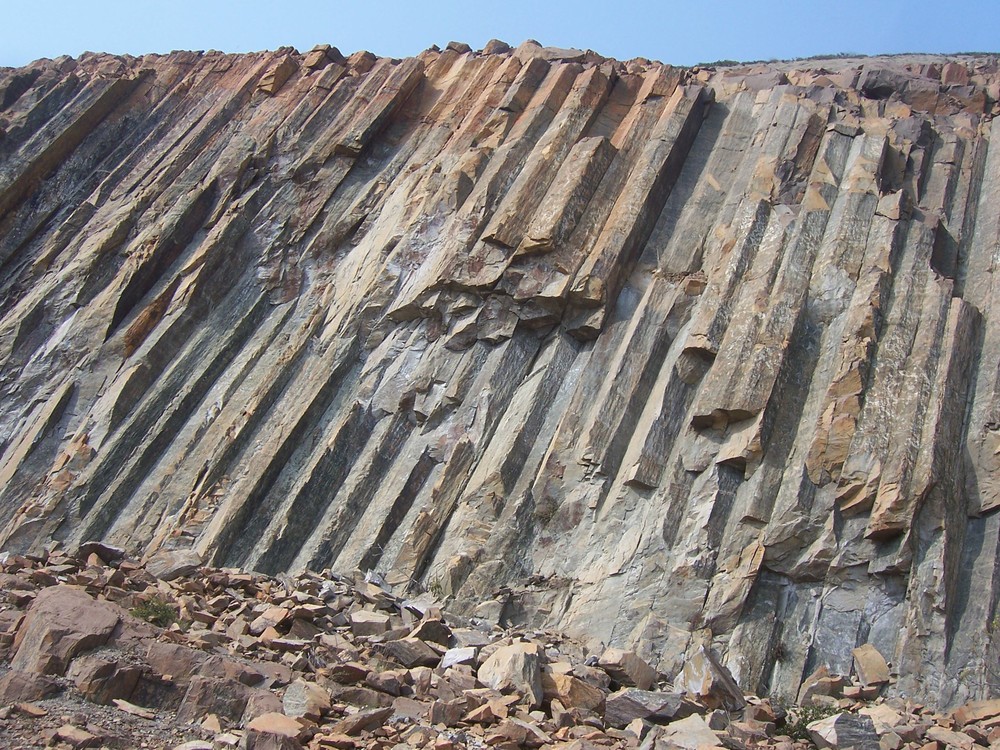
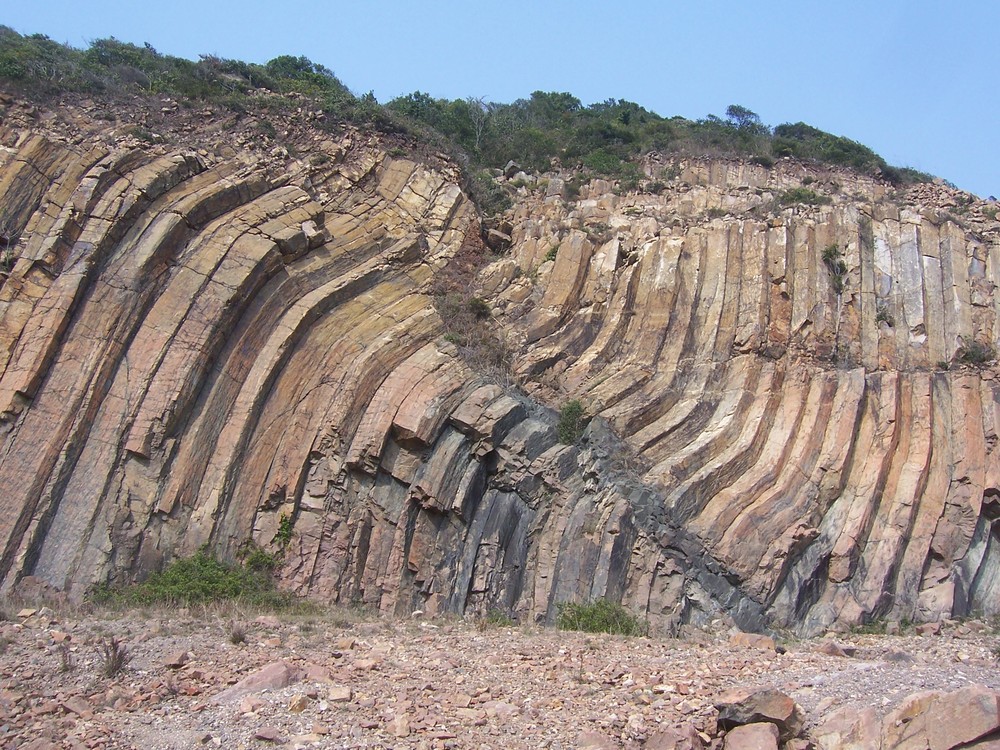
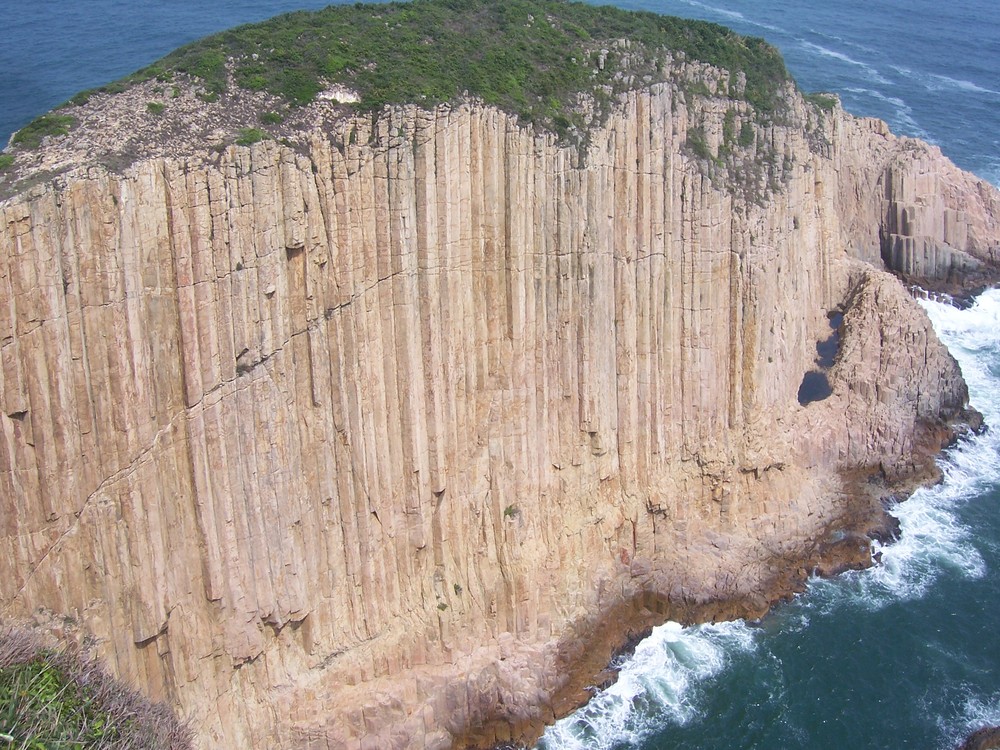
The physics of columnar jointing is interesting, too, and I published a paper on related phenomena a few years back. Let’s first consider a thin layer of lava that has solidified, but is still very hot. As the rock cools, it shrinks. This results in stress building up in the rock, and when the stress at some point gets bigger than the strength of the rock, it cracks. These cracks initially form randomly. Once you get a few cracks, however, these pre-existing cracks influence the location of the next cracks that form: The normal component of the stress is zero at the crack and  biggest half-way between cracks, so new cracks tend to form half-way between old cracks. New cracks also tend to meet old crack at right angles, since they propagate in the direction of the stress gradient. The result of this is that as the pattern of crack develops, the spacing between them tends to become more uniform. Now extend this to three dimensions, i.e., think about a deep layer of cooling lava. The cracks will initially form at the top surface, where the cooling is fastest, but they will propagate downwards into the rock as the subsurface rock cools and contracts. The interactions between the cracks makes them organize very quickly into a hexagonal pattern, resulting in the columnar joints you see in the pictures. My friend Stephen Morris from U. of T. has done some beautiful experiments which mimic this process using drying mixtures of water and corn starch – the diffusion of water replaces the diffusion of heat, but otherwise the physics is very much the same.  


More on my visit to Hong Kong

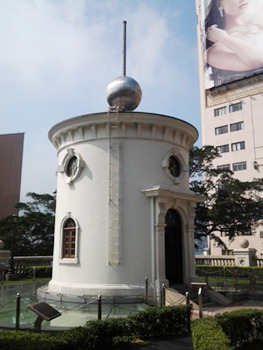
One of the lesser-known sights in Hong Kong is shown in this picture, which I lifted from http://www.1oclockgun.org.uk/hongkong.html because the photos I took are at home.

This is a time ball.Back in the days before GPS, it was vital for ships to have an accurate clock on board if they were to know where they were. This time ball was used in the late 19th-early 20th century by the ships in the harbour to set their chronometers. Normally, the ball was raised up to the top of the pole on the roof of the building. Every day, the Hong Kong observatory would do observations of the sun to determine the local time exactly. They would send a signal to the operator of the time ball, and at precisely 1:00 p.m., the ball would drop from the top to the bottom of the pole. The ships would set their clocks accordingly.

How I spent my year’s leave, part N.

I’m back in London for a little while. We returned from Hong Kong last week after a very productive and enjoyable two months. I was a bit shocked by the falling snow that greeted us when we stepped off the Robert Q bus – perhaps we should have stayed away a bit longer? – but at least it didn’t stick around.


In a previous post I talked about my visit to Chinese University. Since then I visited two more of Hong Kong’s universities: Hong Kong Baptist University and Hong Kong University of Science and Technology. I gave talks to the physics department at both places.


The physics department at HKBU is fairly small – I think they have about eight full time faculty. There are several people there who do nano-materials type research and study optical properties of materials, and a fellow who does theoretical nonlinear dynamics applied to neuroscience. I saw some interesting labs and, as always happens when I talk to people about their research, I got some good (maybe) ideas for things to think about. My host there told me a little bit about a new program in “Energy Science” they were developing. What he didn’t tell me, and what I learned later from a friend at another university, was that their undergrad physics program had been killed! Introducing this new program in Energy Science was apparently part of their survival strategy in the wake of this. Apparently they were not getting many physics majors and their program was ranked lowest among physics programs in Hong Kong, so it was eliminated. Scary!


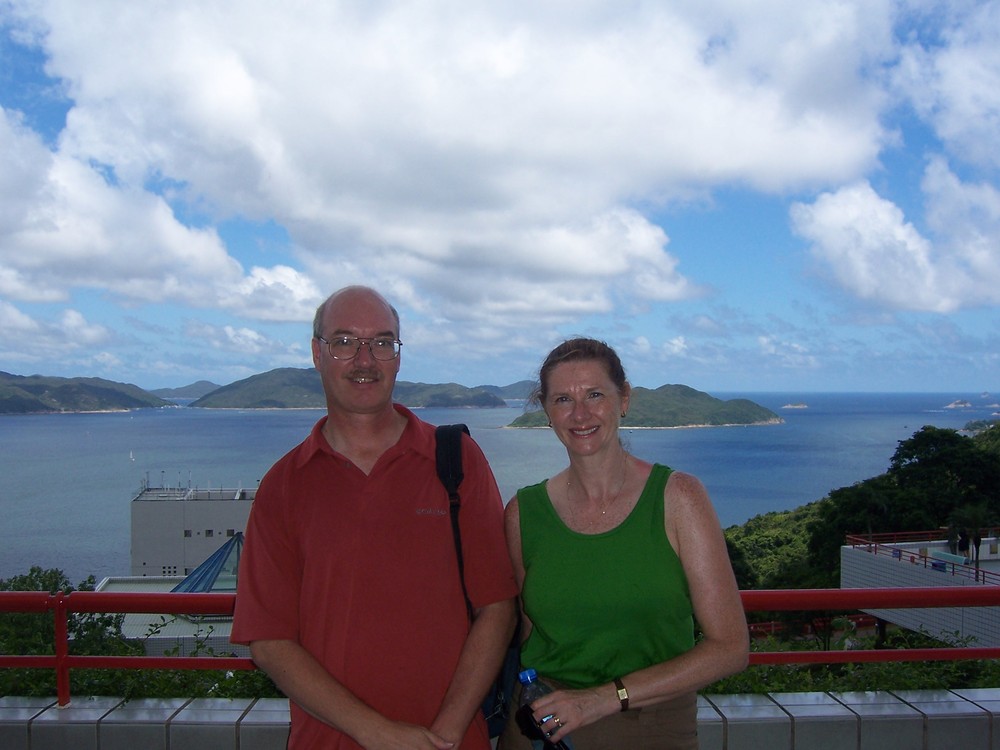
HKUST is a very different place. It is a relatively new university – they just celebrated their 20th anniversary – but it is already ranked in the top 10 in Asia. That’s pretty good! The university was started by the Brits shortly before their lease in HK ended. What I was told is that they had some money in the bank, and, rather than giving it to the Chinese, they used it to build a new university and a new airport. Both are great! The physics department at HKUST is fairly large – about 30 faculty, plus several visitors and soft-money researchers. It’s a very vibrant place. The people I talked to were doing really exciting research in soft matter and nonlinear dynamics; they also have people in many other areas of physics. HKUST also has one of the most beautiful settings of any university in the universe. The picture shows the view from their main building, with a couple of tourists in the foreground. My friend there has an office with an even more spectacular view.


On the same day I was visiting HKUST, a delegation from MIT was there to discuss co-operative international ventures. Western is far from being the only university trying to build ties with Asian universities – in fact, everyone is doing it! I found the article in the Western News about Western’s trip to China, and about how we are trying to “set ourselves apart from the crowd” to be a bit amusing – there really is a crowd, and as far as I can see we are no different from everyone else in this regard.


I also visited Chengdu, in Sichuan, China. Leo Lau, formerly Director of Surface Science Western runs a Green Energy Institute there. Unfortunately my visit there coincided exactly with a major Chinese holiday: Qingming, known as Tomb Sweeping Day. This is like Thanksgiving in that everyone goes home for the holidays. Of course I had no idea of this. One consequence was that Leo’s lab was closed on the days I visited, which meant that, apart from some technical discussions over dinner, I was a tourist for three days. Leo and his wife Margaret were excellent hosts. We went for a great hike in the nearby mountains, saw some of the sights of the city, and had some wonderful food.


What’s next? Once I get through the 30-odd things on my list of things I have to do while I am in my office here, we are off to Vancouver in early May. I will be working at UBC for a month. More on that later!